RulesPal
Chat
Rulebook
Less Is More thumbnail

Less Is More

Less Is More Rulebook

Table of Contents

Table of Contents

  • Game Idea
  • Game Material
  • Setup
  • Gameplay
  • End of the Game

Game Idea

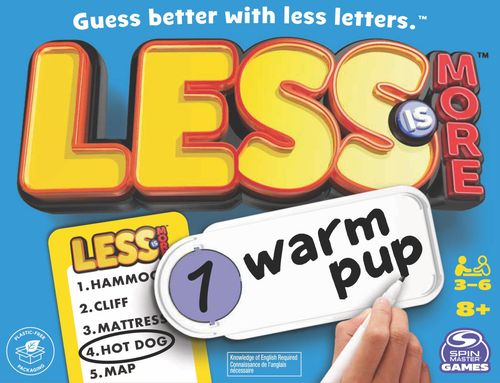
In every round one player becomes the Guesser. The other players receive a term, which they now try to describe using as few letters as possible. For example, to explain "Banktresor" (bank safe), players could write "Geldhaus Schrank sicher". Or perhaps just "Geld Schrnk sichr", because players may leave letters out of words. The Guesser tries to guess the term with the help of the clues. The player who needs the fewest letters and at the same time is "understood" by the Guesser receives points for it together with the Guesser. Whoever has the most points at the end wins the game.

Game Material

  • 102 term cards
  • 6 writing boards
  • 6 erasable pens
  • 6 player cards
  • 6 score markers
  • 2 score cards +10

Setup

Each of you receives 1 score marker, 1 pen and, in the color of your choice: 1 player card and 1 writing board.

Place your player card in front of you with the "Less is More" side face up.

Put your score marker into your matching colored score track (on the start space 0) in the side wall of the box bottom.

The term cards are shuffled and placed as a stack for everyone. Since the cards are printed on both sides, only the terms on the underside, which are not visible, are used.

Place the 2 score cards +10 next to the game box.

Gameplay

  1. The youngest player becomes the Guesser of the first round. The other players are the clue givers. In the next round, the next player in clockwise order becomes the Guesser.

  2. The Guesser first decides on a difficulty level by naming the corresponding color or level: Green (easy), Yellow (medium) or Pink (difficult). The Guesser then draws a term card and shows it to the clue givers, without looking at the terms himself. Now all clue givers know which term they are to describe. The Guesser places the card face down in front of himself, with the shown side facing down.

  3. Now all clue givers try, simultaneously, to describe the term. To do so, everyone writes one or more words on the larger inner surface of their writing board. No communication among the clue givers or with the Guesser is allowed. Each clue giver may be as detailed or as brief with the description as he wishes. But beware, the game is not called "Less is More" for nothing: the words may also be written in shortened form and letters may be left out! Each clue giver may shorten his description as he sees fit and as seems understandable (hopefully to the Guesser). The fewer letters a player uses, the sooner he can show his clue to the Guesser and the more points there are for it.

    Afterwards each clue giver counts the letters he has used. The number of words does not matter, and spaces do not count either. He turns the writing board over, writes the number of letters on the number field and holds it concealed (or turns the board toward himself) until all clue givers are finished.

    Example: Nina tries to describe the term Urlaubsreise (vacation trip) as follows: HAB I GEBUCT. She notes the number 10 (for 10 letters) on her board.

    What must be observed in the descriptions?

    • A. All descriptions must be legible and written exclusively in capital letters. Questions from the Guesser are not allowed. At no time, not even while the Guesser is guessing, may the clue giver read his description aloud.
    • B. No words or abbreviations may be used that are identical to the term to be guessed or its word stem. Example: if the term "Schreibmaschine" (typewriter) is sought, one may not use, for instance, the word "schreiben" as a description. This applies to every form of the word, and so words such as "schreibe, schreibst, schriebst, geschrieben" but also "Schrift" would not be allowed, since they share the same word stem.

End of the Game

Rounds are played until every player has been the Guesser once. Then the game ends and the player with the most points wins.

In case of a tie, the player with the shorter first name wins.

  • C. Only the 26 letters of the alphabet and the umlauts Ä, Ö and Ü may be used.
  • D. Numbers, punctuation marks or special characters are not allowed.
  • E. The words may be written next to each other, but also one below the other.
  • F. Foreign-language translations are not allowed.
  • Now all clue givers simultaneously turn the number field of their writing boards toward the Guesser. The clue giver with the lowest number may now be the first to show his description to the Guesser.

    Note: If two or more clue givers have written down the same number of letters, the one who, viewed clockwise, sits closer to the Guesser goes first.

  • The Guesser may now try once to guess the sought term with this description. If the Guesser does not guess the term, the clue giver with the next higher number shows his description. After that, the one with the next higher number, and so on. The boards of the players whose clue did not lead to the solution remain face up. The Guesser can therefore always also see the clues of the "unsuccessful" clue givers.

    Example: For the term Urlaubsreise, Yasmin has the clues "SOMR SONE MER" and therefore noted the number 11. Katja wrote the clues "FERIEN FLUG WEG" and the number 13. Julia is the Guesser and unfortunately did not guess the term with the first clue, from Nina, with 10 letters (HAB I GEBUCT). Now she has Yasmin's board shown to her, since it has the next higher number (11). If she does not guess the term, she may have the clues with the highest number, Katja's (13), shown to her.

  • If the Guesser does not guess the term even after all descriptions of the clue givers, all clue givers receive 1 point. One player moves the score markers 1 space each. In this case the Guesser receives no points.

  • If he has guessed correctly, only the Guesser and the clue giver with the successful description receive points.

    If the Guesser is already right after the first description, both receive as many points as there are players in total. For every clue giver whose description he does not guess, the Guesser (and the clue giver) each receive one point less.

    In addition there are extra points, depending on the difficulty of the term:

    GREEN (EASY)YELLOW (MEDIUM)PINK (DIFFICULT)
    012

    The clue giver with whose description the Guesser was able to guess the term always receives the same points as the Guesser. One player moves the score markers the corresponding number of spaces.

    If a player reaches more than 10 points on his score track, he turns his player card to the +10 side. The player moves his score marker again from "1" onward, but at the end of the game he adds the 10 points of his player card to his points on the track. In addition there are two neutral +10 score cards, should a player manage another 10 points.

    Example: Since 4 players are playing in total, there are at most 4 points for guessing the term (without extra points). Julia guessed the yellow (medium) term Urlaubsreise only with the third and last description, from Katja. Since Julia needed two further descriptions after the first, she must subtract 2 points. But since it was a medium term, there is 1 extra point for it. In total Julia therefore receives 3 points (4 - 2 + 1 = 3). Katja also receives 3 points, since Julia was able to guess the term with the help of her description.

  • Afterwards all clue givers wipe their writing boards clean again and the next round begins. The player to the left of the previous Guesser becomes the new Guesser.

  • Should a mistake occur and a clue giver have violated the rules, the round is ended immediately. This can happen, for example, because a clue giver wrote down the sought term and/or the word stem of the term, numbers, punctuation marks, special characters or a translation.

    If a player notices this once the Guesser has received this clue, the round is ended immediately! All players except the clue giver who made the mistake receive 2 points. Then a new card is drawn and the round is repeated.