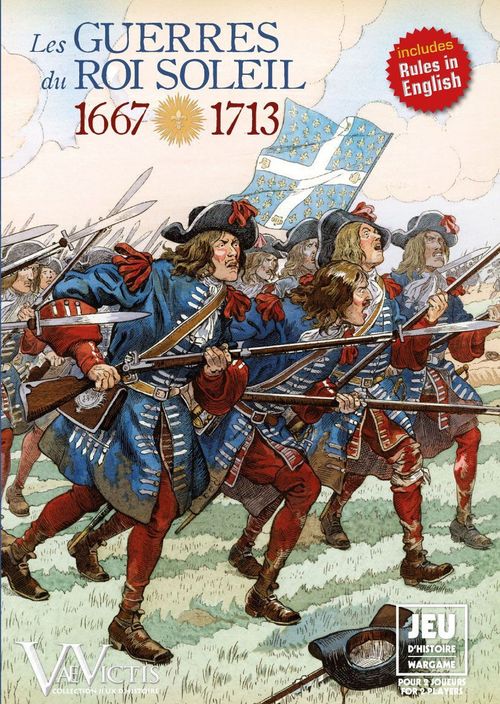
Les Guerres du Roi Soleil 1667-1713
Les Guerres du Roi Soleil 1667-1713 Rulebook
Table of Contents
Table of Contents
- 1 - Overview
- 2 - Abbreviations & Definitions
- 3 - Units and Officers
- 4 - Objectives
- 5 - Strategic Map
- 6 - Game Turn
- 7 - Random Events
- 8 - Resource Points
- 9 - Cabinet Strategy
- 10 - Reinforcements and Recruitment
- 11 - Construction of Defence
- 12 - Determination of Initiative
- 13 - Movement
- 14 - Attrition and Desertion
- 15 - Scorched Earth
- 16 - Decoy
- 17 - Combat
- 18 - Siege
- 19 - Pursuit of the Campaign
- 20 - Strategic Surprise
- 21 - Wintering Quarters
- 22 - Diplomatic Actions
- 23 - Victory
- 24 - Scenarios
- 24.2 - The War of the Reunions (1683-1684)
- 24.3 - The War in Holland (1672-1678)
- 24.4 - The War of the League of Augsburg (1688-1697)
- 24.5 - The War of Spanish Succession (1701-1713)
- Game Turn Summary (player aid)
1 - Overview
One turn represents a year broken down into three phases: preparation, campaign (May to October) and winter (November to April). Each phase is composed of several sequences during which the players carry out different game actions.
A combat factor is equal to approximately 2000 men (three to four battalions), 2000 horsemen (12 squadrons) or 3 to 6 batteries of campaign and siege cannons & mortars (about 60 pieces). A fortress value point equals a fortress and its intrinsic garrison.
This game opposes two players; on one side is the kingdom of France and its allies and on the other the various coalitions led by different states. For the sake of simplicity, the enemies of France are called the Coalition.
2 - Abbreviations & Definitions
Army: One or more stacked units. An army is commanded if a general counter is placed on top of the unit or stack. It is out of command if no general counter is present. The units of allied armies may combat together under the command of any allied general.
Art: Artillery
Camp: The kingdom of France and its allies on one side and the coalition of states that are enemies of France on the other.
Cav: Cavalry
Coalition (C): All of the states that are enemies of France
SC: Strategic capacity: bonus/penalty of a commander used during movement.
TC: Tactical capacity: bonus/penalty of a commander used during a battle or a siege.
Ctrl: Control marker followed by the camp F (France) or C (Coalition) that controls the zone
D6: Six-sided die
France (F): Kingdom of France
SP: Strength Point: represents the number of men that combat.
Garrison: One or more stacked units, commanded or not by a general, placed under a Fortress marker.
Named or anonymous general: An important political or military figure (King, Prince, Duke, Elector of the Germanic Holy Roman Empire, Stathouder, Maréchal, lieutenant-general...) or generic army commander.
Inf: Infantry
Active player, inactive player: The player who carries out the action is called active (attacker or besieger); the other player is inactive (defender or besieged).
GP: Glory point
Zone/Box of land or naval transit: Represents a geographical surface of variable size, corresponding to an administrative, political or topological division or simply adapted to the needs of the game.
RP: Resource points
Sequence: An action led during a phase of the game.
Initiative test: Roll a D6 and add the differential (SC of the army general of the side taking the test - SC of the army general of the opposing side). This test is successful if the modified result is > 2.
FV: Fortress Value
3 - Units and Officers
3.1 - Units
The game uses different units characterised by the following parameters:
- The type of combatants or materiel: outlines of infantry, cavalry, cannon (campaign and siege artillery).
- A combat factor expressed in Strength Points (SP).
- Special marking for the elite units (star).
- Its nationality: Austria, Bavaria, Brandenburg, Denmark, Empire (German principalities, duchies, dioceses, etc.), France, Jacobites (partisans of James II in Ireland and Scotland), Lorraine, Piémont-Savoie, United Provinces, Great Britain, Spain, Sweden.
3.2 - General Officers
A general (generic term for an army commander) is characterised by five parameters:
- The name and outline of the historical or generic commander.
- His strategic capacity (SC) from 0 to 4.
- His tactical capacity (TC) from 0 to 4.
- His nationality.
- A star to indicate a bonus in the modifiers section of the Cabinet strategy and Siege resolution tables.
If several generals are in the same stack of units, the general that commands the army is chosen by the player and is placed on top of the stack of counters.
4 - Objectives
Victory conditions, represented by a Favourable peace treaty in the Diplomacy Table, are checked each game turn during the Determination of victory sequence. To win a war, either France or the Coalition must meet the conditions favourable for peace. A peace treaty is dependent on four conditions: Louis XIV's number of glory points, the number of objectives reached by France, the resource points accumulated by France, the differential in allies between France and the Coalition. Only France's objectives are clarified; those of the Coalition are to prevent France from reaching her objectives.
When three of the four victory conditions are met in the Peace Treaty column of the concerned belligerent, a peace treaty is signed in its favour and the side is awarded victory.
5 - Strategic Map
5.1 - Description
The strategic map is composed of zones and transit boxes identified by several parameters:
- A colour code that demarcates the borders between states.
- A colour code that demarcates the naval borders.
- A name (country, state, province, principal city).
- The available Resource points (0 to 3).
There is no stacking limit for units in a zone or a transit box.
5.2 - States
There are two categories of states.
Major states
- Austria (Habsburgs of Austria): Tyrol and Bohemia on the map.
- Spain (Habsburgs of Spain): Spain, Milan, Franche-Comté, Luxembourg and Spanish Netherlands.
- France.
- United Provinces: Holland and Friesland.
- Great Britain: England, Scotland, Ireland.
Minor states
- Bavaria.
- Brandenburg.
- Denmark (not represented on the map).
- Empire: Baden, Württemberg, Ansbach, Würzburg, Palatinat, Trèves, Cologne, Mayence, Hesse-Cassel, Münster, Liège, Saxe, Hanover.
- Italian States: Genoa, Parma, Modena, Tuscany, Veneto (no military units).
- Scotland/Ireland Jacobites.
- Savoie-Piémont.
- Sweden.
- Lorraine.
5.3 - Zones
A zone represents a geographical area. A zone is:
- Controlled: by the presence of a control marker or when the zone belongs to a state without an enemy control marker;
- Contested: when units (army, fortress with or without garrison) of both sides are simultaneously present in this zone.
6 - Game Turn
It comprises three phases: Preparation, Campaigns, Wintering. During the campaign phase, players alternate a succession of impulses - the campaigns - beginning with the player who has the initiative. One side's impulses stop when its Resource Points have been exhausted or when the player decides to stop.
If no impulse occurs twice in a row, the campaign sequence ends.
At the beginning of the game, the players choose to play an "open" or "closed" game - to keep the counters hidden from the enemy on the Command Table or to leave them on the map (see 13).
Note: given the game's time scale and the very efficient espionage during this period, an army's strength was quickly known, sometimes even before the campaign began (purchase of bread, fodder, powder, horses, etc.).
6.1 - Preparation Phase
(in this order)
- Determination of random events (see 7). Set up of units, generals and the diplomatic cursor of the states that enter the map (war, random event), see scenarios.
- Resource Points (see 8).
- Suppression of the Scorched earth markers and replacement of the Cabinet strategy markers.
- Cabinet strategy (see 9).
- Reinforcements & recruitment, purchase of prisoners (not played during the first game turn of a scenario). See 10.
- Fortresses & Lines of defence (not played during the 1st game turn of a scenario). See 11.
- Determination of the initiative (not played during the first game turn of a scenario). See 12.
6.2 - Campaign Phases
(in this order)
- The player with the initiative leads the first campaign (impulsion), he is the active player, his opponent is inactive. A campaign corresponds to the following actions:
- Campaign
- Movements, attrition and desertion (see 13 and 14).
- Use of the Cabinet strategy markers (see 16 to 18).
- Determination of the end or pursuit of the campaigns (see 19).
- Adjustment of the cursors on the Alliance Table and Diplomacy Table (see 22).
- Campaign
6.3 - Wintering Phase
(in this order)
- Determination of a potential strategic surprise (see 20).
- Winter quarters (see 21).
- Diplomatic actions (see 22).
- Adjustment of cursors on the Alliance Table and Diplomacy Table (see 22).
- Determination of victory (see 23).
- End of the game or end of the turn in which case the time cursor is moved forward one space on the time track.
7 - Random Events
Random events are listed for each year of each scenario in a chart. They are determined by rolling a D6; the result indicates the random event that takes place for this game turn. On a result of 1 to 3 there is no event, on a result of 4, 5 or 6, there is an event. An event is only valid for the turn in which it is determined. Units and generals that arrive following an event are not removed from the game at the end of the turn. If the conditions to be applied for the random event are not met (neutralised state, insufficient units, etc.), then ignore this event.
8 - Resource Points
8.1 - Calculation of Resource Points
Resource points (RP) constitute the sinews of war and thus the heart of the game. They are used for:
- Determining the initiative
- Recruiting units and generals
- Buying back prisoners
- Constructing fortresses and lines of defence
- Carrying out movements
- Taking control of a maritime transit box
- Leading diplomatic actions
- Borrowing RP
- Repaying a loan of RP.
Certain zones have a value that corresponds to the number of RP available. The total number of RP available for a camp corresponds to the sum of the RP of the zones of the camp's allies, the controlled zones and the contested zones. A zone's RP are reduced to zero if a Scorched earth marker is present.
Each scenario indicates the initial number of RP for each side. The RP markers (unit and ten) of each camp are used on a track to identify the number of RP available on the Resources Table (placed on the map). These cursors are adjusted immediately after RP are spent to keep the accounting up to date.
Important: the sum of RP from an ally who doubts (D3 to D6) is divided by two for the alliance (rounded down).
RP may not be accumulated from one year to the next. Each new year, the RP cursors (unit and ten) are placed on space zero. Unspent RP are lost.
8.1.1 - RP & contested zones
The calculation of contested zones is done differently: the RP available for a camp are determined by a D6 roll with any modifiers added. The result indicates for which camp the RP(s) are available:
Each side rolls D6 adding the following modifiers:
- Army present in the zone: +1
- Total superiority (sum of the infantry, cavalry and artillery SP) in SP: +1
- Superiority in SP of cavalry: +2
The camp with the higher result obtains all the RP in the zone. In the case of a tie, no RP is available for this turn for either side (*).
Note: The two sides prefer to destroy the resources rather than leave them intact in the hands of the enemy.
8.1.2 - RP & transit box
Maritime transit boxes have a RP value that corresponds to the maritime commerce. Its RP are awarded to the camp that controls it. If the maritime transit box is not controlled, the RP are attributed to neither camp.
8.1.3 - RP & a neutral state zone
It is possible to claim the RP of a neutral state. A control marker is placed on the zone. Claiming RP for each zone of a neutral state costs one GP to be credited to the opponent.
Example: if an army from the French side moves into the Venetia zone in a neutral state, this costs GP and the GP cursor is moved one space to the left.
8.1.4 - RP & loans
Each camp has the option of borrowing RP. An Emprunt (Loan) marker in the colours of each camp is placed on the Resources Table. It represents a multiple of 1 RP on the front side and a multiple of 1 RP + 10 on the back side.
Example: An Emprunt marker, front side up, placed on space 6 of the Resources Table corresponds to 16 borrowed RP.
The number of RP that may be borrowed corresponds to the D6 roll result, per turn and per camp. Each loan costs 1 RP, representing the interest; this RP is paid in advance.
These borrowed RP are used the same way as the other RP obtained by the controlled zones. During a Determination of victory sequence, these borrowed RP must be reimbursed. They are deducted from the total available RP to determine in which space the Resource Points cursor is located on the Diplomacy Table.
Important: the camp that cannot repay its debts loses the war by bankruptcy.
Note: At the end of the Spanish war of succession, France was nearly bankrupt.
8.2 - Spending Resource Points
- Betting to take the initiative: 1RP for each modifier of +1 added to the D6 (see 12).
- Recruiting units: 1RP for every 5 SP recruited* of all types of troops (Infantry, Cavalry, Artillery). See 10.
- Buying back imprisoned units: 1RP per multiple of 10 SP bought back* all types of troops (Infantry, Cavalry, Artillery). See 10.3.
- Recruiting or buying back a general: 1RP for a general whose sum TC + SC < 4; 2RP for a general whose sum TC + SC ≥ 4. See 10.3.1.
- Constructing or increasing the FV of a fortress: 2RP per FV level and per fortress**. This action is only possible once per turn per camp within the limits of the available markers and without exceeding V4 (see 11).
- Constructing or increasing a line of defence: 1RP per level of line of defence. This action is only possible once per turn per camp (see 11).
Notes:
- * Round up. Example: 15 SP requires spending 2 RP.
- ** Example: to increase by one level four fortresses of FV 1, FV 2, FV 2 and FV 3 the player must spend 8 RP; they become respectively FV2, FV3, FV3 and FV4.
9 - Cabinet Strategy
The cabinet strategy consists of determining the battles, sieges and scorched earth policy that will be led by each camp during its turn.
Note: This represents the direction of the operations carried out from Versailles by Louis XIV and his councillors but also from the principal courts of Europe at the head of various alliances (United Provinces, G.-B., Austria).
The markers are used during the campaign and wintering phrases.
Each player is free to spend all or part of his Cabinet strategy markers during a single campaign or keep them for other campaigns of the same phase or for the Strategic surprise sequence.
Only one cabinet strategy marker from each category (battle, siege, decoy, scorched earth) may be used per zone, per campaign and per camp. Important: Markers that are chosen but not used have consequences on the victory conditions (see 22.4).
The maximum number of campaigns per turn is three per camp, or six campaigns, as explained in the Pursuit or end of the campaigns sequence (see 20).
There are nine markers per camp. Each Cabinet strategy marker contains a French or Coalition symbol on the front side and one of the following symbols on the back:
- Battle (three markers): engage at least 10 SP for each of the camps; any clash without this distribution is not considered a battle - it's a skirmish - and does not require this marker to be spent.
- Siege (four markers): corresponds to an undetermined number of siege rounds to lead against any enemy fortress.
- Scorched earth (one marker): reduces the resource points in a zone to zero.
- Decoy (one marker): cancels out a Battle marker played by the opponent. The Battle marker is eliminated (see 16).
Note: this corresponds to an enemy deception manoeuvre.
Each camp determines the number of Cabinet strategy markers available for this game turn.
Beginning with the player who has the initiative, the cabinet strategy procedure is as follows:
- Roll a D6 and cross the result with the number of RP available for your side.
- Without showing them to your opponent, choose at most the number of markers indicated among the nine Cabinet strategy markers of your camp. You can choose fewer than the value that is indicated; choose a minimum of one marker. These markers constitute your operational objectives for all the campaign and wintering phases of this turn.
- The markers are left visible front side up (the back side - Battle, Siege, Scorched earth, Decoy - are hidden) then are revealed when these events take place and are counted as a reached objective during the Determination of victory sequence (see 22.4).
Modifiers: see table on the player aid.
10 - Reinforcements and Recruitment
This sequence is ignored during the first game turn of each scenario.
There are two ways to bring in units and generals during play: as reinforcements as indicated in the scenarios and through recruitment. All the counters available for recruitment in a scenario are placed in the camp's Reserve space. Eliminated units and generals are placed in the concerned camp's Reserve space.
10.1 - Reinforcements & Withdrawals
A reinforcement is a unit or a general that enters the game for a given turn and is then placed in its camp's Reserve. They are then available for recruiting. A withdrawal is a general removed from the game (usually an officer who is killed, sick, wounded or has left in retreat). Units and generals that withdraw do so definitively except Louis XIV.
10.2 - Recruitments
A recruitment is a unit or a general located in the Reserve that is bought by spending RP. The number and type of units available are limited to the units present in the game. The costs are detailed in 8.2.
10.3 - Buying Back of Prisoners
The costs are detailed in 8.2. Units and generals may be taken prisoner after battles and sieges. They are placed in the Reserve of the camp holding them prisoner.
Sequence 6.1.5 allows for the buying back of prisoners. The buying back of imprisoned units is mandatory.
Units and generals that are bought back are placed in their camp's Reserve and are considered as generals and units to be recruited and must be bought to return to the game. Generals are bought back first.
If there are not enough RP for this game turn, the units are kept "prisoner" in the Reserve of the victorious camp until its own camp can buy them back during a new sequence 6.1.5. RP debited from one camp are credited to the other camp.
Special rule for imprisoned generals
The refusal to return an imprisoned general to his camp, against RP, costs 1GP for each sequence of Buying back of prisoners for the jailing camp. If the French camp refuses, a GP is subtracted from the Diplomacy Table counter. If the Coalition refuses, a GP is added to the Diplomacy Table counter.
10.4 - Random Events
The units and generals that enter the game from a random event are taken in the Reserve and do not require the spending of RP.
Note: These are principally units that were already recruited and were liberated from another front.
10.5 - Set Up
Generals and units that are recruited, bought back or are in reinforcement are set up in a zone controlled by their original state unless otherwise indicated in the scenario (special case for Lorraine, Denmark, Ireland and Scotland Jacobites).
The set up is the player's choice, as an army or garrison (if a Fortress marker is present). set up is not considered as movement in terms of attrition and desertion.
11 - Construction of Defence
This sequence (6.1.6) is ignored during the first game turn of each scenario.
It is possible to construct and increase the Fortresses and Lines of defence values under the following conditions:
- The zone must be controlled by the camp that constructs or increases the Fortresses and/or the Lines of defence. The zone may be taken from the adversary. It is necessary to have an army or a garrison in this zone.
- The player must spend the required number of RP.
The maximum values to which the Lines of Defence and the Fortresses can be increased are respectively 2 and 4.
Note: Only a few fortresses constructed on locations predisposed to defence (confluence of rivers, sea coast, promontory) or with great reinforcement of levelling and masonry (and therefore cost) may reach an elevated value.
When a construction is realised, place a marker Fortresses or Line of defence marker. The units present in the zone are distributed between the constructed or increased (garrison) fortress and the Line of defence (army).
A Line of defence marker alone in a zone is eliminated.
Similarly, a Line of defence marker of a camp cannot be used by the enemy camp. Remove the marker from the zone.
The number of Fortresses or Lines of defence that can be constructed is limited by the number of available markers.
12 - Determination of Initiative
The player with the initiative takes the first Campaign phase. The Campaign cursor is placed on space 1 during the realisation of the first campaign then advanced one space with each new campaign.
The player with the initiative is sure of carrying out a campaign, while the opposing player, during the Pursuit or end of the campaign sequence, may not engage in a campaign on a D6 roll, hence the interest of taking the initiative. The initiative is given for the first turn of each scenario. It is then determined for each subsequent turn by the result of a D6 roll to which is added a number of RP called the bet. This bet is between 0 and 5 RP. The procedure is as follows:
- Each player secretly notes the number of RP bet. Then both players reveal this number simultaneously.
- The cursors on the Resources Table are adjusted.
- Each player rolls a D6 and adds the result of the bet value.
- The higher result wins the initiative. In the case of a tie, the initiative goes back to the player that did not have it previously.
Note: The bet corresponds to diplomatic negotiations (purchase of neutrality, authorisation of an army's passage, etc.) but also to the constitution of depots on the invasion route (purchase of food, munitions, even of the merchants of the country to invade [true]).
13 - Movement
13.1 - Movement and Commands
Movements are made from zone to zone. A double arrow links the same zone on two portions of the map for practical reasons.
A single contact point suffices to consider the zones as adjacent.
Units do not have any movement capacity proper, they cannot move unaccompanied by a general on the strategic map.
Generals who are alone or accompanied by units - they also form an army (see 2) - may carry out these movements.
Players have at their disposal a Command Table on which each general has a place to position the units he commands to facilitate movement (see 6).
An army is composed of units located outside of a fortress:
- An army with a general is commanded and can do everything the rules allow for an army.
- An army without general is "out of command". It cannot move - movement and winter quarters -, cannot attack and does not benefit from the TC of a general.
An army without a general remains in a zone; if a fortress is present, part of the units may form a garrison within the limits of the FV of this fortress (a FV level authorises a garrison of one SP) without requiring the presence of a general. The rest of the units are considered as an army but may not move.
Each movement costs a number of RP depending on the size of the army in number of SP. Movements are strictly limited by the number of RP available.
Movement of a general costs no RP.
13.1.1 - Movement procedure
- Tally the SP present in the army.
- Determine the number of RP necessary to carry out the movement depending on the number of SP that compose the army on the Movement Table. They are doubled if the movement takes place via a transit box or during the Winter phase.
- Move the army.
- Deduct the RP spent from the RP from the concerned camp on the accounting scale and adjust the RP cursors (unit, ten).
Example: an army of 25 SP that moves, regardless of the number of zones, spends 3 RP.
- Before moving, an army may divide - with no RP surcharge - into as many armies as there are generals present in the zone; each commanded army may then carry out a distinct movement.
- An army that carries out a movement may leave units or take on its way the units of another army or garrison. The cost in RP must correspond to the number of SP of the most valuable army during its movement.
Example: an army with 28 SP that moves must spend 3 RP; if it picks up 3 SP in a zone along the way, the movement cost is 4 (size 31-40). On the other hand, an army with 28 SP that leaves 9 SP in a zone as it passes through still spends 3 RP.
- Part of the SP of the army may be transformed into a garrison - within the limits of the FV of the fortress - and inversely, by placing the units under the Fortress marker or by removing units from under the Fortress marker, with no cost in RP.
- An army must end its movement and determine its attrition and desertion (see 14) before another army may move during the same campaign.
- Two armies of the same camp that remain in the same zone are united at the end of the movement, and after the determination of attrition and desertion (see 14).
- Given the time scale, a unit may begin a movement with one army and finish it with another.
- Each unit may move several times per campaign. It is therefore allowed to take along the way a unit that already moved, be it a garrison or an army.
- There is no zone of control.
- A movement via a transit box is possible from a land zone adjacent to the transit box if the latter is controlled by side that is moving or is neutral.
- Movement via a maritime transit box is possible for a cost in RP doubled and within the limit of the number of SP that can be moved; this is the maritime movement capacity indicated for each scenario.
13.1.2 - Special cases
- An army - but not a general alone - may carry out movement in a zone indicated as neutral at the beginning of the scenario. Entering a neutral zone costs one GP in addition to the normal movement cost: it is deducted from the GP counter if the French camp carries out the movement and added if the Coalition is the camp to move.
- It is prohibited to enter the zone of a (enemy) state before it officially enters the war, as it is prohibited to enter the Helvetic Confederation. Entering a state that does not enter the war in the scenario is prohibited, except for the Italian states and the Empire.
- Entering the "Confédération helvétique" and the" Papauté" zones is prohibited.
13.2 - Army and Garrison
There are three possible situations for an army in a zone:
- In garrison: it is located under the protection of fortresses within the limits of the FV.
- In cover: an army that protects the fortress and that is attacked as a priority by the campaigning army.
- In campaign: an army that enters a zone.
A garrison is composed of units located in a fortress within the limits of its FV. There is no stacking limit in a zone.
- An army that enters a zone occupied by an enemy army stops its movement. There is no extra cost for entering a zone controlled by the enemy. The zone becomes contested. The army may nevertheless continue its movement if its general passes an Initiative Test (see 2). If the enemy army isn't commanded by a general, there is no need for an Initiative Test. The army may continue its movement.
- An army that begins its movement in a contested zone toward any other zone of transit box must pass an Initiative Test (see 2).
13.3 - Movement and Interception
An army of the inactive player may move from an adjacent zone to a zone that has been crossed or into which an army of the active player advances; this is an interception. The inactive player must declare the interception as soon as the enemy army enters the zone chosen for the interception.
To engage in an interception, the following conditions must be met:
- The interception must occur from a zone that does not already contain an enemy army.
- The player must pass an Initiative Test.
- Spend the number of RP corresponding to the movement of the SP of the interception army. If the interception is successful, the active player's army stops its movement and the inactive player's army is moved to the interception zone where the enemy army is. A successful interception does not allow the inactive player to engage in a battle unless he spends a Battle marker (see 9).
13.4 - Movement via Transit Boxes
Each side may carry out a long movement via a maritime transit box - this is its maritime movement capacity - a certain number of SP per game turn, in one or more times.
The maritime movement capacities are given for each camp and for each scenario. A movement via one of the four transit boxes (North Sea*, Atlantic Ocean, Mediterranean Sea, France Ouest) costs double the required RP.
* including the English Channel.
Maritime movement by the intermediary of transit boxes allows an army to move from any coastal zone toward any other coastal zone only if the latter is controlled by this camp or not controlled by the enemy.
Control of the transit boxes is given at the beginning of each scenario and can change when certain random events are drawn.
Example: an army with 10 SP (movement cost of 1 RP regardless of the number of zones) that moves via a transit box must double the number of RP spent, for 2 RP.
13.4.1 - Control of a transit box
Control of a maritime transit box may change during the movement sequence of the active player and at his initiative. Each attempts costs 1 RP. Only one attempt is possible for a given box per campaign.
Roll a D6 and add any modifiers. The control of a maritime transit box allows for use of its RP. A control marker is placed in the zones North Sea, Atlantic Ocean and Mediterranean Sea. Movement via a transit box is subject to attrition and desertion (see 14).
For practical reasons, the map depicts two Atlantic Ocean "frames" but only represents one transit box.
Important: France always controls the France Ouest transit box.
Result of the D6 to get to control the maritime transit box.
- North Sea: ≥ 5
- Atlantic Ocean: ≥ 6
- Mediterranean Sea: ≥ 4
D6 modifiers (all cumulative):
- +1: indicated when certain random events occur (Dutch admirals Tromp & Ruyter, French admirals Duquesne & Tourville, squadron war).
- +1: for the coalition when the maritime powers - Great Britain & United Provinces - are allied.
- -1: for France when the maritime powers - Great Britain & United Provinces - are allied.
- +1: for the French camp for the control of the Mediterranean Sea during the Spanish war of Succession.
- -1: for the French camp for the control of the Atlantic Ocean and the North Sea during the Spanish war of Succession.
14 - Attrition and Desertion
The movements of an army lead to the determination of attrition and desertion; land movement, maritime movement, interception, retreat before and after battle. This does not concern garrisons.
At the end of an army's movement, the player checks on the Attrition and Desertion Table if SP have been lost.
Proceed as follows:
- Roll a D6 and add any modifiers (all cumulative).
- Cross the modified result with the column corresponding to the army's SP number.
The number indicated by the table corresponds to the number of SP to be eliminated by the owning player. The eliminated units are placed in the Reserve of the concerned camp. If there aren't enough units to "make change" for the SP to eliminate, adjust the losses in SP up to the next whole number available.
Note: These losses tables are not rules of exact calculations and we consider that the stragglers, additional wounded and added to the determined losses.
The determination of attrition and desertion must correspond to the highest number of SP in the army during its movement.
Example: an army with 28 SP that moves and picks up on the way 3 SP in a zone, determines attrition and desertion in column 31-40. Inversely, an army with 28 SP that leaves 9 SP in a zone on the way determines attrition and desertion in column 21-30.
14.1 - Modifiers
- Movement (stopped or moving through) in a zone with a Scorched earth marker: +2 This modifier accumulates for each zone crossed. Example: two zones crossed with a Scorched earth marker: +4
- Movement in the winter season: +1
- Distance covered: +1 per zone crossed starting with the second zone (no limit)
- Strategic Capacity of the general ≠ 0: -1
- Winter quarters in a non-controlled zone (except garrison, only concerns an army with or without a general): +3
- Random event: see detail of the event
15 - Scorched Earth
A camp may place the Scorched earth marker that he chose during the Cabinet strategy sequence (See 9). To do so, an army must be located in the zone in which the marker is placed and must pass an Obedience Test: the D6 result must be less than or equal to the SC of the general commanding the army.
The marker may be kept and used for any campaign of the game turn. The unused marker is lost and deducted from the objectives during the Winter Phase. (See 6.3 and 22.4).
Note: the majority of generals were hostile to what they saw as an inhumane practice. The central power must have been very firm to apply this order.
16 - Decoy
The inactive player cancels the effect of the active player's Battle marker by playing his Decoy marker. It must be announced immediately after the active player's intention is known. The Battle marker is returned with the other Cabinet strategy markers during the following turn. The two adverse armies remain in the zone which becomes contested.
Note: the unused Battle marker is not deducted during the Wintering phase (see 6.3 and 22.4).
17 - Combat
A combat may take place when two enemy armies are in the same zone.
If a garrison and an enemy army are present, the attacker must first combat the army then - if the result is favourable; elimination or retreat - lead a siege. These are two different actions which require two Cabinet strategy markers, Battle and Siege.
An army that is attacked may not move its units toward the fortress or take units from this fortress.
A fight is not mandatory; the active player decides to carry it out or not. If the combat does not take place, the two armies remain in the same zone which therefore becomes contested.
17.1 - Combat Resolution Procedure
There are two types of combat.
- A battle engages 10 SP or more in each army and includes three combat rounds. It costs a Battle marker.
- A skirmish engages fewer than 10 SP in one and/or the other of the armies and includes one combat round. It does not require spending a Battle marker.
- Each camp indicates its number of SP (sum of the infantry, cavalry and artillery) then determines if this is a battle or a skirmish.
- The active player decides whether or not to resolve this combat:
- If he doesn't want to resolve a combat, the two armies remain in the zone which then becomes contested.
- If he wants to realise the combat, a first round of combat is resolved.
- If the inactive player does not want to combat, he must pass an Initiative Test (see 2).
- If the Initiative test fails, the first round of combat is resolved.
- If it is successful, the army of the inactive player retreats to a controlled adjacent zone by paying the number of RP required. If the army does not have enough RP to retreat fully or if there is no controlled zone adjacent, the retreat does not occur and the combat is resolved.
Important: an army without general cannot retreat and must suffer the combat.
The active player is the attacker, the inactive player is the defender.
17.1.1 - Round of combat
A. Find the ratio in the form Attacker/Defender (round down to the nearest whole number in favour of the defender).
B. The attacker rolls a D6. Add any modifiers to the result (calculated for each battle round) then cross this value with the A/D ratio in the Combat Table.
C. Eliminate the number of SP indicated in the Losses table.
Note: to simplify the recording of SP losses, we recommend noting the losses and removing the counters at the end of the combat.
17.1.2 - Modifiers and results
The Combat Table is on the player's aid.
Modifiers added to the result of the D6 rolled by the Attacker (all cumulative):
- General: the difference in TC of the two army generals: Attacker TC - Defender TC. Example: if the coalition is the attacker, Marlborough's TC (4) minus Villars' TC (3) gives a bonus of +1 added to the D6.
- Line of defence: -1 or -2 depending on the level of the Line of defence placed on the Defender's army.
- Zone: +1 for the Attacker if the zone contains a fortress that he controls (FV 1 to 4), otherwise -1 if the zone contains a fortress controlled by the Defender.
- Superiority (all cumulative, there must be a strict superiority; ex: 5 > 4 gives a modifier):
- Elite (unit with a star): +1 if the Attacker has the superiority, otherwise -1 if the Defender does, for both infantry and cavalry.
- Artillery: +1 if the Attacker has the superiority, otherwise -1 if the Defender does.
- Cavalry: +1 if the Attacker has the superiority, otherwise -1 if the Defender does.
Explanation of results:
- A, B, C, D: see Losses table.
- *: the general that commands the army is eliminated on a D6 roll equal to 1. The battle continues nevertheless with or without a new general. Louis XIV is not affected by this rule.
- –: no loss
If there aren't enough units to "make change" for the SP to eliminate after attrition and desertion and combats, adjust the losses in SP up to the next whole number available.
17.1.3 - End of the combat
- The skirmish automatically terminates at the end of the first round of combat.
- The battle automatically terminates at the end of the third round of battle.
- The attacker and the defender can stop the battle by passing an Initiative Test: the attacker announces and takes the test first then the defender goes. If neither of the two players passes the test, an additional round takes place.
- The player who ends the battle by passing the initiative test retreats his army to an adjacent zone he controls and pays the necessary RP. If the army lacks the RP to retreat completely or if there is no controlled adjacent zone, the retreat does not happen.
17.1.4 - Winner of the combat
- The player who ends the combat by a successful initiative test is the loser, whether or not he retreats.
- If neither player puts an end to the combat, or at the end of the 3rd round, the player with more SP eliminated loses. If this is a tie, the attacker is the winner.
- The Battle marker is removed at the end of a battle or kept if it was a skirmish.
17.2 - Result
The loser has the choice of staying or leaving the zone. If he leaves, he does not need to take an Initiative Test, he withdraws his army toward an adjacent controlled zone and pays the required RP. If no adjacent zone is controlled or if the camp cannot pay the required RP, the army remains in the zone which is then contested.
A general who finds himself without units is taken prisoner and placed in the opponent's Reserve.
17.3 - Consequences of Winning a Battle
The consequences are only valid if a Cabinet strategy marker indicating Battle was used. Skirmishes do not count.
- A won battle awards a GP.
- If France wins: add one GP on the Diplomacy table scale.
- If the Coalition wins: deduct one GP on the Diplomacy table scale.
- A won battle moves all the cursors of the allied states on the Alliances Table in their favour (see 22).
18 - Siege
A siege is possible if the attacker has a Siege marker that is revealed and the zone is free of enemy armies. This marker is removed at the end of the siege.
A Fortress marker represents several fortresses for a given zone as well as their intrinsic garrison. Each marker has a Fortification Value (FV); the higher this value, the more numerous and powerful the fortresses. These FV range from 1 to 4. To win a siege a player must either bring the FV present in the zone to zero (eliminate it) or obtain its Surrender with honours.
Units may be placed under a Fortress marker to indicate they form an additional garrison. The sum of the SP of the units in garrisons must be less than or equal to the FV - this is the limit of a garrison capacity for the fortress(es).
18.1 - Siege Procedure
The active player rolls a D6 to determine the number of siege rounds (modifier of -2 in winter during the Strategic surprise sequence). The attacker is obligated to lead the siege, even if the number of rounds that was determined doesn't seem sufficient to win it (that's war...).
Tip: use the D6 to keep track of the number of siege rounds.
18.1.1 - Siege round
-
Find the ratio of the Attacker (besieger)/Defender (besieged):
Attacker: sum of all the SP of the infantry and artillery plus half the cavalry's SP*. Round down to the nearest whole number; 1 cavalry SP corresponds to 0.5 rounded to 0 and 3 cavalry SP correspond to 1.5 rounded to 1 SP. * A large part of the cavalry is composed of dragoons who servent mounted or on foot.
Defender: sum of all the SP of the infantry and artillery plus half the cavalry's SP (round in the same way) in garrison (limited to the FV) + FV of the fortress. 2. Report the ratio A/D obtained in the column of the Siege resolution Table.
3. The besieger chooses whether or not to spend 1 RP to obtain a +1 modifier for the Effort de guerre (War effort).
4. Roll a D6 and add any modifiers.
5. Cross the modified result with the column obtained in 2.
5. Apply the result indicated in the Siege table beginning with SP to be eliminated, then the other results.
18.1.2 - Modifiers and results
The Siege Table is on the player's aid.
Modifiers added to the result of the D6 rolled by the Attacker (all cumulative):
- War effort: +1 if the besieger spent 1 RP (only one modifier possible per round).
- Assault: +1 starting with a ratio of 7 to 1 and more, non cumulative. Example: a +1 modifier is added to the D6 result if the A/D ratio is 7/1 or 8/1. The column ≥ 6/1 is used.
- For the French camp
- Presence of Louis XIV in the besieging army: +1
- Presence of Vauban in the besieging army: +2
- Presence of Vauban in the besieged garrison: -1
- For the Coalition
- Presence of Coehoorn in the besieging army: +1
- Presence of Coehoorn in the besieged garrison: -1
- Bombardment: +1 per artillery SP present in the besieging army (+2 bonus if there are 2 SP present).
- : see the detailed description of the event.
Explanation of results
- -: no effect
- A: see the Losses table.
- S: Sortie by the besieged (defender). Roll a D6, if the result is less than the highest TC of a general with the garrison, eliminate the number of SP from the besieger (attacker) equal to the D6 result. Ignore this result if there is no general present with the garrison.
- S +: same result as S plus the besieger's cannon are spiked following this sortie and are rendered unusable. Eliminate 1 artillery SP if this unit is present, otherwise apply the S result.
- Es: edge of the sword. After adjusting the new FV, the surplus SP are eliminated and placed in their camp's Reserve. If the FV is zero, the generals and units are placed in their camp's Reserve.
- Sh: surrender with honours. After adjusting the new FV, the surplus SP are placed in an adjacent zone controlled by their camp and the fortress falls under the control of the besieger; put a control marker in the zone. If the FV is zero, the generals and units are placed in an adjacent zone controlled by their camp. If their camp does not control an adjacent zone, the units and generals are taken prisoner and are placed in the Reserve of the victorious camp.
- Br: Breach. A bonus for the attacker is attributed for the following round only: +1 on the D6.
- #FV: value by which the FV is reduced. Adjust the new FV with the help of markers FV1, FV2 and FV3.
18.1.3 - End of the siege
A siege ends when:
- The besieger decides to stop.
- The FV level is 0.
- The fortress comes under the control of the besieger after a Sh result (surrender with honours) [the printed text reads "rh"].
- The determined number of siege rounds has been reached.
Markers with different FV allow the FV level to be adjusted when it is diminished after a siege round.
When there are no more FV and no more of the defender's armies, the zone is conquered; place a control marker of the concerned camp.
If the siege ends and the FV is not zero, the besieging army remains in the zone.
18.2 - Naval Support
Naval support consists of backing a siege from a maritime transit box. To benefit from a die roll modifier, the player must control the Transit box of the maritime zone in which the siege takes place.
Example: if the French player controls the Mediterranean Sea, he benefits from a modifier to besieger the Catalonia zone.
18.3 - Consequences of a Victorious Siege
These consequences are only valid if the Cabinet strategy markers indicating Siege were used.
- A siege won during the same campaign against a fortress FV4 (employing a single Cabinet strategy marker) awards one GP. Adjust the cursor on the GP scale on the Diplomacy table accordingly. Remark: no GP is attributed to the inactive player in the case of a siege that is abandoned by the active player.
- A victorious siege of FV4 moves all the cursors of the allied states on the Alliances table in its favour (see 22).
19 - Pursuit of the Campaign
The Campaign cursor is placed in space 1 during the first campaign then moved forward one space for each new campaign.
When a player finishes a campaign, determine if the Campaign phase continues or terminates as indicated.
Roll a D6:
- If the result is less than or equal to the sum of the campaigns realised by the two sides, indicated by the position of the campaign cursor, the campaign season is over. Move on to the Wintering phase.
- If the result is greater, the initiative returns to the opponent.
Modifiers: certain random events add a modifier to the result of the D6 roll.
A player may decide not to lead a campaign and to pass his turn, in which case this still counts as a campaign and the cursor is moved forward one space. If both players successively refuse to lead a campaign, the campaign season ends.
Example: The French player has led two campaigns and the Coalition has led one campaign and refused one time to lead a campaign. This is a total of four campaigns, the Campaign cursor is in space 4. The D6 roll is a 3; the campaign season ends.
20 - Strategic Surprise
During the wintering phase, only one army per camp may lead a strategic surprise which is a "campaign bonus". Its progression is like that described in the Campaign sequence. Only an army comprising infantry and artillery may carry out a movement of a single zone. The cavalry does not move. The movement cost in RP is doubled for this movement.
Note: Horses are very difficult to feed in the winter due to lack of pastureland and the fodder is cumbersome and expensive to transport.
The active player who has the initiative for this turn determines if he can lead a strategic surprise. Then the inactive player does the same.
The procedure is la [sic] following in order to determine if a strategic surprise a lieu [sic]:
- The active player chooses a general with an army (without limit of the number of SP). A general without an army cannot move then carry out a movement with an army taken on the way.
- Roll a D6. If the result is less than or equal to the general's SC, the strategic surprise occurs.
- Realise all the actions of the campaign as indicated in the campaign sequence.
- Once the campaign is resolved, the opposing camp follows the same procedure if it wins the D6 roll.
EXAMPLE: THE WAR OF DEVOLUTION (the map diagram that accompanies this example is not reproduced)
- Movement: The French Army in Picardy, composed of 20 SP, spends 2 RP to carry out a movement of one zone toward Brabant. They only cross one zone and there is no modifier for the determination of attrition and desertion. The result of the D6 roll is 5 ; 1 x infantry SP is eliminated.
- Combat: There is no Spanish unit in the fortress. The French Army is composed of 12 infantry SP - including 1 elite SP -, 5 cavalry SP - including 1 elite SP -, and 2 artillery SP for a total of 19 SP. The Spanish Army is composed of 4 infantry SP and 2 cavalry SP for a total of 6 SP. The French player wants to lead a combat as opposed to the Coalition player who attempts an initiative test. The Spanish general A's tactical capacity is 2 and Turenne's is 3. The differential is -1 because it is the Spanish player who takes the test. The result of the D6 roll is 3 modified to 2. The test fails, so a combat ensues. Since the Spanish Army has strictly fewer than 10 SP, this is a skirmish with a single combat round and does not require the French player to spend a battle cabinet strategy marker. The ratio is reduced from 19/6 to 3/1. The modifiers are +1 for the tactical capacity differential, +1 for the presence of elite troops, +1 for the artillery and +1 for the cavalry, for a total of +4. The D6 roll result is 3 modified to 7; the result has no consequence for the attacker and C for the defender, or 1 x SP to eliminate. The Spanish player eliminates 1 infantry SP which is placed in his reserves and loses the combat; he decides to retreat (to facilitate my siege example) and spends one RP to enter Flanders and Hainaut that he controls. No GP is attributed for the victory of a skirmish.
- Siege: The French player has the possibility of leading a siege on the Fortress FV2 by playing a cabinet strategy marker because the Spanish army has left the zone. The D6 roll determines the number of siege rounds; the result is 2. There is no infantry present under the FV marker. The force of the besieger is 12 infantry SP plus half of the 5 cavalry SP rounded down (2) for a total of 14. The A/D ratio is therefore 14/2 or 7/1. The column on the Siege Table is that which corresponds to the ratio ≥ 6. The modifiers are +1 for the assault, +2 for the bombardment, +2 for the presence of Vauban and +1 for the presence of Louis XIV, for a total of +6. The D6 roll result is 1 modified to 7; a breach is opened giving a modifier of +1 for the following round and the fortress loses a FV and becomes VF1. For the second round, the D6 roll result with a modifier of +7 is 10: the last level of FV is removed. The zone contains neither army nor enemy fortress; a French control marker is placed in Brabant. No GP is attributed for this success on a FV2.
21 - Wintering Quarters
An army must be in a controlled zone during the wintering period. A garrison may remain in a contested zone. Beginning with the player who has the initiative, move each army located in a zone not controlled by its side toward an adjacent controlled zone without spending RP and without determining attrition and desertion. If there is no zone available, the army must immediately determine attrition and desertion with a penalty of +3.
22 - Diplomatic Actions
The cursors are adjusted on the Diplomacy Table as soon as the triggering event occurs.
22.1 - Alliances
- New allies: the new allies' cursors are placed on the Alliances Table. Their units and generals are placed in one or more zones of the concerned state, as the player chooses, unless otherwise indicated.
- Alliances: each scenario indicates the leader state of the allied Coalition. France is always the leader of its camp. Each ally of a leader has an alliance cursor that moves along the Alliances table. There is no cursor positioned for a leader.
The graduation of the scale is not the same for a major state as for a minor state. When a state allied with a camp is neutralised - cursor in the central part of the Alliances table -, this modifies the cursor's position on the Diplomacy table on the Allies differential line (number of Coalition allies neutralised - number of French allies neutralised).
A victorious siege of a FV4 and major battle that is won move all the cursors of the allied states in their favour on the Alliances table.
- For the allies of a camp: the cursors are moved one space toward the Unbreakable column of the victorious camp (to the left for France and to the right for the Coalition on the Alliances table).
- For the allies of the adverse camp: the cursors are moved one space toward the Neutral column on the Alliances table.
Important: The cursor of an allied state cannot transfer over to the adverse camp once it is neutralised, unless the scenario indicates so.
When a state is neutralised, all its units and generals are removed from the map and are placed in the Reserve of its allied camp. If this state changes alliance, its units and generals are then placed in the Reserve of their new camp.
The control of all the zones of a state by the enemy camp does not neutralise them and does not move its alliance cursor.
Note: all the states' possessions are not present on the map. Moreover, the aristocrats had several titres and associated lands spread across Europe that allowed them to pursue the struggle.
Example: the Duchy of Lorraine controlled by France does not prohibit the Duke of Lorraine and his units from being on the side of the Coalition.
Moving the alliance of a minor state
It is possible to move the alliance cursor of a minor state only - allied with its camp or the opposing camp - by spending 5 RP. The camp with the initiative for this turn decides first if he wants to move the allied cursor, then the other player goes.
The player with the initiative chooses a single minor ally. This minor ally can no longer be moved during this turn. The alliance cursor for this minor ally is moved a single space per game turn. Then the adversary may choose a different ally and move its cursor, following the same procedure.
22.2 - Resource Points and Glory Points
22.2.1 - Resource Points
RP are adjusted regularly at the end of each action requiring RP. The actions and their associated costs are described in the RP expenditures table (see 8.2). The Ressource marker is adjusted during 6.3.4 on the Diplomacy Table according to the zones (and therefore the RP) won or lost during the game turn.
22.2.2 - Glory Points
- A won battle awards a GP.
- If France wins: add a GP on the scale of the Diplomacy Table.
- If the Coalition wins: subtract a GP from the Diplomacy Table scale.
- A won siege during the same campaign against a fortress FV4 (using a single Cabinet strategy marker) awards a GP.
Adjust the cursor on the GP scale on the Diplomacy Table accordingly.
Louis XIV's presence in a battle zone (a skirmish doesn't count) doubles this result (for both camps).
22.3 - Objectives
The geographic objectives are indicated for each scenario. Each zone indicated as an objective that is controlled by France moves the Objective cursor on the Diplomacy Table one space to the right. Each zone in France that is controlled by the Coalition moves the cursor one space to the left, except the France Ouest (West) zone which is always controlled by France. The French player must not only conquer territories but must also (and above all) preserve his own.
22.4 - Cabinet Strategy
Each Cabinet strategy marker, including the Decoy marker, that is unused by the French diminishes the GP cursor by one space on the Diplomacy table scale.
Each Cabinet strategy marker, including the Decoy marker, that is unused by the Coalition increases by one space the GP cursor on the accounting scale on the Diplomacy Table.
Reminder: A Battle marker versus a Decoy marker does not count as an unused Cabinet strategy marker.
23 - Victory
The game ends when the victory conditions have been met or at the end of the final turn.
- All the cursors of the Diplomacy Table evolve in each of the three columns: peace treaty in favour of the Coalition, pursuit of the war, peace treaty in favour of France.
During this sequence, the position of the cursors in the columns of the Diplomacy Table indicates if the war continues or if a peace treaty arises.
The number of cursors in the columns determines the pursuit of the war or a peace treaty:
- Pursuit of the war or peace compromise for the final game turn: at least two cursors in this column.
- Peace treaty: if at least three cursors are in the same column of the Peace treaty, the concerned side obtains a strategic victory. If four cursors are in the same column of the Peace treaty it is a resounding victory.
If neither of these conditions is met during the victory determination on the last turn of the game, a peace compromise occurs without victory.
Note: When the conflict drags on and no military decision prevails, diplomatic negotiations ensue, proof of the good will of a state - often France - to stop military campaigns.
24 - Scenarios
24.1 - The War of Devolution (1667-1668)
Initiation scenario N° 1
This scenario is designed to master the rules before playing a longer scenario.
Casus belli: Spain's non-payment to France of the dowry of the Infante of Spain - married to Louis XIV.
-
Start: 1667
-
End: 1668
-
Initiative: France
-
Maritime capacity
- France: 0
- Coalition: 20 SP
24.1.1 - General context
-
Playable zones
All of France (light blue zones), the Spanish Netherlands (grey zones), the United Provinces (orange zones), Lorraine, Bremen, North Sea.
-
Diplomacy Table
- Differential in allies: cursor space 0
- Resource points: cursor space 6-12
- Objectives achieved: cursor space 0
- Glory points: Cursor space 6
- French objectives: Control the zones: Luxembourg; Flanders-Hainaut; Brabant; Franche-Comté.
-
Alliances Table
- Leader: France
- Allies: None
- Leader: Spain
Note: Position of the diplomatic cursor (official year of entry in the war).
-
Major allies
- United Provinces: Unbreakable 1
- Great Britain: Doubt 5
Note: if random event, see special rules.
24.1.2 - Placement
The units are deployed in armies and/or garrisons, respecting the limit indicated by the FV, as the players choose, unless indicated otherwise.
- France
- Picardie: Louis XIV; Turenne; Vauban; Inf x 12; Inf elite x 1; Cav x 4; Cav elite x 1; Art x 2. FV2
- Artois: general M.; Inf x 2; Cav x 1. FV2
- Champagne & Brie: general N; Inf x 1; Cav x 1. FV2
- Alsace: FV2
- Coalition
- Flandre & Hénaut: FV4
- Brabant: Spain: general A; Inf x 4; Cav x 2. FV2
- Luxembourg: Spain: Inf x 3. FV4
- Franche-Comté: Spain: Inf x 1. FV1
- Hollande: FV2
- Neutral: None
- Naval Transit Box: Mer du Nord (North Sea): Ctrl C
24.1.3 - Random events
1667
- 1-3: None
- 4- Bad weather conditions and peasant resistance at the rear of the French Army. Add a -1 modifier to the D6 result to determine the end or the pursuit of the campaign.
- 5- A rescue army arrives from Spain. Roll a D6 and remove from the Reserve the indicated number of Spanish infantry and/or cavalry SP. Put them in a zone of the Spanish Netherlands (Brabant, Flanders & Hainaut, Luxembourg). If the Reserve is empty, ignore this event.
- 6- Louis XIV remains at Versailles with the court. Remove Louis XIV and place him in the Reserve.
1668
- 4- End of the war between Spain and Portugal. Roll a D6 and remove from the Reserve the number of SP of Spanish infantry and/or cavalry indicated. Put them in a zone of the Spanish Netherlands (Brabant, Flanders & Hainaut, Luxembourg). If the Reserve is empty, ignore this event.
- 5- The Duc de Lorraine pays troops in the service of Spain. Roll a D6 and remove from the Reserve the indicated number of Lorraine infantry SP. Put them in your choice of one of the following zones: Lorraine, Brabant, Luxembourg.
- 6- End of the all powerful Turenne. The Coalition player randomly draws two Cabinet strategy markers from the French camp during the sequence of this turn. This marker cannot be used by either camp.
24.2 - The War of the Reunions (1683-1684)
Initiation Scenario N° 2
This scenario is designed to master the rules before playing a longer scenario.
Casus belli: Spain's refusal to accept France's joining together of enclaves and annexes of the Spanish Netherlands with borders poorly defined by the international treaties of the war of Devolution and the Franco-Dutch war.
- Start: 1683
- End: 1684
- Initiative: France
- Maritime capacity
- France: 0
- Coalition: 10 SP
24.2.1 - General context
-
Playable zones
the whole map except Piémont-Savoie (zones in purple), Italian states (pink zones) and Great Britain (red zones).
-
Diplomacy Table
- Differential in allies: cursor space 0
- Resource points: cursor space > 12
- Objectives achieved: cursor space 0
- Glory points: Cursor space 5
- French objectives: Control the zones: Luxembourg; Brabant; Trèves; Catalogne; Navarre.
-
Alliances Table
- Leader: France
- Allies: None
- Leader: Spain
- Major allies
- United Provinces: Doubt 6
- Great Britain: Doubt 6
-
Resources (in RP)
24.2.2 - Placement
The units are deployed in armies and/or garrisons respecting the limit indicated by the FV, as the players choose unless indicated otherwise.
- France
- Picardie: FV2
- Artois: general A; Inf x 2; Cav x 2. FV2
- Champagne & Brie: FV2
- Flandre & Hainaut: general C; Inf x 13; Inf elite x 1; Cav x 3; Cav elite x 1; Art x 1. FV4. Ctrl F
- Lorraine: general B; Inf x 4; Cav x 2. FV1. Ctrl F
- Rousillon: general D; Inf x 3. FV1
- Franche-Comté: FV1. Ctrl F
- Alsace: FV2
- Coalition
- Brabant: Spain: general A; Inf x 8; Cav x 3. FV2
- Luxembourg: Spain: Inf x 2. FV4
- Holland: United Provinces: general E; Inf x 5; Cav x 1; Art x 1. FV2.
- Catalogne: Spain: general B; Inf x 2. FV4.
- Navarre: Spain: Inf x 2
- Neutral: Empire
- Naval Transit Box
- Mer du Nord (North Sea): Ctrl C
- Mediterranean Sea: Ctrl F
24.2.3 - Random events
1683
- 1-3: None
- 4- The Ottomans raise the siege on Vienna. Roll a D6 and put into the Reserve the number of SP of imperial infantry and/or cavalry indicated. These units are then available for recruitment.
- 5- Additional intervention of the United Provinces. Roll a D6 and remove from the Reserve the number of SP of Dutch infantry and/or cavalry indicated. Put them in a zone of the United Provinces.
- 6- Harsh winter. An additional modifier of +1 is applied for the calculation of attrition and desertion in the winter season.
1684
- 4- Louvois orders the burning of the Spanish villages in retaliation. The French player must choose a Scorched earth marker during the Cabinet strategy sequence and place it in a zone of the Spanish Netherlands.
- 5- Revolt in Hungary. Roll a D6 and remove from the map the number of SP of imperial infantry and/or cavalry. Place the counters in the Reserve. These units are no longer available.
- 6- Spanish acts of violence burning French villages. The Coalition player must choose a Scorched earth marker during the Cabinet strategy sequence and place it in a zone located in France.
24.3 - The War in Holland (1672-1678)
Intermediate scenario N° 3
Casus belli: France wants to bring the United Provinces to their knees as they are a fierce commercial competitor, a too tolerant state and one that opposes France's expansion toward the Spanish Netherlands.
- Start: 1672
- End: 1678
- Initiative: France
- Maritime capacity
- France: 15 SP. When Great Britain is neutral, the capacity goes to 5.
- Coalition: 15 SP. When Great Britain is allied, the capacity goes to 25.
24.3.1 - General context
-
Playable zones: the whole map.
-
Diplomacy Table
- Differential in allies: cursor space 0
- Resource points: cursor space > 12
- Objectives achieved: cursor space 0
- Glory points: Cursor space 0
- French objectives: Control the zones: Holland; Frise; Franche-Comté; Alsace.
-
Alliances Table
-
Leader: France
-
Major Allies
- Great Britain: Doubt 6
-
Minor Allies
Note: Position of the diplomatic cursor (official year of entry in the war).
- Empire: Doubt 4
- Sweden: Unbreakable 2 (1675)
-
24.3.2 - Placement
The units are deployed in armies and/or garrisons respecting the limit indicated by the FV, as the players choose unless indicated otherwise.
- France
- Artois: Inf x 2. FV2
- Alsace: FV2
- Picardie: Louis XIV; Condé; Vauban; Inf x 13; Inf elite x 2; Cav x 9; Cav elite x 2; Art x 1. FV2
- Champagne & Brie: Turenne; Inf x 15; Cav x 8; Art x 1. FV2 + Garrison x 2.
- Roussillon: general D; Inf x 2; Cav x 1. FV1.
- Lorraine: Ctrl F
- Cologne: France: Luxembourg; general B; Inf x 4. Empire: Inf x 9. FV2. Ctrl F
- Munster: Ctrl F
- England: GB: general B; general D; Inf x 10; Cav x 3; Art x 1.
- Coalition
- Brandenburg: Brandenburg: Frédéric-Guillaume; Inf x 7; Cav x 2.
- Holland: United Provinces: Guillaume; Coehoorn; Inf x 5; Cav x 1; Art x 1. FV2 + Garrison x 2.
- Frise: United Provinces: Inf x 4.
- Liège: United Provinces: general A; Inf x 2; Cav x 1. FV4. Ctrl C
- Franche-Comté: Spain: Inf x 1. FV1
- Brabant: Spain: general D; Inf x 2; Cav x 1. FV2
- Luxembourg: Spain: Inf x 2; Cav x 1. FV4
- Flandre & Hainaut: Spain: general B; Inf x 2. FV4
- Navarre: Spain: Inf x 2
- Catalogne: Spain: Inf x 2. FV4
- Palatinat, Hesse-Cassel: FV1. Ctrl C
- Hanovre, Bade, Württemberg, Ansbach, Würzburg, Trèves, Mayence: Ctrl C
24.3.3 - Random events
1672
- 1-3: None
- 4- Flooding of Holland. No movement in the zone. Only a Dutch garrison and/or an army already present may station in the zone.
- 5- Admiral Ruyter (dutch). Bonus of +1 for the Coalition for the maritime control of the zones Atlantic Ocean and North Sea.
- 6- The French invasion plans are well prepared. The French player draws one of the Coalition's Cabinet strategy markers at random. This Cabinet strategy marker, unused by the Coalition, increase the GP cursor by one space on the accounting scale of the Diplomacy Table.
1673
- 4- Harassment of the French troops by the Schnapphahns. Add a -1 modifier to the D6 roll to determine the end or pursuit of the campaign.
- 5- The French pay Sweden to intervene on their behalf sooner. Roll a D6: Pay half the RP indicated by the result of the D6 (round up to a whole number). Remove from the Reserve the number of SP of Swedish infantry and/or cavalry. Place the Swedish general A and the units at Bremen.
- 6- Louis XIV enjoys being with the court on the Flanders front. The Louis XIV counter is not removed from the map in 1673 but in 1674.
1674
- 4- The Danes attack Sweden. Place the Danish general A and 4 x Inf at Bremen.
- 5- Great Britain backs out of the alliance with the French. Place Great Britain's alliance cursor in the neutral space.
- 6- Dutch admiral Tromp lands in Brittany. Roll a D6 and remove from the map or from the Reserve the number of SP of French infantry indicated. Put them in the zone France Ouest. These units cannot carry out movement during the year 1674. Bonus of +1 for the Coalition for maritime control in the Atlantic and the North Sea.
1675
- 4- « Long live the king, without the salt tax and the tax collectors! ». Roll a D6 and remove from the map or from the Reserve the number of SP of French infantry indicated. Put them in the zone France Ouest. These units may not move during the year 1675.
- 5- Warning of revolts of the Tard and the Croquants in Guyenne. Roll a D6 and remove from the map or from the Reserve the indicated number of French infantry SP. Put them in the zone Guyenne & Gascogne. These units may not carry out movement during the year 1675.
- 6- French reinforcements are sent to the Spanish revolts to fight against Spain. Two French infantry SP are removed from the Spanish front (Roussillon and all of Spain) and put in the Reserve. If there is no French unit present, ignore this event. These 2 SP are no longer available for 1675.
1676
- 4- Admiral Duquesne (French). Bonus of +1 for the French side for the maritime control in the Mediterranean Sea.
- 5- Alliance between France and the principality of Transylvania. Roll a D6 and remove from the map the indicated number of imperial infantry SP. Put them in the Reserve. These units are no longer available for 1676.
- 6- Revolt of the papiers timbrés and the bonnets rouges in Brittany. Roll a D6 and remove from the map or from the Reserve the indicated number of French infantry SP. Put them in the zone France Ouest. These units may not carry out movement during the year 1676.
1677
- 4- Iron belt: Vauban's pré-carré territorial doctrine. The French player must spend 4 SP to increase the FV of the fortresses of the zones in France during the Fortress & Line of defence sequence. If this is not possible, ignore this event.
- 5- Peace negotiations begun between France and Austria. Move Austria's alliance cursor one space toward neutrality.
- 6- Louis XIV enjoys being with the court on the front. The Louis XIV counter is not removed from the map in 1677 but in 1678.
1678
- 4- Alliance treaty between Great Britain and the United Provinces. Great Britain joins the Coalition. The alliance cursor is placed in the space Unbreakable 5. If Great Britain is already in the Coalition, ignore this event.
- 5- Iron belt: Vauban's pré carré territorial doctrine. Same as event 4 of 1677.
- 6- Peace negotiations begun between France and Austria. Same as event 5 of 1677.
24.4 - The War of the League of Augsburg (1688-1697)
Grand scenario N° 4
Casus belli: the victory of the Habsburgs against the Ottomans distracted attention from Austria on the French territorial gains as a result of the war of the Reunions. In 1687, Louis XIV wishes to transform the truce of Regensburg into a permanent accord and makes an ultimatum to the emperor, who refuses. Succession problems regarding the elector of Cologne and the palatine house push the French to take territorial tokens on the left bank of the Rhine.
- Start: 1688
- End: 1697
- Initiative: France
- Maritime capacity
- France: 10 SP
- Coalition: 20 SP
24.4.1 - General context
-
Playable zones: the whole map.
-
Diplomacy Table
- Differential in allies: cursor space 0
- Resource points: cursor space > 12
- Objectives achieved: cursor space 0
- Glory points: Cursor space 0
- French objectives: Control the zones: Luxembourg; Irlande; Palatinat; Brabant; Trèves; Catalogue.
-
Alliances Table
-
Leader: France
Note: Position of the diplomatic cursor (official year of entry in the war).
- Minor Allies
- Jacobites: Unbreakable 1 (1689)
- Minor Allies
-
Leader: United Provinces
- Major Allies
- Great Britain: Doubt 4
- Spain: Unbreakable 1
- Major Allies
-
24.4.2 - Placement
The units are deployed in armies and/or in garrisons respecting the limit indicated by the FV, as the players choose unless indicated otherwise.
- France
- Alsace: Vauban; general E; Inf x 14; Inf elite x 2; Cav x 6; Cav elite x 1; Art x 2. FV2
- Artois: general L; Inf x 11; Cav x 4; Art x 1. FV4. Line of Defence 1.
- Champagne & Brie: FV4
- Dauphiné: general J; Inf x 6; Cav x 3. FV1.
- Picardie: FV4.
- Provence: FV1.
- Roussillon: general D; Inf x 5; Cav x 2. FV1.
- Lorraine: FV1; Ctrl F
- Cologne: France: general B; Inf x 10; Cav x 2. FV2. Ctrl F
- Liège: FV4. Ctrl F
- Mayence: France: Inf x 4. FV1. Ctrl F
- Franche Comté: FV2. Ctrl F
- Ecosse: Jacobites: Inf x 2. Ctrl F
- Irlande: Jacobites: Inf x 5; Cav x 2. Ctrl F
- Coalition
- Bade: Empire: general B. FV1 + Garrison x 1.
- Hesse-Cassel: Empire: Inf x 4; Cav x 2.
- Palatinat: FV1.
- Trèves: FV1.
- Württemberg: Empire: Inf x 2; Cav x 2.
- Würzburg: Empire: Inf x 2.
- Saxe: Empire: Inf x 2.
24.4.3 - Random events
1688
- 1-3: None
- 4- Imperials victory over the Ottomans at the siege of Belgrade. Take from the Reserve and immediately position Eugène de Savoie with 8 x Inf and 4 x Cav in Tyrol or in Bohemia.
- 5- James II arrives in France. Louis XIV provides his immediate support. Place the Jacobites alliance cursor on the space Unbreakable 1. Take from the Reserve two Jacobite Inf (1 SP) and put one each in Ireland and in Scotland. Put a Ctrl F marker in each of these zones.
- 6- The German garrisons have not been paid for a long time and are less combative. Add a +1 bonus to the D6 for all the sieges carried out by the French camp in the ten states of the Empire for the year 1688 only.
1689
- 4- Bad harvest in France. Roll a D6: deduct the result from the total French SP for this game turn.
- 4- A member of the French royal family in the armies. Reduce the TC by 1 for a French army general during the battle on the Spanish Netherlands/United Provinces/Germany front.
- 4- Emissaries and pastors from England and the United Provinces push the Huguenot regions to revolt. Local militia must be raised to stifle the rebellions. Roll a D6 and remove from the map or from the Reserve the indicated number of French infantry SP. Put them in the zone Provence. These units may not carry out movement during the year 1689.
1690
- 4- The Turks take back Belgrade. Roll a D6 and remove from the map the indicated number of Imperial infantry and/or cavalry SP. Put them in the Reserve. These units may not be recruited for the year 1690.
- 5- Tourville (French admiral). Bonus of +1 for the French camp for maritime control in the Atlantic and the North Sea.
- 6- The Huguenots revolt in Dauphiné, Cévennes & Languedoc. Roll a D6 and remove from the map or from the Reserve the indicated number of French infantry SP. Distribute them equally beginning with the zones of Provence, Dauphiné and Roussillon. These units may not carry out movement during the year 1690.
1691
- 4- Bad harvest in France. Roll a D6: deduct the result from the total French RP for this game turn.
- 5- Bombardment of Barcelona by the French flotilla. Spain is united and determined facing this attack. The Spanish alliance cursor is moved once space to the right (toward Unbreakable 1). Ignore this result if the cursor is already in this space.
- 6- The French coasts are threatened by the maritime powers; a landing is possible. Roll a D6 and remove from the map or from the Reserve the indicated number of French infantry SP. Put them in the zone France Ouest. These units may not carry out movement during the year 1691.
1692
- 4- Bad harvest in France. Roll a D6: deduct the result from the total French RP for this game turn.
- 5- The French coasts are threatened by the maritime powers; a landing is possible. Idem event 6 from 1691.
- 6- A corn convoy from Smyrne is captured by the Royale. Roll a D6, increase the total French RP for this turn iby [sic] the result.
1693
- 4- Bad harvest in France. Roll a D6: deduct the result from the total French RP for this game turn.
- 5- Bad harvest in the north of Italy and Savoie. Roll a D6: deduct the result from the total Coalition RP for this game turn.
- 6- France stops the squadron war in favour of commerce raiding. Roll a D6: deduct the result from the total Coalition RP for this game turn.
1694
- 4- Bad harvest in the north of Italy and the Savoie. Roll a D6: deduct the result from the total Coalition RP for this game turn.
- 5- Treaty with Spain to suspend the hostilities in the Pyrénées occidentales. No Spanish unit or Spanish general can enter the zones of Guyenne & Gascogne or Roussillon until the end of the game.
- 6- Vauban's pré-carré territorial doctrine is applied. The French player must spend 4 PR [sic] to increase the FV of the fortresses of the zones in France during the Fortress & Line of defence sequence. If this is impossible, ignore this event.
1695
- 4- Death of Luxembourg. Roll a D6: on a result of 1 to 5, remove this general immediately and definitively from the game. On a 6, remove this general at the end of the season phase of the campaigns.
- 5- France stops the squadron war in favour of commerce raiding. Bonus of +1 for the Coalition for the maritime control in the Atlantic Ocean, North Sea & Mediterranean Sea.
- 6- Bad harvest in France. Roll a D6: deduct the result from the total French RP for this game turn.
1696
- 4- A financial crisis erupts in England. Roll a D6: deduct the result from the total Coalition RP for this game turn.
- 5- Raid by Coehoorn on a French supply depot. Roll a D6: deduct the result from the total French RP for this game turn.
- 6- A plan for a French landing in England materialises. Roll a D6 and remove from the map or from the Reserve the indicated number of English infantry SP. Put them in the zone of England. These units cannot carry out movement during the year 1696.
1697
- 4- French naval raid on the port of Cartagena. Roll a D6: add the result from the total French RP for this game turn.
- 4- Jean Bart threatens the commerce of the maritime powers. Roll a D6: deduct the result from the total Coalition RP for this game turn.
- 4- William III dispatches Bentinck to negotiate a separate peace with Louis XIV. Move the English diplomatic cursor one space toward neutrality.
24.5 - The War of Spanish Succession (1701-1713)
Grand scenario N° 5
Casus belli: The 1st November 1700, Charles II, King of Spain, dies with no descendants. The two principal reigning families of Europe, the Bourbons in France and the Habsburgs in Austria, both closely related to Charles II, claim the vacant throne. In reality, the main stake is the domination of Europe, seizing the enormous heritage of the Spanish Habsburgs in Europe and in the Americas.
- Start: 1701
- End: 1713
- Initiative: France
- Maritime capacity
- France: 5 SP
- Coalition: 20 SP
24.5.1 - General context
-
Playable zones: the whole map.
-
Diplomacy Table
- Differential in allies: cursor space 0
- Resource points: cursor space > 12
- Objectives achieved: cursor space 0
- Glory points: Cursor space 0
- French objectives: Control the zones: Luxembourg; Alsace; Milanais; Brabant; Flandres & Hainaut; Catalogue; Madrid.
-
Alliances Table
-
Leader: France
-
Major Allies: Spain: unbreakable 1
-
Minor Allies
- Bavaria: Unbreakable 2
- Jacobites: Unbreakable 1
- Savoie: Doubt 3
-
Leader: Austria
Note: Position of the diplomatic cursor (official year of entry in the war).
-
24.5.2 - Placement
The units are deployed in armies and/or garrisons respecting the limit indicated by the FV, as the players choose unless indicated otherwise.
-
France
- Alsace: Vauban; general D; Inf x 10; Inf elite x 2; Cav x 3; Cav elite x 2; Art x 1. FV2
- Artois: FV4.
- Champagne & Brie: FV4.
- Dauphiné: FV1.
- Picardie: FV4.
- Provence: FV1.
- Roussillon: FV1.
- Lorraine: FV1; Ctrl F
- Cologne: FV2. Ctrl F
- Ecosse: Jacobites: Inf x 2. Ctrl F
- Irlande: Jacobites: Inf x 2. Ctrl F
- Luxembourg: FV4 + Garrison (Inf x 2; Cav x 1). Ctrl F
- Bavière: Bavière: Maximilien; Inf x 4; Cav x 2. FV1
-
Catalogne: Spain: Inf x 2. FV4.
-
Flandre & Hainaut: FV4.
-
Franche Comté: FV2.
-
Valence: FV1.
-
Brabant: : general A; Inf x 4; Cav x 1. : general L; Inf x 10; Cav x 8; Art x 1. FV4 + Line of defence 1
24.5.3 - Random events
1701
- 1-3: None
- 4- Bloodline. Victor-Amédée de Savoie is reticent to confront his cousin Eugène de Savoie. No Savoyarde unit may participate in a combat (skirmish, siege, battle) against the Coalition (don't take them into account).
- 5- The French respect Venetia's neutrality. No army of the French camp may enter this zone in 1701.
- 6- Command problem with the Savoyard ally. The army of Savoie does not carry out movement outside of the Savoie and Piémont.
1702
- 4- Religious revolt of the Camisards in the Cévennes. Roll a D6 and remove from a zone in Italy (Savoie, Piémont, Milanais, Italian states) the indicated number of French infantry SP. Distribute them equally beginning with the zones Provence, Dauphiné and Roussillon. These units may not carry out movement during the year 1702.
- 5- Eugène de Savoie negotiates with his cousin Amédée to get him to change his alliance. During the diplomatic actions sequence, roll a D6; On an odd result, move the Savoie alliance cursor one space toward the Coalition. On an even result, move the Savoie alliance cursor two spaces toward the Coalition. Example: If the cursor is in space Doubt 4 of the French camp and the result is even, the cursor is placed in the space Doubt 4 of the Coalition. On a odd result, Savoie becomes Neutral.
- 6- A member of the French royal family in the armies. Reduce the TC by 1 for a French army general during a battle on the Spanish Netherlands/United Provinces/Germany front.
1703
- 4- Dissension between Villars and Maximilien of Bavaria. At the end of the Cabinet strategy sequence, the Coalition player chooses at random one of the French player's Cabinet strategy markers and puts it aside without looking at it until the end of the turn 1703. The marker is returned in 1704 during the sequence 6.1.3.
- 5- Religious revolt of the Camisards in the Cévennes. Roll a D6 and remove from one zone in Italy (Savoie, Piémont, Milanais, Italian states) the indicated number of French infantry SP. Distribute them equally beginning with the zones Provence, Dauphiné and Roussillon. These units may not carry out movement during the year 1703.
- 6- Revolts of the Tyrol and skirmish wars. Add a +1 modifier to the D6 result on the Attrition and desertion table for any army of the French camp that crossed the Tyrol zone in 1703.
1704
- 4- Landing in Portugal of a contingent of English, Dutch and Imperials. Roll a D6 and remove from the map the number of SP of English and/or Dutch and/or German infantry with a Coalition general of the same nationality. Put them in a zone of Spain that is controlled, disputed or not controlled. No expenditure of RP is required.
- 5- Revolt of the Huguenots in the Cévennes. Roll a D6 and remove from the map the indicated number of French infantry SP as well as Villars. Put them in the Reserve. These units and the general may not return until 1705.
- 6- Ràkoczi and his Hungarian followers revolt and threaten Austria. Roll a D6 and remove from the map the number of Imperial infantry and/or cavalry SP. Place the counters in the Reserve. These units may not return until 1705.
1705
- 4- Dissension between Marlborough and his Dutch allies. At the end of the Cabinet strategy sequence, the French player chooses at random one of the Coalition's Cabinet strategy markers and puts it aside without looking at it until the end of turn 1705. The marker is returned in 1706 during the sequence 6.1.3.
- 5- A member of the French royal family in the armies. Reduce the TC by 1 of a French army general during a battle on the Savoie/Milanais/Italian states front.
- 6- Line of defences on the Flanders and Germany front. The French player spends the required RP to place the three Line of defence markers on all his armies located in the Spanish Netherlands and in the Empire.
1706
- 4- Marlborough triumphs and frees himself from his Dutch and English tutelage. The Coalition player ignores sequence 4 of the Cabinet Strategy and takes a many [sic] of the Coalition's Cabinet Strategy markers as he wishes. The unused Coalition Cabinet strategy markers are not counted during the Diplomatic Actions sequence.
- 5- Dissensions between the French generals and Maximilien of Bavaria. At the end of the Cabinet Strategy sequence, the Coalition player chooses one of the French Cabinet strategy markers at random and puts it aside without looking at it until the end of turn 1706. The marker is returned in 1707 during the sequence 6.1.3. This Cabinet strategy marker, unused by the French camp, diminishes the GP cursor by one space on the accounting scale of the Diplomacy Table.
- 6- Sweden enters the war on the side of the French. Place Sweden's alliance cursor in space Doubt 3. Roll a D6; the result corresponds to the number of Swedish infantry and/or cavalry SP and general B to position at Bremen.
1707
-
4- Commerce raiding led by the French. Roll a D6: deduct the result from the total Coalition RP for this game turn.
-
5- Terrible winter in Europe. An additional +1 modifier is applied for the calculation of attrition and desertion in the winter season.
-
6- Dissensions between the French generals and Maximilien of Bavaria. Same as event from 1706. The marker is returned in 1708 during the sequence 6.1.3. This Cabinet strategy marker, unused by the French camp, diminishes the GP cursor by one space. 1708
-
4- A member of the French royal family in the armies. Reduce the TC by 1 of a French army general during a battle on the Spanish Netherlands/United Provinces/Germany front.
-
5- Attempt to land by a Stuart pretender to the throne of England. Roll a D6 and remove from the map the number of English infantry SP. Position the counters in England and/or in Scotland. These units may not carry out any movement during the year 1708.
-
6- Famine in France. Roll a D6: deduct the result from the total French RP for this game turn.
1709
- 4- Terrible winter in Europe. An additional +1 modifier is applied for the calculation of attrition and desertion in the winter season.
- 5- Famine in western Europe. Roll a D6: deduct the result from the total French RP for this game turn.
- 6- Famine in western Europe. The campaign season is shortened. Add a modifier of -1 to the D6 result to determine the end or pursuit of the campaign.
1710
- 4- Louis XIV removes his French troops from Spain in the hope of facilitating a peace accord with the Coalition. Roll a D6 and remove from one zone in Spain (Catalonia, Aragon, Navarre, Valence, the two Castille, Madrid) the indicated number of French infantry SP. Distribute the counters at will in Guyenne and/or Roussillon. These units may not carry out movement during the year 1710. If there is no French unit in Spain, ignore this event.
- 5- The French court donates its silver dishes to finance the war effort. Roll a D6: add the result to the total French RP for this game turn.
- 6- Villars is fatigued and unwell and must withdraw to take the waters at Bourbonne-les-Bains. Remove Villars from the map and put him in the Reserve for the entire year 1710. Replace him with a French general at 1 RP cost.
1711
- 4- Death of Emperor Joseph I. Charles, pretender to the throne of Spain, succeeds him under the name Charles VI. The maritime powers are unenthusiastic about giving him the Spanish throne. Move Great Britain's and the United Provinces' alliance cursors one space toward neutrality. Example: if Great Britain's cursor is in the space Unbreakable 2, it is moved to Unbreakable 3.
- 5- Anne, Queen of England, and the new party the Tories are less favourable toward the war and less belligerent. At the end of the Cabinet Strategy sequence, the French player chooses two of the Coalition Cabinet strategy markers at random and puts them aside without looking at it until the end of turn 1711. The markers are returned in 1712 during the sequence 6.1.3. These Cabinet strategy markers, unused by the Coalition camp, increase the GP cursor by two spaces on the accounting scale of the Diplomacy Table.
- 6- End of the Hungarian rebellion led by Ràkoczi. Roll a D6: take from the Reserve the indicated number of Imperial infantry and/or cavalry SP and put the counters in the zones Bohemia and/or Tyrol. If no counter is available, ignore this event.
1712
- 4- Marlborough is disgraced by the Queen of England. Roll a D6: on a 1 to 5, remove this general immediately and definitively from the game. On a 6, remove this general at the end of the Campaign season Phase.
- 5- Raids of the French privateers on the Dutch and Portuguese ports in South America. Roll a D6: add the result to the total French RP for this game turn.
- 6- Ceasefire between the English and the French. The combats (battle, siege, skirmish) between the French and English are prohibited in 1712. If combats engage allied units among which French or English units are present, their SP do not count but follow the army which stay or retreat after combat. Great Britain's alliance cursor is moved one space toward neutrality.
1713
- 4- Anne, Queen of England, and the new party the Tories are less favourable toward the war and less belligerent. Same as event 6 from 1712.
- 5- The fronts in Flanders, Italy and Spain are calmer and the main part of the war is concentrated on the front in Germany. Add a -2 modifier to the D6 roll to determine the end or pursuit of the campaign.
- 6- With 1.2 million dead and 13 years of war, the states are exhausted. The war ends immediately. Check the victory conditions of sequence 4 of the Winter phase to determine the victor. [Source prints this item as "4-"; numbered 6- here to match the French original on page 1 of the PDF, where the same item is "6-".]
Game Turn Summary (player aid)
The printed player aid on the last page of the PDF gives the English column of the game turn and of the resource point spending table. It repeats sections 6 and 8.2 above and is reproduced here as printed.
6 - Game Turn
6.1 - Preparation phase
- Determination of random events (see 7). Set up of units, generals and the diplomatic cursor of the states that enter the map (war, random event), see scenarios.
- Resource Points (see 8).
- Suppression of the Scorched earth markers and replacement of the Cabinet strategy markers.
- Cabinet strategy (see 9).
- Reinforcements & recruitment, purchase of prisoners (not played during the first game turn of a scenario). See 10.
- Fortresses & Lines of defence (not played during the first game turn of a scenario). See 11.
- Determination of the initiative (not played during the first game turn of a scenario). See 12.
6.2 - Campaign phases
- The player with the initiative leads the first campaign (impulsion), he is the active player, his opponent is inactive. A campaign corresponds to the following actions:
- Campaign
- Movements, attrition and desertion (see 13 and 14).
- Use of the Cabinet strategy markers (see 16 to 18).
- Determination of the end or pursuit of the campaigns (see 19).
- Adjustment of the cursors on the Alliance Table and Diplomacy Table (see 22).
- Campaign
6.3 - Wintering phase
- Determination of a potential strategic surprise (see 20).
- Winter quarters (see 21).
- Diplomatic actions (see 22).
- Adjustment of cursors on the Alliance Table and Diplomacy Table (see 22).
- Determination of victory (see 23).
- End of the game or end of the turn in which case the time cursor is moved forward one space on the time track.
8.2 - Spending Resource Points
- Betting to take the initiative: 1RP for each modifier of +1 added to the D6 (see 12).
- Recruiting units: 1RP for every 5 SP recruited* of all types of troops (Infantry, Cavalry, Artillery). See 10.
- Buying back imprisoned units: 1RP per multiple of 10 SP bought back* all types of troops (Infantry, Cavalry, Artillery). See 10.3.
- Recruiting or buying back a general: 1RP for a general whose sum TC + SC < 4; 2RP for a general whose sum TC + SC ≥ 4. See 10.3.1.
- Constructing or increasing the FV of a fortress: 2RP per FV level and per fortress. This action is only possible once per turn per camp within the limits of the available markers and without exceeding V4 (see 11).
- Constructing or increasing a line of defence: 1RP per level of line of defence. This action is only possible once per turn per camp (see 11).
Notes:
- * Round up. Example: 15 SP requires spending 2 RP.