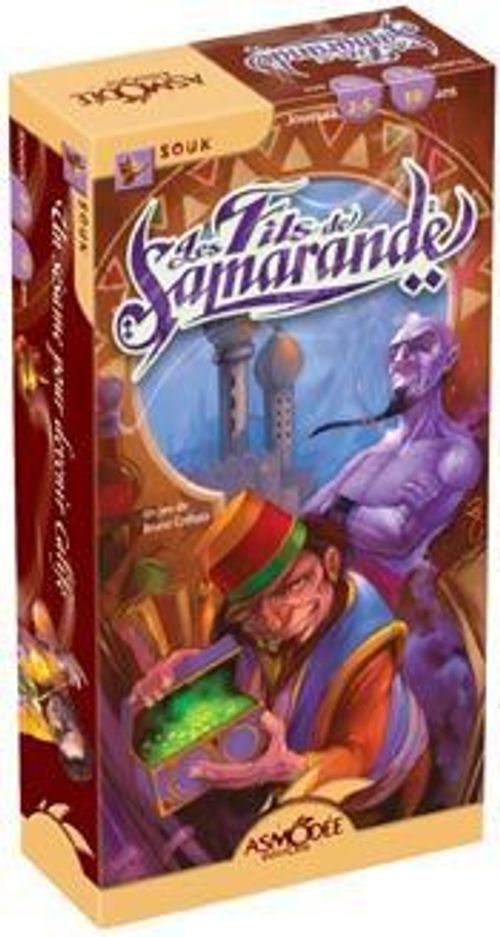
Les Fils de Samarande
Les Fils de Samarande Rulebook
Table of Contents
Table of Contents
- Game Components
- Overview
- The Different Types of Cards
- Game Preparations
- Game Play
- The End of the Game
- Details of Particular Cards
- Caliph (Calife)
- Desert Horsemen (Cavaliers du désert) and Bedouins (Hommes du désert)
- Scary Genie (Génie effrayant)
- Discoverer Genie (Génie explorateur)
- Joker Genie (Génie facétieux)
- The Giant Genie (Génie imposant)
- The Kidnapper Genie (Génie kidnappeur)
- Protector Genie (Génie protecteur)
- Assassins' Guild (Guilde des assassins)
- The Magic Lamp (Lampe magique)
- Open Sesame! (Sésame ouvre-toi !)
Game Components
110 cards distributed as follows:
- 23 districts (brown cards)
- 26 artisans (yellow cards)
- 19 guards (grey cards)
- 42 special actions (red cards)
60 gold pieces 1 die 1 board
Overview
In the land of the 1001 nights, the Caliph has decided that he will soon retire and that his successor will be the vizier who shows the most merit. Each player represents one of these viziers and will try to gain the greatest number of renown points by developing the little city that they are in charge of.
On their turn, each player has a number of action points to be spent in taking actions of their choice. These include:
- Drawing new cards.
- Developing and protecting their city by playing district, artisan and guard cards. For example, placing a new district allows more artisans to be housed.
- Slowing down your opponents with the help of special actions.
The players can also earn precious gold pieces thanks to the work of their artisans or through more questionable activities.
The game will end when, at the end of a player turn, there are no more cards in the draw deck or there is no more money in the royal bank.
Each vizier then scores points according to how well he has developed his city and for his personal fortune. His score will be as great as his city is large, diverse and wealthy. The vizier who scores the most renown points wins the game.
The Different Types of Cards
In order to begin playing, it is only necessary to know that there are four main categories of cards:
The Districts (brown cards)
Each of these cards represents a district of your city. A district can house between 0 and 3 artisans [as shown by the number of heads in the blue circle at the top of the card and repeated in the card text].
These cards are one of the keys to the game because, without districts, a city cannot house artisans. In addition, at the end of the game players score as many renown points as there are district cards in their cities (with a bonus for each different type of district).
The Artisans (yellow cards)
Each of these cards represents an artisan. The work of artisans brings in taxes each turn (at least if they haven't fled or been spirited away).
At the end of the game, players score as many renown points as there are artisan cards in their cities (with a bonus for each different type of artisan).
The Guards (grey cards)
In the land of the 1001 nights, evil genies prowl each night and poorly protected inhabitants disappear. Each card of this type represents a guard who will contribute to the protection of a city's artisans. There are guards of three different quality levels, with a bonus of +1 to +3 when their protection is tested.
At the end of the game, players score as many renown points as there are guard cards in their cities (with a bonus for each different type of guard).
Special Actions (red cards)
Each special action card has a particular effect. These cards serve to slow your opponents' development, to protect your city by countering opponents' actions, or even to influence the course of the game by allowing you the choice of the best cards.
[A red symbol in the top right hand corner of a special action card means that it is discarded after use. A green symbol means that the card remains in play.]
Game Preparations
Thoroughly shuffle the 110 cards. Deal 8 cards to each player. Each player looks at their cards and decides which 4 to keep as their starting hand. The other 4 cards are returned to the dealer and shuffled back into the deck.
If a player has no district card among the 8 cards they were dealt, they may (this isn't required) return all their cards and be dealt another 8.
Next, place the deck, face down, in the middle of the table. This becomes the draw deck.
Place the game board with its 6 spaces next to the draw deck and deal a line of 6 cards, face-up, onto the spaces on it.
Put the 60 gold pieces in the middle of the table to represent the royal bank.
The game can now start.
Game Play
The first player is decided by the roll of the die. This player undertakes all of their actions, and then each player in clockwise order takes their turn.
A player turn is made up of four phases that take place in the following order:
- Test the protection of artisans
- Collection of taxes
- Take actions of your choice
- End of turn
Test the Protection of Artisans
In this phase the player must check whether their city's guards have been effective enough to protect the population. If this is not the case, the evil genies will have made some inhabitants disappear.
Any player with artisan cards in their city must perform this protection test at the beginning of their turn:
The player to the left of the active player rolls the die. The number of artisan cards in the active player's city is added to the die roll. This total represents the level of difficulty of protecting the city.
Next, the active player rolls the die and adds to it the bonus (+1, +2 or +3) of each of their guards, as well as a bonus point for every fortified district in the city. This is the protection total.
If the protection total is greater than the one for difficulty, the artisans are well protected and nothing happens to them. However, if the protection total is not higher, the evil genies cause one artisan to disappear. The player to the left of the active player decides which one will disappear and that card is discarded.
Collection of Taxes
The player receives as many gold pieces as the number shown on the artisan cards remaining in their city [shown as 1, 2 or 3 coins in the blue octagon at the top of the card].
Perform Actions of Your Choice
On their turn, each player may use up to 6 action points during this phase. Unused points are lost; saving for the next turn is not possible. Action points are used as the player sees fit. The different actions can be performed in any order.
The costs of the different actions are as follows:
-
Drawing a face-up card from the board costs a number of action points equal to its position in the line. The first card, that's to say the one furthest from the draw deck, costs 1 point… and the sixth costs 6 points. It is possible to draw several cards in this way; for example the 1st, 2nd and 3rd cards could be drawn for a total cost of 6 points.
-
Drawing the top card from the draw deck costs 3 points. It is therefore possible to draw the top two cards of the draw deck for a total of 6 points.
-
Playing a card from your hand to your city costs the number of points shown in the yellow box in the top left corner of the card (generally 1-3 points). Cards placed in front of you represent the development of your little city and will score points at the end. [When playing an artisan card, it must be clear which district it is housed in. This is because some special actions affect a district and its inhabitants. Guards are not attached to particular districts; they protect the whole city.]
Artisans cannot be placed unless your districts have the capacity to house them [the number of heads in the blue circles shows how many artisans each district can house]. A player who has no district cannot play an artisan card (but they could play a guard).
-
Playing a special card (red cards) costs the number of action points in the yellow box in the top left corner of the card. The effects of any special card are immediate.
NB: During this phase, the player can at any time buy extra action points by paying two gold pieces per action point. A maximum of three extra action points may be bought per player turn.
End of Turn
The player counts the cards in their hand. If there are more than 4 cards, they discard the excess (but don't forget that the library (bibliothèque) district allows more than 4 cards to be held). The player chooses which cards to discard.
Next, if there are no longer 6 cards on the board, the line is replenished:
- Slide the cards remaining on the board to the left so that they occupy the lowest numbered spaces with no gaps between them.
- Replenish the line to 6 cards by turning up cards from the draw deck.
It is now the next player's turn.
The End of the Game
The game comes to an end when, at the end of a player turn, there are no more cards in the draw deck or there is no money left in the royal bank.
The players discard any cards left in their hands. Each then sorts the district, artisan and guard cards left in front of them into groups of the same type.
Each vizier now gains one renown point for each district, artisan and guard card in their city.
There is also credit for the diversity of a city: for each group of identical cards [e.g. palaces, armourers, royal guards], the vizier gains renown points equal to the cost of that card (the number in the yellow box in the top left corner).
Don't forget to count points gained for the enchanted scimitar (cimeterre enchanté) and the magic carpet (tapis magique).
Finally, there is credit for your wealth: each player counts their gold pieces. The richest vizier gains 5 renown points. If there is a tie for the most money, all tied players gain 3 points.
After all points have been totaled, the vizier who has accumulated the highest number is the winner.
Details of Particular Cards
Caliph (Calife)
If you have already bought some cards in your turn, you may re-arrange the line so that the empty spaces are where you wish.
Desert Horsemen (Cavaliers du désert) and Bedouins (Hommes du désert)
The great experience of these guards brings them two bonuses:
- When attacked by the Assassins' Guild, these guards can require the player using the assassin to re-roll his die.
- In the protection of artisans phase, a player who possesses only guards of these types can require the protection difficulty die to be re-rolled.
In both cases, whatever the result of the second die roll is must be counted.
Scary Genie (Génie effrayant)
All cards put out of the game by the Scary Genie count for nothing: artisans earn no gold, but do not count during the protection test and cannot be stolen by a Kidnapper Genie. Artisans cannot be played to a district affected by the Scary Genie; its housing capacity does not count. Cards in an affected district count for nothing at the end of the game.
Discoverer Genie (Génie explorateur)
When drawing from the draw deck, you must take the first card drawn that is of the type that you have chosen. If the drawn card cannot be put into play, add it to your hand. All the cards turned in finding yours are re-shuffled into the draw deck.
You can look at the cards in the discard pile before deciding whether to play this card.
Joker Genie (Génie facétieux)
This card can be played at any time (it is the only card in the game that can be played out of turn). All effects of an action card played by an opponent are cancelled, even those which do not concern you directly. If you play a Joker Genie during your turn, you do not spend an action point immediately. The action point is not spent until the beginning of your next turn. It is possible to make a Joker Genie disappear using a magic lamp. [Note that Joker Genies stay in play, so you are paying an action point for it every turn.]
The Giant Genie (Génie imposant)
This genie has no effect on the special powers of the Bedouins and Desert Horsemen.
The Kidnapper Genie (Génie kidnappeur)
If you have nowhere to place a kidnapped artisan, add that card to your hand.
Protector Genie (Génie protecteur)
This genie card must be placed in front of you. It only cancels the negative effects of cards played by your opponents. It has no effect on special actions that you play on yourself or others.
Assassins' Guild (Guilde des assassins)
The combat procedure for this card is as follows:
Roll a die and add the result to the Guild's +4 combat bonus. The player controlling the guard who is under attack rolls a die and adds the guard's combat bonus (for example, +1 for the Militia). The player who has the highest total kills the opposing character.
If the assassin is killed, the Assassins' Guild card is discarded and the player who defeated it is rewarded with 6 gold pieces.
If the guard is killed, his card is discarded. The player who played the Assassins' Guild takes that card back into their hand and takes gold pieces equal to the combat bonus of the dead guard.
In the case of a tie, both cards are discarded and nobody gets any money.
The Magic Lamp (Lampe magique)
You can discard a genie card that has been played in front of you or in front of an opponent.
Open Sesame! (Sésame ouvre-toi !)
If the target of your theft doesn't have enough gold, they give you all the gold that they have. You must decide who will be the victim of your thievery before rolling the die.
Desert Tornado (Tornade du désert)
You must destroy all of the cards present in the chosen district. If you don't have sufficient action points to achieve this, you must choose another district.