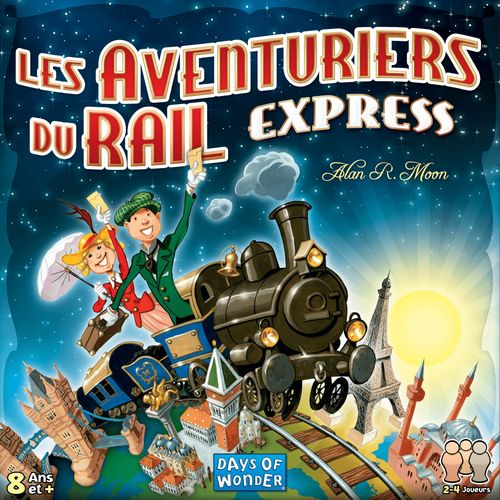
Les Aventuriers du Rail Express
Les Aventuriers du Rail Express Rulebook
Table of Contents
Table of Contents
Components
- 1 Board map of Europe
- 27 Train Cars and a score marker per player (plus extra "replacement" cars in each color)
- 116 illustrated cards:
- 70 Train Car cards - 10 each of color
- 12 Locomotives
- 30 Destination Ticket Cards
- 4 bonus Europe Express Cards (London - Istanbul)
- 1 Rules Booklet
Setting up the Game
Place the board map in the center of the table. Each player takes a set of 27 Colored Train Cars along with its matching Scoring Marker. Each player places his Scoring Marker near the 100 points (Start) on the Scoring Track running along the map's border.
Place the deck of Locomotive cards face up near the board map. Shuffle the Train Car cards and deal a starting hand of 4 cards to each player. Place the remaining deck of Train Car cards next to the Locomotives pile face down, then turn the top five cards from the deck face-up.
Place the deck of Destination Tickets stack next to the board. At the beginning of the game, each player draws three Tickets. Each player then looks at his Destination Tickets and decides which ones he wishes to keep. He must keep at least two, but may keep all three if he chooses. Unwanted tickets are placed back into the stack. Players keep their Destination Tickets secret until the end of the game. You are now ready to begin.
Put the bonus Europe Express Cards next to the Destination cards stack, putting them in the descending order (the bigger value on top of the bonus cards stack).
Object of the Game
The object of the game is to score the highest number of total points. Points can be scored by:
- Claiming a Route between two adjacent cities on the map;
- Successfully completing a Continuous Path of routes between two cities listed on your Destination Ticket(s);
- Successfully completing a Continuous Path of route of his color between London and Istanbul.
Points are lost if you do not successfully complete the route given on the Destination Ticket(s) you kept.
The Game Turn
Randomly decides the starting player. Play then proceeds clockwise around the table, each player taking one turn at a time until the game ends. On his turn, a player must perform one (and only one) of the following four actions:
1. Draw Cards
The colors of each type of Train Car card match various routes between cities on the board - Purple, Blue, White, Green, Yellow, Black, and Red. A player may have any number of cards in his hand at any time.
The player may draw 2 cards. He may take any one of the face-up cards or he may draw the top card from the deck (this is a blind draw). If he draws a face up card, he immediately turns a replacement card face-up from the deck. He then draws his second card, either from the face up cards or from the top of the deck.
When the deck is exhausted, the discards are reshuffled into a new draw pile deck. The cards should be shuffled thoroughly, since all the cards have been discarded in sets.
In the unlikely event that there are no cards left in the deck and there are no discards (because players are hoarding many cards in their hands), a player cannot draw Train Car cards. Instead he may only claim a route or draw Destination Ticket cards.
2. Draw a Locomotive Card
The Locomotives cards are multicolored and, like the Joker cards, they can replace a card of any color when building a route. This action permits to take a Locomotive card from the deck. There's no limit of the number of Locomotive cards that a player can have in his hand.
3. Claim a Route
A route is a set of continuous colored spaces (in some instances, gray spaces) between two adjacent cities on the map.
Some cities are connected by Double Routes. One player cannot claim both routes to the same cities.
NOTE: In 2 player games, only one of the Double between two cities can be used. A player can claim one of the two routes, but the other route(s) is then closed to the other player.
To claim a route, a player must play a set of Train Cards whose color and quantity match the color and number of spaces of the chosen route. When a route is claimed, the player places one of his plastic trains in each of the spaces on the route. All the cards in the set used to claim the route are then discarded.
A set of cards must be of the same type. Most routes require a specific type of set. For example, a Blue route must be claimed using Blue Train Cards. Some routes - those that are gray colored - can be claimed using a set of cards of any one color.
The discarded Locomotive cards are put in their deck and are available again.
A player may claim any open route on the board. He is never required to connect to any of his previously played routes. No more than one route may be claimed in a given player's turn. The player then immediately records his score by moving his Scoring Marker the appropriate number of spaces along the Scoring Track, per the route scoring table.
Route scoring table:
| Route length (spaces) | Points |
|---|---|
| 1 | 1 |
| 2 | 2 |
| 3 | 4 |
| 4 | 7 |
| 5 | 10 |
The rulebook illustrates that a route of three spaces (for example) can be claimed with four different combinations of Train Car cards and Locomotives (for example, all cards of the route's color, or the route's color mixed with Locomotives, or all Locomotives).
If the route you claimed lets you connect by a Continuous Path of trains of your color between London and Istanbul, take the bonus Europe Express Card (London - Istanbul) from the top of the stack and put it in front of you. A player may take only one bonus card.
If a player doesn't have enough trains in his pile as to claim a route he can't claim it.
4. Draw Destination Tickets
Each Destination Tickets includes the name of two cities on the map and a Point Value. A player may accumulate any number of Destination Ticket cards during the game.
If a player successfully completes a series of routes that connect the two cities, he will add the amount of points indicated on the Destination Ticket to his point total at the end of the game. If he does not successfully connect the two cities, he deducts the amount of points indicated.
A player can use his turn to draw more Destination Ticket Cards. To do so, he draws 3 new cards from the top of the Destination Ticket Deck. He must keep at least one of the cards, but may also keep two, or all three if he chooses. Any returned cards are placed at the bottom of their corresponding Destination Ticket Deck. The kept card can't be discarded after this.
Game end and Calculating Scores
When one player's stock of colored train cars gets down to zero, 1 or 2 trains left at the end of his turn, each player, including that player, gets one final turn. The game then ends and players calculate their final scores.
Players should have already accounted for the points earned as they completed different routes. To make sure no mistakes were made, you may want to re-count the points for each player's routes.
Players should then reveal all their Destination Tickets and add (or subtract) the value of their Destination Tickets still in hand, based on whether they successfully connected those cities together or not.
Then they add the points on every player's bonus Europe Express Card (London - Istanbul).
The player with the most points wins the game. If two or more players are tied for the most points, the player (among those tied) who has completed the most Destination Tickets wins. If the tied continues both players are considered winners.