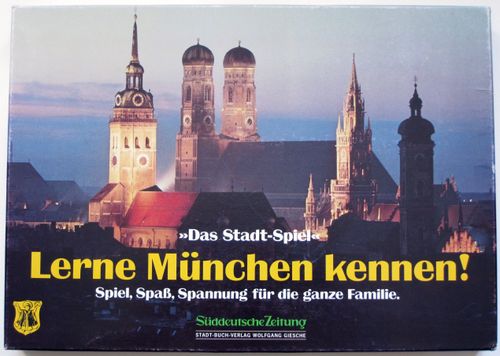
Lerne München kennen
Lerne München kennen Rulebook
Table of Contents
Table of Contents
Game Description
Number of Players
"Lerne München kennen" is a city game for the whole family. 2 to 6 players, or 2 to 6 groups of players, can take part in one game.
Contents
- 1 game board
- 1 card box
- 350 Knowledge cards (Wissens-Karten)
- 52 Event cards (Ereignis-Karten)
- 48 Collection cards (Sammel-Karten)
- 50 Master Questions (Meister-Fragen)
- 6 game pieces
- 1 die
Meaning of the Game
With 500 question, answer and action cards from the areas of history, culture, curiosities, humour, knowledge worth knowing, tradition and modern Munich, the city game "Lerne München kennen" aims to convey knowledge of the world city of Munich in a playful way to all friends of Munich.
STADT-BUCH-VERLAG has compiled 300 further interesting supplementary questions about the city of Munich. How these supplementary questions can be obtained is described on the last page of the game description sheet.
Goal of the Game
Knowledge and luck are both part of the course of play. The goal is to collect all 8 Collection cards as quickly as possible, by rolling the die and by answering the Knowledge questions. The player then moves to the goal and answers the closing Master Question. Whoever answers it correctly wins the game.
Game Setup
The game board consists of four parts. Assemble them to form the board.
Sort the 500 game cards as follows, shuffling each type separately and placing each type in its own compartment of the card box:
- 350 Knowledge cards
- 52 Event cards
- 48 Collection cards
- 50 Master Questions
Each player chooses one of the 6 game pieces. The player who rolls the highest number on the die begins the game. Play then passes to the left, so that each player takes the next turn after the player to their left.
Game Play
The game begins in the centre of the board, on the red point labelled "START/ZIEL". Players take turns in order. On their turn a player rolls the die and moves their piece on an exploration journey by the number rolled. The directions of the compass may be chosen freely along the paths. A game piece may only be moved in one direction during a single roll.
Over the course of the game it is decisive to collect the 8 Collection cards by a fast route, in any order, and then to go directly to the goal and win the game by answering the Master Question.
If a player lands on a field that is already occupied by another game piece, they must choose a different route.
During the game, players reach points of different colours. Each colour has a different effect.
Blue Points Without Numbers
When a player reaches a blue point without a number, the blue Knowledge card is brought into play. The player to the right of the active player draws the card from the back of the card box, reads the question aloud, and after use returns it to the front of the card box.
The Knowledge card contains a question and an answer, as well as the number of spaces the player may advance if they answer correctly. (If the point the player would move to is occupied, the player must remain standing on the point.)
The point the player has reached then becomes the starting point for the next round. No further Knowledge or Event card may be drawn in the same turn.
If the question is not answered, the player stays where they are and waits until the next round.
Blue Points With Numbers
Proceed exactly as with the blue points without numbers.
The numbers point to sights, which are named only in connection with the black Event cards.
Black Points With a White "E"
When a player rolls onto a black point with a white "E", the black Event card is brought into play. The player to the right of the active player draws the card from the card box, reads it aloud, and after use returns it to the front of the card box.
The Event card contains an instruction that moves the player closer to the goal or sends them back. Through these cards players also gain blue or black points again.
In this case no further card is drawn. The die then passes to the next player.
Among the Event cards are some Jokers. A Joker may be used when a question cannot be answered. The questions then count as answered, and the player may advance the full number of spaces given on the card.
A Joker may not be used to answer the closing Master Question.
Pink Points With the Numbers 1 to 8
When a player reaches or passes a pink point with a number from 1 to 8, the player receives the matching pink Collection card. As described above, the player must hold all 8 Collection cards before they may end the game.
If a player passes pink points several times during play, the repeat has no effect on the game once the card has already been received.
End of the Game
The red "START/ZIEL" point marks both the beginning and the end of the game.
Once a player holds all 8 Collection cards, they must reach the goal point directly. If the player rolls a higher number than required, they must move past the goal point, and they may roll again only in the next round.
Only when the player's piece has reached the goal point does the player draw the rear Master Question from the card box, to the right of the player. The player reads it aloud.
- If the player answers the Master Question correctly, they have won the game.
- If the player answers incorrectly or not at all, they must return the Collection card prescribed on the Master Question. The player must then head for that point again, as soon as they may roll the die again in the next round.