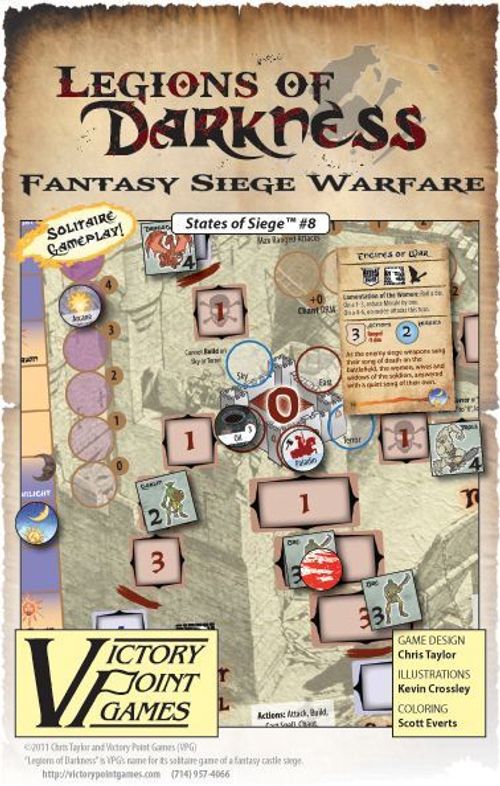
Legions of Darkness
Legions of Darkness Rulebook
Table of Contents
Table of Contents
(1.0) Introduction
(1.1) How to Win
Stop the invading armies from entering your castle until the time marker moves to the bottom of the time track and reinforcements arrive to save the day.
(1.2) Components
Legions of Darkness includes the following components:
- One 8½" x 11" map
- One 8½" x 5½" double-sided player aid card
- 12 single-sided ¾" army counters
- 28 double-sided 5/8" round markers
- 36 cards (20 day and 16 night)
You will need to provide one standard 6-sided die for resolving events and battles.
The map represents the castle you are in charge of defending. The most important features are the five tracks used to measure the attacker's progress, the time track, the tracks for magic energy and the number of defenders.
The player aid has reminders for the various actions you and your heroes perform. Two scenario set up instructions are on the reverse.
The time marker tracks the passage of time and determines day/night.
The morale marker notes any actions gained or lost due to morale.
The three defender markers keep track of castle casualties.
Two magic energy markers track energy available for spells.
Each spell marker is one spell, which must be researched before use.
Enemy armies place breach markers on walls before sacking the castle.
Upgrade markers must be built before they can be placed on the walls.
The bloody battle marker is placed on one enemy army by the cards.
Hero markers track the location and health of your most powerful allies (each hero marker has a wounded side).
Each army counter represents dozens (dragons and wraiths) to hundreds (zombies) or even thousands (goblins) of enemy troops. The counter has the name, image and strength of the army (and a melee attack -1 modifier on some counters). The strength is used in battles, where you must roll higher than the strength to push the army away from the castle.
Event cards are the fickle nature of fate. Cards determine enemy advancements and how many actions/heroic acts you can take to thwart the enemy. Some cards have mandatory events or optional quests. Cards also regulate the passage of time or if a particular battle becomes very dangerous and bloody. Each card shows, from top to bottom: card title, advances, event, heroic acts, actions, quest, flavor text, time, and bloody battle.
Conventions
New gaming terms, when they are initially defined, appear in dark red lettering for quick referencing.
The instructions for this game are organized into major "Rules" sections as shown in large blue font, and represented by the number to the left of the decimal point (e.g., rule 4.0 is the fourth rule). These rules generally explain the game's components, play procedures, core systems and mechanics, how to set it up, and how to win.
With each Rule, there can be "Cases" that further explain a rule's general concept or basic procedure. Cases might also restrict the application of a rule by denoting exceptions to it. Cases are an extension of a Rule shown in the way that they are numbered. For example, Rule 4.1 is the first Case of the fourth Rule.
Important information is in red text. Examples are in blue text and this font.
(2.0) Set Up
See the reverse side of the player aid card for specific scenario set up instructions.
- Place the map in the center of a table or flat surface.
- Shuffle the day and night event cards separately to form their respective decks and place them near the map, leaving enough room for discard piles.
- Place the three defender markers (archers, men-at-arms and priests) on the right-most space of their respective track. Men-at-arms start on 3 melee attacks, archers start on 2 ranged attacks and priests start on +2 chant die-roll modifier (drm).
- Place the time marker on the first dawn space at the top of the day/night track on the map.
- Place the two building upgrades, the bloody battle and breach/barricade markers next to the map to form the Reserves.
- Place the morale marker near the morale space at the top of the map.
- Randomize the spell markers face-down (with the arcane and divine symbols facing up) near the map.
- Set the arcane and divine energy markers aside for the moment until you have determined your heroes (see 2.1).
- Choose one of the two scenarios from the reverse side of the player aid card and follow the instructions for that scenario. If this is your first time playing, start with the Greenskins scenario with the standard set up. Optional random set up instructions are included to vary the location of the armies.
(2.1) Winds of Magic
Roll the die. Set the arcane or divine energy to that result (your choice). Set the other energy to 6 minus that result (i.e., from 5 to 0). Then add +2 arcane energy if one of your heroes is the Wizard and/or add +2 divine energy if one of your heroes is the Cleric. If the modified magic energy is greater than 6, place the magic energy marker on the 6 space. Each type of magic is limited to 6 points of energy.
Example: The winds of magic die result is 4. You can set arcane energy to 4 and the divine energy will be (6-4) or 2, or you can set divine to 4 and arcane to 2.
(3.0) Sequence of Play
Each turn is comprised of a series of phases. At the start of each turn, you will draw the top card of the appropriate deck (day or night). Then read the card (carefully!) from top to bottom to complete the turn. Finally, discard the card at the end of the turn to the appropriate discard pile. When a deck is exhausted, shuffle those discards to form a new deck.
- Card Phase: If the time marker is on a day (including dawn) space, draw the top card from the day deck else draw the top card from the night deck (for night and twilight spaces).
- Army Phase: Advance the listed armies on the card a number of spaces equal to the number of icons displayed. See 4.0.
- Event Phase: If there is an event, read and follow the event text. See 5.0.
- Action Phase: During this phase you will take up to the number of actions (see 6.0) and heroic acts (see 7.0) listed on the card. You can perform actions and heroic acts in any order. The number of actions you are allowed may be modified by your current Morale (see 6.1.1) and/or events. If there is a quest on the card, you can attempt it once (see 6.8). There may be a positive or negative dice-roll modifier (drm) for specific actions and/or heroic acts. Tip: You may want to use a pair of large, differently colored dice or markers to keep track of the number of actions and heroic acts remaining each turn.
- Housekeeping Phase: Check for victory or defeat (see 11.0). If the game continues, you may have to advance the time marker (see 3.1) or place the bloody battle marker on an army (see 3.2).
(3.1) Time
Advance the time marker a number of spaces equal to the number of time icons at the bottom of the card. The time marker can never advance past the final twilight space (see 11.2).
(3.1.1) Twilight
When the time marker advances into or through a twilight space add +1 arcane energy (see 9.1) and add the terror army to the "3" space of the Terror track.
(3.1.2) Dawn
When the time marker advances into or through a dawn space reduce morale by one step (see 6.1.1), add +1 arcane energy and remove the terror army from the Terror track.
(3.2) Bloody Battle
Move the bloody battle marker to the army depicted on the bottom of the card. The bloody battle marker starts in the Reserves and is placed on an army or is transferred from one army to another each time an event card with the bloody battle icon is drawn. If the Gate symbol is on the card, place the bloody battle marker on the closer of the two Gate armies. If there is a tie, place the marker on the Gate army of your choice.
Tip: The Bloody Battle marker will cause defender casualties. Place it on the Gate army that you will be least likely to attack.
(4.0) Armies
Army counters represent the attackers and their position on their track determines how close the army is to breaching the castle walls and sacking the castle defenders.
(4.1) Advancing & Retreating
Armies advance by card effect, moving from a higher numbered space to a lower numbered space. Armies retreat away from the castle in the opposite direction. Armies advance one space for each symbol on the card. Unless otherwise directed, advance the army by one space when the keyword "advance" is written in an event or action text.
(4.1.1) Gate Track Advancement
The farthest (highest numbered space) of the two Gate armies advances first. If both armies are on the same space, advance both armies together.
Example: A goblin is on space 4 and an orc is on space 3. If the Gate advances once, the goblin moves from 4 to 3. If instead it advances twice, the goblin would first move to 3 and then both armies would advance to 2.
(4.1.2) Breaches
The East, West and Gate tracks lead into the castle. Before the attackers can enter the castle and begin the sack (see 11.1), they must create a breach in the wall. The first time an army would advance from the "1" to the "0" space, instead remove any upgrade on that track from the game and add a breach marker to that track's castle circle. An army on a track with a breach can move to the "0" space on a future advance.
Example: The Zombie army on the East wall is on the "1" space. A card with two East wall icons is drawn. The first East advance creates a breach and the second advance moves the Zombie army into the castle, ending the game in a loss.
(4.1.3) Barricades
If an army on a track with a breach is pushed back from the "1" space, you can use a Build (see 6.3) action to flip the breach to the barricade side. A barricade is not an upgrade. If an army advances from the "1" space with a barricade to the "0" space, roll the die. If the result is equal to or less then the strength of the army, you lose the game. If the result is greater then the strength of the army, the army does not advance and the barricade marker is flipped to the breach side.
Example: A strength 2 Goblin army attempts to overrun the barricade blocking its entrance into the castle. The die is rolled and the result is 4. The Goblin army does not sack the castle but it does tear down the barricade. If the result had been 1 or 2, the Goblins would have advanced into the castle immediately.
(4.2) Terror Track
The Terror track is the small, all melee-range track. The Terror army is only placed and advanced on this track during night turns. At the start of a twilight turn place the Terror army on the "3" space. The Terror army can be placed and advanced on the same turn. At the start of a dawn turn, remove the Terror army from the track. The Terror army cannot advance into the castle (see 4.4).
(4.3) Sky Track
The Sky track is a long, mostly ranged-attack only track. Melee attacks are limited to the first space of the Sky track. The Sky army cannot advance into the castle (see 4.4).
(4.4) Terror and Sky Track Effects
You cannot lose the game by the Terror and Sky tracks advancing into the castle (the "0" space). Instead, each time one of those two armies would advance into the "0" space, the army stays in the "1" space and you must choose one defender to lose (see 8.2.1). If all defenders are reduced to 0, the game immediately ends in a loss. The Terror and Sky armies never move past the "1" space.
Example: The Dragon is on the "1" space when a card with two Sky advancement icons is drawn. The player selects one men-at-arms and one priest to lose. The Dragon remains on the "1" space.
(5.0) Events
Events are mandatory. After moving armies, read and follow the event text. Event rules supersede all other rules. Events are always placed between the armies and the actions on the card.
(5.1) Event Die Rolls
You may be instructed to "roll a die". If so, roll one 6-sided die and compare the result to the event table or rule. If the result is not listed on the table, the event has no effect.
(6.0) Actions
You can perform a limited number of actions each turn, based on the current card's action points (see 6.1). Some actions are automatic (Memorize and Pray), while others require a die roll. Unless otherwise directed, the same action can be performed multiple times in a single turn (up to the limit of available action points). An action must be completed in its entirety before another action or heroic act (see 7.0) can be performed.
- Attack: Attempt to push back an army.
- Build: Upgrade a castle wall.
- Cast Spell: Use a spell marker.
- Chant: Increase divine energy.
- Memorize: Learn a new arcane spell.
- Pray: Learn a new divine spell.
(6.0.1) Action Rolls
Actions that require a die roll always fail on a natural roll of "1".
(6.0.2) Action Event Card DRMs
The current event card may list a die-roll modifier (drm) for a specific action. All positive drms are in green; negative drms are in red.
Example: While this card is in play, attacks targeting the West wall track have a -1 drm. Other attacks, actions and heroic attacks are not affected.
(6.1) Action Points
At the start of the action phase, you have a number of action points equal to the actions number listed on the card. Each action uses one action point. Action points cannot be saved from turn to turn.
Tip: There is no requirement to use all available action points in a turn, but you would fail your Wisdom check by not doing so.
(6.1.1) Effect of Morale
Morale starts the game at "normal". It may lose a step and go to "low", or gain a step and go to "high". Normal morale has no effect on actions. Low morale reduces the number of action points gained at the start of the action phase by one. High morale increases the number of action points gained at the start of the action phase by one. Morale has no effect on heroic acts (see 7.0). Morale that is adjusted during a turn has no effect on the number of action points until the beginning of the next action phase.
Example: Morale is high. The drawn card has 3 actions and 2 heroic acts. After the morale bonus, you can make up to 4 actions but still only 2 heroic acts.
(6.2) Attack
Attacks can force an army to retreat. There are two types of attacks with this action: melee and ranged. Melee attacks are close range with sword and shield. Ranged attacks are long distance attacks with bows and siege weapons. Ranged attacks can attack at any range but melee attacks are limited to the red-tinted spaces on the track. See Battles, 8.0.
Example: The Goblin army on the "4" space can only be attacked by ranged attacks. The Orc army on the "3" space can be attacked by melee or ranged.
(6.3) Build
You can add to the defenses of your castle by building upgrades. Upgrades can only be built on the East Wall, West Wall and Gate. Upgrades cannot be built on a track if there is an army in the "1" space. Only one upgrade can be built per track. Select an upgrade and track, then roll the die. If the result is greater than the build difficulty number listed on the marker, place the upgrade marker on the castle circle adjacent to space "1" for that track. If the result is equal to or less than the number, do not build the upgrade.
(6.3.1) Rogue Traps
Rogues add a +1 drm to any build roll.
(6.3.2) Upgrade Effects
Building upgrades increase the castle's defenses on a specific track.
- Grease (Build number: 3): Roll the die when an army in the "1" space attempts to place a breach (see 4.1.2). If the result is greater than 2, the army creates a breach. If the result is 1 or 2, the army fails to create the breach and stays in the "1" space.
- Oil (Build number: 3): Add a +1 drm to all non-heroic melee and ranged attacks against the army in the "1" space of this track.
- Acid (Build number: 5): Once per turn, make a free melee attack against an army in the "1" space of this track.
- Lava (Build number: 5): Add a +2 drm to all non-heroic melee attacks against an army in the "1" space of this track.
(6.4) Cast Spell
Select a known, revealed spell marker and pay the energy cost by moving the appropriate magic energy marker down a number of spaces equal to the magic cost of the spell. The magic cost of the spell is listed on the marker and on the player aid card. Spell effects are immediate. Discard the spell marker when completed. See Magic, 9.0.
(6.5) Chant
Roll the die and add the current priest drm. If the total is greater than 3, the chanting is successful and you add +1 divine magic. This action cannot increase divine energy beyond 6.
(6.6) Memorize
Draw and reveal one face-down arcane spell marker at random. If there are no face-down arcane spell markers available, the memorize action cannot be performed.
(6.7) Pray
Draw and reveal one face-down divine spell marker at random. If there are no face-down divine spell markers available, the pray action cannot be performed.
(6.8) Quests
A quest is a special, unique action that can only be attempted once per turn. You must use at least one action and/or heroic act to attempt the quest, but you can use more. Total the drms from used actions (+1 drm) and/or heroic acts (+2 drm) and roll the die. If the total is greater than the target number listed in the quest, the quest is successful. If the total is equal to or less than the target number, the quest fails and cannot be attempted again this turn. Failed quests usually have no effect (beyond the loss of used actions and/or heroic acts), unless otherwise noted. Quests are not mandatory. Quests are marked with large question mark and are below actions/heroic acts on the event card.
Example quest on a card: "Put Forth the Call: Spend actions (+1 drm) or heroic acts (+2 drm). Roll 7+ to add +1 defender."
(6.8.1) Ranger Questing
Rangers add a +1 drm to any Quest roll.
(7.0) Heroic Acts
Heroic acts are similar to actions (see 6.0), except that they are performed by heroes. You must have at least one living hero on the map (assigned to tracks or in the Reserves) in order to use heroic acts.
- Cast Heroic Spell: Use a known spell, with an improved effect.
- Heroic Attack: Make an attack led by your hero.
- Move: Move a hero from one location to another in the castle.
- Rally: Attempt to improve morale.
(7.0.1) Paladin Holy Ability
Paladins can re-roll any one die once per turn after you see the result. You must use the result of the re-roll.
(7.0.2) Heroic Act Rolls
Heroic acts that require a die roll always fail on a natural roll of "1".
(7.0.3) Heroic Act Event Card DRMs
The current event card may list a die-roll modifier (drm) for a specific heroic act. Positive drms are in green; negative drms are in red.
(7.1) Heroic Act Points
At the start of the action phase, you have a number of heroic act points equal to the heroic acts number listed on the card. Each act uses one point. Heroic act points cannot be saved from turn to turn.
(7.2) Cast Heroic Spell
Same as Cast Spell (see 6.4), except the heroic spell effect is used instead of the normal spell effect. Heroic arcane spells require a Wizard hero and heroic divine spells require a Cleric hero. The casting hero can be on a track, in the Reserves, and/or wounded, but cannot be dead. Some spells only have an effect when cast from a track.
(7.3) Heroic Attack
Same as attack (see 6.2) with a positive drm based on the type of hero (usually +1; the Warrior adds +2 to melee attacks). One hero can attack one army on the track they are assigned to. Heroes cannot use this act from the Reserves or if they are dead. Heroes with an axe symbol make melee attacks. Heroes with a bow symbol make ranged attacks. Heroic attacks do not count against the maximum number of defender attacks per turn.
(7.4) Move
Move one hero from a track or the Reserves to another track or the Reserves. Heroes are placed on the castle circle of a track. More than one hero per track is allowed and heroes can occupy the same space as a castle upgrade.
(7.4.1) Rogue Movement
The Rogue can move to any track or the Reserves at any point during the Action phase without using an Action. The Rogue can move multiple times in a turn.
(7.5) Rally
Roll the die. If the result is greater than 4, the Rally attempt succeeds and Morale is improved one step (from Low to Normal or Normal to High). This act has no effect if Morale is already at High. Failure has no additional effect. Rally can be used from the Reserves.
(7.5.1) Paladin Rallies
Paladins add a +1 drm to the Rally roll.
(8.0) Battles
Each attack or heroic attack will cause one battle. You can only make a limited number of attacks, based on your current number of available defenders (see 8.2) and remaining actions (see 6.1). Melee attacks are limited to armies in the red-tinted spaces. Ranged and magical attacks can target armies in both red and blue-tinted spaces.
(8.1) Battle Process
Select an army to attack and use one action (attack) or heroic act (heroic attack, led by a hero). Determine the total relevant die roll modifiers (drms; see 8.1.4) and roll the die. Compare the total of the die roll and the drms to the strength of the target army.
(8.1.1) Battle Results
If the total of the die roll result and the drms is greater than the army strength the attack is successful and the army retreats one space. Armies cannot retreat beyond the highest numbered space on the track.
If the total is equal to or less than the army strength the attack fails.
If a hero was used to make an heroic attack and the die roll result was a natural 1, then that hero is wounded (see 8.3.1).
(8.1.2) Battling Armies at the Gate
Only the closest (on the lowest numbered space) of the two armies can be targeted. If the armies are tied, choose one of the armies to attack.
(8.1.3) Bloody Battles
The army marked with the bloody battle marker is especially deadly. The first non-magical attack each turn against this army causes the loss of one defender (see 8.2.1) after the attack or heroic attack is determined but before the attack is rolled and results are determined.
(8.1.4) Die Roll Modifiers
Die roll modifiers, or drms, add or subtract from the result of the die. Events, quests or quested items, spells and heroes all provide various drms. Regardless of the total drms, a natural 1 result always fails. Magical attacks against targets in melee range ignore negative modifiers. Event cards, heroes and spells (Inspire) can list drms. Unless otherwise ruled, drms "stack" and are added together.
(8.2) Defenders
The current number of defenders limits the number of attack actions that can be used each turn. Refer to the number under the men-at-arms marker for the maximum number of melee attacks and the number under the archers for the maximum number of ranged attacks. The number of defenders has no effect on the number or type of heroic attacks (see 7.3).
Example: The castle defenders have taken some losses. The player can only make 1 ranged attack and up to 2 melee attacks, subject to the number of available actions. (The loss of all the priests doesn't affect the number of attacks, but does mean that chant actions do not have a positive drm.)
(8.2.1) Defender Losses
Defenders are lost by events (see 5.0), bloody battles (see 8.1.3), or Sky/Terror track advances from the "1" space. Unless specified, you may choose which defender to lose. Move a defender marker one space to the left for each loss. The new value immediately takes effect.
Example: The player makes their first melee attack of the turn against the bloody battle army. They must immediately lose one defender. If they move the men-at-arms marker from the "2" attacks space to the "1" space, they cannot make any additional melee attacks this turn.
(8.2.2) Defender Gains
Defenders can be gained by events or divine spells. The number of defenders can never exceed the right-most space on the track. The new value immediately takes effect.
Example: The player casts Mass Heal and gains one men-at-arms, moving the marker from the "1" space to the "2" space. The player can immediately make another melee attack (if they have at least one action).
(8.3) Heroes in Battle
Heroes are only involved in battle during heroic attacks. If an attack action is used to initiate a battle, heroes do not add their drm and cannot be wounded.
(8.3.1) Hero Wounds
When used for an heroic attack, heroes are wounded on a natural die roll result of "1". An unwounded hero is flipped to the wounded side. A previously wounded hero that is wounded a second time is killed, slain and/or chopped to pieces. Dead heroes have no effect and cannot perform heroic acts. Dead heroes aren't much fun, they don't come when you call them. Set dead heroes aside.
(8.3.2) Warrior Armor/Ranger Agility
Warriors and Rangers cannot be wounded in battle. They can be wounded by events.
(9.0) Magic
There are two types of spells: arcane (mostly offensive) and divine (mostly defensive). Each type of spell requires magic energy, which is tracked separately for the two types. Spells can be cast by action (by unnamed and untracked magicians and priests in the castle) or by heroic act (by a wizard or cleric hero). A wizard or cleric is not required to cast spells, but those heroes can cast heroic spells with an improved effect.
All spell markers start face-down. Spells must be memorized (arcane) or prayed for (divine) before use. The number of spell markers is limited. Spells are discarded when cast.
(9.0.1) Magical Attacks
Some spells are magical attacks. These attacks do not count against the number of defender attacks each turn. They can be used at melee and ranged distances. If used against armies in melee range, ignore any negative drms. Magical attacks against the Bloody Battle army (see 8.1.3) do not cause defender loss.
(9.1) Magic Energy
There is a single magic track on the map, ranging from 0 to 6. Two markers, one for arcane and one for divine magic, are used to track the current amount of magical energy available for casting spells. One point of arcane magic is added each twilight and dawn, and is often modified by events during the night. Divine magic is added by the chant action. The maximum amount of magic energy is 6 points (each). Magic energy is reduced when spells are cast. A spell cannot be cast unless there is enough magic energy of the appropriate type remaining to pay for the entire cost of the spell.
(9.2) Arcane Spells
Arcane spells are the spell markers with an "ice-cream cone" symbol. With the exception of Chain Lightning and Fortune which can be cast from the Reserves, the Wizard must be on the same track as the target of the arcane spell.
(9.2.1) Fireball
The magicians conjure a giant flaming ball of pure elemental fire and fling it towards the soon to be toasted enemy troops. Burning goblins smell funny.
Energy Cost: 1
Normal effect: Make one magic attack with a +2 drm.
Heroic effect: Make one magic attack with a +2 drm. If the attack fails, you may re-roll the die one time.
(9.2.2) Slow
Conjured tentacles, animated plants and puddles of infinitely slippery goo cause havoc with the enemies' ability to coordinate movement.
Energy Cost: 2
Normal effect: Place the slow spell marker on an army. The next time that army would advance one space, remove the marker instead of moving the army.
Heroic effect: Place the slow spell marker on an army on the Wizard's current track and retreat that army one space. The next time that army would advance one space, remove the marker instead of moving the army.
(9.2.3) Chain Lightning
Dark clouds gather, lightning strikes, and orcs die. Giant bolts of lightning blast the attackers into piles of carbon.
Energy Cost: 3
Normal effect: Make three magic attacks, one at a time. The first attack with a +2 drm, the second with a +1 drm and the third with a +0 drm. You can see the results of one attack before choosing the target of the next. Each attack can target the same or different armies.
Heroic effect: Make three magic attacks, one at a time. The first attack with a +3 drm, the second with a +2 drm and the third with a +1 drm. You can see the results of one attack before choosing the target of the next. Each attack can target the same or different armies. The Wizard can attack any track, even from another track or the Reserves.
(9.2.4) Fortune
Drawing on arcane temporal threads, the magicians can vaguely see into the future when throwing bones into enchanted fires. A powerful wizard can reach through time and exert his will to alter the strands of fate itself.
Energy Cost: 4
Normal effect: Draw the top three cards from the day or the night deck. Return them to the appropriate deck in any order.
Heroic effect: Draw the top three cards from the day or the night deck. You may discard one card of your choice. Return the non-discarded cards to the appropriate deck in any order.
(9.3) Divine Spells
Divine spells are the spell markers with an "ankh" symbol. All divine spells can be cast from any track or from the Reserves.
(9.3.1) Cure Wounds
From healing hands flows divine energy that can restore a horribly wounded individual to perfect health.
Energy Cost: 1
Normal effect: Flip one wounded hero to the non-wounded side.
Heroic effect: Flip one or two wounded heroes to their non-wounded side.
(9.3.2) Mass Heal
Calling on more powerful divine energies, large groups of men can be restored to health. Broken limbs are mended and wounds are closed without infection.
Energy Cost: 2
Normal effect: Gain one defender (archers, men-at-arms, or priests). This cannot increase the number of defenders above the maximum number.
Heroic effect: Gain one each of up to two different defenders. This cannot increase the number of defenders above the maximum number.
(9.3.3) Divine Wrath
The power of angry gods can be summoned by the righteous. This wrath is stronger against the blasphemous undead.
Energy Cost: 3
Normal effect: Make one magic attack with a +1 drm. If the targeted army is undead, retreat that army an extra space.
Heroic effect: Make two different magic attacks, each with a +1 drm. You cannot target the same army twice. If the target army is undead and the attack succeeds, retreat that army an extra space. The casting Cleric does not have to be on the targeted track.
(9.3.4) Inspire
Powerful words and divine inspiration rally the down-hearted.
Energy Cost: 3
Normal effect: Increase Morale one step, from Low to Normal or Normal to High. This spell cannot be cast if Morale is High.
Heroic effect: Increase Morale one step, from Low to Normal or Normal to High, and all die rolls have a +1 drm until the end of the turn. This spell can be cast if Morale is High, but only for the +1 drm.
(9.3.5) Raise Dead
With enough prayer, even the wall between this world and the next can be pierced with the gift of life.
Energy Cost: 4
Normal effect: Gain one each of up to two different defenders. This cannot increase the number of defenders above the maximum number.
Heroic effect: Gain one each of up to two different defenders and/or return a dead hero to the Reserves. This spell cannot increase the number of defenders above the maximum number.
(10.0) Heroes
Heroes represent the exceptional characters that are aiding in the castle defense.
Heroes start in the Reserves. Heroes use the listed number of heroic acts on the event card to act. You can move a hero to a specific track or back to the Reserves. Heroes can lead heroic attacks with a bonus drm if they are not in the Reserves. Heroes can rally the troops and improve morale. Wizards and Clerics can cast heroic spells, with an improved effect. Heroes can be wounded or killed. Heroes add their bonuses when wounded, but not when they are dead.
(10.1) Warrior
The Warrior adds a +2 drm to melee heroic attacks. The Warrior is heavily armored and cannot be wounded in battle.
(10.2) Wizard
The Wizard adds a +1 drm to ranged heroic attacks. If the Wizard is part of your forces during set up, add +2 arcane energy. Finally, spells cast by the Wizard use the heroic effect.
(10.3) Ranger
The Ranger adds a +1 drm to ranged heroic attacks. The Ranger is agile and cannot be wounded in battle. When you quest, the Ranger adds a +1 drm to quest rolls.
(10.4) Rogue
The Rogue adds a +1 drm to melee heroic attacks. Since the Rogue is fleet of foot, he can move for free at any time during the action phase. The Rogue is the master of traps and adds a +1 drm to build rolls.
(10.5) Paladin
The Paladin adds a +1 drm to melee heroic attacks. The Paladin's holy power permits you to re-roll any one die per turn. The Paladin is inspirational and adds a +1 drm to rally rolls.
(10.6) Cleric
The Cleric adds a +1 drm to ranged heroic attacks. If the Cleric is part of your forces during set up, add +2 divine energy. Lastly, spells cast by the Cleric use the heroic effect.
(11.0) Victory or Defeat
Ultimately, you must conserve your defenders and keep the invading armies out of the castle to win.
(11.1) Defeat
There are two possible ways to lose: one of the East, West or Gate armies moves from space "1" to space "0" through a breach/broken barricade or if all defenders (archers, men-at-arms, and priests) are reduced to 0.
If either occurs, you immediately lose the game and your castle is rudely sacked right in front of you. Make little sobbing cries of helplessness to simulate what happens to you and your peasants.
(11.2) Victory
There is only one way to win: move the time marker to the bottom of the track and survive the last night card drawn for the final twilight. The game ends immediately at the end of the first final twilight turn.
Congratulations! You have beaten back the horde, the reinforcements have arrived and your castle is safe until next time.