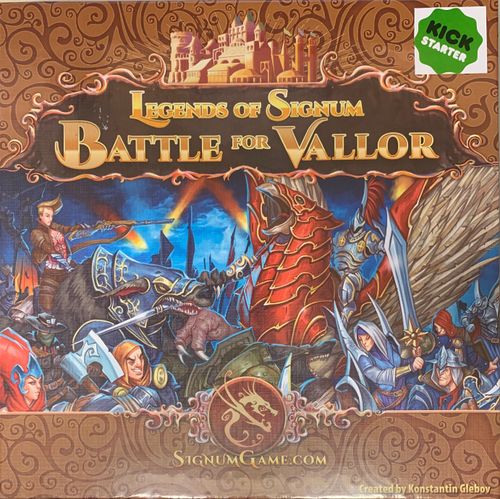
Legends of Signum: Battle for Vallor
Legends of Signum: Battle for Vallor Rulebook
Table of Contents
Table of Contents
Setup
Set up the battlefield using the supplied map or any 24x24" (60x60cm) area. Each player chooses a side.
Each player chooses a faction. Players can select the same faction and heroes, but each player can only have 1 hero.
Players build their own battle decks of between 20 and 40 cards (the number of cards in each player's deck does not have to be the same). You can only use battle deck, building and terrain cards that are affiliated to your faction, though you may also include mercenary character cards. At least half the deck must be comprised of character cards, and no more than half of those can be mercenaries. A deck cannot contain more than 1 character card of the same name. Other card types can be included in the deck in any proportions or not at all.
Each hero has unique cards for the battle deck which can only be brought into play if your squad is led by that specific hero.
Place your battle deck facedown in front of you. Clear a city zone area in front of you where you will place your terrain and building cards, and a graveyard zone for your card discards. Any player can look at the cards in any graveyard at any time.
Each player rolls a die and the winner decides who goes first. Turn order remains unchanged throughout the game. The player who is playing their turn is the active player.
The first player sets their hero creature on the battlefield with the edge of its base touching their edge of the field. Then the second player does the same on their side.
Players start with 3 points of prosperity each and draw 4 cards from the top of their battle decks to form their starting hand.
Once, before the game starts, each player has the option to return up to 4 cards from their hand to their battle deck and replace them with an equal number of cards. Then shuffle the deck.
Turn Structure
Beginning Phase
The active player untaps all the tapped cards in their city zone, if they have any. All your creatures can now be activated again. Then remove all temporary effect tokens from your creatures, if the effects expire before the start of the turn.
Take 1 card from your battle deck into your hand and take 1 point of prosperity. You cannot have more than 10 battle deck cards in your hand. If you already have 10 cards, one of the cards, randomly chosen by your opponent, is discarded to your graveyard.
If your battle deck runs out, every time you need to take a card from the deck, your opponent receives prosperity points. The first time it happens, your opponent receives 1 point, and then the amount doubles every turn.
Construction Phase
The active player may construct buildings or gain prosperity points. If you decide to skip the construction phase, you take 2 points of prosperity.
Choose which buildings and in which order you are planning to construct them. You cannot construct more than 1 building per phase.
To construct a building, you need its building card. The construction is finished if the building cost has been paid and the card has been placed in your city zone. The order of placing building cards in the city does not matter, nor does the order in which they are constructed.
A building can be used in the same turn it is constructed. Buildings that are not currently in use are untapped; those that were used in the current turn are tapped (flipped 90 degrees and unusable again this turn). Buildings in your city are used for playing battle deck cards from your hand or terrain cards, and for using abilities on the building card.
The maximum amount of buildings you can have in your city is 12, and you cannot have 2 with the same name, nor 2 guilds or 2 orders (even if these have different names). You cannot remove constructed buildings from the city zone at will.
Buildings can be destroyed. While the 9 basic buildings (City Hall, Temple, Arena, Smithy, Library, Shooting Range, School of Magic, Tavern, Barracks) can be constructed again, each unique building can only be constructed once per game.
Creature Activation Phase
The active player may:
- Play any number of support cards (character, spell, relic or tactic) from their hand;
- Activate creatures on the battlefield;
- Play up to 1 terrain card.
You can carry out these actions in any order. You cannot play building cards in this phase. Before playing cards, you must declare your action by stating which card you are going to activate.
Alternatively, players may discard any number of cards from their hand and take 1 prosperity for each discarded card.
Each card has a cost in the top left corner. You can play the card from your hand if the city zone already has all necessary buildings constructed and untapped. Then pay the cost of the card by tapping all the necessary buildings in the city, and spending the required prosperity points.
The terms hero and character are different, and effects that work on one do not work on the other. Abilities that work on both heroes and characters use the term creature.
Sometimes, "any building" can be part of the card's cost, in which case playing the card requires you to tap any building in your city.
Players must activate all of their creatures on the battlefield during their turn. You can skip a creature's activation, but the creature is still considered activated.
Your next creature can begin its turn only after the previous one has completed all its actions, and you cannot activate the same creature twice in one turn.
Abilities that require their owning creature to be activated are marked with an activation icon, and the creature must use its entire activation to use one. If it has moved or is in contact with an opposing creature, it cannot use such an ability. If an ability doesn't state that it requires activation, its effect is active at all times.
After all your creatures on the battlefield have finished their actions, your turn is over.
All abilities and effects active until the end of the turn, or abilities that only activate at the end of the turn, are declared in an order chosen by the player controlling those cards.
The other player's turn then begins.
Character Cards
If you play a character card, place it next to your hero card, and place the character card's creature on the battlefield so that the edge of its base touches the player's edge of the field.
It cannot be placed closer than S (8 cm) to any of your opponent's creatures. If that is not possible, the creature can be placed on the field regardless, but receives a backstab from every hostile creature at S distance or less.
A creature that has just been summoned to the battlefield is considered activated and cannot perform any actions that turn. If your opponent enters melee combat with it, or declares a ranged attack against it, it can defend itself as normal.
If the creature has any passive abilities that affect other creatures and do not require activation, these abilities are active immediately after the creature is summoned.
The creature card and its creature on the battlefield remain in play until the creature is eliminated (until the amount of wound markers becomes equal to its HEALTH). When that happens, discard the creature card to your graveyard and remove the creature from the battlefield.
A player cannot have more than 7 creatures on the battlefield at the same time.
Spell Cards
If you play a spell card, it takes effect immediately and the card is discarded to the graveyard.
Relic Cards
If you play a relic card, place it next to your hero card. It can only be given to your hero, and can be used immediately.
The icons on a hero card indicate how many relics of a particular type may be carried by that hero. A relic remains in play until it is destroyed or replaced by another one of the same type. When either happens, discard it to the graveyard.
Tactic Cards
If you play a tactic card, place it facedown near your hero card. It is not revealed to your opponent, but you must declare that you are playing one and tap all the necessary buildings. Mark the cost of played tactic cards with dice or your own tokens.
Tactic cards remain concealed until the activation conditions are met. As soon as that happens, flip the card, show it to your opponent, apply the effects, and discard the card to your graveyard. A tactic can only take effect during your opponent's turn.
Terrain Cards
You can only play up to 1 terrain card per turn, and it may require certain buildings to be constructed in your city. You can only play terrain cards that are affiliated with your faction.
Place the card in your city zone and place its corresponding terrain type template on the battlefield. It cannot be placed in contact with any creature bases, and must be placed at least S distance (8 cm) away from your side of the battlefield and other terrain elements, and at least M distance (10 cm) away from your opponent's side. If you cannot fulfill these criteria, the terrain card cannot be played.
Terrain cards such as Forest or Rocks are available to any faction, and players may play them as many times as they wish during the game (but still only once per turn).
Faction-specific unique terrain types have their own names and can only be played once per game. If the faction-specific terrain has been played on the battlefield by a player, it cannot be played again.
Terrain can be destroyed. Any non-unique terrain can be played again.
Activation
When a creature is activated, it can perform the following actions:
- Move up to its movement distance;
- Use the run rule;
- Move up to its movement distance range and enter melee combat;
- Enter into melee combat if it was already in contact with an opponent's creature;
- Perform a shot or any other ranged attack (if it has the ranged attack ability);
- Use any abilities on its card.
The active creature can move up to the MOVEMENT distance on its card: S (8cm), M (10cm), L (15cm) or XL (25cm). Use the appropriate range template.
If the base of the moving creature touches the base of an opponent's creature, the creature enters into contact with it and must immediately stop. If a creature enters into contact with 2 or more of the opponent's creatures, the active player can choose which to enter into melee combat with.
If a creature moves during its turn, it cannot use any attacks in that turn except for melee combat.
If a creature starts or ends its movement while in difficult terrain or passes through difficult terrain during its activation, its movement distance is reduced to S.
Creatures cannot move through one another or stop on another creature's base, and cannot move through or stop on impassable terrain.
Run
Before your creature moves, you can declare that it will run in the current turn.
The creature's movement increases to the next movement value, and its activation ends immediately after the move is completed. No abilities can be used after running, including melee combat.
A creature with XL movement cannot run. A creature cannot run if it is in contact with an enemy creature.
If your running creature enters into contact with an opponent's creature, it immediately ends its movement and receives a backstab.
Backstab
When a creature breaks contact with an enemy creature, moves while in contact with an enemy creature, or comes in contact with an enemy creature while using the run ability, it receives a backstab.
Each opponent's creature that was in contact, or enters contact, rolls 1 die and is successful on [die face] or [die face]. If a creature is wounded and doesn't have the Fortitude ability, it successfully backstabs only on [die face]. A backstab is not an attack and cannot be defended against.
A creature with a stealth token that performs a backstab loses its stealth token.
Creatures can perform a backstab even if their STRENGTH is 0, or they cannot fight in combat using the normal rules at all.
Melee Combat
If your creature enters contact with an opponent's creature during its movement, or starts its turn already in contact, it may enter melee combat.
A creature can declare melee combat only once per activation unless stated otherwise.
A creature can remain in contact with another without declaring melee combat; it can just stay in contact to impede that creature's actions.
The active player's creature is the attacker, and their opponent is the defender. A creature with a STRENGTH value of 0 cannot attack or defend itself in melee combat.
If the active creature is in contact with several enemy creatures, it can choose only 1 to fight in melee this turn. If a creature is being attacked by several creatures, after the first attack it must assign all of its strength dice to defense in the subsequent melee combats this turn.
A creature's STRENGTH is how many dice it can use in melee. First, the defender declares how many of these dice they are assigning to attack, and how many to defense. Then, the attacker declares their choice.
Both players roll their attack dice at the same time. Each die assigned to attack deals 1 point of damage when [die face] or [die face] is rolled. However, a wounded creature (one that has sustained any wounds) deals damage only on [die face].
Then, both players roll their defense dice at the same time. Each defense roll of [die face] blocks 1 point of damage.
Place damage markers on the creature's card to track how much damage it has taken. If it has any armour tokens, remove those first (1 armour token for 1 point of damage).
A creature's HEALTH is how many wounds it can sustain until it dies: remove it from the battlefield and discard its card to the graveyard.
Ranged Attacks
An active creature can make a ranged attack if it has one of these abilities: shot X, throwing X, or magical shot X.
A creature in contact with an enemy cannot declare a ranged attack. You can choose an opponent's creature as a target, even if it's in contact with another of its own creatures.
A creature cannot move before a ranged attack unless it has special abilities, and ranged attacks cannot be performed after using the run ability.
Measure the distance to your target: shot and magical shot attacks can hit targets within XL range, throwing attacks hit within L range.
You must be also able to draw line of sight (LOS) between the shooter and the target. LOS is a straight line between any points of the creatures' bases that isn't blocked by anything that blocks LOS. LOS is blocked by all creatures (except those with a stealth token), and blocking terrain.
Roll X dice, where X is the value of the creature's ranged attack, including any modifiers. The target suffers 1 damage for each [die face] rolled.
Throwing attacks hit on [die face] or [die face].
A creature that is the target of a shot or throwing attack may roll as many dice for defense as the number of successful hits. Each [die face] rolled cancels 1 successful hit. The target's STRENGTH has no effect.
A target cannot roll defense dice against a magical shot attack.
Stealth
Creatures with a stealth token are stealth and cannot be targeted by attacks or any actions by enemy creatures.
A creature cannot have more than 1 stealth token.
A creature loses its stealth token if it declares an attack, performs a backstab, uses an activated ability, or is detected by an enemy.
To attempt to detect an enemy creature, the active player's creature must come into contact with it (without using the run ability) and roll a die. On [die face] the enemy is detected and loses its stealth token. The detecting creature can then immediately attack it. If detection fails, the active creature immediately ends their turn.
Creatures with magical shot can also detect stealth creatures within XL distance. They must draw LOS to the stealth character and roll a die: on [die face], they can immediately declare a magical shot with the discovered enemy as the target.
Creatures with a stealth token can use the run ability. They cannot block LOS for ranged attacks, and cannot be targeted by a backstab. They can search ruins without losing the stealth token, and do so while in contact with an opponent's creature.
Enemy creatures in contact with a stealth creature can declare ranged attacks and activate other abilities, and are not subject to backstab if they move out of contact.
Terrain
Terrain abilities are active for as long as the terrain remains on the battlefield.
- Impassable: Creatures without Flight cannot cross this template when moving. No creatures can end their movement on top of this terrain.
- Difficult: If a creature without Flight touches this template with its base during movement, its movement distance decreases to S. Creatures that already have a movement distance of S are not affected. If a creature has already moved beyond S distance before touching the template, it must immediately stop upon contact with it.
- Blocks line of sight (LOS): Players cannot draw LOS through this template.
- Defense against shooting: If a creature in contact with this template becomes the target of a ranged attack, or an attacker's LOS goes through it, the ranged attack target can reroll any failed rolls for defending against shot or throwing attacks. If the attack is a magic shot, the defending creature treats it as a common shot.
- Ruins: If a character is in contact with this template, they can search it. Characters cannot search ruins if they are in contact with an enemy creature. After the search is completed, the character's turn ends immediately. Heroes cannot search ruins. Regardless of the result, each set of ruins can only be searched once per game.
Characters can use a secret entrance to move any distance between ruins that have been searched. Roll a die while your character is in contact with the ruins. If the result is [die face], the character remains in place and ends its turn. If [die face] or [die face] were rolled, the character can move into contact with another set of searched ruins on the battlefield (but not in contact with any of your opponent's creatures) and then ends its turn.
Stealth characters may search ruins and use secret entrances without losing their stealth token.
End of Game and Victory
Players can win in either of these ways:
- Eliminate your opponent's hero: The player whose hero survives is the winner. If eliminating the hero activated any tactic cards or effects that could influence the result, take into account those effects before finishing the game. This form of victory has priority.
- Accumulate prosperity: A player who reaches 51 points of prosperity wins.
If you wish to play to a time limit, the player whose hero has the least number of wound markers when the time limit is reached wins. On a tie, compare prosperity points and the cost of constructed buildings. On a further tie, the player who eliminated the most opposing characters wins.
Other Rules
If an ability allows a player to affect creatures or cards of their opponent, then the player chooses which of the opponents will be affected, with all conditions and rules of the ability taken into account.
If an ability on a card contradicts basic game rules, the card text has priority.
Abilities with the same name are not cumulative; the highest parameter replaces lower ones. If the ability value has a + it is added to the same ability of the target, if applicable.
If an attack, any effect, or a creature's STRENGTH becomes less than 0 after all modifiers, it is considered to be 0. If any action produces an effect with a value of 0, there is no effect, but the action is still considered taken. Abilities or attacks cannot be declared if their value is 0 after applying modifiers.
If a creature is affected by 2 effects, the description of which contradicts each other, then the effect that has been applied last takes priority. The latest effect cancels the preceding one.
If an effect text does not state target limitations, it affects all the available targets.
Game Variants
Experienced Architect
Before the game starts, both players create a separate construction deck of up to 12 cards that consists of building cards in any desired order. Keep this deck facedown. You cannot change the order of cards in the deck during the game.
During the construction phase you must draw a card from the construction deck. No more cards can be drawn until this building is constructed.
The Battle of Three
Three player variant. The game ends when only 1 hero remains on the battlefield or one of the players reaches 51 prosperity points.
Roll the die to determine who goes first. The first player chooses one of the corners and measures a distance equal to an XL ruler from that corner and along the side of the field clockwise to claim that side. The player to the left chooses next and so on. Turn order proceeds clockwise.
All card abilities that are in effect until the end of the opponent's turn, or take effect at the end of the opponent's turn, are active until the end of the third player's turn or take effect at the end of it. That is, both opponents must complete their turns.
If an ability allows a player to affect creatures or cards of their opponent, then the player chooses which of the opponents will be affected.
The Battle of Four
Four player variant. The game continues until only 1 hero remains on the battlefield and all 3 others have fallen, or until one of the players gains 51 points of prosperity.
Roll the die to determine who goes first. The player at the winner's left takes the next turn and so on clockwise.
The first player chooses one of the corners and measures a distance equal to an XL ruler from that corner and along the side of the field clockwise to claim that side. The player to the left chooses next and so on. Turn order proceeds clockwise.
All card abilities that are in effect until the end of the opponent's turn, or take effect at the end of the opponent's turn, will be active until the end of the last player's turn or at the end of it. That is, all three opponents must complete their turns.
If an ability allows a player to affect creatures or cards of their opponent, then the player chooses which of the opponents will be affected, with all conditions and rules of the ability taken into account.
Shoulder to Shoulder
Four players, 2 vs 2 variant. Players agree on the composition of their teams beforehand as it cannot be changed during the game.
To win, one team must eliminate both heroes belonging to the opposing team. If one of the heroes falls, its ally can still continue and win. If one of the players gains 51 points of prosperity, their team wins immediately.
The first player chooses one of the corners of the field and measures a distance equal to XL towards the corner of their ally. The player who has the first turn chooses their side of the field first in a way that their opponents are set opposite and the ally's corner is to the left or right. Turn order proceeds clockwise. Both players of the first team must take their turns, and then the players of the opposing team take their turns.
Allied creatures cannot be attacked in the same way your own ones cannot be attacked, and any cards or abilities affecting "opponent's creatures" do not affect the creatures and cards of your ally.
All card abilities that are in effect until the end of the opponent's turn, or take effect at the end of the opponent's turn, will be active until the end of the last player's turn or at the end of it. Thus, both opponents must complete their turns.
If an ability allows a player to affect creatures or cards of their opponent, then the player chooses which of the opponents will be affected.
Keywords
Agile
The creature cannot be targeted by a backstab.
Armor X ([icon])
The creature has X armor tokens, and prevents the first X wounds from non-magical effects. When the creature receives 1 damage, remove 1 armor token.
Aura X: (text)
All of your creatures, unless indicated otherwise, at a distance within X receive the (text) ability or effect. The source of the aura does not receive the benefits.
Battle Mage
The creature can declare a magical shot if it moved this turn.
Beserk X
While the creature is wounded (has wound markers on its card) it receives +X STRENGTH.
Buckshot
If the target of this shot is within M distance and the shot was successful, the target is moved backward from the shooter at S distance along the drawn LOS. If it leaves a contact, it does not receive a backstab. If it cannot move the full distance, it receives an additional 1 point of damage.
Cautious X
This creature must assign at least X dice to defense in melee combat (but no more than the creature's STRENGTH).
Charge: (text)
Once per turn, this creature receives (text) until the end of the turn, if it moved before attacking in melee.
Contract: (text)
At the start of this creature's turn, the active player can pay 1 prosperity and this creature will receive all (text) effects until the end of the active player's turn.
Concentration X
Activate this ability to gain X tokens.
Control X
Roll X dice: on at least 1 [die face], a targeted opposing creature within XL distance and LOS goes under your control until the end of your turn, and can be activated.
Defender
If an enemy creature declares a melee attack while in contact with this creature, it must select it as the target. If there are several creatures with this ability in contact with the attacker, it can choose which one to strike.
Defense against ranged attacks
If a creature is currently in contact with a terrain template which has this ability and becomes the target of a ranged attack, or that template is in LOS, the owning player can reroll any failed rolls to defend against shot or throwing attacks, once per ranged attack. In the case of a magical shot, the creature receives 1 defense die as if it were the target of a shot.
Difficult
Terrain ability. If a creature without Flight touches this template during movement, its movement distance decreases to S, and no running is possible.
If a character has already moved beyond S distance before touching the template, it must immediately stop. If it starts its turn in difficult terrain, its movement distance is S until the end of its turn.
Difficult target
When performing a ranged attack against this creature, the attacker must reroll all successful hits.
Durability X ([icon])
Relic ability. When this relic is played, place X armor tokens on the card. When the hero equipped with this relic receives non-magical damage, remove that number of armor tokens.
Damage dealt by a single attack cannot be spread over different relics, though you can continue to assign damage to another relic once one is destroyed.
If a card deals wounds, it ignores armor tokens. Armour tokens protect the hero from any physical attacks, but not magical damage or effects.
Once all the armor tokens are gone, the relic is discarded and the hero loses all of its effects.
Expert of attack X
If this creature assigns all available dice to attack in melee combat, it receives X additional attack dice.
Fast
This creature may attack in melee combat even if it used run before the attack.
First Word ([icon])
Triggered ability. Triggers when the card is played from the player's hand.
Flight
This creature can ignore obstacles when moving across the battlefield, including other creatures and terrain. This creature still can't end its move in contact with other creatures or in impassable areas.
Fortitude
This creature always hits its target in melee when rolling [die face] or [die face], whether they are wounded or not.
Hammerblow
When attacking in melee combat, every successful hit by this creature deals 2 points of damage.
Healer X
When this creature activates, choose a target, roll X dice, and remove as many wound tokens as there are successful rolls. In contact with a target, [die face] or [die face] are successful. If the target is at a distance of up to XL, only [die face] are successful.
Healing X
Remove X wound tokens from the target of healing. If there are fewer wounds than the ability can heal, they are all removed and the target creature is considered fully healed. If the target creature has no wounds, healing can still be performed, and all triggered features are activated.
Howl X
All creatures within X distance gain (text) until the end of the turn. (text) can contain additional limits for the targets of this ability.
Initiative
In melee, a creature with this ability strikes first. Its target can defend as normal, but it attacks second and will not attack if it was killed by the creature with this ability. If both combatants have this ability, melee combat occurs as normal.
Jump
This creature can ignore other creatures when moving on the battlefield. The jump can be carried out only in a straight line up to the distance specified. Terrain cannot be crossed. This creature cannot finish its movement after the jump in other creatures or terrain.
Last Word ([icon])
Takes effect when the creature or support card is discarded to the graveyard.
Magical Shot X ([icon])
A magical ranged attack with X dice that can target a creature within XL distance. Each die hits on a [die face] and deals 1 wound. Creatures cannot roll defense dice against a successful magical shot.
Magical Strike X
A magical melee attack with X dice that can be declared against a creature in contact with the attacker. Each successful hit inflicts 1 wound. Creatures cannot defend against a successful magical strike.
Master of Attack X
This creature can reroll up to X different dice that it assigned to attack in melee combat.
Master of Defense X
This creature can reroll up to X different dice that it assigned to defense in melee combat.
Master of Healing X
This creature can reroll up to X different dice that it used for healing.
Master of Shooting X
This creature can reroll up to X different dice that it used for a shot or throwing ranged attack.
Multiple Uses X: (text) ([icon], [icon])
Relic ability. The ability (text) can be used X times. The relic is destroyed immediately after the hero uses it the specified number of times, and all effects it granted cease to function.
Pathfinder
This creature ignores all difficult terrain penalties.
Persecution X
If this creature eliminates an opposing character in melee combat, it can declare a movement up to S distance into contact with another one of its opponent's creatures and perform another melee attack, X times per turn.
Predator
If this creature enters melee combat with a wounded opponent's creature, it gains +1 STRENGTH until the end of its turn.
Quick Shooter
This creature can declare a shot or throwing ranged attack even if it moved in its turn (and if the run ability was not used).
Rush
This creature may be activated immediately after being summoned to the battlefield.
Reckless X
In melee combat, this creature must assign at least X dice to attack (but no more than its STRENGTH value). If this creature is in melee combat again during the opponent's turn, after the first attack it must assign all its dice to defense.
Regeneration X
At the start of this creature's turn roll X dice. For each [die face], this creature is healed by 1.
Shield from (text)
This creature cannot be targeted by (text).
Shot X ([icon])
A non-magical ranged attack with X dice that can target a creature within XL distance and in LOS. Each die hits on a [die face] and deals 1 point of damage.
The target rolls a number of defense dice equal to the number of hits, and each [die face] rolled decreases the number of successful hits by 1.
Slow
This creature cannot use the run ability.
Sniper
This creature can reroll all of its shot dice at a distance of L and more. Each successful shot result at this distance deals 2 points of damage.
Stamina
This creature can assign its melee combat dice into attack during all opponent creature attacks.
Stealth
This creature cannot be targeted for attacks or impact effects from the opponent's creatures as long as they have a stealth token on them. They can be targeted with spells.
They can also return to stealth after being discovered if they activate while out of contact with any enemy creatures and they were not a target of ranged attacks in their opponent's last turn.
Steam Engine (text)
This takes effect when the creature declares the ability or action indicated in (text), once per turn. Roll a die to see the results and perform (text) before the ability takes effect.
Throwing X ([icon])
A non-magical ranged attack with X dice that can target a creature within L distance and in LOS. Each die hits on a [die face] or [die face] and deals 1 point of damage.
Veteran
When attacking this creature in melee combat, the attacker must reroll all successful dice results.
Play Reference
The document's one-page play reference, transcribed as printed.
Turn Structure
Beginning phase: Untap all your city zone cards and remove all expired temporary effect tokens from your creatures. Draw 1 card from your battle deck and take 1 point of prosperity. You cannot have more than 10 cards.
If your battle deck runs out, every time you need to take a card, your opponent receives prosperity points (1 point the first time, then the amount doubles every turn).
Construction phase: If you skip the construction phase, take 2 points of prosperity. Choose building cards and the order you plan to construct them. You cannot construct more than 1 building per phase. The maximum amount of buildings you can have in your city is 12, and you cannot have 2 buildings with the same name, nor 2 guilds or 2 orders (even with different names).
Creature activation phase:
- Play any number of support cards (character, spell, relic or tactic) from your hand;
- Activate your creatures on the battlefield;
- Play up to 1 terrain card.
You can carry out these actions in any order. Before playing cards, declare your action. Pay the card's cost by tapping the necessary buildings and spending the required prosperity.
Cards
Characters: If you play a character card, place it next to your hero card, and place the creature touching your edge of the battlefield. It cannot be placed closer than S to any enemies. If not possible, it can be placed on the field, but receives a backstab from every hostile creature at S or less. The creature is considered activated and cannot perform any actions that turn (though it can defend itself). Maximum 7 creatures on the battlefield at the same time.
Spells: If you play a spell card, it takes effect immediately and the card is discarded.
Relics: If you play a relic card, place it next to your card. It can only be given to your hero, and can be used immediately. The icons on a hero card indicate how many relics of a particular type may be carried by that hero.
Tactics: If you play a tactic card, declare you are playing one, place it facedown near your hero card, and tap the necessary buildings. It is not revealed to your opponent. Tactic cards remain concealed until the activation conditions are met. When that happens, flip the card, show it to your opponent, apply the effects, and discard it. A tactic can only take effect during your opponent's turn.
Terrain: You can only play up to 1 terrain card per turn. Place it in your city zone and its corresponding template on the battlefield. This cannot be placed in contact with any creature bases, and must be at least S away from your battlefield side and other terrain and at least M from your opponent's side. Faction-specific terrain can only be played once per game.
Activation and Movement
An activated creature can perform these actions:
- Move up to its movement distance;
- Use the run rule;
- Move up to its movement distance range and enter melee combat;
- Enter into melee combat if it was already in contact with an opponent's creature;
- Perform a shot or any other ranged attack (if it has the ranged attack ability);
- Use any abilities on its card.
Abilities that require a creature to be activated are marked with an activation icon, and the creature must use its entire activation to use one. If it has moved or is in contact with an opposing creature, it cannot use an ability that requires activation.
Movement: An active creature can move up to its MOVEMENT distance. Creatures cannot move through one another or stop on another base. If the base of a creature touches another, the creature enters into contact with it and must immediately stop. If a creature starts or ends its movement while in difficult terrain or passes through it, its movement is reduced to S.
Run: The creature's movement increases to the next value, and its activation ends immediately after the move. No abilities can be used after running, including melee combat. A creature with XL movement, or in contact with an enemy, cannot run.
Backstab: When a creature moves while in contact or breaks contact with an enemy, or comes in contact with an enemy while running, it receives a backstab. Each opponent's creature in contact or entering contact rolls 1 die and hits on [die face] or [die face]. If the creature is wounded, it hits on [die face]. A backstab cannot be defended against. A stealth creature that performs a backstab loses its stealth token.
Combat
Melee combat: A creature can declare melee combat with 1 enemy only once per activation. If a creature is being attacked by several creatures, after the first attack it must assign all its dice to defense in subsequent combats.
A creature's STRENGTH is how many dice it can use. First, the defender declares how many they are assigning to attack, and how many to defense. Then, the attacker declares their choice. Both players roll their attack dice. Each die assigned to attack deals 1 point of damage when [die face] or [die face] is rolled. A wounded creature deals damage only on [die face]. Both players then roll their defense dice. Each [die face] blocks 1 point of damage.
Ranged attacks: Shot X, throwing X, magical shot X. A creature in contact with an enemy cannot declare a ranged attack. A creature cannot move before a ranged attack unless it has special abilities. Measure the distance to your target: shot and magical shot attacks can hit targets within XL range, throwing attacks L range. You must be able to draw LOS, which is blocked by all creatures (except those with stealth), and blocking terrain. Roll X dice including modifiers. The target suffers 1 damage for each [die face] rolled. Throwing attacks hit on [die face] or [die face].
The target of a shot or throwing attack may roll as many dice for defense as the number of successful hits. Each [die face] cancels 1 hit. You cannot roll defense dice against a magical shot attack.