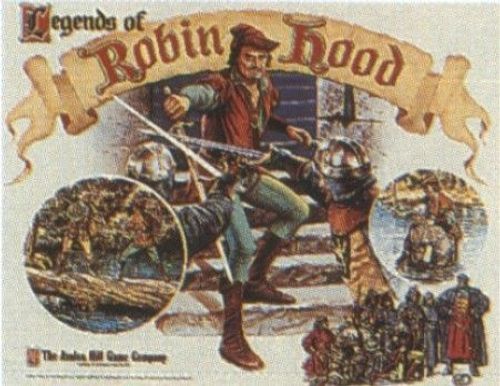
Legends of Robin Hood
Legends of Robin Hood Rulebook
Table of Contents
Table of Contents
1. Introduction
Robin Hood, Friar Tuck, Little John, Allan A'Dale and Will Scarlett have gone their separate ways to see who can relieve the rich of the most gold while avoiding the clutches of the evil Sheriff of Nottingham and his assistant Sir Guy. Each player assumes the role of one of these outlaw heroes and attempts to win the game by having the most gold coins at game end. The game is played in alternating turns by two to five players. Each player in turn plays cards from his hand to move his character around the board, recruit more Merry Men, gain gold, or have the Sheriff, Sir Guy or Prince John ambush his fellow players.
2. Setup
Insert each of the five large character pieces into a plastic stand so that it can stand erect. Each player randomly draws one of the five characters and places it in the "Camp" square. The player drawing Robin Hood takes the first turn and is followed in clockwise order by the others.
Each player also receives Merry Men pieces equal to the number of players in the game (two for a two-player game, five for a five-player game) and places them before him. A player's Merry Men are assumed to accompany the character piece wherever it moves, but they are not actually placed on the board.
Each player is dealt six cards; the remainder form a Draw Pile and are placed in a location convenient to all players.
3. Gameboard
The board consists of squares containing different types of terrain which are defined by the Terrain Key at the edge of the board. Terrain determines which cards can be played when the player's character occupies that square.
4. Player Turn
Each turn a player may play up to one card of each color/suit from his current hand. Since there are four colors/suits of cards (Red Hex, Blue Circle, Green Square and Black Triangle), a player can play a maximum of four cards per turn. All played cards are placed in front of the player, and kept separate from those drawn to resolve his actions, until the end of his turn.
In addition, a player may discard one card at the end of his turn. However, if a player plays no cards in a turn, he may discard any number of cards. Place each discard face up in a Discard Pile next to the Draw Pile.
After playing and discarding his cards, the player draws enough cards from the Draw Pile to return his hand to six cards and places all played cards (except "Disguise") in the Discard Pile.
5. Movement (Blue Circle)
Playing a "Movement" card allows a player to move his character a number of continuous squares equal to or less than the number on the card. A character moving along a road may move up to two squares on the road for each increment of movement allowance.
6. Ambush (Red Hex)
An "Ambush" card is played to attack an opposing character occupying one of the terrain types shown on that card. To resolve each attack, a number of random cards equal to the ambush number printed on that card are drawn and placed in the Discard Pile. For each card drawn with a Sword symbol at the top of the card, the attacked character loses one Merry Man.
If a player must lose more Merry Men than he has, his character is captured and placed in the nearest castle dungeon. The player who played the "Ambush" card may choose which castle if there is a tie for the closest.
A captured character loses one gold piece (if he has any) and his next turn. Place the character on its side to show its captured status until his forfeited turn has passed. No cards can be played by or against a captured character.
Card notes: The Sheriff Ambush card (Castle, Forest; ambush number 1) may never be played against a character in a Castle or Forest square. The Sir Guy Ambush card (Castle, Forest Road, Town; ambush number 2) draws two cards to resolve the Ambush, and each Sword symbol eliminates a Merry Man.
7. Fortune (Black Triangle)
There are three types of Fortune cards, but because they are all black a character may play no more than one per turn. Each card requires the character to be present at the location listed on the card at the time it is played.
7.1 Recruiting
Playing a "Recruit Merry Men" card allows the player to draw a number of cards equal to the number printed on the card. Each card drawn is placed directly into the Discard Pile, but the player receives another Merry Man piece for each one that contains a sword or bow symbol at the top of the card.
7.2 Robbery
Playing a "Rob" card allows a player to draw cards equal to the number of Merry Men he has. Each card drawn is placed directly into the Discard Pile, but for each card drawn containing a symbol at the top of the card matching the symbol of the "Rob" card, the character receives gold equal to the number of gold pieces shown at the bottom of the played "Rob" card.
7.3 Archery Contest
Playing an "Archery Contest" card allows a player to draw one card. The drawn card is placed directly into the Discard Pile, but if it contains a bow at the top of the card, that player receives three Gold coins.
8. Special (Green Square)
The green cards depict special situations which are largely self-explanatory. The following rules offer additional clarification.
8.1 Shortcut/Secret Passage
These cards may be used to move one more square either with or without a blue movement card if they are in the proper terrain.
8.2 Fur
These cards may be used to automatically recruit one Merry Man, either separately or in addition to those gained by the random draws generated by playing a black Recruiting card.
8.3 Maid Marian
This card permits a player to escape from a dungeon without losing a turn. It is played at the instant he would otherwise have to forfeit his turn. It does not save any Gold coins.
8.4 Disguise
A played "Disguise" is kept in front of its owner until it is discarded at the start of his next turn. It can only be played if the character is currently in one of the listed locations. A disguised character cannot be ambushed until he is discovered.
8.5 Discovered
A "Discovered" card voids a "Disguise" card and forces it to be discarded, but only if played in conjunction with an "Ambush" card for that terrain.
8.6 To Horse
The "To Horse" card can be used to double the movement allowance of an already played blue card. It can be played after an intervening black card so that a character could move, collect gold, and then move again. The doubled movement allowance is that of the printed card, not the actually used portion of the card. For example, a player who plays a "Movement 3" card but only moves one square to enter a town where he plays a black card, has no Movement Allowance remaining. However, if he then plays a green "To Horse" card, he may move another three spaces. That portion of the move using the "To Horse" card cannot be used to enter a forest unless it does so along a road.
8.7 Message Arrow
A player who draws a card from an opponent due to a "Message Arrow" card may use that drawn card during his turn provided it does not exceed his limit of one played card per color. The player who loses the card cannot replace it until the end of his own turn.
9. Sequence of Play
Cards can be played in any order but must be played one at a time. Each card is resolved before the next card is played. This means that a character must be in the required square to play a black card before or after he moves, not during movement. In other words, a player could not play a "Movement 3" card to move two squares to a castle, play a black card in that town, and then move his remaining one square movement allowance. However, he could then play a green "Secret Passage" card to move to an adjacent hex.
10. Winning
Play continues until the deck is emptied twice for each player in the game (e.g., in a three-player game, the deck would be shuffled and drawn six times). If the last card is drawn during the middle of a player's turn, the deck is reshuffled so that he can finish his turn before the game ends. The player with the most coins at the end is the winner. Any ties are won by the player with the most Merry Men.
The game plays even better using two decks of cards and halving the number of times the deck is emptied. Players may order a second deck direct from Avalon Hill by requesting a current Parts List.