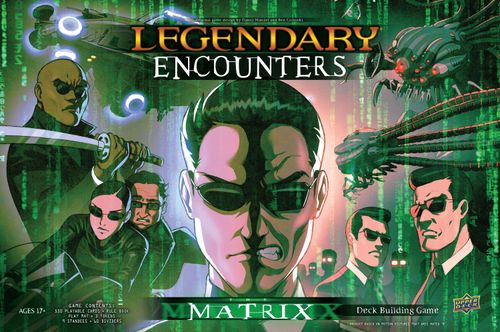
Legendary Encounters: The Matrix
Legendary Encounters: The Matrix Rulebook
Table of Contents
Table of Contents
- Deckbuilding and How to Win
- What's New in This Legendary® Encounters Game?
- Sorting Guide
- Your First Game - Use These Cards
- Game Setup
- Turn Sequence
- Matrix Phase: Add a Matrix Card to the Matrix Row
- Action Phase: Play Cards from Your Hand to Scan, Recruit, and Fight. Move into or out of the Matrix.
- Heroes
- Class Abilities (Combos)
- Free Your Mind and Avatar Abilities
- Moving Between the Real World and the Matrix
- How to Recruit a Hero
- How to Scan a Space
- Acts and Objectives
- Card Abilities
- Hero Keyword Abilities
- Matrix Deck Keyword Abilities
- Additional Game Rule Clarifications
- Specific Card Clarifications
- Strategy Tips
- Adjusting Difficulty
- Playing through the Films
- Make Your Own Stories
- Playing a Campaign
- Traitor Modes
- Ignorance is Bliss Mode
- Fighting Other Players
- When a Normal Player is Defeated
- When the Traitor is Defeated
- When the Time Track Reaches 0
- Table Talk and Etiquette
- Additional Traitor Mode Rules
- Me, Me, Me Mode
- When the Assimilated Smith Player(s) is Defeated
- When Everyone but the Assimilated Smith Player(s) are Defeated
- When the Time Track Reaches 0 (Me, Me, Me Mode)
- Keyword Quick Reference
- Side Job Table
Deckbuilding and How to Win
Each game is made up of three Acts, each with its own cards. Each Act is harder than the last, but you're going to get tougher too:
When you recruit a Hero, it goes into your discard pile. Each time your deck runs out, shuffle your discard pile to make a new deck including all the Heroes you've recruited. You must fight your way through each Act, complete the final Objective and win the game.
What's New in This Legendary® Encounters Game?
It's possible you've played other Legendary® Encounters games. If you have, here's a summary of what's new. If you haven't, you can skip this section.
Enter The Matrix
The most important new concept is going back and forth between the Real World and the Matrix. The play area in front of each player and the bottom row of the playmat is the Real World. The top two rows of the playmat are The Matrix. (See "Moving Between the Real World and the Matrix" below for more info.)
Your Avatar card stays in your play area in the Real World the whole game. Your Residual Self Image (RSI) standee represents where your consciousness is and will move in and out of the Matrix.
While in the Real World put your RSI on your Avatar card. You can only spend Recruit to recruit Heroes from the Hovercraft stack and the Dock while you're in the Real World.
When you enter the Matrix, put your RSI on the "In the Matrix" Space. While there you can pay Attack to scan spaces and fight Enemies.
There are also many effects that only apply to players that are in the Real World or in the Matrix.
Once during your turn, you may either move to the Matrix or to the Real World for free. You can always move to the Matrix. But you may only leave the Matrix if there's an available exit on the playmat. (See "Moving Between the Real World and the Matrix" below for more info.)
Avatar Abilities
When you play your Free Your Mind card, you get your Avatar's ability for the current Act. At the beginning of the game it's Act 1 so you'll use your Act 1 ability. After you complete Act 1 and move on to Act 2, you'll start using your Act 2 ability. And so on.
Double-Sided Acts
Each Act card has two sides: Part 1 and Part 2. The game starts with Act 1 Part 1. When you complete its Objective, flip it over to Part 2 which will either have its own Objective or some instructions before sending you on to Act 2 Part 1.
Note: Each Act 3 actually has TWO double-sided cards. The first card has Part 1 and Part 2. The second card has Part 3 which is the final part of the game and generally has some extra rules. It will tell you which side the card starts on.
IMPORTANT: Whenever you are instructed to begin the next Act or part of an Act, it will end your turn. You turn to the appropriate Act + Part, skip the rest of your Action Phase and the Strike Phase and go straight to your Cleanup Phase.
The Time Track
The Time Track represents how long the resistance has before the Machines win. It starts at 10 and if it reaches 0 the players lose. When an Enemy strikes during your turn, if you're in the Matrix you'll draw a Strike card. But if you're in the Real World, it will subtract 1 from the Time Track instead. There are also some card effects that directly subtract from the Time Track so be careful! Finally, the Time Track is also sometimes used in other ways, but you'll discover how as you play the game.
Sorting Guide
You'll find 500 cards in the box. Here are suggestions on how to sort your cards. Most cards have a Deck Label at the bottom. First sort the following cards:
- 35 Unplug
- 25 There Is No Spoon
- 5 Free Your Mind
- 13 Avatars
- 5 Hovercrafts
- 40 Strikes
- 19 Part of the System cards
- 12 Act cards
- 9 Traitor Mode cards (3 Secrets Revealed, 5 cards with the word Traitor, 1 Assimilated Smith)
Each of the following Hero Groups has 14 cards:
- 14 Morpheus (The Matrix)
- 14 Trinity (The Matrix)
- 14 Tank
- 14 The Nebuchadnezzar Crew
- 14 Neo (Reloaded)
- 14 Morpheus (Reloaded/Revolutions)
- 14 Trinity (Reloaded/Revolutions)
- 14 Ship Captains
- 14 Neo (Revolutions)
- 14 Niobe
- 14 Link
- 14 Defenders of Zion
Note: There are three additional Hero Groups – Neo (The Matrix), The Keymaker, and Seraph – which are found in the next section as "Extra" cards.
Each of the following groups has a mini deck and some have "Extra" cards that start out of play:
- Act 1: What is the Matrix? – 10 cards (plus 14 Extras)
- Act 2: Know Thyself – 11 cards (plus 9 Extras)
- Act 3: He is The One – 13 cards (plus 11 Extras)
- Act 1: The Oracle's Call – 10 cards (plus 4 Extras)
- Act 2: Free the Keymaker – 11 cards (plus 14 Extras)
- Act 3: The Source – 13 cards (plus 1 Extra)
- Act 1: Club Hel – 10 cards (plus 14 Extras)
- Act 2: The Battle of Zion – 11 cards (and no Extras)
- Act 3: Everything That Has a Beginning – 13 cards (and no Extras)
Your First Game - Use These Cards
- Act 1: What is the Matrix?
- Act 2: Know Thyself
- Act 3: He is The One
- Avatars: Thomas Anderson/Neo, Morpheus, Trinity, Switch, Mouse (In a four-player game leave out Mouse. In a three-player game leave out Switch and Mouse, etc.)
- Hero Groups: Morpheus, Trinity, Tank, The Nebuchadnezzar Crew
Note: Use the Morpheus and Trinity Avatars and Hero Groups from The Matrix (not Reloaded/Revolutions).
Game Setup
Player Starting Decks
Give each player their own personal 13-card deck made up of these Hero cards:
- 7 Unplug
- 5 There Is No Spoon
- 1 Free Your Mind
Each player then selects an Avatar and puts it in front of them. This is who you will be playing as in the game. (You can choose which ones you like or randomly deal them out.) Find the Residual Self Image standee that matches your Avatar and put it on your Avatar card.
Some characters have multiple Avatars: There's one Neo for The Matrix, one for Reloaded, and one for Revolutions; and there's one Morpheus and Trinity for The Matrix and another of them for Reloaded/Revolutions.
Note: The Thomas Anderson/Neo Avatar has two sides. Start on the Thomas Anderson side, with your Free Your Mind card out of play, and your RSI starts on the In The Matrix space. (You haven't yet been freed from the Matrix.)
Your Avatar stays in front of you during the game.
- Your Rank determines who goes first. (Highest rank goes first with 1 being the highest.)
- Your Speed value is only referenced by certain card effects.
- Your Health determines how much damage it takes to defeat you.
- You have three Abilities. When you play your Free Your Mind card, use the ability that corresponds to the current Act the game is in.
Game Stacks
There are five different Hovercraft Hero cards. Shuffle them together and put them face down on the Hovercraft space. Shuffle the 40 Strikes and put them face down on their space. These stacks are used every game.
Act Cards
Choose three Acts to play: one Act 1, one Act 2, and one Act 3. (For your first game use "Act 1: What is the Matrix?", "Act 2: Know Thyself", and "Act 3: He is The One.")
Find the corresponding Act cards for those Acts. Act 1 and Act 2 each have a double-sided card. Act 3 actually has two double-sided cards. Stack those four cards in the following order from top to bottom: Act 1 Part 1; Act 2 Part 1; Act 3 Part 1, Act 3 Part 3. (Act 3 Part 3 will tell you which side it starts on.)
Put the Act stack on its space on the playmat.
The Matrix Deck
The Matrix Deck is made up of cards from the three Acts you chose as well as some Part of the System cards, which are added based on the number of players.
Each Act has its own "mini-deck" of cards which will be used to build the full Matrix Deck. Start with Act 3. It has a 13-card mini-deck. First take out its double-sided Inevitable card, check which side it starts on, and put that side face up on the Matrix Deck space.
Now take the remaining 12 cards, and shuffle them along with a number of randomly selected Part of the System cards. (See the chart below) For example, in a 3 player game, you'll shuffle 3 random Part of the System cards into each mini-deck.
Put the Act 3 mini-deck face down on top of the Inevitable card.
Next take Act 2's 11-card mini-deck, shuffle in a number of randomly selected Part of the System cards, and put it on top of the Act 3 mini-deck.
Finally, take Act 1's 10-card mini-deck, shuffle in a number of randomly selected Part of the System cards, and put it on top of the Act 2 mini-deck.
When you're finished, you should now have a single Matrix Deck with the Act 1 cards on top followed by the Act 2 cards, the Act 3 cards, and finally the Inevitable card.
| Number of Players | Part of the System Cards |
|---|---|
| 1 | No Part of the System Cards |
| 2 | 1 Part of the System card in each mini-deck |
| 3 | 3 Part of the System cards in each mini-deck |
| 4 | 5 Part of the System cards in each mini-deck |
| 5 | 5 Part of the System cards in each mini-deck (plus one Prep Turn*) |
*If there are 5 players, each player's first turn is a "prep turn" which means you skip the Matrix Phase on that turn.
Extra Cards
Most Acts also have some "Extra" cards. Set these cards out of play – you will use them during the game.
Zion
There are 12 different Hero Groups, each with 14 cards, that you can use to build the Zion deck. Choose four Hero Groups (at random or your choice) for a total of 56 cards. (For your first game, use Morpheus, Trinity, Tank, and The Nebuchadnezzar Crew). Put the rest of the Hero Groups back in the box.
Note: There are 3 additional Hero Groups that are marked as "Extra" in their Deck Label. These Heroes don't start in the Zion deck but might be added to it during the game.
Operations
Nothing starts in Operations. This area of the playmat is only used when cards specifically say to put them in Operations.
The Time Track
Put the Time Track counter on 10.
Starting the Game
- Shuffle Zion and put its top five cards face up into the five spaces of the Dock.
- You start the game in the Real World so put your RSI on top of your Avatar card. (If you're Thomas Anderson you start with it on the In The Matrix space.)
- Each player shuffles their personal deck of 13 cards and draws a hand of 6 cards from it.
- The player with the highest Rank goes first. (Example: Thomas Anderson/Neo is Rank 1 which is the highest.) Then play proceeds clockwise. Note: If two or more Avatars are tied for the highest Rank, choose one of them to go first.
Turn Sequence
During your turn, complete the following phases in order:
- Matrix Phase: Draw a Matrix card (keeping it face down) and add it to the Matrix row.
- Action Phase: Play cards from your hand to recruit, scan, and fight. You also get one "free" move into or out of the Matrix.
- Strike Phase: Each Enemy in the Combat Zone strikes.
- Cleanup Phase: Discard your hand and all Heroes you have in play. Then draw six new cards.
Matrix Phase: Add a Matrix Card to the Matrix Row
At the beginning of your turn, without looking at it, put the top card of the Matrix Deck face down into the rightmost space of the Matrix Row.
Push Other Cards to the Left If Necessary
Each of the five spaces in the Matrix Row can only hold one card. Whenever a card enters a space in the Matrix Row, if there's already another card there, the existing card gets pushed forward one space to the left to make room for it. So a single card entering the Matrix Row sometimes causes several cards to get pushed.
- Remember: Only push a card forward if it needs to move to make room for another card entering that space.
- Cards move the same way whether they're face up or face down.
A Card Might Get Pushed to the Combat Zone
If a card is on the leftmost space of the Matrix Row and gets pushed, it leaves the Matrix Row and enters the Combat Zone. If it's face down, immediately turn it face up. (See "How to Scan a Space" below for what happens when a card is revealed.)
The Combat Zone can hold any number of cards. Each time a new one is added, slide the existing ones over to the right. However, while there are three or more cards in the Combat Zone the Combat Zone phone can't be used. (See "Moving Between the Real World and the Matrix" below for more info.)
Note: Some effects put cards into certain spaces in the Matrix Row. In this case, if there's already a card in that space, it gets pushed normally.
Action Phase: Play Cards from Your Hand to Scan, Recruit, and Fight. Move into or out of the Matrix.
The Action Phase is when you get to play Heroes from your hand and when you can move into or out of the Matrix.
- Some game actions (such as recruiting a Hero, scanning a space, or fighting an Enemy) require you to be either in the Real World or the Matrix. But instructions on cards do not have any such restrictions unless the card says so. For example, you can normally only recruit Heroes while you're in the Real World, but if a card tells you to "gain a Hero" you can do so from wherever you are.
- You also gain the Recruit and Attack listed on the bottom left of the card. You don't have to use those points right away. They last until the end of your turn.
- Some cards have a "or" or "+" next to their number. This means they have game text that may affect that number.
- Keep the cards you play face up in front of you until the end of your turn.
- You don't have to play every card in your hand.
- You can play cards whether you're in the Real World or the Matrix.
Heroes
Each card in your starting deck and all cards in the Hovercraft stack and Zion count as Heroes. Here are the different parts of a Hero card: its Title, its Character Name, its Class Icon, its Recruit Points (used to recruit more Heroes), its Attack (used to scan spaces and fight enemies), its Special Ability, and its Cost (how many Recruit Points it costs to recruit this Hero).
Some of your Heroes produce "Recruit Points" (Recruit) which allow you recruit new Heroes from the Dock or the Hovercraft stack. Some Heroes produce "Attack" (Attack) which let you scan the Matrix Row and fight Enemies. Some Heroes produce both Recruit and Attack, and some Heroes give you special abilities like drawing cards or healing Strikes.
Play cards from your hand in any order, one at a time.
- Follow any instructions on the card.
- Many cards have an effect right away. But if a card says "Once this turn" you can wait to use that effect later during your Action Phase.
Class Abilities (Combos)
Most Heroes you'll recruit have one of five classes. A Hero's class is shown with the class icon on the upper left and also in the color of the card's border.
- Intellect cards represent a Hero's knowledge and leadership.
- Range cards represent a Hero's skill with guns or helping allies from a distance.
- Strength cards represent a Hero's physical might, vitality, and determination.
- Survival cards represent a Hero's ability to adapt and to avoid danger.
- Tech cards represent a Hero's skill at using and repairing devices.
Some Heroes have an ability with a class icon and a colon, like "Range: You get +2 Attack." You can use a Class Ability if you've already played at least one other Hero of that class earlier in your turn. However, you can only use a particular Hero's class ability ONCE a turn, even if you played more than one card of the required class earlier in the turn.
Example of a Class Ability: Guns. Lots of Guns. always gives you 2 Attack. If you've already played at least one other Ranged Hero earlier in the turn, then the class ability on Guns. Lots of Guns. gives you an additional +2 Attack. If you play two copies of Guns. Lots of Guns. as your first two cards of the turn, then you won't get to use the class ability on the first one, but you will get to use it on the second one.
Free Your Mind and Avatar Abilities
Your Free Your Mind is a Hero card, but it doesn't give you any Recruit or Attack. Instead, when you play it you get to use one of your Avatar's abilities. Each Avatar has three abilities, one for each Act. When you play your Free Your Mind, check what the current Act number is and resolve that effect on your Avatar.
Some Act abilities say "same effect" which means use the effect from its previous Act ability.
Moving Between the Real World and the Matrix
Once each turn during your Action Phase, you may move into the Matrix or you may move into the Real World. You may make one "move" per turn for free, however card effects may let you make additional moves. You may move before, after, or in-between playing cards from your hand.
To move into the Real World put your RSI on top of your Avatar. You can only spend Recruit to recruit Heroes from the Dock or Hovercrafts while you're in the Real World.
To move into the Matrix put your RSI on the In The Matrix space. You can only spend Attack to scan spaces, fight Enemies, and complete Challenges that are in the Matrix while you're in the Matrix.
Note: Some Enemies and Challenges actually go into the Real World. You can only fight or complete them while you're in the Real World.
You can always use your free move to enter the Matrix. (Your Operator can always find a safe place to put you.)
However, you may only use your free move to leave the Matrix through an available phone. There are three phones in the game: One in the Alley, one in the Subway, and one in the Combat Zone.
The phones in the Alley and the Subway work like this: As long as at least one of those spaces is clear (meaning there's no face-up or face-down card there) you can use that phone to exit the Matrix and move to the Real World. If both spaces are clear, it doesn't matter which one you use.
However, if neither space is clear you won't be able to get out through their phone. Instead, you can use the "pay" phone in the Combat Zone: It costs 3 Attack to exit the Matrix through the Combat Zone. You can use that phone unless there are three or more cards in the Combat Zone. If there are three or more cards in the Combat Zone and a card in the Subway and Alley, you can't leave the Matrix with your free move. (Card effects can still move you out, though.)
Tip: To help remember the rules of exiting the Matrix, we recommend touching your RSI to the phone to show how you're exiting.
Example 1: Morpheus is in the Real World at the start of his Action Phase. He plays some cards to generate Recruit and spends them to recruit two new Heroes. He then uses his free move to enter the Matrix (placing his RSI on the In The Matrix space). He plays some more cards and generates Attack which he uses to fight an Enemy in the Matrix Row. He ends his Action Phase in the Matrix.
Example 2: Trinity is in the Matrix at the start of her Action Phase. She plays all of her cards, generating some Recruit and Attack. She wants to leave the Matrix but there is a face-down card in the Subway and an Enemy in the Alley. If she had enough Attack to defeat the Enemy she could then use the phone there for free, but she doesn't have enough. Instead, she pays 3 Attack to use the phone in the Combat Zone. She enters the Real World (placing her RSI on top of her Avatar) and continues her turn.
Important: You only need a phone when leaving the Matrix as your free move. If a card effect allows you to move to the Real World, you do NOT need a phone. (Your Operator has found you a different exit.)
Note: Some card effects may move you into or out of the Matrix during another player's turn. In this case, simply put your RSI in the appropriate place.
How to Recruit a Hero
While you're in the Real World, you can spend Recruit to recruit Heroes. You can do this in-between playing cards from your hand or after you've played all of your cards. You can recruit as many Heroes as you like as long as you have enough Recruit.
The Dock has five spaces, each of which contains exactly one face-up Hero from Zion. To recruit a Hero, spend Recruit equal to that Hero's cost (found on its bottom right corner) and then put it into your discard pile. When your deck runs out and you shuffle your discard pile to make a new deck, you will soon draw that Hero.
When there is an empty space in the Dock, immediately refill it with the top card of Zion.
You can also recruit a Hovercraft Hero card from the Hovercraft stack: Pay 3 Recruit and put the top card of the stack into your discard pile. Hovercrafts always cost 3 Recruit, and there is one for each of the five classes.
Some cards say to directly "gain" a card, without paying its cost. Whenever you gain a card, unless the effect says otherwise, put it into your discard pile. (You can use a "gain" effect whether you're in the Real World or Matrix, unless the effect says otherwise.)
How to Scan a Space
While you're in the Matrix you may scan a space that has a face-down card to reveal that card (turn it face up). Revealing an Enemy lets you try to defeat it before it is pushed to the Combat Zone and starts striking you. There are also certain cards that are helpful (or less harmful) if you scan them before they reach the Combat Zone.
Each space in the Matrix Row has a Scan Cost. If a space has a face-down card, you may pay the required amount of Attack indicated on that space's Scan Cost. Then turn the face-down card face up.
Some card effects say to "scan any space." In this case you don't have to spend any Attack, and unless the card says otherwise you can do the effect whether you're in the Real World or the Matrix.
If a face-down card is pushed to the Combat Zone, it is automatically revealed.
When a card is turned face up, whether by scanning it or by it entering the Combat Zone, what happens depends on the card type:
Revealing an Enemy
Enemies make up the majority of the cards in the Matrix Deck.
When an Enemy is revealed, it stays where it is. It will continue to move through the Matrix Row the same way a face-down card moves. Some Enemies have "Reveal" abilities. When an Enemy is revealed, its Reveal ability triggers once and then can be ignored afterwards (unless the Enemy somehow turns face down again).
Revealing a Challenge
Revealing a Challenge works similarly to revealing an Enemy, however many Challenges have Reveal abilities that instruct you to put the card somewhere else (usually into Operations). If the Challenge doesn't say to put it anywhere else, leave it where it is and it will move just like Enemies and face-down cards.
Revealing an Event
When an Event is revealed, follow its instructions and then put it into the Discarded Challenges/Events/Specials Space on the playmat.
How to Fight an Enemy
While you're in the Matrix you can fight a revealed Enemy that's in the Matrix Row or Combat Zone. Pay Attack equal to the Enemy's Attack then defeat it (put it in the Defeated Enemies space).
You can only fight an Enemy if you have enough Attack to defeat it. Some Enemies have a "Fight:" ability which modifies how fighting them works.
After you fight an Enemy, if you have more Attack left over, you can use it to scan spaces and/or fight more Enemies. Sometimes you may even have to fight the same Enemy multiple times in a turn.
Some Enemies have a "or" or "+" next to their Attack. This means its abilities may affect how much Attack you need to spend to fight it.
Some Enemies have an icon instead of a number in their Attack. In this case the Enemy can't be fought at all.
How to Complete a Challenge
While you're in the Matrix, you can complete a Challenge that it's in the Matrix Row, Combat Zone, or Operations. Some Challenges simply require you to pay an amount of Recruit or Attack to complete them. Other Challenges have specific conditions you must complete. When you complete a Challenge, put it in the Discarded Challenges/Events/Specials Space.
Enemies and Challenges in the Real World
Some Enemies and Challenges are placed in the Real World instead of the Matrix. Fighting these Enemies and Completing these Challenges works the same way as above, except you must be in the Real World.
Note: Some Enemies say to put them in the Real World next to your Avatar. This means the Enemy is focusing on you. However, ANY player in the Real World may fight that Enemy during their own turn.
Strike Phase: Each Enemy in the Combat Zone Strikes
From right to left, each Enemy in the Combat Zone strikes, one at a time. When an Enemy strikes, one of two things happens depending on whether you are in the Matrix or Real World.
If you're in the Matrix, the Enemy strikes you: Draw a card from the Strike Deck.
If you're in the Real World, the Enemy strikes the Time Track: Subtract 1 from it.
Important: During the Strike Phase on your turn it doesn't matter if OTHER players are in the Matrix. The Enemies in the Combat Zone will only strike YOU or the Time Track.
Strike Cards
When you are instructed to "Draw a Strike" take the top card of the Strike deck, follow its instructions, and unless it says otherwise put it next to your Avatar. Most Strikes have a damage number. If you ever have damage greater than or equal to your Avatar's Health you're defeated and the whole team loses the game. Exception: If the game is in Act 3, the rest of the team may continue on, hoping to seize victory in the face of your sacrifice. (In this case, remove your Avatar, RSI and all of your cards from the game. Your turns will be skipped from now on.)
Some effects let you "Heal" a Strike. In this case discard the selected Strike card.
The Time Track
The Time Track represents how time is always against our heroes. It starts at 10 but if ever reaches 0 all players lose the game. If the active player (the player whose turn it is) is not in the Matrix during the Strike Phase, each Enemy in the Combat Zone subtracts 1 from the Time Track.
Strike Abilities
Some Enemies have "Strike:" abilities. These affect how the Enemy Strikes, cause additional effects, or even prevent the Enemy from striking at all.
Avoiding a Strike
Some effects allow you to "avoid" a Strike. In this case you don't draw a Strike card at all.
Enemies in the Real World Strike
Some Enemies instruct you to put them in the Real World, either in a specific area of the playmat, in front of certain players, or next to the Avatar of the player who revealed the Enemy.
During the Strike Phase, after each Enemy in the Combat Zone strikes, each Enemy in the Real World will strike the active player whether that player is in the Real World or in the Matrix. (That player draws a Strike card.)
Exception: If an Enemy has been placed next to a player's Avatar, it will only strike during that player's turn and will only strike that player.
Cleanup Phase: Discard Your Hand and Draw Six New Cards
- At the end of your turn, put all the cards you played this turn and any still in your hand into your discard pile. (You can look through your discard pile at any time.)
- Then draw six new cards from your deck.
- If you don't have enough cards left in your deck and you still need to draw more, then shuffle your discard pile to form a new deck, then draw the rest of the cards you need.
- Don't shuffle your discard pile into a new deck until your deck has completely run out AND you still need to draw or reveal more cards from your deck. (This means sometimes your deck will be completely empty.)
Acts and Objectives
Most Act cards have an Objective. Some Objectives require you to complete Challenges or defeat Enemies. Others require you to recruit Heroes or perform specific actions.
Sometimes it won't be clear how to complete an Objective at first, but it will make sense as you play through that Act and reveal its cards. (For example, the very first Act's Objective is to "Show Neo what the Matrix is." But you won't know how to do that until you reveal certain cards in that Act's mini-deck.)
Sometimes the Act card itself will tell you to begin the next Part and sometimes a card you reveal during the game will do so.
Each Act is divided into 2 or 3 Parts. You begin the game in Act 1 Part 1. As you progress, you'll be instructed to "begin Act 1 Part 2", and then "begin Act 2 Part 1" and so on.
Whenever you finish Part 1 of an Act, turn that Act over to Part 2. Whenever you finish an entire Act card, put it on the bottom of the Act stack and move on to the next Act card. Some Parts have "Setup:" instructions. Follow them when you start that Part.
Important: Whenever you are instructed to begin the next Act or Part of an Act, after following any Setup instructions, YOUR TURN ENDS. Skip the rest of your Action Phase, skip the Strike Phase, and go straight to the Cleanup Phase.
Inevitable Cards
Each Act 3 mini-deck includes one Inevitable card which will be placed on the very bottom of the Matrix Deck. Each Inevitable card has two sides – it will tell you which side starts face up.
During the Matrix Phase, when you need to add a card to the Matrix Row, if the only card left in the Matrix Deck is the Inevitable card, slide it right into play (pushing other cards normally). Do not turn it to its other side at this time unless it says to.
Once it is in play, any time you would need to add a card from the Matrix Deck to the Matrix Row, instead just move the Inevitable card one space.
Inevitable cards can't be scanned or otherwise interacted with. When an Inevitable card has entered a space in the Matrix Row with a Scan Cost, that Scan Cost can't be used for the rest of the game. Put the counter on that space's Scan Cost. (This does not apply to the Combat Zone's phone.)
Note: The Inevitable card always counts as face up.
Extra Cards
Most Acts have Extra cards. These cards stay out of play until a card says what to do with them. Some Extra cards add new Heroes to the game, some add Enemies or Challenges to the game, and some just give you special instructions.
When a card says to do something with an Extra card it always refers to an Extra card tied to that Act. For example, if an Act 2 card says to put an Agent Smith Extra card into play, it refers to the Agent Smith Extra card from Act 2.
Once an Extra card is put into play, it works just like any other card in play. For example, when an Enemy is defeated, it goes into the Defeated Enemies space.
Note: Act 3: He is the One has two different Agent Smith Extra cards. Make sure to use the right one when instructed by the Act.
Major and Minor Victories
If you make it to Act 3, at some point you may be offered a choice: You can either end the game with a Minor Victory or continue on and try for a Major Victory. A Minor Victory is a solid achievement the first few times you play, but after you get the hang of things we encourage you to go for a Major Victory. There may also be times when things are going so rough that escaping with a Minor Victory is better than losing.
Note: When playing a Campaign, you must win a Major Victory in each film. (See "Playing a Campaign" below for info about Campaigns.)
Card Abilities
The following sections expand on how abilities work.
Abilities on Cards
- Cards can override the rules of the game.
- If one card says you can't do something while another tells you to do it, "can't" beats "can."
- If a card tells you to do something, but you can't do all of it, do as much as you can. For example, if a card tells you to discard two cards from your hand, but you only have one card, then just discard the one card.
- If a card requires a choice, but it's not clear who should make the choice, then the active player makes the choice.
- If a card instructs "you" to do something, but you're not sure to whom it refers, it refers to the active player.
Ability Timing
Most abilities tell you when they happen:
- "Reveal:" This ability happens when the card is revealed.
- "Matrix Row:" or "Combat Zone:": These abilities are only active while the card is in that part of the playmat.
- "Act #:" This ability is only active during the listed Act.
- "Fight:" This ability affects how you fight an Enemy or happens when the card is defeated.
- "Strike:" This ability affects how an Enemy strikes. (It may cause them not to strike at all.)
If multiple abilities on cards would happen at the same time, resolve them in this order: Go from right to left in the Combat Zone. Then go left to right in the Matrix Row.
If a card tells multiple players to do something at the same time, the active player does it first. Then other players do it in clockwise order.
If multiple cards are pushed to the Combat Zone at the same time, reveal the first one first and if it's an Event or has any Reveal: abilities resolve that now. Then reveal the next card, and so on.
If multiple effects happen at the same time, and it's not clear what order to resolve them in, the active player chooses the order.
Hero Keyword Abilities
The following abilities are found on Hero cards:
Coordinate
Coordinating allows you to let another player "borrow" one of your Heroes. It is a critical way to help your teammates recruit high-cost Heroes or defeat tough Enemies. Several Heroes in Zion and all Hovercrafts have Coordinate.
During another player's turn, you can Coordinate with them like this:
- Set aside a Coordinate card in your hand face up, and then immediately draw a new card to replace it. While it is set aside, it's considered "out of play."
- The active player can now play a virtual copy of the card you coordinated with them. (A virtual copy counts as playing the exact same card including its abilities, Recruit, Attack, and class symbol.)
- At the end of that player's turn, put the card you coordinated into YOUR discard pile.
You can only Coordinate one card to a player on their turn. However, multiple players can each Coordinate one card to the active player in order to give that player a huge advantage.
You can Coordinate a card to a player whether they want the card or not. They can choose not to play a virtual copy of it. Either way, you still immediately draw a replacement card.
If you are the only player (either because you're playing solo or all other players have been defeated), once per turn you may discard a card from your hand with Coordinate to draw a new card. You do not get the effects from the discarded card.
Note: A Virtual Copy of card can't be defeated by card effects (unless the effect says it can).
Digital Hero
You are able to recruit a Digital Hero while you're in the Matrix. (Once it's recruited, its Digital Hero ability doesn't do anything.) You can also recruit this Hero from the Real World like usual.
Sacrifice
If a card has a Sacrifice: ability, you may defeat (not just discard) that card to get its Sacrifice text. You can play the card and get its Recruit/Attack and then use its Sacrifice ability later during your Action Phase. You do not have to use a card's Sacrifice ability.
Matrix Deck Keyword Abilities
There are several keyword abilities found on Enemies. These are located in the "Keyword Quick Reference" section below for easy reference during the game.
Additional Game Rule Clarifications
"Above" and "Below"
Some cards tell you to put a card above a space or below a space. This means put it just off the playmat higher than or lower than that space.
"Attach"
Some cards tell you to "attach" to a space. Put the card in that space, but slide it up a bit. An attached card doesn't count as occupying a space, so other cards can go into that space on top of the attached card. Attached cards don't move from their attached space unless a game effect tells them to.
"Avoid"
Some effects allow you to "avoid" Strikes. This includes when an Enemy strikes or a card effect tells you to draw a Strike. When you avoid a Strike don't draw a Strike card or reduce the Time Track.
"Clear Space"
A clear space is a space in the Matrix Row that has no cards in it (face up or face down). Having a card attached does not stop a space from being clear.
Counting Cards
You can count how many cards are left in decks. For example, you might want to know how many cards are left in the Matrix Deck, Zion, or your own deck.
"Defeating" Cards
In addition to spending Attack to defeat Enemies, there are many effects that instruct you to "defeat" certain cards. Depending on their type, they go to different spaces on the playmat.
- Defeated Heroes (Starting cards, Hovercrafts, and Zion cards) go to the Defeated Heroes space.
- Discarded and healed Strikes go to the Discarded Strikes space.
- Defeated Enemies go to the Defeated Enemies space.
- Completed Challenges, Events and Specials go to the Discarded Challenges/Events/Specials space.
If an effect defeats a Hero you have in play, you still get to use the Recruit, Attack, and abilities the Hero has already produced. You also still get to count it for the purposes of triggering another Hero's Class ability.
If an effect says something like "Defeat all Machine Enemies" this counts all the Machine Enemies you can see in play. It does not count face down cards or cards in the Matrix deck.
A few effects say to "put" a card(s) into the Defeated Enemies or Defeated Heroes space. This does not count as defeating those cards.
"Discarding" Cards
When you discard a card from your hand or deck, it always goes to YOUR discard pile. (Even in cases where you gained the card from the Matrix Deck such as the event Bug.) When you discard a Strike, it always goes to the Discarded Strikes space.
Descriptors
Enemies and some Challenges have descriptors next to their card type. Some examples are "Enemy – Machine", "Enemy - Human", and "Challenge – Training." Descriptors have no inherent function, but some effects reference them. For example, EMP defeats a Machine Enemy.
"Gaining" Cards
Gaining a card means to put that card in your discard pile. Usually you gain Heroes by recruiting them. However, some card effects can tell you to "gain" a card directly. In this case just put the card right into your discard pile.
"Next Player"
Some effects refer to the next player. Usually this means the player who is next to act. However, if there's only one player left in the game (because you're playing solo or because everyone else is currently defeated), then "next player" refers to you.
Play Area
Each player has their own play area in front of them. If an effect is checking Heroes you have in your play area, it includes any you played this turn including any virtual copies of coordinated cards.
Running Out of Cards in Zion
If Zion runs out, keep playing normally except you won't be able to refill cards to the Dock. Once there are no Heroes in the Dock, you won't be able to recruit more Heroes (other than Hovercrafts).
Running Out of Hovercrafts
Once there are no more Hovercrafts left you will no longer be able to recruit them.
Running Out of Strikes
When the Strike deck runs out, immediately shuffle all of the discarded Strikes to make a new deck. If there are ever no Strikes in the deck AND discard pile the players lose.
Story Text
Some cards have a "story" word or phrase followed by instructions. The word or phrase is just a colorful way of telling you to follow the instructions. For example: Objective: While in the Real World, if you gain a Hovercraft or have one in your play area, you may "free Neo from the Matrix": [Instructions].
This means if you've gained a Hovercraft or have on in your play area, you have the option of announcing that you're going to "free Neo from the Matrix." Then just follow the instructions.
"When You Draw This"
Some Events such as Bug, Cause and Effect, and The Machines are Digging go into your deck and do something when you draw them. If you ever need to draw more than one card at a time (either at the end of your turn, or from a card effect) finish drawing all of those cards before you resolve any "When you draw this" effects.
Specific Card Clarifications
Only read this section if you run into a question about a specific card.
Ballard
You can Coordinate Ballard even if you already coordinated another card this turn. If you're the only player in the game, discarding Ballard to draw a card doesn't count against your limit of discarding one coordinate card a turn.
Become The One
This card changes how the Time Track works. Instead of going down when Enemies strike it, it goes up when the Matrix player spends enough Attack. (Note: Enemies won't strike the Time Track anymore because they now always strike the Matrix player no matter whose turn it is.)
Bug
This card has no direct effect, but it clogs up your deck.
Club Hel Guards
When this Enemy is revealed, it flips 180 degrees so it's upside down. Then each time it moves it will flip again. So it starts upside down, then right-side up, then back to upside down, and so on.
If this Enemy is face up already when it moves from the Subway to the Combat Zone, it will flip 180 degrees.
If this Enemy is revealed in the Combat Zone it flips upside down. Sliding it over when another Enemy enters the Combat Zone does NOT count as moving.
Crisis Meeting
A Hero Group's name is found underneath the card's name. It is possible to have four or more Hero Groups among the Heroes in the Dock when you reveal this Challenge. In that case, you can complete it immediately (while you're in the Matrix).
Digger / The Machines are Digging
Once you defeat these cards they will no longer cause you to lose the game if Zion runs out.
Everything That Has a Beginning Part 3
During this part, you must quickly send the Deletion Program through the five Smiths from left to right. You may pay any combination of Recruit and Attack to move the Time Track to the next higher or lower number. For example, if it's at 6, you could either pay 5 to move it to 5 or pay 7 to move it to 7.
At any point if the Time Track is the same number as the leftmost Smith, defeat it. It is possible to defeat multiple Smiths in the same turn.
Smiths can't be fought but may be defeated by effects such as I Have Beaten You Before.
Unfortunately, at the end of your turn the Deletion Program also deletes each card in your hand, play area, and discard pile.
Fly the Mechanical Line
When revealed put this Challenge below the Hovercraft stack. It moves to the right along the 5 "spaces" underneath the Dock. When it moves from under the Dock to under Zion, the Challenge is completed.
Go Up, Over Them.
When this card's ability takes effect, on each player's turn after they've drawn one Strike they will not draw anymore. This does not count as "avoiding" those. If you've already drawn any Strikes during your turn before this effect occurred, you won't draw any more this turn.
Gotcha
If you Coordinate Gotcha to another player, its heal effect applies to them.
He is The One Part 3 and Sentinel Destroyer
Act 3 Part 3 dramatically changes the game: One player is stuck in the Matrix running from three Agents while the other players are in the Real World with Sentinels attacking their ship. The Matrix player can't fight the Agents or recruit new Heroes. They can only spend Attack to increase the Time Track and to Evade the Agents.
Fortunately, the players in the Real World can help in two ways: They can use the Evade ability to guide the Matrix player away from the Agents. And whenever they gain a Hero, they automatically put it into the Matrix player's hand.
Note: Players can still Coordinate with each other.
The Sentinel Destroyer doesn't strike, and its "tears apart your ship" effect can't be avoided. It can only be reduced by paying Attack. The Sentinel Destroyer CAN be defeated by cards such as EMP or Burn It, Link. (We'll assume if the Matrix player becomes The One, they'll escape before the electromagnetic pulse kills them.)
I'll Handle Them
This Hero reduces the Attack of all Enemies in play. If an Enemy is revealed later in the turn, it will also have its Attack reduced.
Incoming
During the final part of the game, the Time Track will be used in other ways. However, you can still choose to subtract 1 from it to avoid taking this Strike.
Know Thyself Part 2
Each player gets a free Oracle Hero card. These cards have a cost of 1, not because you pay for them, but because some effects reference a card's cost.
Make an Offer to Deus Ex Machina
When you complete this challenge, if any of the cards in the Matrix Row or Matrix Deck have "Fight:" or other abilities, ignore them.
Mobile Bombs
If you scan a Mobile Bomb, it won't strike this turn. The team has until your next turn to defeat it. But if it is revealed by entering the Combat Zone, it WILL strike this turn. So be careful!
Sentinel Hunter
When this Enemy strikes, if you don't have any Heroes with cost 1 or more in your discard pile, it will move to the next player's Avatar. It will NOT do anything to that player until their turn.
She is Going to Die
This card's effect is not optional. Once you play it, it will defeat the top card of your deck.
Stranded
If an Act card instructs you to enter or leave the Matrix, that overrides Stranded's effect.
The Keymaker Hero Group
The Keymaker's Hero cards let you choose a Class(es) for them to have each time you play them, which helps trigger Class Abilities. Note: If you Coordinate You Are Handy, the player who plays the Virtual copy of it chooses which class it has this turn.
The Source Part 3 and Tow Bomb Sentinels
During this part, you must defeat the Tow Bomb Sentinels by fighting them with 20 Attack. (Using an EMP won't work.) Each turn you may either spend Attack to increase the Time Track as much as you can, OR you may gain Attack from the Time Track. If you choose to gain Attack, you get Attack equal to current Time Track for EACH Neo Hero you have in play.
For example, if the Time Track is at 6 and you have two Neos in play, you'll gain 12 Attack from the Time Track.
Note: You can't spend Attack to increase the Time Track AND gain Attack from the Time Track on the same turn.
The Sentinels want to destroy your Hovercrafts, so if you have one in play it will defeat it instead of striking. If you have a virtual copy of a Coordinated Hovercraft, the Sentinels WILL defeat it. In that case defeat the physical copy your teammate set aside. If you have more than one Hovercraft in play, you choose which one the Sentinels defeat.
If you have no Hovercrafts in play, the Sentinels will strike you twice and the next player once. (Remember: if you're the only player left then you ARE the "next player", which means the Sentinels will strike you three times.)
What Good is a Phone Call If You're Unable to Speak
Game strategy includes verbal and non-verbal communication, showing cards from your hand, or otherwise trying to help each other make strategic decisions. You are still allowed to perform game actions.
For example, if another player draws the Strike, One of You is Going to Die, you can choose to take it instead. (You just can't discuss with them whether you should take it or not!)
If you're not sure if something would count as discussing strategy, err on the side of not being able to do it.
Strategy Tips
Play as a Team
Legendary® Encounters: A Matrix Deck Building Game is a cooperative game. You'll need to make the best decisions for the team, even if that means sometimes it's not the best decision for you personally.
Communicate
There is no time limit. Discuss your possibilities. Discuss which Heroes are best for whose deck. Talk about each other's hands.
Recruit Hovercrafts
Do this -- early and often. They allow you to help the team by drawing more cards as well as pumping up the Attack per turn.
Manage Your Movement
One of the trickiest parts of the game is deciding when to move into or out of the Matrix. In the early game most of your turns will go like this: You'll start in the Real World to recruit some Heroes, then enter the Matrix to scan spaces and fight Enemies. Or the other way around.
But as things heat up, there may be turns where you either can't leave the Matrix because all the phones are blocked, or you don't want to leave because there are Enemies in the Combat Zone and the Time Track is low. On the other hand, there may be turns where you're desperate to get out of the Matrix because you have too much damage or because you really want to spend your Recruit to recruit a particular Hero.
Outside of other factors, it's generally better to start your turn in the Real World. This is because you're always allowed to enter the Matrix on your turn, but you can't always leave the Matrix. So if a teammate has an effect that can move you to the Real World, take them up on their offer.
Smart Scanning
Sometimes it's good to scan spaces farther to the right since you'll have more time to defeat a revealed Enemy before it makes it to the Combat Zone. But sometimes you may want to scan a space with a phone hoping to reveal an Event which will clear that space allowing you to use its phone.
Be Careful With Act Changes
Whenever you are instructed to begin the next Act or Part of an Act, the game skips to your Cleanup Phase. So try to spend any remaining Recruit or Attack before you complete the current Objective. Also, you don't have to complete an Objective the moment you can. Sometimes it's better to wait a turn or two, especially if you need to focus your resources on dangerous Enemies.
Card Effects Work Wherever You Are
You can only pay Recruit to recruit Heroes while in the Real World. And you can only pay Attack to scan spaces and fight Enemies in the Matrix while you're in the Matrix. But card effects don't have these restrictions (unless stated on the card). For example, you can use card effects to scan spaces while you're in the Real World.
Adjusting Difficulty
The game can be very hard, especially for new players, so don't be surprised or dismayed if you don't even make it to Act 3 the first few times you play.
To make the game easier, do one or more of these:
- Not Ready to be Unplugged: During setup, add 1 (or more) additional Part of the System card to each mini-deck. (These cards are generally weaker and slow down the Matrix Deck, giving you more time to build a powerful deck.)
- The Construct: Give each player a prep turn at the start of the game. (Skip the Matrix Phase during each Prep turn.)
- Trying to Tell Me I Can Dodge Bullets?: Add each Character's Speed to its Health so it's harder for you to be defeated.
- Slowing Time: If more than one Enemy would strike the Time Track during a turn, only subtract 1 from it.
On the other hand, if after several plays you'd like to make the game harder, do one or more of these:
- A Smaller System: During setup put in fewer Part of the System cards into each mini-deck.
- The Agents are Coming: Start the game with the top 3 cards of the Matrix Deck face down in the Matrix Row.
- Time is Running Out: Start the Time Track at 7.
- The Trilogy: Try playing through a Campaign (see "Playing a Campaign" below).
Playing through the Films
We recommend for your first few plays you use the following setups to play through The Matrix, Reloaded, and Revolutions:
The Matrix
- Act 1: What is the Matrix?
- Act 2: Know Thyself
- Act 3: He is the One
- Heroes: Morpheus, Trinity, Tank, The Nebuchadnezzar Crew
- Avatars: Any combination of Thomas Anderson/Neo, Morpheus, Trinity, Switch, Mouse, and Apoc
Note: Use the Morpheus and Trinity Heroes and Avatars from The Matrix.
Reloaded
- Act 1: The Oracle's Call
- Act 2: Free the Keymaker
- Act 3: The Source
- Heroes: Neo (Reloaded), Morpheus, Trinity, Ship Captains
- Avatars: Any combination of Neo (Reloaded), Morpheus, Trinity, Niobe, Roland, and Soren
Note: Use the Morpheus and Trinity Heroes and Avatars from Reloaded/Revolutions.
Revolutions
- Act 1: Club Hel
- Act 2: The Battle of Zion
- Act 3: Everything That Has a Beginning
- Heroes: Neo (Revolutions), Niobe, Link, Defenders of Zion
- Avatars: Any combination of Neo (Revolutions), Morpheus, Trinity, Niobe, Roland, and Soren
Note: Use the Morpheus and Trinity Avatars from Reloaded/Revolutions.
Make Your Own Stories
In addition to playing through the setups above, you can mix and match Heroes and Acts to make your own stories:
- Select any Avatars you like. (However, you can't have two Neos, Morpheuses, or Trinitys.)
- Select any Act 1, any Act 2, and any Act 3.
- Choose any four Hero Groups.
Important: There must always be at least one Neo Hero Group used during the game. You must either use Act 1: What is the Matrix? which includes the "Extra" Neo Hero Group, or make sure Zion starts with at least one Neo Hero Group.
There are three "Extra" Hero Groups – Neo (The Matrix), The Keymaker, and Seraph – which are normally only added to Zion when certain Objectives are completed. However, when making your own stories you may include any of these Hero Groups in Zion from the beginning if you like, whether or not you're playing with their related Objectives.
For example, you may use the Keymaker Hero Group from the beginning whether or not you're playing with Act 2: Free the Keymaker.
If you do start with any Extra Hero Groups, if you're later told to add that group the game just ignore that instruction.
Playing a Campaign
In addition to playing single games, you can play through a campaign of three games in a row. A campaign can either be playing the films in order or making your own stories.
Here are the rules:
Each player selects an Avatar that they will use in all three games.
- You CAN choose someone that didn't survive in the original big screen movie (such as Switch) or someone that wasn't in the first movie (such as Niobe).
- If you are Neo, use his Matrix Avatar in the first game, his Reloaded Avatar in the second, and his Revolutions Avatar in the third.
- If you are Morpheus or Trinity, use their Matrix Avatar in the first game and their Reloaded/Revolutions Avatar in the second and third games.
If you're playing through the films, use the Act and Hero Groups listed in that section.
If you're making your own story, before the first game create three "films" making sure each of the 9 Acts and each of the 12 Hero Groups are used exactly once.
- Each of the "films" must either include Act 1: What is the Matrix? or start with a Neo Hero Group in Zion (but not both).
- Don't use the Extra Hero Groups when you set up the starting Zion decks. They will be added to Zion during the games as usual.
The team must win a Major Victory in each game to advance to the next game.
If the team loses a game, you may reset and try that game again with the exact same setup you started with. In other words, the Campaign only ends when you win the 3rd game or if you give up.
When the team wins a game, reset all player decks, strikes, the Time Track, etc. However, make the following adjustments when setting up the next game:
Each player who was defeated comes back for the next game. However, subtract 1 from the starting Time Track for each player who was defeated in the last game. (So if two players were defeated in first game, the Time Track will start at 8 in second game. And then if one player is defeated in the second game, the Time Track will start at 7 in the third game.)
Each player who was not defeated gains Scars. If you have damage greater than or equal to your Health, you gain two scars. Otherwise you only gain one scar. At the start of the next game, for each scar you have, take the top card(s) of the Strike deck without looking at it and put it next to your Avatar. Each scar counts as 1 damage and is ignored by all healing effects. Scars will last for the rest of the campaign. So if you get two scars after winning the first game and one scar after winning the second game, you'll start with three scars in the third game.
If NO players were defeated the previous game, each player gets 1 prep turn at the start of the game, where you skip the Matrix Phase.
Traitor Modes
If you've managed to win the game a few times, you may want to try one of two different Traitor Modes, where one player fights against the others. In both modes you'll need 3-5 players. Here's how they work:
Ignorance is Bliss Mode
In this mode, one player wants to kill all the others and be reinserted into the Matrix.
You will need all 9 of the Traitor Mode cards except Assimilated Smith.
During setup shuffle one Secrets Revealed into the Act 2 mini-deck and two Secrets Revealed cards into the Act 3 mini-deck.
Then after each player has chosen their Avatars, find the following four cards: You're Out. You Can't Go Back.; Morpheus Set Us Free; The Matrix Isn't Real; and You're Gonna Burn. If you're playing with 3 players, randomly remove one of those cards without looking at it and put it back in the box.
Take those cards and shuffle them together with the card, I Choose the Matrix. Now without looking at them, give one of those cards to each player. (If you're playing with 3 or 4 players, there will be one card left over – put it back in the box without looking at it.)
Each player should look at their own card but must not reveal it. If it's I Choose the Matrix, then you are the Traitor. Otherwise, you are a normal player. (In a 3 or 4 player game, it's possible that no one is a Traitor… but no one knows this yet.)
Keep your card face-down next to your Avatar. Don't put it into your deck yet.
If you are a normal player, you are playing the normal game: You win by completing all the Acts and earning a Major Victory. (The game can't end in a Minor Victory.)
If you are the Traitor, you're playing a very different game. You are working with the Machines. You want the other players to be defeated so you can be reinserted into the Matrix.
Start off playing the normal game. When the first Secrets Revealed card is revealed, discard it, and then the active player must choose any player (including themselves) to reveal their hidden card. This does two things:
- It shows everyone else whether that player is a traitor or not.
- That player gains that Hero card to the top of their deck.
When the second Secrets Revealed card is revealed, the same thing happens except the active player must choose a player who hasn't already revealed their hidden card.
When the third and final Secrets Revealed card is revealed, ALL remaining players reveal their hidden card and gain it to the top of their deck.
Fighting Other Players
During your turn, if you're in the same place as another player (either the Real World or Matrix), you may spend Attack equal to another player's Health to force them to draw a Strike.
You can fight another player as many times as you like as long as you have enough Attack.
You CAN fight someone even if you don't know whether they're the traitor or not.
When a player is defeated, they must reveal their Hidden card if they haven't already done so.
When a Normal Player is Defeated
The game continues if a player is defeated. However, once all players except the Traitor have been defeated, the Traitor can win the game by playing their I Choose the Matrix card. (This represents their getting reinserted into the Matrix.)
When the Traitor is Defeated
The other players don't need to defeat the Traitor to win the game, but if they do, not only does that remove a big threat to the team, but it buys the players some extra time: Heal all Strikes from players who haven't been defeated and set the Time Track to 10.
When the Time Track Reaches 0
Everyone loses. It turns out the Machines didn't need the Traitor's help after all…
Table Talk and Etiquette
In the regular game players are allowed to say anything they want and even show each other their hands. When playing with a potential Traitor use the following etiquette:
- Players may not reveal or discuss details about their hidden Hero or ask other players for details.
- It is okay to ask another player if they're the Traitor or not. (Either way they should probably say they're not.)
- Players may lie about their hand or intentions, but you must reveal each card you play during your turn.
- Players can look through each other's discard piles at any time.
Additional Traitor Mode Rules
If an Act card removes all the cards in the Matrix Deck before the final Secrets Revealed has been revealed, treat this as it getting revealed.
In Act 3: He is the One Part 2 the Traitor is not allowed to defeat Agent Smith. Another player must do so.
In Act 3: The Source Part 1 the Traitor may not complete any of the Challenges.
Me, Me, Me Mode
In this mode, Smith wants to assimilate the players. This mode plays similarly to Ignorance is Bliss except none of the players know who will be assimilated.
During setup, shuffle the Assimilated Smith Avatar into the Act 2 mini-deck. (No other Traitor Mode cards are used.)
Play the normal game. When Assimilated Smith gets revealed, the active player is assimilated. When a player is assimilated, replace their Avatar with Assimilated Smith, heal all of their Strikes, then skip to their Cleanup Phase.
For the rest of the game, their goal is for the other players to be defeated.
The following rules are added to the game:
- Players can fight other players (see above).
- Use the "Additional Traitor Mode" rules (see above) except the Assimilated Smith player(s) count as the Traitor.
- Enemies with "Smith" in their name won't strike the Assimilated Smith player.
- If any Smith including the Smith player forces another player to draw a strike which defeats them, they are Assimilated: Heal all their Strikes and they gain the Assimilated Smith's Avatar ability. (They keep their own Avatar card and Speed and Health though.)
When the Assimilated Smith Player(s) is Defeated
Once there are no Assimilated Smith players left, heal all Strikes from players who haven't been defeated and set the Time Track to 10.
For the rest of the game, once per turn the active player can defeat an Enemy with "Smith" in its name for free.
When Everyone but the Assimilated Smith Player(s) are Defeated
The Smiths take over the Matrix and win the game.
When the Time Track Reaches 0 (Me, Me, Me Mode)
Everyone loses. The machines were able to kill the Resistance fighters and purge Smith from the Matrix.
Keyword Quick Reference
Digital Hero
You can recruit a Digital Hero while you're in the Matrix. (Once it's recruited, its Digital Hero ability doesn't do anything.) You can also recruit this Hero from the Real World.
Sacrifice
If a card has a "Sacrifice:" ability, you may defeat (not just discard) that card to get its Sacrifice text. You do not have to use a card's Sacrifice ability.
Buy Time
While you're in the Matrix you can pay 5 Attack to distract this Agent. If you do, it won't strike this turn, even if you are no longer in the Matrix during the Strike Phase. If it has Double Strike, this will stop both of its strikes.
Chase
At the end of the Matrix Phase, a card with Chase in the Matrix Row moves another space. This happens whether the card was pushed by another card this turn or not.
If two or more cards in the Matrix Row have Chase, move each one starting from left to right. (It should look they're moving simultaneously.)
Cover
While this Enemy is in the Matrix Row, it can't be fought if there's a face-down card to either its left or right in the Matrix Row.
Double Strike
A card with Double Strike will Strike twice during the Strike Phase. Each Strike is treated separately so if an effect lets you avoid one Strike, you'll still receive the other one from a Double Striker.
Note: If you're not in the Matrix during your Strike Phase, an Enemy in the Combat Zone with Double Strike will subtract 2 from the Time Track.
Evade
Any player can pay the listed amount of Attack to move this Enemy to the rightmost clear space of the Matrix Row. This represents the Matrix player running away from the Enemy. (Or a Real World player helping them escape the Enemy.)
Stationary
A card with Stationary doesn't move in the Matrix Row. If another card including the Inevitable card would push it, instead that card moves to the next space.
Undefeatable
This card can't be defeated. (There are usually ways to work around this powerful effect.)
Wild Swing
When this Enemy strikes you, you may discard the first Strike you draw and draw a new one. You must keep the new one.
Side Job Table
Printed as a quick-reference table on the back cover, still labeled "Side Job Table" even though this game's equivalent cards are called Part of the System cards.
| Number of Players | Part of the System Cards in Each Mini-Deck |
|---|---|
| 1 | 0 |
| 2 | 1 |
| 3 | 3 |
| 4 | 5 |
| 5* | 5 |
Each player also gets one prep turn, where they skip the Matrix Phase.
©2023 UDC. 5830 El Camino Real, Carlsbad, CA 92008. All rights reserved. Printed in China. THE MATRIX and all related characters and elements © & ™ Warner Bros. Entertainment Inc. (s23). WB Shield: © & ™ Warner Bros. Entertainment Inc. (s23)