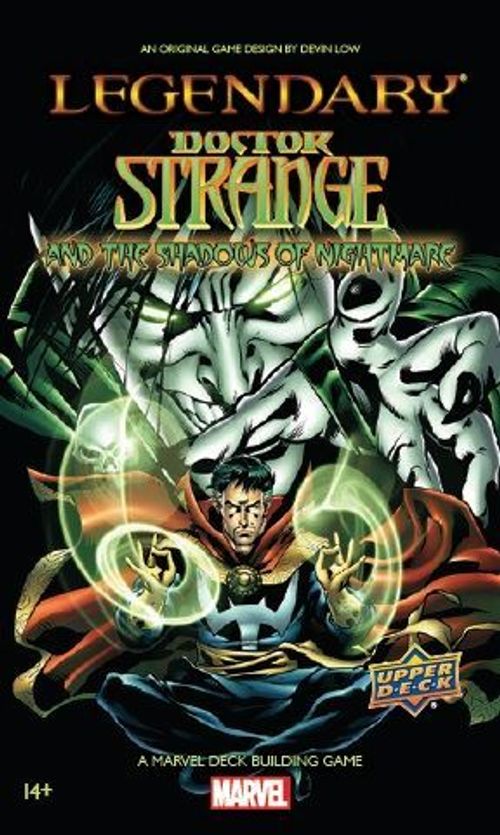
Legendary: A Marvel Deck Building Game – Doctor Strange and the Shadows of Nightmare
Legendary: A Marvel Deck Building Game – Doctor Strange and the Shadows of Nightmare Rulebook
Table of Contents
Table of Contents
Demonic Bargain
Demons offer gifts of power with a dark price, hoping to corrupt the souls of mortals. These deals with the devil are especially corrupting to the powerful and arrogant. The humble are more likely to escape with their souls intact. This is represented with the new Demonic Bargain keyword.
- Some Villains like Satana Hellstrom say things like "Fight: Choose a player to make a Demonic Bargain with Satana Hellstrom to rescue three Bystanders."
- That player discards the top card of their deck to see if they are corrupted by power. If that discarded card costs 1 or more, that player is too powerful and arrogant to resist temptation and gains a Wound, to the demon's delight.
- If that discarded card costs 0, then that player has been humble enough to resist corruption.
- Whether that player gained a Wound or not, they then gain the Demonic Bargain's listed benefit.
- Some cards have you choose which player must make a Bargain for a benefit. Think carefully about how many cards in your deck cost 0. If most of your deck is still 0-cost cards, it may be worthwhile to seize the power of the Demonic Bargain for yourself. But if your deck has lots of high-cost cards, then it may be wiser to choose another player to make the Demonic Bargain instead. Just beware: mortals who think they can outwit and outbargain a Demon are often left regretting their hubris.
- When you choose a player to make a Demonic Bargain, that player cannot decline.
- Dormammu can force players to make cruel, all-downside Demonic Bargains, with the chance of a Wound plus an additional negative effect.
- If you use card abilities to look at or manipulate the top card of your deck, you may gain valuable insight as to whether a Demonic Bargain will punish you.
Astral Plane
The Fear Lords are cruel demons that move themselves and others beyond the physical world to a realm of pure psychic energy. There they prey on the human psyche, evoking nightmare and terror. This is represented with new "Astral Plane" abilities.
- Some Villains say things like "Fight: If this Villain was in the city, it enters the Astral Plane."
- The Astral Plane is a single, unique space that only exists in games with cards that use the Astral Plane. It sits immediately to the right of the Villain Deck.
- While a Villain is in the Astral Plane, it has no physical form: It can only be fought with Recruit, not Attack. To fight a 5 Attack Villain you must spend 5 Recruit. When you fight a Villain in the Astral Plane, put it in your Victory Pile and do its Fight effect as normal.
- When a Villain enters the Astral Plane, any Villain already there escapes. This causes all the same effects as if that Villain had escaped the city (including KO'ing from the HQ, discarding from captured Bystanders, and Escape abilities).
- Villains still get -Attack and +Attack bonuses while in the Astral Plane. You just use Recruit to fight the total Attack.
- The Mastermind "Nightmare" can also enter the Astral Plane. While there, he can only be fought with Recruit, not Attack. If he escapes the Astral Plane, do all the normal effects for a Villain escaping the city. Then do the Escape ability written on Nightmare, which moves him to the Mastermind space.
- The Astral Plane is not a city space. It's not "adjacent" to any city spaces. Card effects can't move or swap Villains to or from the Astral Plane unless they explicitly mention the Astral Plane.
- Villains do Ambush effects when they enter the city. The Astral Plane is not part of the city, so Villains that enter the Astral Plane don't do their Ambush effects at that time.
- For keywords from other sets: To fight a "Chivalrous Duel" enemy in the Astral Plane, you must spend Recruit from a single Hero name. You must spend Recruit to use Excessive Violence or Human Shields from the Astral Plane. You can't use "Piercing Energy" on enemies in the Astral Plane. "Bribe" and other cards that say "You can spend any combination of Recruit and Attack to fight that Villain this turn." do not work against enemies in the Astral Plane.
Artifacts
Through epic quests, Doctor Strange and his mystic colleagues have uncovered arcane objects of staggering power. These are represented by powerful "Artifact" cards that persist from turn to turn. Artifacts have previously appeared in Legendary: Guardians of the Galaxy, Fear Itself, and Heroes of Asgard.
Some Hero cards in this set are also Artifacts. (They still count as Hero cards too.) When you gain a Hero Artifact, put it in your discard pile like any other Hero card. When you draw that Artifact later in the game, you may play it in front of you and use its effects. This means you "control" that Artifact. At the end of your turn, when you discard all the cards you played that turn, the Artifacts you control stay in front of you.
- You can use Artifacts on the first turn you play them.
- You can control multiple Artifacts with the same card name and use each of them.
- You can only use Artifacts during your turn unless otherwise specified.
- If a card effect during any player's turn asks you to "Reveal a Hero," you may reveal a Hero Artifact you control. Card effects that say "your Heroes" or "Heroes you have" include Hero Artifacts you control as well.
- However, you only "played" an Artifact on the turn you put it out, so it only activates Superpower Abilities (like "Strength: You get +1 Attack.") on the turn you play the Artifact, not every turn of the game. Likewise, card effects that count "each Hero you played this turn" only count an Artifact if you played it this turn.
Ritual Artifacts
Marvel's sorcerers invoke Rituals of awesome power, anchored by mystic talismans. This is represented with a special type of Artifact appearing for the first time in this set: Ritual Artifacts. These use the Artifact rules above, with some new twists.
- They say things like "Ritual Artifact — If you drew a card, you may discard this Artifact to get +3 Attack."
- If you have fulfilled the listed Ritual condition this turn, you can discard the Ritual Artifact to get the listed effect.
- You don't have to use the Ritual Artifact even if you fulfill the Ritual condition. You might want to save it for a future turn instead of discarding it.
- You can use as many Ritual Artifacts as you wish in a turn, including using multiple Ritual Artifacts with the same name. If you draw one card, that's enough to use the Rituals of multiple Artifacts that each have the condition "Draw a card."
- If you use a "draw a card" ability, and it draws you a Ritual Artifact with the condition "draw a card," then you can play that Artifact and use it right away. It's ok that the Artifact wasn't in play when you fulfilled the Ritual condition earlier in the turn.
- If a card lets you "copy" a Ritual Artifact card or "play a copy of it," then you can use its Ritual effect (or "Thrown Artifact" or "Once per turn" Artifact ability) once, and you don't need to fulfill the ritual condition. You don't need to immediately discard the copy card to use the Ritual. The copy doesn't stay in play as an Artifact.
Game Contents
Rules insert and 100 cards:
- 5 New Heroes of 14 cards each (Each Hero has 1 rare, 3 uncommons, 5 of one common, and 5 of another common)
- 2 New Villain Groups of 8 cards each
- 2 New Double-Sided Epic Masterminds (Each has 1 Mastermind card and 4 Mastermind Tactic cards)
- 4 New Schemes