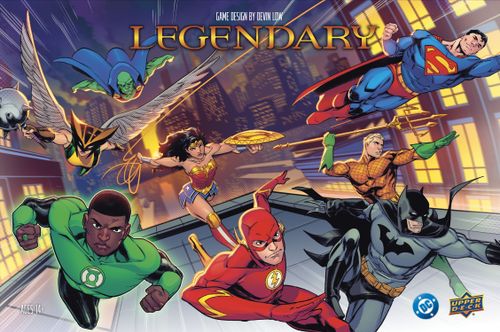
Legendary: A DC Deck Building Game
Legendary®: A DC Deck-Building Game Rulebook
Table of Contents
Table of Contents
- How to Win
- How the Evil Mastermind Wins
- Your First Game
- Game Setup
- How to Play
- Step 1) Play the Top Card of the Villain Deck
- If the Card from the Villain Deck Is a Villain:
- The Villain Enters the City
- Push Other Villains Forward if Necessary
- A Villain Might Escape
- The New Villain Might Ambush
- If the Villain Deck Card is a Bystander:
- If the Villain Deck Card Is a Master Strike:
- If the Villain Deck Card is a Scheme Twist:
- "Gaining" Wounds & Other Cards
- Step 2) Play Cards from Your Hand, Using Them to Fight and Recruit
- Step 3) Discard Your Hand and Draw 6 New Cards
- Masterminds
- End of the Game
- Transforming Heroes
- Hope and Fear
- STOP – End of the Core Rules
- Specific Card Types
- Checkmate Cards, Supports, and Sidekicks Are Heroes
- Support
- Sidekicks
- Special Sidekicks, Special Supports & Special Wounds
- Bystanders
- Wounds
- Healing Wounds
- Running out of Support, Sidekicks, Bystanders, or Wounds
- Special Abilities on Cards
- Revealing a Card
- "Reveal the Top Card of Your Deck"
- "Each Hero You Played This Turn"
- "Your Heroes" & "Heroes You Have"
- "Choose One"
- Advanced Card Interactions
- "Copy a Hero" Effects
- Taking Extra Turns
- Henchman are Villains
- Masterminds are Not Villains
- "Defeat a Villain"
- Villains Capturing Heroes
- Schemes that Count "Escaped Villains"
- Card Effects Causing Villains to Enter the City Can Cause Ambushes
- Scheme Setup Details
- Cards That Don't Have a Number
- Hero Name
- Reduce Fear or Reduce Hope
- Alternate Game Modes
- Hero Classes / Colors
- Hero Teams
- Game Contents
How to Win
Players must work together to fight the evil Mastermind four times. Each fight takes one of the Mastermind's four face down "Tactic" cards. When the Mastermind has no more Tactics, the players win the game! Fighting Villains and rescuing Bystanders along the way earns each player additional Victory Points. If the Mastermind is defeated, then all players win a group victory, and the player with the most Victory Points is the most Legendary Hero of all!
How the Evil Mastermind Wins
The Mastermind, like Lex Luthor or The Joker, isn't played by a player. Instead, the game itself plays that role.
The Mastermind works to accomplish an evil Scheme throughout the game. Every Scheme card has a part that says "Evil Wins," which tells you how the Mastermind completes their Scheme. If the Scheme is completed, then the Mastermind wins the game for evil, and all the players lose! If this happens, then the Victory Points don't matter and no player wins.
Your First Game
For your first game, follow the setup rules on the following page, using the specific card stacks listed there instead of choosing card stacks at random.
After your first game, every session of Legendary® uses different Heroes, Villains, Mastermind, and Scheme, so there are always new challenges to confront and new combinations to explore.
Your First Game - Cards to Use
Mastermind: Captain Cold Scheme: Weaponize Chemo Against the City Heroes:
- 1 player: Superman™, Batman™, Wonder Woman™
- 2-4 players: Also add The Flash™, Cyborg™
- 5 players: Also add Starfire™
Villain Groups for the Villain Deck:
- 1 player: Rogues, Devoted Goons Henchmen (2 Devoted Goons in Villain deck, and 2 start in the city)
- 2 players: Also add Titans for Hire (now with all 10 Devoted Goons in Villain Deck, and none in the city)
- 3 players: Also add Fearsome Five™
- 4 players: Also add Gotham City™ Underworld and Bestiamorph™ Henchmen (all 10 cards)
- 5 players: Also add Villainy Inc.
Game Setup
(Once you're used to the setup, the Quick Reference Guide on the back of this rulebook summarizes the setup steps.)
Player Decks
Give each player their own personal 12-card deck, made of these cards:
- 8 Checkmate Pawns
- 4 Checkmate Knights
Always Available Decks
Put each of these decks on their spaces on the playmat. Use all the cards you own of each type:
- Support
- Sidekicks
- Bystanders
- Wounds
Special Bystanders, such as Lois Lane and Steve Trevor, are shuffled in with the other Bystanders. Decks of all identical cards can stay face up. Decks containing different cards should be shuffled face down.
Mastermind and Scheme
- Pick 1 Mastermind at random. Put it on the Mastermind space on the playmat. Tuck its 4 matching Mastermind Tactic cards underneath it, face down in random order.
- All the Masterminds in this set are double-sided, with a normal side and a harder "Epic" side. For most games, you'll want to use the normal (non-Epic) side.
- Pick 1 Scheme card at random. Put it face up on the Scheme space. Each Scheme card has a "Setup" that specifies how many "Twists" to use. Add that many "Scheme Twist" cards to the Villain Deck. Some Schemes also change the number of Heroes or Villain Groups or specify other special rules.
A Scheme card shows: Name (top), Card Type (SCHEME), Setup (how many Twists), a numbered list of Twist effects, and a final Evil Wins condition (its Special Abilities).
Villain Deck
- Add all 5 Master Strike cards to the Villain Deck.
- Add Villain Groups and Henchman Groups to the Villain Deck. A "Villain Group" is a set of eight Villain cards that work together, like "Rogues" or "Legion of Doom". Each Villain card lists its Villain Group under its card name.
To Add Bystanders:
- Check the game setup table below to see how many cards from the Bystander Deck to add to the Villain Deck. (By random chance, some of the cards might be Special Bystanders.)
To Add Villain Groups:
The more players you have in the game, the more Villain Groups you use, as shown in this game setup table:
| Players | Villain Groups | Henchman Groups | Bystanders | Heroes |
|---|---|---|---|---|
| 1 | 1 | 1* (2 cards in deck, 2 cards in city) | 1 | 3 |
| 2 | 2 | 1 | 2 | 5 |
| 3 | 3 | 1 | 8 | 5 |
| 4 | 4 | 2 | 8 | 5 |
| 5 | 5 | 2 | 16 | 6 |
- Each Mastermind card says that the Mastermind "Always Leads" a particular Villain Group or Henchman Group. Include it as one of the groups you add to the Villain Deck. Pick the remaining Villain and Henchman Groups at random.
- For each Villain Group you pick, add those 8 Villain cards to the Villain Deck.
- For each Henchman Group you pick, add those 10 identical Henchman cards to the Villain Deck.
- In 1-player games only: Add only two cards from the chosen Henchman Group to the Villain Deck. Two more cards from that same Henchman Group enter the city at the start of your first turn. Do not use the remaining 6 cards.
Hero Deck
There are fourteen different Heroes in the Legendary®: A DC Deckbuilding Game Core Set. There are fourteen cards for each of these Heroes. Make the Hero Deck this way:
- Check the game setup table (on the previous page) to see how many Heroes you should add. Pick that number of Heroes at random. For each of them, add all 14 cards for that Hero to the Hero Deck.
Completing Setup
- Shuffle the Hero Deck. Put it face down on the Hero Deck space. Put 5 cards from the Hero Deck face up into the 5 HQ spaces (Headquarters).
- Shuffle the Villain Deck. Put it face down on the Villain Deck space.
- Each player shuffles their own personal deck and draws a hand of 6 cards from it.
Starting HQ Mulligan
If there are at least two cards in the starting HQ that cost 7 or more, then all players can agree to "mulligan" those HQ spaces like this: Set aside all cards that cost 7 or more from the HQ. Refill those HQ spaces, also setting aside any other Heroes that cost 7 or more that appear during any of these refills. Once the HQ is full, shuffle the set-aside Heroes back into the Hero Deck. Do this only during game setup – you can't mulligan once the game has already started. This helps avoid overly expensive starting HQs.
How to Play
Choose a random player to go first. Players take turns in clockwise order. On your turn, do 3 things:
- Play the top card of the Villain Deck.
- Play cards from your hand, using them to fight and recruit.
- Discard your hand and draw 6 new cards.
4-5 Players: Warmup Rounds
Note: In 4 and 5 player games only, there is a "Warmup Round" where on each player's very first turn, they do not play a card from the Villain Deck. On every turn after that, play the top card of the Villain Deck as normal. These extra turns give a little more time for large player groups to get their decks going before the Villains start invading.
Step 1) Play the Top Card of the Villain Deck
Play the top card of the Villain Deck face up. What you do with that card depends on what kind of card it is. There are four kinds of cards in the Villain Deck: Villains, Bystanders, Master Strikes, and Scheme Twists.
If the Card from the Villain Deck Is a Villain:
That Villain invades the city! Here are the different parts of a Villain card. (Note: "Henchman Villains" are Villains too.)
A Villain card shows: Card Type (VILLAIN), Card Name, Villain Group, Special Ability, Victory Points, and Attack (you must use this many Attack Points to Fight this Villain).
The Villain Enters the City
Move the new Villain into the city space closest to the Villain Deck. That city space is labeled "Sewers". Villains in the city are always face up.
Push Other Villains Forward if Necessary
Each of the 5 city spaces can only hold one Villain. Whenever a Villain enters a city space, if there's already another Villain there, that existing Villain gets pushed forward one space to make room. A single Villain entering the city sometimes causes a chain reaction of several Villains getting pushed forward.
- Remember: Only push a Villain forward if it needs to move to make room for another Villain entering that space.
A Villain Might Escape
If a Villain gets pushed off the final, fifth city space, then that Villain "escapes" the city and goes into the Escape Pile space, face up. Here's what happens when a Villain escapes:
- The escaping Villain KOs a Hero that costs 6 or less from the HQ. The player whose turn it is chooses which of those Heroes gets KO'd. Put that Hero in a shared, face up "KO pile" off to the side of the playmat, knocking that Hero out of the game.
- Immediately flip a new Hero from the Hero Deck, face up, to fill the empty space in the HQ. (Whenever any of the 5 HQ spaces is empty, immediately refill it this way.)
- If the escaping Villain had any captured Bystanders, then each player must discard a card from their hand as a penalty for failing to rescue the Bystanders. After all, what kind of Super Heroes let innocent Bystanders get carried away by Villains? Those Bystanders stay in the Escape Pile.
- Note: Each player only discards one card when a Villain carries away Bystanders, no matter how many Bystanders it carried away.
- If the escaping Villain has an "Escape" effect on its card, do what it says.
The New Villain Might Ambush
If the new Villain has an "Ambush" effect on its card, do what it says now. Remember:
- Make sure that the newly entering Villain has fully moved into the Sewers (pushing any other Villains as necessary) before doing its Ambush ability.
- If another Villain was pushed out of the city and escaped when this new Villain entered the city, handle all the Escape effects for the escaping Villain before handling any Ambush effect for the new Villain.
If the Villain Deck Card is a Bystander:
The innocent Bystander is captured by a Villain! Tuck the Bystander (face up) under the Villain that's closest to the Villain Deck. If there are no Villains in the city, then the Bystander is captured by the Mastermind. Make sure the Bystander pokes out a bit so players can see it.
- Whenever a Villain with any Bystanders moves to a new city space, it carries all those Bystanders along with it to the new space.
- It's up to the players to rescue that Bystander! When a player fights a Villain or Mastermind with Bystanders, that player rescues those Bystanders and puts them into their personal Victory Pile.
- Each Bystander is worth 1 Victory Point. Some "Special Bystanders" give you extra rewards when you rescue them, listed after the word "Rescue".
If the Villain Deck Card Is a Master Strike:
A Master Strike represents the evil Mastermind emerging from their lair to get their hands dirty and smash the Heroes themselves. Each Mastermind has their own specific Master Strike. When a Master Strike is played from the Villain Deck, put that card in the KO pile, then look at the "Master Strike" effect on the Mastermind card and do what it says.
If the Villain Deck Card is a Scheme Twist:
A Scheme Twist represents the evil Scheme moving forward towards victory for the Mastermind. Every Scheme provides a unique challenge that intensifies when a Scheme Twist enters play. When a Scheme Twist card is played, put it in the KO pile, then look at the "Twist" effect on the main Scheme card and do what it says. Some Schemes say they do something special when "Twist 1" or "Twists 4-6" come up.
Note: Villains in the city don't get pushed forward when the card played from the Villain Deck is a Bystander, Master Strike, or Scheme Twist. Resist any temptation to push Villains forward before revealing the card from the Villain Deck!
"Gaining" Wounds & Other Cards
Some card effects say that a player "gains" a particular card. That means put that card into that player's discard pile. For example, "Gain a Wound" means put a card from the Wound Deck into your discard pile. (See page 16 for more details on Wounds.)
Step 2) Play Cards from Your Hand, Using Them to Fight and Recruit
The only types of cards that can typically be in your hand are Heroes and Wounds. Here are the different parts of a Hero card: Team Icon, Class Icon & Card Color, Card Name, Hero Name, Recruit Points (use these to Recruit more Heroes), Attack Points (use these to Fight Villains), Special Abilities, and Cost (how many Recruit Points it costs to add this Hero to your deck).
After you play the top card of the Villain Deck, it's time to play the cards from your hand. Some of your cards produce Attack Points, represented as an attack icon, that let you fight Villains and Masterminds. Other cards produce Recruit Points, represented as a star, that let you gain more Heroes. Many cards also give you special abilities, which are listed in the card text.
- Play each card in your hand in any order, one at a time.
- Each time you play a card, do what that card says.
- You get any Attack Points listed in its Attack icon.
- You also get any Recruit Points listed in its Recruit icon.
- Keep the cards you play in front of you until the end of your turn.
- To make it easier to count up your Attack Points and Recruit Points, you can line up all the Attack icons as you go, so that you can read all the Attack Points in a row. You can do the same with lining up your Recruit icons.
- You can play all your cards, building up a pool of Attack Points and Recruit Points, before deciding which Enemies to fight and which Heroes to recruit.
Numbers Like 2+ or 2 (with a symbol):
Some cards have numbers like "2+" inside their Recruit icon. The "2" means that you always get at least 2 Recruit from that card. The "+" symbol means that you might get even more Recruit based on what the card says in its special ability. Heroes' Attack icons and Enemies' Attack icons can have numbers like "2+" too, working the same way.
Likewise, some Hero and Enemy cards in other sets have a number with an asterisk-like symbol inside one of their icons. This means the card's special abilities tell you something especially important about how to use that card's Attack, Recruit, or Cost. (It doesn't mean multiplication or a variable.) (For effects that count different costs, a symbol-4 and plain 4 are the same cost.)
Superpower Abilities
Some cards have a Superpower ability with a Hero Class (color) icon and a colon, like: "[Green icon]: You get +2 [Recruit]."
You can use that special Superpower ability only if you have already played another card of that color earlier in your turn.
- A card's color is shown in the Hero Class icon in the card's upper left, and also in the color of the card's border. (Each Hero has a "Rare" card with no border. You can see a rare card's color by checking the Hero Class icon.)
- Some Superpowers use a team icon like The Justice League or Titans instead of a Hero Class icon. These work the same way as Superpowers that use color icons. A card's team icon is in the card's upper-left corner.
- Important: You can only use a card's Superpower ability once, even if you played multiple cards of that color that turn.
- However, a few Superpower abilities will explicitly tell you to count a number of cards you've played, like "For each Cyborg-class Hero: You get +1 Attack for each other Cyborg-class Hero you played this turn."
- You don't have to use a Superpower ability if you don't want to.
- Some Superpower Abilities require things like "two Green Arrow icons:" or "Batman icon plus Support icon:" To use these, you must have played two Green cards earlier in the turn or played a Batman-class card and played a Support card earlier in the turn.
Example of Superpower Abilities:
Cyborg's "Technokinesis" card gives you 2 Attack when you play it, even if you didn't play any other black ("Tech Hero") cards.
- But if you have already played another black card earlier in the turn, then you may use Technokinesis' Superpower ability to get an additional +1 Attack, so that Technokinesis gives you 3 Attack in total.
- The black card you played earlier in the turn could be a black Batman card, another black Cyborg card, or even another copy of Technokinesis.
- If you play two Technokinesis cards as your first two cards of the turn, you won't get to use the Superpower ability for the first Technokinesis card you play this turn, but you will get to use the Superpower for the second Technokinesis card you play this turn. So you would get 5 Attack total.
KO
Many card effects tell you to "KO" a card, meaning "knock out." Put that card in the shared, face up "KO pile" off to the side of the playmat, permanently knocked out of the game.
- Getting your starting Checkmate Heroes KO'd is actually very good for you, since it means you will draw your more powerful Heroes more often, instead of drawing as many of the weaker Checkmate Heroes.
- Note: If a card says to KO "one of your Heroes," that can be a Hero you've already played this turn or a Hero still in your hand. If you KO a Hero you already played this turn, you still get to use the Recruit, Attack, and special abilities that Hero produced.
Fighting Villains and Recruiting Heroes
In between playing cards from your hand, and/or after you've played all your cards, you can fight any number of Villains and recruit any number of Heroes. You can play cards, fight, and recruit any number of times in any order in the same turn.
How to Fight a Villain
As you play Heroes from your hand, you generate a pool of Attack Points. You can spend these to fight Villains in the city, one at a time. You can only fight a Villain if you have at least as many Attack Points remaining as that Villain's Attack number. You don't have to match up specific Heroes you play against specific Villains. It doesn't matter which city space holds the Villain.
To fight a Villain:
- Spend Attack Points equal to that Villain's Attack to put that Villain into your personal Victory Pile, faceup. (Also rescue any Bystanders it was holding, putting them all into your Victory Pile.)
- If the Villain card has a "Fight" effect on it, do what it says. Also do any "Rescue" effects on any Bystanders you rescued this way. (Do these Fight and Rescue effects in any order.)
You can also fight the Mastermind (See below).
Victory Piles
- Each player has their own personal Victory Pile. It holds all the Villains they have fought and all the Bystanders they have rescued. It's face up. Players can look through face up Victory Piles (and discard piles) if they wish.
- Villains and Bystanders are not shuffled into your deck.
- Keep your Victory Pile horizontal so you don't accidentally mix it up with your discard pile.
- At the end of the game, Villains and Bystanders in your Victory Pile are worth the Victory Points shown on their cards.
How to Recruit a Hero
As you play Heroes from your hand, you generate a pool of Recruit Points. You can spend these to recruit Heroes from the HQ, one at a time. You can only recruit a Hero if you have at least as many Recruit Points remaining as that Hero's cost. The "HQ" area of the playmat has five spaces, which always contain exactly five Heroes, all face up.
To recruit a Hero:
- Spend Recruit equal to that Hero's cost to "gain" that Hero and put it into your discard pile. A Hero's cost is in its lower-right corner. When your deck runs out and you shuffle your discard pile to make a new deck, you will soon draw that new Hero and be able to use their abilities.
- Then refill the empty space in the HQ with a new card from the Hero Deck, face up. Whenever there is an empty space in the HQ for any reason, refill that space immediately this way. You can even recruit a Hero, see what new Hero appears in its place from the Hero Deck, and then potentially recruit that new Hero too, if you have enough Recruit Points.
- You can also spend 3 Recruit Points to recruit a Support from the Support Deck (even multiple times).
- Up to once per turn, you can also spend 2 Recruit Points to recruit a card from the playmat's Sidekick Deck. (See below for more details on Supports and Sidekicks.)
Step 3) Discard Your Hand and Draw 6 New Cards
- At the end of your turn, put all the cards you played this turn into your discard pile, face up. Any unspent Attack and Recruit Points are lost.
- Also discard any cards in your hand that you didn't play this turn.
- Then draw 6 new cards from your deck. If your deck runs out and you still have to draw more cards, shuffle your discard pile into a new face down deck, then draw the rest of the cards you need.
- (Don't shuffle your discard pile into a new deck until your deck has completely run out and you still need to draw or more cards.)
Masterminds
A Mastermind is a diabolical Supervillain that pursues an evil Scheme and leads the other Villains. You can fight the Mastermind just like you fight a Villain, by spending Attack Points equal to the Mastermind's Attack.
A Mastermind card shows: Card Name, Card Type, Special Abilities, Always Leads (which Villain Group or Henchman Group it leads), Master Strike (its specific Master Strike effect), Victory Points, and Attack.
Mastermind Tactics
Masterminds are so powerful that they don't count as mere Villains. Instead, Masterminds use different abilities during each fight, represented by "Mastermind Tactic" cards. All four of a Mastermind's Tactics have the same Attack number, but they each have different "Fight" effects.
To fight a Mastermind:
- Spend Attack Points equal to the Mastermind's Attack. Take a random card from the face down Tactics underneath the Mastermind and put that Tactic into your Victory Pile, face up. It's worth several Victory Points. (Also rescue any Bystanders the Mastermind was holding, putting them all into your Victory Pile.)
- Do what the "Fight" effect on the Tactic card says. Also do any "Rescue" effects on any Bystanders you rescued this way. (Do these Fight and Rescue effects in any order.)
- These effects usually either give you a reward, or cause the Mastermind to hit each other player with some cruel effect, or power up the Mastermind for the future.
- If a Tactic's Fight effect somehow increases the Mastermind's Attack number, that will only apply for future fights.
A Mastermind Tactic card shows: Card Name, Card Type, Mastermind Name, Fight Ability, Flavor Text, Victory Points, and Attack.
A Mastermind is not truly beaten until all of their Mastermind Tactic cards have been fought by the players. If you create an amazing combo that gives you tons of Attack Points, you can even fight the Mastermind multiple times in one turn.
End of the Game
Players Win
When the Mastermind has no more Tactic cards under them, the players win the game!
- When fighting the final Mastermind Tactic, the current player still does that Tactic's "Fight" ability. That player can still finish the rest of their turn in case they want to grab a few more Victory Points.
- As soon as the Mastermind has no more Tactics, victory is assured, and players will win the game even if the final Tactic's "Fight" ability would achieve the Scheme's "Evil Wins" condition or cause the Hero Deck or Villain Deck to run out.
Evil Wins
Every Scheme card has a part that says "Evil Wins," which tells you how the Mastermind completes their Scheme. If the evil Scheme is completed, then the Mastermind immediately wins the game for evil, and all the players lose. Don't finish the turn.
Tied Game
If either the Hero Deck or the Villain Deck ever reaches zero cards, you can finish the current turn as your final chance to win. If you have not won or lost by the end of this turn, then the game ends in a tie between good and evil. The players have successfully survived the Scheme, but they didn't defeat the Mastermind. The player with the most Victory Points wins an individual victory. Be sure to get the Mastermind next time!
- If a card effect reveals or plays cards from the Hero Deck or Villain Deck then immediately puts them back in that deck, that's not enough to trigger a tie.
- Once the Hero Deck or Villain Deck has reached zero cards (not in the middle of an effect), then the game will end at the end of this turn, even if another effect later in the turn somehow puts cards back in the Hero Deck or Villain Deck that was empty.
- Note: If the Scheme says that evil wins "when the Hero Deck runs out" (or Villain Deck), then the game is over as soon as that deck reaches zero cards (not in the middle of an effect). You do not finish the turn in that case – evil has already won.
Transforming Heroes
A key part of many DC stories is the duality between a Hero and their secret identity. How does the mask of "Bruce Wayne" help Batman achieve his mission? How does Clark Kent help Superman stay connected to normal people? How can Barry Allen keep his loved ones safe from the Flash's many enemies? DC Legendary® explores this theme of duality and secret identity through "Transforming Heroes."
- Several Heroes in this set have special "Transformed" cards that go along with them. They say the word "Transformed" right next to their Hero Name, like "Martian Manhunter, Transformed." When you use these Heroes, don't shuffle their "Transformed" cards into the Hero Deck.
Instead, set the Transformed cards aside in a special "Transformation Pile." You can't recruit cards from this pile. Instead, you transform other cards into them.
- When you play a Hero card that says it transforms into another card, you complete all effects on the card you played and get its normal Recruit and Attack.
- Then remove the transforming card from the game (putting it in the Transformation Pile) and put the newly transformed card into your hand instead (from the Transformation Pile). You can play the new Transformed card immediately on that same turn.
- You still count as having played the transforming card that you played and removed from the game, including counting for effects like "You get +1 Attack for each [team icon] card you played this turn."
- You can look through the Transformation Pile at any time.
- When putting the game away, some players like to store a Hero's Transformed cards with the rest of that Hero's cards. Other players prefer to store all the Transformed cards together.
Hope and Fear
A crucial part of many DC stories is how DC Super Heroes like Superman aren't just strong – they are icons that bring out the optimism in everyone around them. Superman famously inspires Hope in Metropolis and throughout the world. He lifts people up through his compassion, self-sacrifice, and faith in humanity. Likewise, Green Lantern's ring is powered by sheer willpower.
Meanwhile, Masterminds like The Joker and Lex Luthor delight in spreading Fear and suppressing Hope. They grow stronger in an atmosphere of darkness and oppression. Although most Heroes try to overcome Fear, Batman is an unusual Hero who actively thrives in Fear and uses it as a weapon. Batman deliberately terrifies the cowardly and superstitious criminals of Gotham City to use Fear to his advantage. Legendary® DC explores these themes through the Hope and Fear Track.
- At the beginning of the game, put the Hope token on the "0" space of the Hope Track.
- Which side of the Hope token is face up doesn't affect gameplay.
- The top 3 spaces on the Hope Track are called 1 Hope, 2 Hope, and 3 Hope. The middle space is called 0. The bottom 3 spaces are called 1 Fear, 2 Fear, and 3 Fear.
- Some card effects will tell you to "Inspire Hope." This means:
- Move the token one space up towards Hope on the Hope Track.
- This might go from 3 Fear → 2 Fear. Or 0 → 1 Hope. Or 2 Hope → 3 Hope.
- If the Hope token is at Hope 3, and something "Inspires Hope", then the Hope Token overflows off the top of the track, causing the current player to draw a card and the token to move to 2 Hope.
- Likewise, "Inspire Fear" means:
- Move that token one space down towards Fear.
- This might go from 2 Hope → 1 Hope. Or 0 → 1 Fear. Or 2 Fear → 3 Fear.
- If the Hope token is at Fear 3, and something "Inspires Fear", then the Fear Token overflows off the bottom of the track, causing the current player to discard a card and the token to move to 2 Fear.
- Card effects on Heroes, Villains, Masterminds, and other cards sometimes say they are especially powerful "If Hope is 2 or more:" meaning that the token is at 2 Hope or 3 Hope. Likewise other effects say they are especially powerful "If Fear is 2 or more:" meaning that the token is at 2 Fear or 3 Fear.
- Some cards say they do something "If there is no Hope." This means the Hope token is not at 1 Hope, 2 Hope, or 3 Hope. That is to say, it's at 0, 1 Fear, 2 Fear, or 3 Fear.
- If a card effect says "You may Inspire Hope" then it is up to you whether to Inspire Hope or not. However, if a card effect does not say "you may" and just says "Inspire Fear", then you have to do it.
Fighting Crime: Spending 3 Attack to Inspire Hope or Fear
In addition to card effects that say they change Hope and Fear:
Once per turn, you may spend 3 Attack to "Fight Crime" and Inspire Hope or Inspire Fear.
- You can't "Fight Crime" this way more than once per turn. However, it's ok if other card effects Inspire Hope or Inspire Fear multiple times in a turn, as well as you Fighting Crime up to one time.
- As an exception, Fighting Crime cannot "overflow" the track past 3 Hope or 3 Fear (like other Inspire Hope and Fear effects can).
- Wound cards say that you can't heal Wounds if you fight anything that turn, so you can't heal Wounds if you Fight Crime that turn.
STOP – End of the Core Rules
Now you know all the rules you need to play! You can stop here and play the game. The rest of this rulebook contains additional clarifications and other game modes. You can skim through them if a question comes up or read them later for more details about the game. There is also a Quick Reference Guide on the back of this rulebook. Go challenge the Mastermind!
Specific Card Types
Checkmate Cards, Supports, and Sidekicks Are Heroes
If a card effect says to "KO one of your Heroes," you can KO one of your starting Checkmate Heroes, and that's usually a good idea. Most normal Checkmate Heroes, Supports and Sidekicks have no Hero Class and are the color grey.
Support
You can always spend 3 Recruit Points to recruit a Support. Gain the top card from the playmat's Support Deck, putting it in your discard pile. There's no limit to how many Supports you can recruit in a turn.
In the Legendary® DC: Core Set all the cards in that deck are normal grey Supports that produce 2 Recruit with no special abilities.
Sidekicks
Once per turn, you can also spend 2 Recruit Points to recruit a Sidekick. Gain the top card from the playmat's Sidekick Deck, putting it in your discard pile. Card effects that say "Gain a Sidekick" are not recruiting, so they are not affected by the "recruit up to one Sidekick per turn" rule. (The reason you can only recruit one Sidekick per turn is to prevent players in some game situations from falling into a repetitive loop where they just spend all their Recruit Points on Sidekicks, turn after turn.)
When you play a Sidekick, it says it gives a specific effect, like Daring Sidekicks giving 1 Attack and drawing a card. Then the card says "Return this Sidekick to the bottom of the Sidekick Deck." This means a Sidekick will give you a short burst of power, then go away, without permanently improving your deck. When you play a Sidekick, you still get any Attack, Recruit, and special abilities from that Sidekick, and you still "played that card this turn" for the purposes of Superpower Abilities or other effects that care which cards you played this turn.
Special Sidekicks, Special Supports & Special Wounds
In the DC Legendary® Core Set, all the Sidekick cards are identical, so you can keep that Deck face up. However, future DC Legendary® expansion sets will sometimes include new, different Sidekicks with different special abilities that get shuffled into your Sidekick Deck. If your Sidekick Deck has different kinds of Sidekicks in it: Shuffle it face down at the start of the game. Whenever you gain a new Sidekick draw it from the top. Whenever you return a used Sidekick, put it back on the bottom of the Sidekick Deck. Whenever a card goes to a deck, it turns face up or face down to match the rest of that deck.
Likewise, future DC Legendary® expansions will sometimes include different Support or Wound cards. If you have those, shuffle those decks face down and follow the same rules listed above.
Bystanders
Some card effects tell you to "rescue a Bystander." This means take the top Bystander from the Bystander Deck and put it into your Victory Pile. This represents saving Bystanders that are trapped or in danger from all the chaos and destruction. Each Bystander in your Victory Pile gives you additional Victory Points at the end of the game.
- Important: Cards that say "rescue a Bystander" can't save Bystanders captured by specific Villains in the city – you have to fight those Villains to save those Bystanders.
- Some "Special Bystanders" say you get an extra effect when you rescue this Bystander. This could happen because you fought a Villain holding that Bystander or because you rescued that Bystander from the Bystander Deck through a "Rescue a Bystander" effect.
- When an escaping Villain carries away any number of captured Bystanders, each player must discard a card as a penalty. Only one card per player needs to be discarded, no matter how many Bystanders that Villain had.
- If an effect puts a Bystander directly into the Escape Pile, without being carried there by an escaping Villain, that does not cause players to discard.
- Some Villains like Mirror Master and The Penguin give special rules to their captured Bystanders. Those cards are still also Bystanders and still use all the normal Bystander rules.
Wounds
Some card effects make you gain Wound cards, representing your team getting hurt especially badly. When a player gains a Wound, take a card from the Wound Deck and put it into that player's discard pile. You can play Wounds from your hand, but they don't typically have any Attack or Recruit, so they don't give you any benefit.
- Some card effects let you KO your Wounds. Some cards even turn Wounds to your benefit.
- Wound cards aren't Heroes. Wounds don't have a Hero Class or color, not even grey. If a card tells you to "KO one of your Heroes," you can't KO a Wound, since Wounds aren't Heroes. However, if a card says "KO one of your cards," then you can KO a Wound, since Wound cards are still cards.
- Wounds cost 0. However, you only gain Wounds when an effect tells you to. You can't intentionally gain Wounds by paying 0 Recruit Points.
Healing Wounds
If you have one or more Wounds in your hand, you can use the ability written on the Wound card: "Healing: If you don't recruit or fight anything on your turn, you may KO all the Wounds from your hand."
- If you use this Healing ability, you can't recruit or fight anything either before or after you use the Healing ability.
- You can't use this Healing ability on the same turn that you "Fight Crime" to Inspire Hope or Fear (see above), since that is a kind of fighting.
- Healing is often worthwhile if you have at least two Wounds in your hand, and/or if Wounds were weakening your hand enough that your turn wouldn't have been very good anyway.
- You use this Healing ability directly from your hand, without actually playing the Wound cards.
- When you have Wounds, it's okay to play the rest of the cards in your hand and use some abilities like "draw a card" to see how your turn develops and how many Attack and Recruit you would have. Then you can decide whether to use the "Healing" ability on the Wounds, or whether to fight and recruit.
Running out of Support, Sidekicks, Bystanders, or Wounds
If the Support, Sidekick, Bystander, or Wound Deck runs out, the game continues as normal. If a player would gain one of these cards, and there aren't any more left in the appropriate deck, then you just don't gain that card and the game continues. Don't take extra copies out of the KO pile.
- If all the cards in the Wound Deck are used up, the Heroes have taken enough punishment, and the game is probably close to complete!
Special Abilities on Cards
Special abilities can override game rules.
- Some cards tell "each player" to do something. In those cases, the player whose turn it is does it first, then go in clockwise order.
- If a card tells you to do something, and you can't do all of it, then do as much as you can. For example: if a card tells you to KO two Bystanders from your Victory Pile, and you only have one Bystander, then KO that Bystander and move on.
- If a card calls for a choice, and it's not obvious who should make the choice, then the player whose turn it is makes the choice. For example, Circe's Master Strike says "Take the leftmost Hero from the HQ and the lowest-cost-non-grey Hero from each player's discard pile. Stack them next to Circe as 'Devolved Pig' Villains." If there are three lowest-cost-non-grey-Heroes in a player's discard pile, then the current player chooses which of those cards is captured.
- If a card asks you to "KO one of your Green Arrow-class Heroes" or otherwise choose, discard, or KO a certain kind of card from "your Heroes" or your hand, and you don't have any cards of that kind, reveal your hand to show you don't have any.
Revealing a Card
"Reveal a card" just means show the other players that you have it. You can reveal a card from your hand or you can reveal a card in front of you that you have already played this turn. "Revealing" a card doesn't automatically play or discard that card. You can reveal the same card multiple times in a turn if necessary.
- Say a card effect tells you to "Reveal a Green Arrow-class card or gain a Wound." If you have a Green Arrow-class card in your hand or that you've played this turn, you could reveal it to stop the Wound, or you could choose not to reveal it and just gain the Wound instead. In rare cases where you have lots of cards that benefit from gaining Wounds, you might prefer to just gain the Wound.
- Essentially, if a card says "do A or do B," you can choose either option that you can actually do. You can't choose an option that you can't do.
- If a card effect tells you to do something like "Ambush: Each player that has a Titans and/or Cyborg-class Hero gains a Wound." and you don't have any of that kind of card, reveal your hand to show you don't have any.
"Reveal the Top Card of Your Deck"
If a card effect says to reveal the top card of your deck, and it doesn't say where to put that card afterwards, then that card stays where it was, face down on top of your deck.
"Each Hero You Played This Turn"
This phrase only counts cards you have already played this turn, not other cards still in your hand. Say you play two of the same Titans Hero card. Then you play a different Titans Hero card. Then you play "Starfire – Starbolts" which says "Titans: You get +1 Attack for each other Titans Hero you played this turn." That ability would give you +3 Attack, because you played three other Titans Heroes this turn.
"Your Heroes" & "Heroes You Have"
These phrases include both the cards you have played this turn and the cards in your hand. The Heroes in your deck and discard pile don't count.
"Choose One"
Representing a crucial decision point, some Hero cards say "Choose one:" then list two or more options as bullet points. Choose one of the bullet points, then do what is says. Ignore the unchosen bullet points. Occasionally the end of one of these cards says something like "Green Arrow + Batman: Do both". If you are able to use that Superpower Ability, do both bullet points in the listed order.
Advanced Card Interactions
This section covers some unusual card interactions. There's no need to read this section unless you have a particular rules question that you need help figuring out.
"Copy a Hero" Effects
There are two kinds of Copy effects in the game. The first kind, "Martian Manhunter: Shapeshift," says "Play this card as a copy of one of your Heroes that you played this turn." As you play it, Shapeshift becomes exactly like the card you're copying. It loses its Justice League team icon, loses its Martian Manhunter Hero Class/color, loses its 5 cost, loses its Hero Name, etc. and instead takes on the team, Hero Class, cost, Hero Name, etc. of whatever it's copying. It gives the Recruit, Attack, and special abilities of the copied card, as if you had played another copy of that card from your hand.
- If you copied an effect like "Batman: You get +1 Attack for each other Batman Hero you played this turn," you would check the Attack bonus at the moment you played the Shapeshift.
- To play Shapeshift as a copy of Zatanna's "Eldritch Blast" that says "To play this, you must put another card from your hand on top of your deck," you must put another card from your hand on top of your deck for the Shapeshift.
- If you play Shapeshift as a copy of a card that can "Transform," the Shapeshift can Transform as normal and will stay Transformed.
The second kind of Copy effect is shown by Circe's Mastermind Tactic, "The Mirror of Circe". It says "Fight: Play a copy of one of your Heroes that has a Recruit icon." In this case, you are instead playing an "invisible copy" of the copied card that grants all the same Recruit, Attack, and special abilities of the copied card. If you play an "invisible copy" of a Batman card this way, you still "played a Batman card this turn" for the purposes of triggering "Batman:" Superpower abilities. However, "your Heroes" and "Heroes you have" don't include the card, since it's not actually in front of you.
- If The Mirror of Circe plays an "invisible copy" of a card that can "Transform" like Clark Kent, the "invisible copy" can Transform and will give you the Beacon of Hope into which Clark Kent transforms.
Taking Extra Turns
Occasionally a card effect will let you "take another turn." You still play a card from the Villain Deck during your extra turn unless the effect tells you not to do so. If the players win, if evil wins, or if the game ends in a tie this turn, don't take any extra turns after that.
Henchman are Villains
Henchman Villains are a kind of Villain. Henchman Groups are likewise a kind of Villain Group. When a Scheme says "add an extra Villain Group," it means a standard 8-card Villain Group (not a Henchman Group), unless it specifically says to add Henchmen. If a Mastermind always leads "any 'Arkham Asylum' Villain Group," that does not include 'Arkham Asylum' Henchman Groups.
Masterminds are Not Villains
Masterminds are so powerful that they don't count as mere Villains. Abilities that affect Villains don't affect Masterminds unless they explicitly say they do.
"Defeat a Villain"
When a card effect tells you to "Defeat a Villain" outright, you don't need to spend any Attack and you can ignore any fighting restrictions written on that Villain like "You can't fight Mirror Master while he has any Bystanders." You still do the defeated Villain's Fight effect. If a card effect lets you "Defeat a Mastermind," that means defeating one Tactic for free.
Villains Capturing Heroes
Some Villains like Doctor Psycho can capture Heroes. If a Villain escapes with captured Heroes, that doesn't cause any discarding. The captured Heroes just stay in the Escape Pile.
Schemes that Count "Escaped Villains"
Some Schemes say things like "Evil Wins: When 3 Villains per player have escaped." These count only the Villain cards currently in the Escape Pile.
- This doesn't count Villains that escape the city and are immediately put somewhere besides the Escape Pile. For example, Cheshire says "Escape: Cheshire becomes a Master Strike that takes effect immediately." Since a Master Strike typically goes to the KO pile when it takes effect, Cheshire would not be in the Escape Pile and would not count towards "the number of Villains in the Escape Pile" – not even for a moment.
- Some Schemes turn Bystanders or other card types into Villains that can enter and escape the city. Such cards escaping the city count as Villains as well as their normal card type while in the Escape Pile.
- Captured Heroes and Bystanders can also be carried into the Escape Pile by Villains. If the Escape Pile contains both Heroes/Bystanders that turned into Villains and Heroes/Bystanders that didn't, keep the ones that aren't Villains off to the side, so you can remember which is which.
- If Hero cards enter the city as Villains, ignore their Hero abilities.
Card Effects Causing Villains to Enter the City Can Cause Ambushes
The Scheme "Merge Earth with Bizarro World" can cause Bizarro to enter the city without being drawn from the Villains Deck. When a Villain enters the city with an effect like this, their Ambush effect still triggers.
Scheme Setup Details
If a Scheme says to "add an extra Hero," add all 14 cards for that Hero to the Hero Deck. If it says, "add an extra Villain Group," this means all 8 cards for a normal Villain Group, not a Henchman Group. If it says, "add a Henchman Group," add all 10 Henchman cards, even in solo mode.
Cards That Don't Have a Number
If a card effect needs to know a number from a card, and that card doesn't have that kind of number, use 0. For example, the "Devoted Goons" Henchmen say "Fight: Reveal the top card of your deck. If it costs 0, KO it. Otherwise, draw it." If some Scheme shuffles Scheme Twists into your deck for some reason, and you reveal one of them with that Devoted Goons ability, then you KO that Scheme Twist, since a Scheme Twist doesn't have a cost, so its cost is considered to be 0.
Hero Name
If a Hero card has no printed Hero Name, then its card name counts as its Hero Name. For example, a Checkmate Knight's Hero Name is also "Checkmate Knight". Likewise, if a Villain becomes a Hero somehow, its card name counts as its Hero Name.
For Heroes using the "Transform" Keyword, you can ignore the word "Transformed" in their Hero Name. So the Hero Name "Superman, Transformed" counts as being the same as just "Superman". "Green Lantern (John Stewart)" is a different Hero Name from "Green Lantern (Hal Jordan)".
Reduce Fear or Reduce Hope
Some cards, such as Lex Luthor, say Reduce Hope or Reduce Fear. What makes Reduce Hope or Reduce Fear different from Inspire Fear or Inspire Hope is that this will not move the tracker past zero. For example, if you are at Hope 1 and a card tells you to Reduce Hope twice, you only reduce Hope to 0 so that now there is no hope.
Alternate Game Modes
Cooperative and Competitive Play
You can play Legendary® anywhere on a spectrum from fully cooperative to fully competitive. Some play groups like to focus on cooperation to beat the Mastermind, helping each other at every opportunity and not even counting Victory Points. Other groups focus on competition, even looking for ways to slow down or sabotage other players to get more Victory Points for themselves.
Most groups end up in the middle, focusing mostly on cooperating to beat the Mastermind, but with each player also hoping to score the most Victory Points. In that kind of group, beating the Mastermind is a collective celebration where the whole team wins, with a further congratulations for the player who scores the most VP and is the most Legendary Hero of all.
Adjusting Difficulty
Some play groups like an easier challenge when introducing new or younger players or after the Mastermind wins. Other groups like to face tougher and tougher challenges. One way to adjust the difficulty level is choosing which cards to use in your next game:
- Mastermind: Some Masterminds are intentionally easier or harder to defeat. This is the easiest way to adjust difficulty. Learning which Masterminds are easier and stronger (and the best ways to fight each one) is part of the game!
- Epic Mastermind Side: If you are feeling especially confident and ambitious, you can flip over any of the Masterminds in this set to their "Epic Mastermind" side, which has more dangerous special abilities, Master Strikes, and Attack numbers. These are not for the faint of heart!
- Scheme: Likewise, you will find that some Schemes are easier or harder to defeat. Some Schemes are especially difficult in combination with certain Masterminds or Villain Groups. Again, finding out which Schemes are hardest and the best ways to beat each Scheme combined with each Mastermind is part of the game!
- Villain Groups: Some Villain Groups are intentionally tougher than others. The Superman Revenge Squad is very strong, while the Rogues are much easier. The VP of the Villains in the group is the clearest signal for which Villain Groups are harder.
Making the Game Harder
If you are seeking even greater challenges, you can try increasing the Mastermind's base Attack or increasing the number of Scheme Twists in the Villain Deck. A small change here can have a big impact!
Optional End Game: "Final Blow"
Some players like to play with an optional rule that after the Mastermind has been fought 4 times and has no more face down Tactics, a player must still fight the Mastermind card itself in a 5th, final fight to put the Mastermind card into their Victory Pile and win the game. This variation makes the game harder and a bit longer. If your group wants to use Final Blow, it's best to make that clear at the start.
Making the Game Easier
If you want to give newer or younger players a boost to help them compete with veteran players, or if you want some help in challenging an especially powerful or Epic Mastermind:
- You can replace some number of the Checkmate Pawns with Supports in those players' starting decks.
- Or you can give them a larger hand size, like 7 or 8 cards.
- Or you can agree to reduce the Mastermind's Attack by some fixed number throughout the game.
Solo Mode
You can also play Legendary® as a single player, competing to defeat each Mastermind and Scheme combination while earning the highest scores you can.
Solo Setup
Hero Deck: Use 3 random Heroes, 42 cards in total
Villain Deck:
- 1 Villain Group (8 cards. In solo mode, ignore the Mastermind's "Always Leads" ability.)
- 2 Henchman cards from the same random Henchman Group
- In addition, set aside 2 additional cards from that same Henchman Group. Those 2 Henchmen enter the city at the very beginning of your first turn, after you've draw your starting hand, right before you play the normal card from the Villain Deck for your first turn. They enter the city one at a time, doing any Ambush ability before the next one enters.
- Do not use the remaining 6 cards from that Henchman Group. If a Scheme says to add an extra Henchman Group, use all 10 Henchmen from that extra group unless it tells you to use another number.
- 1 Bystander - taken randomly from the Bystander Deck.
- 5 Master Strikes
- Scheme Twists - the normal number listed on the Scheme.
Extra Scheme Twist Effect
Whenever you complete a Scheme Twist effect in solo mode, choose a Hero from the HQ that costs 6 or less and put it on the bottom of the Hero Deck.
- This helps you avoid Heroes you don't want and helps you craft a more focused personal strategy. Without this rule and without other players taking cards from the HQ, you would be stuck recruiting most of the cards that the Hero Deck randomly served up to you.
- Note: Some Scheme Twists say things like "Play two cards from the Villain Deck," which can cause even more Scheme Twists to be played. No matter how many Twists end up occurring in the same turn, only put one Hero from the HQ onto the bottom of the Hero Deck. This avoids you having to remember how many Twists happened then tucking away multiple Heroes in a row.
- There is no extra effect after a Master Strike.
"Each Other Player"
In solo mode, when a Villain, Mastermind, or Mastermind Tactic tells "each other player" to do something, do it yourself. (Don't do this for "each other player" effects on Hero cards.)
Mastermind Abilities & Specific Villain Groups
Since there is only 1 Villain Group in a 1 player game, ignoring "Always Leads" ensures that the Villain Groups which aren't "Always Led" by any Mastermind still show up sometimes in solo mode. This also adds variety to different games against the same Mastermind.
Some Masterminds have special abilities and Tactics linked to the specific Villains that they usually "Always Lead." In solo mode, if you don't use the group that your Mastermind usually "Always Leads," then apply that ability to the corresponding Villain Group or Henchman Group that you are using instead.
- For example: Say that you play Circe in Solo mode, using Devoted Goons Henchmen instead of the Beastiamorph Henchmen that she usually "Always Leads". Her "Savage Revel" Mastermind Tactic says "Fight: Each other player KOs three Beastiamorphs from their Victory Pile or gains a Wound." Since in solo mode, "each other player" effects happen to you, you would have to KO 3 Devoted Goons Henchmen or gain a Wound.
Solo Scoring
If you win the game, add up your Victory Points and subtract these penalties:
- -3 for each Scheme Twist that was played (and isn't in the Villain Deck).
- -1 for each Villain in the Escape Pile.
- -1 for each Bystander in the Escape Pile.
Write down your scores and which Heroes, Mastermind, and Scheme you used. Compete against yourself, your friends, or the many Legendary® solo challenge groups on board game websites or social media groups to get better scores against that Mastermind and Scheme with the same or different Heroes!
Alternate Solo Mode: Simulating Multiple Players
Another way to play Legendary® solo is to simulate two (or more) players, and you play each of them. This lets you play the game without any solo mode special rules. When doing this, it can be difficult to remember whose turn it is, so whenever a card is played from the Villain Deck, some players like to tilt that card towards the direction of the "player" who played that card. That makes it easier to glance at the playmat and see that the most recent card from the Villain Deck was played by "the right-hand player." Some players also like to jot down with a pencil which colors or strategies each 'player' is pursuing, since it can be otherwise hard to remember.
Hero Classes / Colors
A card's color is shown in the Hero Class icon in the card's upper left, and also in the color of the card's border. (Each Hero has a "Rare" card with no border, but you can still see that card's color by checking the Hero Class icon in its upper left.) Hero Class and color are the same thing except that there is a sixth color, grey, for cards with no Hero Class.
- Strength Heroes (Green) include Heroes with raw physical power, but also Heroes with strength of will, determination, and strong leadership.
- Instinct Heroes (Yellow) use savagery and quick reflexes to dominate combats. Some Instinct Heroes use superhuman senses to get an edge on their opponents.
- Covert Heroes (Red) include Heroes using trickery and deception to outwit their foes. Some Covert Heroes also plan clever maneuvers or use subtle Superpowers to gain subtle advantages.
- Tech Heroes (Black) include Heroes using advanced weaponry, incredible gadgets, brilliant inventions, or next-generation science.
- Ranged Heroes (Blue) unleash massive firepower. This includes bows, projectiles, energy beams, elemental powers, and mental assaults.
- Basic Heroes (Grey) include normal Checkmate Pawns, Knights, Supports, and Sidekicks. They all count as Heroes, though they don't quite get the job done as well as high-flying Super Heroes.
Hero Teams
Most Hero cards have a Team icon in their upper-left corner. Superpower abilities or other special effects sometimes trigger on Team icons instead of Hero Classes.
- The Justice League: The world's greatest team of Super Heroes includes Superman, Batman, and Wonder Woman. In humanity's darkest hours, the Justice League works together to save Earth from its most deadly dangers.
- Titans: A younger, energetic team of up-and-coming Heroes, proving themselves day after day. The Titans in this set are Nightwing, Cyborg, and Starfire.
- Justice League Dark: A mysterious offshoot group of mystical Heroes and supernatural creatures, they work in the shadows to stop sinister spirits and demons. The only Justice League Dark Hero in this set is Zatanna.
- Birds of Prey: This all-female team of elite street-level crime fighters dedicate themselves to keeping citizens safe. The Birds of Prey in this set are Black Canary and the Oracle Support cards.
- Checkmate: This mysterious government espionage agency investigates superpowered threats, calling in Super Heroes to fight the foes that Checkmate Knights can't handle on their own.
Game Contents
Rulebook, playmat, dividers, and 500 game cards:
- 14 Heroes, each with 14 cards (196 cards. Each Hero has 1 rare, 3 uncommons, 5 of one common, and 5 of another common)
- 15 Transformed Hero cards
- 7 Villain Groups of 8 cards each (56 cards)
- 4 Henchman Groups of 10 cards each (40 cards)
- 5 Double-Sided Epic Masterminds (25 cards: 5 Mastermind cards and 20 Mastermind Tactics)
- 40 Checkmate Pawns
- 20 Checkmate Knights
- 15 Support Heroes
- 8 Daring Sidekicks
- 30 Bystanders (26 Normal Bystanders and 4 different Special Bystanders)
- 30 Wounds
- 9 different Schemes
- 11 Scheme Twists
- 5 Master Strikes
Use the dividers in the box to separate the different types of cards. Some people like to put their cards in card sleeves to help protect them.