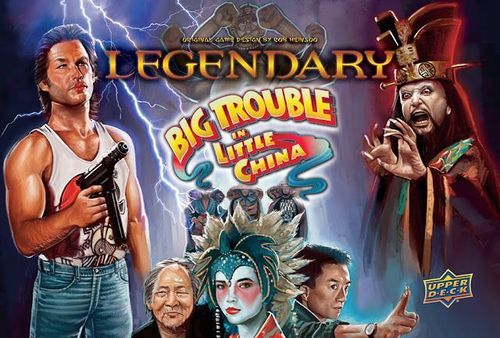
Legendary: Big Trouble in Little China
Legendary: Big Trouble in Little China Rulebook
Table of Contents
Table of Contents
- Overview
- Game Summary
- How to Win
- How the Evil Mastermind Wins
- Your First Game
- Game Set-up
- Villain Deck
- Hero Deck
- Starting the Game
- On Your Turn
- Masterminds
- Final Showdown
- Additional Rules
- Chinatown!
- The Many Wing Kongs
- Sorcerous Lo Pan
- Jack Burton Hero Cards
- Wang Chi Hero Cards
- "That You Play this Turn"
- Reveal a Random Card from the Hand of the Player to Your Left
- Mediocre Heroes aren't Full Heroes
- Keeping Track of Special Bystanders
- Coin Flipping
- "Henchman Villains Have -1 Attack This Turn"
- Printed Attack and Printed Recruit
- Components
- Set Up (Quick Reference)
Overview
Welcome to Legendary®: Big Trouble in Little China, the deckbuilding game of fighting ancient evils with a gang of unlikely heroes in San Francisco's Chinatown! Maverick trucker Jack Burton teams up with his gambling buddy Wang Chi, love interest (well, he's interested) Gracie Law, and friends like Egg Shen, Margo and Jack's truck, the Pork Chop Express. Their goal is to prevent Evil Masterminds like Sorcerous Lo Pan and Ching Dai from implementing terrible Schemes such as Fill the Hell of Upside Down Sinners, Flood Chinatown with Mediocrity, and Kill Uncle Chu!
If You Have Played Previous Legendary® Sets
If you have played the other Legendary® games, you're pretty far along to knowing the rules of this game. The two rules changes you'll want to pay the most attention to are the addition of Mediocre Heroes in the setup (page 5) and the new Chinatown board described on page 15.
Game Summary
In this game for 1-5 players, each player starts with their own deck of twelve basic Hero cards. Ten of them will be members of the Chang Sing gang. Two of the basic heroes will be random Mediocre Heroes, not so tough characters from the film. At the start of your turn, you play the top card of the Villain Deck, showing how Villains invade the city, capture Bystanders and create special events. Then, you play Hero cards from your hand to generate Attack, Recruit Points and special abilities. You attack with your Heroes to defeat Villains. You use Recruit Points to buy better cards to add to your deck.
Whenever your deck runs out of cards, you shuffle your discard pile to make a new deck, including all the new Heroes you recruited. This way your deck gets stronger over time. Build up enough Power and you can defeat the evil Mastermind! Don't waste time! If you don't defeat the Mastermind quickly enough, then the Mastermind will complete their horrible Scheme and win the game for the powers of the dark.
How to Win
Players must work together to successfully attack the evil Mastermind four times. If they do, the Mastermind is beaten and the players win the game for the good guys! In addition, defeating Villains and rescuing Bystanders earns each player Victory Points. If you defeat the Mastermind, then the player with the most Victory Points is the most legendary hero of all and the individual winner.
How the Evil Mastermind Wins
In Legendary®: Big Trouble in Little China, the game fights back against the players. No one plays the Mastermind, instead the game itself plays the part of the Mastermind, working to accomplish an evil Scheme throughout the game. You'll choose an evil Scheme to play against at the start of the game. Every Scheme card has a part that says, "Evil Wins," which tells you how the Mastermind completes their Scheme. If the evil Scheme is completed, then the Mastermind wins the game for evil, and all the players lose, even the player with the most Victory Points!
Your First Game
For your first game, follow the setup rules on the following page, using the specific card stacks listed there instead of choosing card stacks at random. After your first game, every game of Legendary®: Big Trouble in Little China uses different Heroes, Villains, Masterminds and Schemes!
Note that the hero of the movie, Jack Burton, comes with extra cards. You use only 14 cards per Hero, and in this first game, take out the Sleeveless Jack cards because they team up better with Gracie Law, and she's not in the setup for this first game.
Your First Game - Cards To Use
Mastermind: Six Shooter
Scheme: Forge Crime Syndicate
Heroes: Eddie, Egg Shen, Margo, Pork Chop Express, Jack Burton (remove the five Sleeveless Jack cards)
Villain Groups for the Villain Deck:
- For 2 players: Monsters, Wing Kong Gang, Wing Kong Thugs
- For 3 players: Monsters, Wing Kong Gang, Wing Kong Thugs, Wing Kong Exchange
- For 4 players: Monsters, Wing Kong Gang, Wing Kong Thugs, Wing Kong Exchange, Ceremonial Warriors
- For 5 players: Monsters, Wing Kong Gang, Wing Kong Thugs, Wing Kong Exchange, Ceremonial Warriors, Warriors of Lo Pan
Game Set-up
Player Decks
Shuffle the 22 Mediocre Hero cards and place them in a face-down deck. Then, give each player their own personal 12-card deck, made of these cards:
- 6 Chang Sing Strategists
- 4 Chang Sing Warriors
- 2 random Mediocre Heroes from the Mediocre Hero deck. Feel free to tell each other which Mediocre Heroes you each got before you shuffle your personal decks. It's more fun that way.
Mastermind and Scheme
- Pick 1 Mastermind at random. Put the Mastermind cards face-up on the Mastermind space on the board. Take the 4 Mastermind Tactics cards that match the Mastermind you selected. Put them underneath the Mastermind card, face down in random order.
- Pick 1 Scheme card at random. Put it face up on the Scheme space on the board. Each Scheme card has a "Setup" section. Follow the setup instructions for that Scheme now. A Scheme card's Setup section always tells you how many Scheme Twist cards to put into the Villain Deck. Put that many Scheme Twist cards onto the Villain Deck space to start the Villain Deck. Many Schemes also have unique special rules.
A Scheme card is made up of a Name, Card Type, and Special Ability.
Game Stacks
Put these stacks of cards face up on their spaces on the board. Use all the cards of each type:
- 25 Uncle Chu
- 20 Wounds
- 32 Bystanders
Villain Deck
- Add 5 Master Strike cards to the Villain Deck.
- Now add Villain Groups to the Villain Deck. A Villain Group is a group of eight Villain cards that work together, like "Wing Kong Exchange" or "Monsters." Each Villain card lists its Villain Group under its card name. The more players you have in the game, the more Villain Groups you use, as shown in this table:
| Number of Players | Villain Groups | Henchmen Groups | Bystanders |
|---|---|---|---|
| 2 | 2 | 1 | 2 |
| 3 | 3 | 1 | 8 |
| 4 | 3 | 2 | 8 |
| 5 | 4 | 2 | 12 |
To Add Villain Groups
- Each Mastermind card says that the Mastermind "Always Leads" a particular Villain Group or Henchman Group. Include that group as one of the groups you add to the Villain Deck.
- Pick the other Villain Groups at random.
- For each Villain Group you pick, add all 8 Villain cards from that Villain Group to the deck.
To Add Henchman Groups
- Pick that many Henchmen Groups at random. Henchmen are weaker Villains and each group has 10 identical cards. Add those cards to the Villain Deck.
To Add Bystanders
- Check the table to the left to see how many Bystander cards to add to the Villain Deck from the Bystander stack. Leave the rest in the Bystander stack.
Hero Deck
There are 9 different Heroes in Legendary®: Big Trouble in Little China. Seven of the Heroes have fourteen cards, while Jack Burton and Wang Chi have nineteen cards. Make the Hero Deck this way.
- Pick 5 Heroes at random. For each of those Heroes, add all 14 cards for that Hero to the deck.
- If you've chosen Jack Burton or Wang Chi, you'll see that they each have three sets of five identical cards. Take one of the three sets out of the game, so that Jack and Wang also only have 14 cards.
- Shuffle the Hero cards together into a 70-card deck.
- If you are playing with 5 players, add a 6th Hero for an 84-card deck.
Starting the Game
- Shuffle the Villain Deck. Put it face down on the Villain Deck space.
- Flip 5 cards from the Hero Deck face up into the 5 Hero Spaces in the HQ.
- Each player shuffles their own personal deck and draws a hand of 6 cards from it.
- Choose a player to go first. Players take turns in clockwise order.
On Your Turn
On your turn, you do 3 things:
- Play the top card of the Villain Deck.
- Play cards from your hand, using them to recruit and attack.
- Discard your hand and draw 6 new cards.
Step 1) Play the Top Card of the Villain Deck
At the beginning of your turn, reveal the top card of the Villain Deck and play that card. What you do with that card depends on what kind of card it is. There are 4 kinds of cards in the Villain Deck: Villains, Bystanders, Scheme Twists, and Master Strikes.
If the Villain Deck Card is a Villain:
That Villain invades the city! Here are the different parts of a Villain card:
Villain Card — Name, Card Type & Villain Group, Victory Points, Special Ability, and Attack: You must have this much attack power to defeat this Villain.
To have the Villain invade the city, here's what you do:
Villain Enters the City
Move the new Villain into the city space closest to the Villain Deck. That city space is labeled, "Sewers." (Villains in the city are always face-up.)
Push Other Villains Forward if Necessary
Each of the 5 city spaces can only hold one Villain. Whenever a Villain enters a city space, if there's already another Villain there, then that existing Villain gets pushed one space toward the Escaped Villains pile to make room. So a single Villain entering the city sometimes causes a chain reaction of several Villains getting pushed forward.
- Remember: Only push a Villain forward if it needs to move to make room for another Villain entering that space.
A Villain Might Escape
If a Villain gets pushed out of the fifth and final city space (The Bridge), then that Villain "escapes" the city and goes into the Escaped pile on the game board, face-up. Here's what happens when a Villain escapes:
- The escaping Villain KOs a Hero that costs 6 or less from the HQ. (KO stands for "Knock Out.") The player whose turn it is chooses which of those Heroes gets KO'd. Put that Hero into the KO pile on the game board, face-up. Immediately flip a new Hero face up from the Hero Deck to fill the empty space in the HQ.
- If the escaping Villain has any captured Bystanders, then each player must discard a card from their hand as a penalty for failing to rescue the Bystanders. Real heroes would have kept the Bystanders from being carried away! Each player only discards one card, no matter how many Bystanders were carried away by that Villain. Put the captured Bystanders in the Escaped Villains pile.
- If the escaping Villain has an "Escape" effect on its card, do what it says.
New Villain Might Have an Ambush Effect
If the new Villain has an "Ambush" effect on its card, do what it says when the card enters play. Remember, if a Villain escaped when this new Villain appeared, handle all the Escape effects for the escaping Villain before handling any Ambush effect for the new Villain.
If the Villain Deck Card is a Bystander:
This innocent Bystander is captured by a Villain! Put the Bystander under the Villain in the city that's closest to the Villain Deck. If there are no Villains in the city, then the Bystander is captured by the Mastermind. Make sure the Bystander pokes out a bit so players can see it.
- Whenever a Villain with one or more Bystanders moves to a new city space, those Bystanders all go with the Villain.
- It's up to the players to rescue that Bystander! When a Villain or a Mastermind with a Bystander is defeated by a player, that player rescues that Bystander and puts it into that player's personal Victory Pile. Each Bystander is worth 1 Victory Point, so the more Bystanders you rescue, the more Victory Points you earn.
If the Villain Deck Card is a Scheme Twist:
A Scheme Twist card represents the Scheme moving forward towards victory for the evil Mastermind. Every Scheme works in a different way. When a Scheme Twist card is played, look at the "Twist" effect on the main Scheme card and do what it says. Put the Scheme Twist in the KO pile unless the Scheme tells you to put it somewhere else. Some Schemes say they do something special when Twists 1-5 or 6-8 come up.
If the Villain Deck Card is a Master Strike:
A Master Strike card represents the evil Mastermind coming down to get their hands dirty and smash the Heroes themselves. Each Mastermind card has its own specific Master Strike effect. When a Master Strike card is played, look at the "Master Strike" effect on the Mastermind card and do what it says. Put the Master Strike in the KO pile.
Note: Villains in the city don't get pushed forward when the Villain Deck card is a Bystander, Scheme Twist, or Master Strike.
Step 2) Play Cards from Your Hand, Using Them to Recruit and Fight
The only types of cards that can be in your hand are Heroes and Wounds. Here are the different parts of a Hero card:
Hero Card — Card Name, Hero Class Icon/Color, Hero Name, Recruit Points: use these to recruit more heroes, Special Ability, Attack: use this to defeat Villains, Cost: how many Recruit Points it costs to add this Hero to your deck.
After you play the top card of the Villain Deck, you play the cards from your hand. Some of your cards produce "Recruit Points" that let you recruit more Heroes. Other cards produce "Attack" that lets you defeat Villains. Most cards also give you cool special abilities, like drawing more cards. Here's what you do:
- Play the cards in your hand in any order, one at a time.
- Each time you play a card, do what that card says.
- You also get any Recruit Points listed in the Recruit icon on the card.
- You also get any Attack listed in the Attack icon on the card.
- Some cards have a number like "2+" inside their Recruit icon or their Attack. The "2" means that you always get at least 2 Recruit Points or Attack from that card. The "+" symbol means that you might generate even more Recruit Points or Attack based on what the card says in its special ability.
- Cards with a 0+ Star or 0+ Attack also count as having "printed Star" or "printed Attack," which can come in handy when fighting the Warriors of Lo Pan.
- Keep the cards you play in front of you until the end of your turn (meaning that they don't get shuffled along with your discard pile if you have to shuffle in the middle of your turn).
Hero Classes
- Covert: represents the ability to sneak around, catch people by surprise, use trickery and deception, or get things done behind the scenes.
- Instinct: represents guts, bravery, ferocity, and reflexes.
- Magic: represents supernatural power or magic mojo. Other Legendary® games call this symbol "Ranged." That's fine if you're combining games; there isn't a problem, we just think of it as Magic!
- Strength: which is exactly what it sounds like, is usually brute force and raw power or more rarely strength of will.
- Tech: representing machines like trucks and phones, is modern technology that's not like the old-fangled magic stuff.
- Chang Sing Strategists, Chang Sing Warriors, Mediocre Heroes and Uncle Chu cards do not have a specified class, but they are considered to be a unique color, grey.
Triggered Special Abilities
Some Hero cards have a triggered special ability with a Hero class icon and a colon, like:
Instinct: You get +2 Attack.
You can use that triggered special ability only if you have already played a card of that Hero class earlier in your turn.
- A card's Hero class is shown with the type icon in the card's upper left and also corresponds with the color of the icon and the card's border.
- These are the 5 Hero classes: Covert, Instinct, Magic, Strength, and Tech.
Example of a Triggered Special Ability
- Wang Chi's "The Colors that Never Run" card, shown here, always gives you 2 Attack when you play it.
- But if you have already played one or more Covert cards earlier in the turn, then you can rescue a Bystander!
- Whether or not you played a Covert card, if you already played one or more other Instinct cards earlier in the turn, you get +2 Attack.
- And if you already played one or more Magic cards earlier in the turn, you get +2 Star to spend this turn.
- If you play two "The Colors that Never Run" cards on your turn, and no other Instinct cards, the first card won't get to trigger its special ability. But the second card will get to trigger its special ability, so you'll get 6 Attack total from the two cards.
Recruiting Heroes and Fighting Villains
In between playing cards from your hand, or after you've played all your cards, you can recruit any number of Heroes and fight any number of Villains. You can recruit and fight in the same turn.
How to Recruit a Hero
You use Recruit Points to gain Heroes from the HQ, one at a time. The "HQ" area of the game board has five spaces. Those five spaces always contain exactly five heroes, all face-up. You can also recruit Uncle Chu Heroes from the Uncle Chu stack on the game board. To recruit a Hero:
- Use Recruit Points equal to that Hero's cost and put that Hero into your discard pile. A Hero's cost is in its lower right-hand corner. When your deck runs out and you shuffle your discard pile to make a new deck, you will soon draw that new Hero and be able to use their abilities.
- Then, refill the empty space in the HQ with a new card from the Hero Deck, face up. Whenever there is an empty space in the HQ for any reason, you refill that space immediately with the top card of the Hero Deck, face up. You can even recruit a Hero, see what new Hero appears in its place from the Hero Deck, and then recruit that new Hero too, if you have enough Recruit Points.
How to Fight a Villain
You use Attack to fight any number of Villains in the city, one at a time. It doesn't matter which city space holds the Villain. To fight a Villain:
- Expend Attack equal to that Villain's Attack to defeat it. You then have the remaining Attack value available to attack another Villain.
- Put the defeated Villain and any Bystanders that it had captured into your personal Victory Pile.
- If the Villain card has a "Fight" effect on it, do what it says prior to comparing Attack totals.
You can only attack a Villain if you have at least as much Attack as the Villain's Attack. You can also fight the Mastermind—see the Masterminds section for details.
Your Victory Pile
- Each player has their own personal Victory Pile. Your face-up Victory Pile holds all the Villains that you defeated and all the Bystanders you rescued.
- Villains and Bystanders are never shuffled into your deck.
- Many players keep their Victory Pile horizontal or stuck underneath something so they don't mix it up with their face-up discard pile.
- At the end of the game, Villains and Bystanders in your Victory Pile are worth the Victory Points shown on their cards.
Step 3) Discard Your Hand and Draw 6 New Cards
- At the end of your turn, put all the cards that you played this turn into your discard pile.
- Also discard any cards in your hand that you didn't play this turn.
- Then, draw 6 new cards from your deck.
- If you don't have any cards left in your deck and still need to draw more cards, then shuffle your discard pile to form a new deck. Then, draw the rest of the cards you need.
- Don't shuffle your discard pile into a new deck until your deck has completely run out and you still need to draw or reveal more cards.
Masterminds
A Mastermind is a powerful evil genius, gang leader, or demon who pursues an evil Scheme and tells the lesser Villains what to do. A player can choose to fight the Mastermind instead of fighting a Villain. Like any other fight, you have to use Attack equal to the Mastermind's Attack to fight that Mastermind.
- Masterminds do not count as Villains. For example, the Pork Chop Express card "6.9 on the Richter Scale" has the triggered special ability Tech: Gain +1 Attack for each non-Henchman Villain in your Victory Pile. The Mastermind is not a Henchman, but the Mastermind is also not a Villain, and any Mastermind Tactics in your Victory Pile don't add to the bonus from 6.9 on the Richter Scale.
Mastermind Card — Name, Card Type, Special Ability, Victory Points, Attack.
Mastermind Tactic Card — Name, Card Type, Special Ability, Victory Points, Attack.
Mastermind Tactics
Masterminds use different abilities during fights, represented by "Mastermind Tactic" cards. All 4 Mastermind Tactic cards have the same Attack number, but they each have different "Fight" effects on them. When you fight a Mastermind:
- Choose a random card from the 4 face-down Mastermind Tactics cards underneath the Mastermind.
- Put that Mastermind Tactic card into your Victory Pile. It's worth several Victory Points.
- Then, follow the "Fight" effect listed on that Mastermind Tactic card. A Mastermind is not truly defeated until all 4 of their Mastermind Tactics cards have been defeated by the players. However, if you create an amazing combo that gives you tons of Attack, you can fight the Mastermind multiple times in one turn.
- When you fight the 4th Mastermind Tactic, players win even if the 4th Mastermind Tactic causes the Hero Deck or Villain Deck to run out or meets the "Evil Wins" condition on the Scheme.
Final Showdown
When a player defeats the 4th Mastermind Tactic, that player finishes their turn and draws 6 cards as normal. Then, it's time for the Final Showdown between the players and the Mastermind! Each player, in turn, now takes a special "Showdown Turn," starting with the player on the left of the player who had defeated the 4th Mastermind Tactic.
In a Showdown Turn, you don't play the top Villain card, you don't recruit Heroes, and you don't fight Villains. Instead:
- Play the cards in your hand as normal, using those cards' special abilities as normal and producing Recruit Points and Attack as normal.
- Add together all the Recruit Points and Attack you produced into a single, big Showdown Total.
- Don't draw a new hand at the end of your Showdown Turn. (This is important for several cards. For example, Jack Burton's "It's All in the Reflexes" reveals a random card from the hand of the opponent to your left, but if that player doesn't have a hand because they already took their Showdown Turn, then there's no way for It's All in the Reflexes to trigger all its extra goodness.)
Whichever player has the highest Showdown Total wins the Final Showdown! That player puts the actual Mastermind card into their personal Victory Pile. When the Final Showdown is complete, the Mastermind has been utterly defeated! The players win a team victory. In addition, the player with the most Victory Points in their Victory Pile wins an individual victory and is the most legendary hero of all.
Tied Final Showdowns
If multiple players tie for the highest Showdown Total, then it's time for a Cliffhanger Showdown! Each of the tied players discards all the cards they played and draws a new hand of six cards. Each of those players then takes another Showdown Turn to find the winner of the Final Showdown. If players keep tying, then keep running additional Cliffhanger Showdowns until someone wins the Showdown.
- The Final Showdown was optional in other Legendary® games, but it feels so much like Big Trouble in Little China that we're using it as the standard way to play in this game. The "What Ol' Jack Burton Says" card will be very disappointed if you skip it!
- Remember that you also don't recruit during Showdown turns. A couple powerful cards, like Gracie Law's "Fighting Bride," are slightly less powerful than they look because you can't recruit during the Showdown Turn.
Additional Rules
"KO"
Many card abilities tell you to KO certain cards, meaning "Knock Out." This means put them into the KO pile on the game board. Cards in the KO pile are permanently out of the game. The players and the game all share one big KO pile.
- If a card says to KO "one of your Heroes," that can be a Hero you've already played this turn or a Hero still in your hand. If you KO a Hero that you have already played this turn, you still get to use the Recruit Points, Attack, and special abilities that Hero produced.
- If you KO a Hero from your hand, you obviously do not get to use its Recruit Points, Attack, and special abilities.
- Don't be afraid to KO your Chang Sing Strategists, Chang Sing Warriors, and even your Mediocre Heroes. Getting weak cards out of your deck means you'll be more likely to draw your stronger cards.
Grey Heroes
Chang Sing Strategists, Chang Sing Warriors and Uncle Chu all count as Heroes for special abilities that talk about Heroes. These Heroes also share a color, which you may have been able to guess from their card art, grey! Grey counts as its own color, but isn't a Hero class. Along with the five non-grey colors, there are a total of 6 colors of Heroes.
Rescue a Bystander
Some card abilities tell you to "rescue a Bystander." This means take the top Bystander from the Bystander deck and put it into your Victory Pile. This represents saving innocent people who would otherwise have been kidnapped, slain, or sacrificed by the Villains.
- Wing Kong Security are more or less innocent people who sometimes fight for the Villains! Outside Chinatown, they are like any other Bystander, but inside Chinatown, they add +2 to the Attack of the Villain who has captured them.
- Bystanders that have been captured by Villains in the city usually can't be saved unless you defeat the Villain who captured them, but the Gracie Law card "Smooth Move" is an exception. Smooth Move can pluck a Bystander right off the board, but the Bystander has to have already been captured.
- To trigger Bus Tourists' special ability, you need to defeat a Villain that has Bus Tourists captured in Chinatown. You'll never trigger Bus Tourist's special ability by drawing the card from the Bystander stack.
Wounds
Some special abilities make you gain Wound cards, representing your Heroes getting hurt. When a player gains a Wound, take a Wound from the Wound Stack and put it into that player's discard pile. Wounds don't have any Recruit Points or Attack, so when you draw Wounds in your hand, your hand is weaker than normal.
- Some cards, like Uncle Chu, let you KO your Wounds so you don't have to worry about them anymore.
- Wound cards aren't Heroes. If a card tells you to "KO one of your Heroes," you can't KO a Wound. However, if a card says "KO one of your cards," then you can KO a Wound because Wound cards are still cards.
Healing Wounds
If you have one or more Wounds in your hand, you can use the ability written on the Wound card:
- If you don't recruit any Heroes or defeat any Villains on your turn, you may KO all the Wounds from your hand.
- This is often worth doing if you have at least two Wounds in your hand or if your turn wouldn't have been great anyway.
- It's okay to play the cards in your hand, use some abilities like "draw a card," and then use the "Healing" ability to KO Wounds from your hand as long as you don't recruit any Heroes or fight any Villains during your turn.
Running out of Cards in the Hero Deck or Villain Deck
If either of these decks runs out of cards before the Scheme is completed, then finish the turn, and view the players as having successfully survived the Scheme, but they didn't defeat the Mastermind. As a result, the game is a draw between good and evil. The player with the most Victory Points wins an individual victory, but it's not a glorious group victory. Next time, beat the Mastermind!
Running out of Cards in the Bystander, Wound or Uncle Chu Stacks
If one of these stacks runs out, the game continues. If a player would gain one of these cards, and there aren't any more of that card left in the appropriate stack, then you don't gain that card, and the game continues. Don't take extra copies out of the KO pile.
Special Abilities on Cards
Special abilities on cards can override the rules of the game. Some cards tell each player to do something. In those cases, the player whose turn it is acts first. Then, go in clockwise order. If a card tells you to do something, but you can't do all of it, then do as much as you can. For example, if a card tells you to KO two Bystanders from your Victory Pile, but you only have one Bystander, then KO just that Bystander.
- If a special ability calls for a choice, but it's not obvious who should make the choice, then the current player, the player whose turn it is, makes the choice.
Chinatown!
As you can see on the board, the Rooftops and Streets are the two areas that make up Chinatown. If you use Big Trouble cards playing on other Legendary® boards, decide ahead of time if you want to consider the Rooftops and the Streets on that other map to count as Chinatown or not.
- Therefore, the spaces in the HQ directly underneath the Rooftops and the Streets are the spaces beneath Chinatown, referred to by cards like "He Owns the Block."
The Many Wing Kongs
The Wing Kong Gang Villain group is not the same as the Wing Kong Exchange Villain Group. Neither are they the same as the Wing Kong Thugs Henchman Group. We used the names from the movie! When a card like "Six Shooter" refers to the Wing Kong Gang, it refers to only that one Villain group, not the others.
Sorcerous Lo Pan
- Sorcerous Lo Pan's Master Strike returns the Warrior of Lo Pan that is closest to him (in other words, closest to the Bridge) to the top of the Villain Deck. Any Bystanders or other cards (like Uncle Chu in the "Kill Uncle Chu" Scheme) that were captured by that Warrior of Lo Pan are KO'd. No Warrior of Lo Pan in the city? Then, just draw the next card in the Villain Deck.
- Sorcerous Lo Pan's "Rule the Universe from Beyond the Grave" Mastermind Tactic can result in a Villain being placed under Sorcerous Lo Pan as a new face-down Mastermind Tactic. Consequently, the players will have to beat Sorcerous Lo Pan a fifth time to win the game. When that Villain card is drawn from under Sorcerous Lo Pan as if it were a Mastermind Tactic, it will generate its "Fight" effect, if any.
Jack Burton Hero Cards
To give you more possible games, we supplied three sets of common cards instead of the usual two sets of common cards. When you play with Jack Burton, use all five copies of two of the following cards and take out the five copies of the third card:
- Sleeveless Jack
- Son of a Bitch Must Pay
- Surprisingly Good Shot
It's up to you whether you randomly choose the two cards you'll use or specifically pick the two cards you want to play with. If you like a lot of randomness, you could also shuffle these 15 cards together and draw 10 of them to play with, placing the other 5 Jack Burton commons back in the box.
Wang Chi Hero Cards
The same goes for the three sets of common cards supplied for Wang Chi. When you play with Wang Chi, use all five copies of two of the following, and take out the five copies of the third card:
- Everybody's Buddy
- Time to Go!
- You Gotta Help Me!
"That You Play this Turn"
Cards like "Shake the Pillars of Heaven" and "China is Here!" don't care which order you use for playing other cards with Attack bonuses. "That you play this turn" means you keep getting bonuses whether you play the cards that provide the bonus before or after Shake the Pillars of Heaven or China is Here!
Reveal a Random Card from the Hand of the Player to Your Left
This special ability requires the player on your left to have a hand. If it's the Showdown, and the player on your left has already taken their turn, then this special ability won't do anything because there's no opponent's hand to reveal a card from.
- Other cards that share variations of this problem include "Green-eyed Bride" (Players with no hands can't give you a gift.), "Son of a Bitch Must Pay" (No hand to KO a card from means no bonus for you.), "You Gotta Help Me!" (Can't get a 0-cost Hero from a non-existent hand.), and "The Rescue" (People with hands will still pass cards, even if they're passing to non-existent hands, but people without hands can't pass.).
- The other important fact about revealing a card is that you just show it off. Nothing else happens to the card. That applies to all other reveal effects, including cards that get revealed from the top of the Hero Deck (like with Margo's "Yeah, I'll Call the President") or revealed from the stack of Mastermind Tactics (like the Fight effect of the Spirit Warrior).
Mediocre Heroes aren't Full Heroes
One easy post-game mistake to make is to shuffle Mediocre Heroes in with the Heroes who have the same name. Don't do it! Keep the grey Mediocre Heroes out of the 14 card non-grey Hero groups.
- Despite being mediocre, Mediocre Heroes can be surprisingly helpful; fighting Smoke-Staff Guard, for example.
Keeping Track of Special Bystanders
Mediocre Heroes like the Bus Driver and John care whether a Bus Tourist Bystander or White Tiger Bystander has entered play. Even if you don't keep careful track, it's easy to figure out whether one of these Bystanders has come into the game because once they appear in the game, they'll either be captured by the Mastermind, captured by a Villain in the city, in someone's Victory Pile or in the KO pile.
Coin Flipping
Flip a coin for each copy of "Unpredictable Magician" you play. If you get Heads, then that copy of the card gives you 2 Star and lets you KO a card from your hand or discard pile. Tails only gives you 2 Attack, but being able to fight is its own reward, so we didn't need to make Tails any better.
"Henchman Villains Have -1 Attack This Turn"
Jack Burton's "Surprisingly Good Shot" reduces Henchman Villain's Attack by 1. Gracie Law's "One Step Ahead" can also reduce one or more Villain's Attack. If a Villain or Mastermind's Attack goes to 0, you can defeat that Villain or Mastermind without spending any Attack. But a Villain or Mastermind's Attack can never go below 0.
Printed Attack and Printed Recruit
A card's "printed Attack" or "printed Star" means the number literally printed inside the card's Attack or Star icon. Ignore any '+' symbols, '*' symbols, or special abilities on that card.
"Defeat for free"
Defeating a Villain for free means you don't have to pay any Attack to defeat that Villain. While it's a good deal, remember that you can't defeat Villains during the Showdown. Also, if Villains have other weird requirements for being defeated that have nothing to do with Attack, like Smoke-Staff Guard, then "defeating for free" takes care of only the Attack requirement, not the Villain's other conditions.
Under a Spell
Miao Yin's Under a Spell card refers to the possibility of taking a 0-cost Hero from the Mastermind's stack. So far, that only happens when Ching Dai is the Mastermind. When Ching Dai is the Mastermind, Under a Spell is a big deal. Otherwise it's just helpful cleaning out your discard pile and messing up the discard pile of the player to your left. If the player to your left doesn't have a discard pile at the moment, then you just started it for them!
How Nasty is Ching Dai?
Players who play selfishly may discover that they have a tough time beating Ching Dai. It's possible to beat him without having Miao Yin as one of the Heroes, but "Under a Spell" helps.
- Note that you're always free to KO Chang Sing Warriors when you're facing Ching Dai. It's only the Chang Sing Strategists and Mediocre Heroes that go into the pile that makes the demon lord harder to fight.
- It's also important to remember the +5 max limit on the Attack bonus that Ching Dai gains from KO'ing 0-cost cards that provide Recruit Points. The stack of cards can go much higher, but +5 is the maximum bonus Ching Dai gets from the stack.
No Solo Rules in this Set
Other Legendary® games have solo rules. You could try those rules with some of the cards in this game. But Legendary®: Big Trouble in Little China is designed to focus on player interaction: reaching out and revealing cards from each other's hands, flipping over the top card of everyone's deck and groaning at the results, letting the player to your left discard a card and draw, or dropping a 0-cost Hero into your opponent's discard pile. Play with a friend, or play with two hands running side-by-side!
Components
Rulebook, game mat, and 400 cards:
- 14 cards for 7 Heroes and 19 cards for 2 Heroes (136 cards) (Each Hero plays with 1 Rare, 3 Uncommons, 5 of one Common, and 5 of another Common)
- 8 cards for each of 4 different Villain groups (32 cards)
- 10 cards for each of 3 different Henchman Villain groups (30 cards)
- 22 Mediocre Heroes
- 35 Chang Sing Strategists
- 20 Chang Sing Warriors
- 25 Uncle Chu
- 32 Bystanders (23 regular Bystanders, 3 Bus Tourists, 3 White Tigers, 3 Wing Kong Security)
- 20 Wounds
- 4 Masterminds, each with 4 Mastermind Tactics (20 cards)
- 12 Schemes
- 11 Scheme Twists
- 5 Master Strikes
- 60 Dividers
Set Up (Quick Reference)
- Each player starts with their own personal 12-card deck consisting of: a. 6 Chang Sing Strategists b. 4 Chang Sing Warriors c. 2 random Mediocre Heroes
- The following cards are placed face-up on the board: a. 25 Uncle Chu b. 20 Wounds c. 32 Bystanders
- Select 1 Mastermind and place it face-up on the board with the associated Tactics cards face-down underneath.
- Select 1 Scheme card and place it face-up on the board.
- Add cards based upon the table to the right:
- Adjust the game's starting conditions based upon the selected Scheme and Mastermind cards.
| Number of Players | Villain Groups | Henchmen Villains | Bystanders | Heroes |
|---|---|---|---|---|
| 2 | 2 | 1 | 2 | 5 |
| 3 | 3 | 1 | 8 | 5 |
| 4 | 3 | 2 | 8 | 5 |
| 5 | 4 | 2 | 12 | 6 |