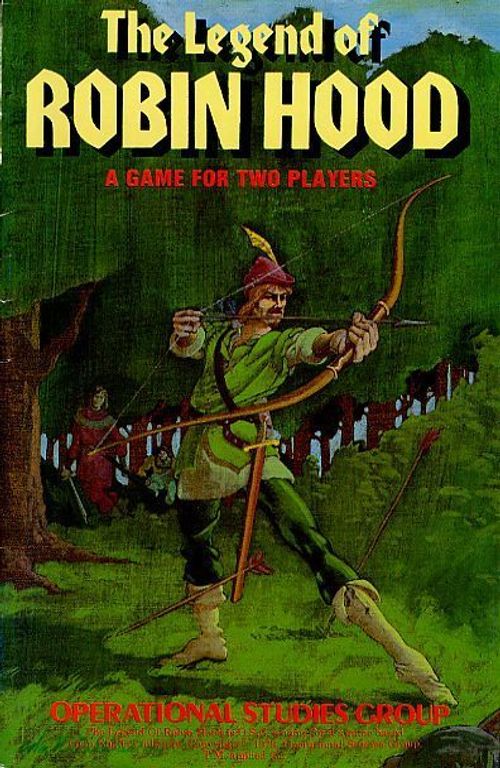
The Legend of Robin Hood
The Legend of Robin Hood Rulebook
Table of Contents
Table of Contents
- General Course of Play
- Equipment
- Setup
- Play Sequence
- Movement Phase
- Combat
- Captives, Ransom, Murder, Hanging
- Gold, Taxes, Robbery, Looting
- Outlaw Recruitment
- Reinforcements
- Disguise (King Richard and Robin Hood only)
- Random Event
- Archery Contest (any time after Prince John arrives)
- Marriage to Marion (at the end of Robin Hood's Player-Turn)
- End of Game and Victor
General Course of Play
One player assumes the role of Robin Hood, the other that of the Sheriff Of Nottingham. Each can recruit other personalities (Leaders) and units of fighting men. The Sheriff attempts to maintain law and order by ensuring the collection of taxes and safe travel of the rich through Sherwood Forest. Robin Hood builds a band of merry outlaws to exact a toll from the rich.
Over a series of Game-Turns, Players alternate moving units and Leaders and having combat. Combat may result in units permanently or temporarily removed and Leaders killed or captured. Captured outlaws may be hung by the Sheriff. Play continues until Robin Hood is killed or King Richard comes home from the Wars (see Robin Hood Victory Conditions).
Equipment
The Map (17 x 22")
Represents the Northern Midlands of England, divided into boxes that regulate movement and positioning of the pieces.
Charts and Tables
Printed on the map: Archery Table, Mêlée Table, Terrain Effects Chart, Recruitment Table, Tax Table, and Turn Record Track.
Playing Pieces
The pieces represent either a group of men or an individual Leader. A Leader is referred to by name. Counters representing fighting men are units. Other counters are Travelers representing rich nobles and bishops passing through the district and Markers used to denote Looting and Passages.
Terms
Archery Strength: Strength to fire the longbow at other units.
Box: A map space regulating positioning of pieces. A piece can occupy 1 box at a time. Movement is from 1 box to another adjoining box, assuming the terrain is passable.
Command Ability: Number of Merry Men units an Outlaw Leader can cause to be moved during the Robin Hood Movement Phase. Sheriff Leaders have no command number because they can move without a Leader present.
Mêlée Strength: Strength to engage other units hand-to-hand.
Movement Allowance: Movement Points of a unit or Leader. Each box entered normally costs 1 MP (Forest costs 2 MP).
Personal Combat Strength: A Leader's strength for engaging in combat with opposing Leaders.
Phasing Player: The player whose Player-Turn it currently is.
Setup
Sheriff Player starts with 12 gold. Outlaw Player starts with no gold.
Units and Leaders that start the game on the map have their setup positions printed there. Some boxes have 2 designations and hold 2 pieces. Units and Leaders with no setup on the map appear later due to a Random Event roll or automatically on a particular Game-Turn – place these on the Turn Record Track.
Place the 6 travelers (4 Nobles and 2 Bishops) in the Traveler Box – these will enter the game due to a Random Event roll.
Unrecruited Sheriff Units & Leaders
Sir Guy of Gisbourne and his Men At Arms unit are face down at the start and cannot move nor engage in combat until the Sheriff Of Nottingham ends his Player-Turn in the same box or the Outlaws attack Sir Guy.
Unrecruited Robin Hood Units & Leaders
All Outlaw units and Leaders except Robin Hood are unrecruited at the start and are face down until recruited (see Outlaw Recruitment). Unrecruited Outlaw units and Leaders may not be attacked or otherwise molested by the Sheriff until they are recruited. Outlaw units and Leaders that have not been recruited cannot move, engage in combat, or influence the game in any manner. They are out of play until recruited.
Play Sequence
One Game-Turn is composed of 2 Player-Turns.
A. Robin Hood Player-Turn
1. Movement Phase. Robin Hood may move any or all of his Outlaw units and Leaders as per the Movement rules. No Outlaw unit in the same box may move to another adjacent box without a Leader. Robin Hood may murder Sheriff Leaders during this phase.
2. Combat Phase. Conduct a), b) and c) in order for each combat situation on the board. Completely resolve each before proceeding to the next. The Phasing Player chooses the order to resolve combats.
a) Archery Sub-Phase: Outlaw units in the same box with enemy units must exchange archery fire (see Combat).
b) Mêlée Sub-Phase: Outlaw units in the same box with an enemy unit must attack using Mêlée Combat (see Combat).
c) Personal Combat/Capture Sub-Phase: Opposing Leaders in the same box with no other units of either side engage in personal combat. Leaders with enemy units and no friendly units roll to see if they are captured, killed, or escape.
3. Robbery & Looting Phase. Outlaw units in a box containing a bishop or noble may rob the traveler if no Sheriff units are present in the box. Robin Hood receives the traveler's money, deducting the same value from the Sheriff. Looting can also occur in this phase.
4. Recruitment Phase. Robin Hood may recruit any Outlaw Leader or Merry Man that occupies the box with him. This may involve a special form of personal combat (see Outlaw Recruitment and the Recruitment Table).
5. Hanging Phase. The Sheriff may hang any Outlaw Leader he holds captive in a town box if the requirements for hanging have been met (see Captives, Ransom, Murder, Hanging).
6. End Phase. Ransom Sheriff Leaders and Marriages (see Marriage to Marion) take place.
B. Sheriff Player-Turn
1. Random Event Phase. Sheriff rolls 1d6. Consult the Traveler Box – a Noble or Bishop may arrive and attempt to move across the map without being robbed by the Outlaws. On a '6' a new Leader enters the game. New Leaders and new Sheriff units may also enter automatically.
2. Movement Phase. The Sheriff moves his units and Leaders. His units do not require a Leader present to be able to move.
3. Combat Phase. The Sheriff conducts combat in the same manner as Robin.
4. Taxation Phase. The Sheriff may tax any villages with no Merry Men that 1 or more of his units occupy with a Leader. Roll 1d6 on the Taxation Table and add any taxes collected to his Treasury.
C. Game-Turn Advance
A Game-Turn ends once both Players complete their turns. Advance the Game-Turn marker by 1 on the Turn Record.
Movement Phase
See the Terrain Effects Chart on the map.
How to Move Units and Leaders
The Phasing Player may move any or all of their units and Leaders, each as many boxes as desired up to their Movement Allowance. Unused points may not be saved nor transferred. Only the Phasing Player's pieces may move, and no combat may take place. Movement is in terms of Points: each piece expends 1 MP for each box entered (Forest costs 2 MPs). Move each unit or Leader by tracing a path from box to adjacent box. Once a piece has moved and the Player's hand withdrawn, the piece may not move again, nor its path be retraced or changed, during that Movement Phase.
Movement Inhibitions & Prohibitions
A unit or Leader must stop on entering a box containing enemy unit(s) or Leader(s) (but not a traveler). Unlimited friendly and enemy pieces can be in the same box. A unit or Leader may use some, none, or all of its MPs during a Game-Turn.
Robin Hood Unit Movement
Outlaw units may only move with an Outlaw Leader that began the Movement Phase in their box and may not enter any box not entered by the Leader. At any point in a Leader's move he may drop off units in boxes moved through. Outlaw Leader's have a Command Ability – the limit of Merry Men the Leader may move during a Movement Phase.
Bridges and Fords
A unit or Leader may enter or leave a bridge or ford only from a box which the ford or bridge symbol leads to. Units or Leaders may never end their movement in a bridge or ford box.
Keeps and Castles
Pieces on their way into or out of a Keep move through the castle box (exception: Secret Passages Into Keeps), which counts as a movement space.
Secret Passages Into Keeps
All Keeps can be entered or left via secret passage, but only by Outlaw units and Leaders. Movement is between the Keep box and the adjoining box the secret passage enters.
Entering a Keep: Only Robin Hood may enter a Keep via a secret passage, accompanied by at most 2 Merry Men and 1 Leader. Each Keep may have passage entry attempted once per game (place a Discovered Passage chit). Roll 1d6: 1-4 Success, 5-6 Mishap.
MISHAP: Eliminate any Merry Men, each Leader rolls 1d6: 1-2 Killed, 3-6 Escape. Place escaped Leader outside in the box they attempted entry from – they may continue moving.
Leaving a Keep: Outlaw units and Leaders not captive may always leave a Keep via secret passage, even a Discovered one. No die roll is necessary.
The River Trent
May never be entered. Units or Leaders may only cross at the bridge and ford boxes.
Combat
Use the Archery Table and Mêlée Table on the map. Combat occurs between opposing units and Leaders in the same box, and is always mandatory. The Phasing Player is the attacker, the other Player is the defender. Treat net die rolls less than 1 as 1; greater than 6 as 6.
Follow the 3 Sub-Phases in order:
a) Archery Sub-Phase: Each Player simultaneously totals their Archery Strengths and rolls on the Archery Table. Remove the resulting number of units, chosen by the owning Player.
b) Mêlée Sub-Phase: Compare the total Mêlée Strengths of the remaining attacking units to the total of the remaining defending units in the box. The comparison is a probability ratio: Attacker Strength to Defender Strength using the simplified odds of the Mêlée Table, rounded down in favor of the defender. Roll 1d6 – the attacker reads the result on the appropriate line under the specified odds column.
Example: 11 Mêlée Points of Sheriff units attack 4 Points of Merry Men. 11-4 odds round to 2-1. 12-4 would be 3-1.
c) Personal Combat/Capture Sub-Phase: Capture: Leaders in a box with enemy units and no friendly units roll to see if they are captured, killed, or escape (see Personal Combat and Capture). Personal Combat between Leaders must occur if opposing Leaders occupy the same box and no other units are now present. Each Player rolls 1d6 and adds the Personal Combat Strength(s) of their Leader(s). The side with the higher total wins. If the results are equal then the combat is a draw and all Leaders remain in the box.
Effects of Terrain on Unit Combat
Terrain can affect the result of archery and mêlée combat, but has no affect on Personal Combat.
Units in a forest, town, mill or village box get –1 to their Archery roll.
Archery combat cannot occur in a Keep, castle, or ruined castle box. Skip Archery and proceed directly to Mêlée.
Units who passed through a ford in the preceding Movement cannot participate in Archery fire as their bow strings are wet.
–1 to the Mêlée roll if the Mêlée takes place in a Keep, castle, or ruined castle box.
If attacking units fail to eliminate at least 1 defending unit in a castle, the attackers must retreat to any adjacent box except the Keep. If all adjacent boxes are occupied by enemy units then the attacking units are eliminated.
If attacking units fail to eliminate at least 1 defending unit in a Keep, they must immediately retreat to the adjacent castle or use the secret passage. If the box moved to contains enemy units then attacking units are eliminated.
Leaders present with attacking units in the two rules above retreat with their units; but if all their units are eliminated in the Mêlée Phase their fate is resolved as per the personal-combat capture roll. If all their units are eliminated due to lack of a box to retreat into then the Leaders are automatically captured.
Effects of Leaders on Unit Combat
Merry Men get +1 to the Archery roll if Robin is present.
Units defending against mêlée attack with any friendly Leader(s) in the same box have –1 to their Mêlée roll.
Attacking units involved in Mêlée have +1 to their roll if at least 1 friendly Leader is in the same box.
All mods are cumulative, even those of terrain. Example: 2 Leaders on opposing sides in mêlée result in no mod.
Leaders never add their Personal Combat Strength to Archery or Mêlée between units. Leaders are never affected by the results of Mêlée or Archery combat.
Maid Marion and Alan a Dale never modify a die roll.
Multiple Battles
If more than one combat situation exists (more than 1 box has opposing units or Leaders at the start of a Combat Phase), each must be resolved completely before proceeding to the next. The Phasing Player (Attacker) determines the order. Units and Leaders that have participated in a combat and then retreated may not be used in combat in the box they retreated into, nor may they be used to capture or kill an opposing Leader there or free a friendly Leader that has been captured.
Personal Combat and Capture
The victor in Personal Combat rolls 1d6 for each losing Leader to determine their fate: 1-2 Captured; 3-5 Killed; 6 Escape. Place an escaped Leader in any adjacent box unoccupied by enemy units or Leaders. If no such box exists then the Leader is captured.
If at the start of the Personal Combat Sub-Phase a Leader is in a box with an opposing enemy unit and there are no friendly units there, the Leader(s) must roll 1d6 individually: 5-6 Escape; 1-4 Caught. Outlaws in forest, village, or town escape on a 4-6. Decide the fate of a caught leader as: 1-3 Killed, 4-6 Captured.
Alan a Dale and Maid Marion never engage in personal combat and are automatically captured if the two situations above pertain, with no die roll necessary.
Return of Outlaw Units to Play
Each Outlaw unit eliminated in combat rolls 1d6 to determine where they reappear. The Merry Men boxes on the map contain numbers 1–6; place the returned unit in the box corresponding to their die roll. Merry Men units reenter the game unrecruited.
Return of Sheriff Units to Play
Eliminated Sheriff Men At Arms units automatically reappear on the 4th Game-Turn after elimination, but no more than 1 previously eliminated may reappear per Game-Turn. Thus if 2 Sheriff units were eliminated in Game-Turn 10, one would return on Game-Turn 14 and one on Game-Turn 15. These units appear exactly as if they are reinforcements (see Reinforcements): Place them on the Turn Record at the appropriate Turn number. Eliminated Kings Foresters and Knights never reappear.
Captives, Ransom, Murder, Hanging
Captives
Leaders captured during the Personal Combat Capture Phase must be guarded by at least 1 unit or Leader. The captive(s) and guard move normally, but at the rate of the slowest piece. A single unit or Leader may guard or convey any number of captives in the same box.
Murder and Ransom (of Sheriff Leaders)
Captive Sheriff Leaders can be murdered at the start of any Robin Hood Movement Phase. They may also be ransomed (cannot be refused) by Robin Hood at the following values:
- Sheriffs of Nottingham and Lincoln: 2 Marks each
- Sir Guy of Gisbourne: 3 Marks
- Prince John: 10 Marks
The Sheriff pays the Leader's ransom to Robin Hood, then places the Leader in any town, Keep, or castle. Ransoms occur at the end of Robin Hood's Player-Turn.
Hanging (of Outlaw Leaders)
Captive Outlaw Leaders may be hung by the Sheriff; they cannot be murdered (except King Richard, see King Richard). A captive must first be conveyed to a Keep and held there 2 complete Sheriff Player-Turns – they need not be guarded while in the Keep. Any turn after, the Sheriff may take the Leader to any town for hanging, which will take place during the Hanging Phase of Robin Hood's Player-Turn. A Sheriff Leader must be present in the box for a hanging.
The Sheriff gets 2 Gold Marks for each Outlaw Leader hung, 3 if the victim is Little John or Will Scarlet. The Sheriff immediately wins if Robin Hood is hung (see Sheriff Victory Conditions).
Maid Marion and Friar Tuck may never be hung.
Rescue (at end of any Combat Phase)
A captive is rescued if a Friendly Leader or unit occupies the same box at the end of any Combat Phase, regardless of the presence of enemy units or Leaders. A Leader may not escape with the captive(s) he is guarding.
Prisoner Exchange (any time)
Players may agree to a prisoner exchange. Any exchange agreed to is legal, at any point in the game. The Sheriff places returned Sheriff Leaders in any town, Keep, or castle. Place Outlaw Leaders in a forest box of Robin Hood's choice.
Gold, Taxes, Robbery, Looting
Treasuries may not have a negative balance.
Gold Marks (money is public)
Both Players have a Treasury with gold Marks to measure Robin Hood's ability to take from the rich and give to the poor. If Robin is due Marks but the Sheriff does not have enough, take all from the Sheriff and the balance from the general pool.
Initial Treasury Levels
See Setup.
Robbery
Rich travelers traverse Sherwood to pass between northern England and the Midlands. Robin Hood's band lie in wait beside the road through the forest.
Nobles and Bishops appear by Random Event (see Random Event). If during the Robbery Phase a Merry Men unit (with a Leader or not) occupies a box containing a Noble or Bishop and no Sheriff units are present then a Robbery takes place.
On being robbed the Noble or Bishop is removed from play, but may reenter on a future Random Event.
Nobles yield 1 Mark, Bishops yield 2. Add this to Robin Hood's gold and subtract this from the Sheriff.
Looting (takes place during the Robbery Phase)
A Merry Men unit in a Keep Box may loot 4 Marks if the Keep box is unoccupied by opposing units. Subtract the amount from the Sheriff and give it to Robin Hood. Each Keep can only be looted once per game – place a Looted marker there.
Safe Conduct
The Sheriff receives 1 gold Mark for each Noble or Bishop that safely exits the map without being robbed (see Traveler Movement).
Taxation
See the Tax Table on the map. During the Taxation Phase the Sheriff may attempt to extort money from villages. He must have at least 1 unit and a Leader in each village to tax, which must contain no Merry Men. Roll on the Tax Table for each such village. The Sheriff may not attempt to tax the same village on 2 consecutive Game-Turns.
Outlaw Recruitment
See the Recruitment Table on the map. Tales of Robin Hood discuss his combats with Little John, Will Scarlet and Friar Tuck. After prolonged duels all of these men were won over and recruited into his band. Gradually the outlaws grew to number between 200 and 300 men.
Leader Recruitment
Only Robin Hood can recruit Outlaw Leaders (including Alan a Dale). Recruitment is automatic if Robin occupies the same box as the Leader during the Recruitment Phase, except for Little John, Will Scarlet and Friar Tuck, who must be fought. Flip a recruited Leader to indicate he has joined the Outlaws. Outlaw Leaders cannot be attacked or captured until recruited.
Recruitment Combat
Roll on the Recruitment Table for the target Leader. If Robin is wounded here he must spend the next friendly Player-Turn in his current box to heal. Wound Effects: Robin is automatically captured if attacked in Personal Combat or caught by enemy units with no friendly units, he cannot modify Merry Men combat rolls, nor disguise himself, nor recruit. Lift these wound effects at start of the 2nd Robin Hood Player-Turn after.
Merry Men Recruitment
Only Robin Hood, Will Scarlet, Will Stutley and Little John can recruit Merry Men. This is automatic – no personal combat.
Reinforcements
These are preset on the Turn Record track. The Sheriff receives 1 Men At Arms unit on Turns 4 and 9, 1 King's Forester unit on Turn 6, and 1 Knights unit on Turn 11. Place these in any town box of the Sheriff's choice, even if occupied by Outlaw units, at the start of the next Sheriff Player-Turn. They may move and engage in combat normally as soon as they appear.
Disguise (King Richard and Robin Hood only)
King Richard and Robin Hood may assume disguise at the start of any Robin Hood Player-Turn; flip the Leader face down.
Effects of Disguise
- May not use their Command Ability to move Merry Men.
- Move normally and must stop on entering a box with Sheriff units and/or Leaders.
- May not be captured, killed, or engage in Personal Combat unless recognized.
Recognition: At the start of the Personal Combat Phase the Sheriff rolls to see if the Leader is recognized. If only Sheriff units are present then recognition takes place on 5-6, else 4-6 if a Sheriff Leader is present. Upon recognition the disguised Leader is flipped face up and resumes normal status. Prince John always recognizes his brother King Richard.
Leaving Disguise
A Leader may shed their disguise at the start of any Robin Hood Player-Turn. Simply flip the counter face up.
Random Event
Sheriff rolls 1d6 to see if a new traveler or personality enters. 1d6 Event: 1-5 New Traveler Arrives, 6 New Leader Arrives. New Leaders may not arrive on consecutive turns, even if either or both arrived automatically. Ignore a 'New Leader' result on a turn after a new Leader arrives – treat this as though a '6' was not rolled, and no Event occurs that Game-Turn.
Traveler Arrival (on a result of 1-5)
Place a traveler at the edge of the map in the road box whose number corresponds to the die result. Roll another 1d6 for type:
Traveler Type: 1-4 Noble, 5-6 Bishop.
A total of 6 travelers (4 Nobles, 2 Bishops) are stored in the Traveler Box until brought into play. Ignore the event if the type called for is not available because all are already in play.
Traveler Movement (Sheriff Movement Phase)
- Travelers arriving at road box 1 must move 3 boxes toward road box 3 during every Sheriff Movement Phase.
- Travelers arriving at boxes 2, 3, 4, 5 must move 3 boxes toward road box 1 during every Sheriff Movement Phase.
Travelers move 3 boxes each turn toward their final destination: arrival box 1 goes to destination box 3; arrival boxes 2, 3, 4, 5 go to destination box 1.
Travelers may only enter road, town, bridge and village boxes, ignoring the presence of all units and Leaders while moving. Point the Traveler top in the direction they must move. Every box moved to must bring them closer to their destination. Only travelers may end the Movement Phase in a numbered road box. Travelers never participate in combat.
Return the Traveler to the Traveler Box after being robbed. On reaching the destination road box, return the Traveler to the Traveler Box and give the Sheriff 1 gold.
Personality Arrival (on a result of '6')
A new Leader arrives on the map. These arrive strictly in the order listed below, and never on consecutive Game-Turns.
| Leader | 'Six' Event | Turn | Side | Location | Recruited |
|---|---|---|---|---|---|
| Will Scarlet | 1st | 5 | Outlaw | A/B/C | no |
| Alan a Dale | 2nd | 10 | Outlaw | A/B/C | no |
| Maid Marion | 3rd | 15 | Outlaw | A/B/C | yes |
| Prince John | 4th | 20 | Sheriff | Road 3 | yes |
| King Richard | 5th | 25 | Outlaw | Road 1d6 | yes |
3 boxes on the map are labeled A, B, and C. The 1st 3 Leaders arrive in a random one of these, as below.
Random Box A/B/C: 1-2 Box A, 3-4 Box B, 5-6 Box C.
Automatic Arrival: A Leader who does not appear before their Turn is placed at their Location at the start of that turn, with no Random Event roll later that Game-Turn. Shift the number of 6s needed for all following Leaders down by 1.
Will Scarlet (1st '6' or Turn 5)
The 1st Random Event roll of a 6 in the game brings out Will Scarlet into box A, B, or C, face down to indicate he is unrecruited.
Alan a Dale (2nd '6' or Turn 10)
Appears on the 2nd non-consecutive roll of a 6 in the same manner as Will Scarlet.
Maid Marion (3rd '6' or Turn 15)
Appears on the 3rd roll of a 6 in the manner of Will Scarlet. She is considered recruited, may move normally, and be captured.
Prince John (4th '6' or Turn 20)
Appears in road box 3, with his retinue of 1 King's Foresters, 1 Knight, and 1 Men At Arms. They may all be moved normally in the subsequent Sheriff Movement Phase.
King Richard (5th '6' or Turn 25)
Roll 1d6 again to determine the entry road box number (re-roll 6s). Richard may move and have combat in the subsequent Robin Hood Player-Turn. He can never be hung, but may be killed or murdered. The Sheriff may murder him at the start of his Player-Turn in the same manner as allowed Robin.
Archery Contest (any time after Prince John arrives)
One of the traps the Sheriff devised for Robin was the Archery Contest. Accounts disagree as to the trap's success, but all state that Robin Hood managed to win the Golden Arrow.
The Sheriff may declare an Archery Contest any time after Prince John arrives. The contest occurs at the end of the 2nd complete Robin Hood Movement Phase after the declaration, in the Nottingham Green box outside Nottingham Town. Any number of units and Leaders from both sides may attend. Prince John and one other Sheriff Leader must attend the contest (be in Nottingham Green at the end of the Robin Hood Movement Phase). If they do not attend then the Sheriff loses 10 Marks to the pool. If Robin Hood attends (even in disguise) then he wins and receives 2 Marks from the Sheriff (the Golden Arrow). If he does not attend then the Sheriff gains 5 Marks and Robin Hood loses 5 Marks.
Combat During the Contest Turn
If forces from both sides are present for the contest then a battle will take place during the subsequent Robin Hood Combat Phase. All Melee losses in any combat in Nottingham Green immediately after the contest are +1, including EX results.
Example: After exchanging archery fire, Robin Hood must melee with the remaining Sheriff units at 1-2 odds and rolls a 2, for an AL2 result. Robin loses 3 (2+1), the Sheriff loses 0.
Movement During the Contest Turn
Outlaw units and Leaders may pass through Sheriff units and Leaders on the turn of the contest as long as they end movement in Nottingham Green. At the end of the Robin Hood Player-Turn of the contest, Robin moves all Outlaw units and uncaptured Outlaw Leaders remaining in Nottingham Green to any forest box within 4 boxes of the Green.
Marriage to Marion (at the end of Robin Hood's Player-Turn)
Robin Hood and Sir Guy of Gisbourne can each attempt to marry Maid Marion. All marriages take place at the end of the Robin Hood Player-Turn.
Robin Hood's Wedding Conditions
Robin Hood, Maid Marion, Alan a Dale, and Friar Tuck must be present in the same box for the wedding to occur. After the marriage Maid Marion must still be held captive and guarded since she has been married against her will.
Sir Guy's Wedding Conditions
The following conditions must be met:
- Maid Marion must be held captive.
- Take her to a Keep and hold her there for 2 consecutive complete Sheriff Player-Turns.
- She may then be conveyed to a town box for the wedding. Maid Marion, Sir Guy, and the Sheriff Of Nottingham must be present in the box for the ceremony to occur. Prince John may substitute for the Sheriff.
Bigamy Prohibition
Maid Marion cannot be married to 2 men at once. If Sir Guy Of Gisbourne marries her then Robin Hood must kill Sir Guy before he can marry Maid Marion, even if she is no longer captive.
End of Game and Victor
Ending the Game
The game ends as soon as any of the following occur:
- Robin Hood is killed or hung
- King Richard is killed or murdered
- King Richard is present in the same box as Robin Hood at the end of any Game-Turn
- Game-Turn 30 is completed
- All of the Sheriff Leaders are killed or murdered (see Automatic Victory)
Sheriff Victory Conditions (at game end)
The Sheriff wins if any of the following are true.
- Robin Hood is killed or hung
- Robin Hood is held captive at the end of the game
- Robin Hood does not achieve his victory conditions
Robin Hood Victory Conditions (any 3 of 4)
To win at game end, Robin Hood must be alive and not held captive, and also achieve 3 of the 4 victory conditions below.
- Robin Hood has married Maid Marion and she is not held captive by the Sheriff at the end of the game.
- King Richard is present in the same box as Robin Hood at game end. King Richard then pardons Robin Hood, returns to him his illegally annexed lands, and pardons and disbands Robin Hood's Outlaw band. Robin Hood must time the meeting with King Richard such that he has already fulfilled the other required victory conditions.
- The Sheriff's treasury is reduced to 5 Marks or less.
- Robin Hood has at least 20 Marks in his treasury.
Automatic Victory
Robin Hood wins if he kills or murders all 4 Sheriff Leaders.
Optional Victory Conditions
If the players find that Robin Hood is winning too easily, they may agree to change the victory conditions so that he must fulfill conditions 1) and 2), and either 3) or 4).