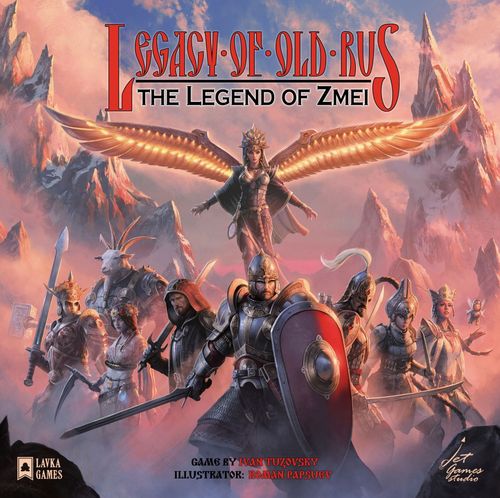
Legacy of Old Rus
Legacy of Old Rus Rulebook
Table of Contents
Table of Contents
- Components
- Setup
- Path Dice and Amulet Die
- Board Key
- Personal Player Sheet
- Course of the Game
- Dice Results and Building the Path
- Interaction with Cells on the Game Board
- Ways of Moving the Character
- Moving with Path Dice
- Moving with Amulets
- Moving with the Character's Ability
- Characters and Their Abilities
- Example of Character Movement
- Moving the Player Tokens
- Important Movement Rules
- Action Phase
- Special Place Cards
- Placing Markers on Special Place Cards
- Cities
- Outposts
- Wild Sites
- End of the Game and Scoring Glory
- Solo Mode
- Symbols
- Round Structure
Components
- Game board — 1
- Pad with personal player sheets
- 8 character cards
- 4 character tokens
- 32 wooden player markers, 8 in each colour
- 3 hexagonal path dice
- 1 hexagonal amulet die
- 4 player aids
- 1 solo-mode player aid
- 4 pencils
- 54 special place cards:
- 18 wild site cards
- 18 city cards
- 18 outpost cards
Setup
Example of setup for a 4-player game is shown on the board diagram on page 4 of the rulebook.
-
Place the game board, the path dice and the amulet die in the centre of the table.
-
Shuffle the decks of city cards, wild site cards and outpost cards separately. Each side of the common game board corresponds to one of the Tridevyatye Tsarstva and has 3 card slots. Place 3 cards in each kingdom: one in each of the matching slots next to the game board, face down.
- City cards go in the slots: Zelenov, Gorsk, Toretsin and Retivin.
- Outpost cards go in the slots: Kholmovka, Bilibinka, Afanasyevka and Sotovka.
- Wild site cards go in the slots: Goryuch-Gora, Bel-Kamen, Dikoye Rasputye and Kostyany Les.
Return the remaining cards to the box — you will not need them in this game.
-
Each player chooses one character card. Alternatively, you can deal one character card to each player at random. The front of the character card shows the character's special ability, and the back shows the starting items. The abilities of all characters are described on page 13. In your first game, we recommend choosing one of the following characters: Alyosha, Dobrynya Nikitich, Finist — Yasny Sokol, or Elena Koshcheyevna.
-
Each player chooses a colour to play and receives:
- a personal player sheet,
- 8 player markers of their colour,
- a character token of their colour,
- a pencil,
- a player aid.
-
The first player is the one who last read a fairy tale, or the youngest player. The first player receives the path dice and the amulet die. Thereafter, at the start of each round, the role of first player passes clockwise.
-
Each player marks with a cross on their personal sheet the cell where their character begins its journey.
-
When you receive your character card, write the character's name in the name field on your personal sheet, and mark in pencil, in the corresponding boxes, how much equipment and which amulets your character has at the start of the adventure. The starting items are shown on the back of the character card (see page 13).
Starting positions. In the first game we recommend placing characters on the cells marked 1–4 in the figure on page 5. Board key (page 5):
- Edge of the game board.
- Empty cell on the edge.
- Cell with an amulet on the edge.
- Cell with a special place on the edge.
- Empty cells of the game board are cells with no special place, equipment, amulet or battle icon.
- Cells on the edge of the game board are cells that touch the edge of the game board.
In later games you may change the starting positions. Begin the game on any empty cell on the edge of the game board where neighbouring cells (and the same cell) hold no character of another player. Starting with the last player (the one sitting to the right of the first player), in turn place your character tokens on empty cells on the edge of the game board.
Path Dice and Amulet Die
Faces on the path dice:
- Forest — green
- Field — yellow
- Water — blue
- Mountains — grey
- Any path
- Time of year — the tree symbol
Faces on the amulet die:
- Horse
- Endless Ring
- Hatchet
- Yaga's Ring
- Cross
Board Key
In this game 4 of the Tridevyatye Tsarstva are represented: the Triozyorskoye kingdom (1), the Logovinskoye kingdom (2), the Aranetskoye kingdom (3) and the Morevye kingdom (4). The kingdoms are separated from one another by red lines — the borders of the kingdoms (5), which place no restrictions on movement. The borders of the kingdoms matter only when carrying out tasks and assignments.
On the game board there are:
- 4 types of terrain: water (6), forest (7), field (8) and mountains (9);
- 3 types of special places: cities (10), outposts (11), wild sites (12);
- 5 types of cells with amulets (13);
- cells with equipment (14);
- battle cells (15).
Personal Player Sheet
- The area where the character's items are marked (amulets and equipment) and the battles the character takes part in.
- The map of the Tridevyatye Tsarstva, which fully repeats the map on the game board.
- The round counter. There are 8 rounds in each game. The coloured cell with the tree symbol above every 2 rounds shows the season of the year: green — summer, yellow — autumn, blue — winter, grey — spring. The column of 3 white cells under the season is used to record which faces came up on the path dice in the current round. This information tracks the rounds already played and helps you avoid confusion about which path dice have been used.
- The good-fame point area (with the good-fame point symbol). The scenario-symbol box is not needed in the base game: there, good-fame points earned under special scenario conditions would be recorded.
- A box to write the character's name.
Example. A player gets 4 amulets (crosses). They used 2 (crossed out). The 3rd and 4th may be used in any round.
Example of a personal sheet prepared for the game. Elena Koshcheyevna starts with 2 equipment and 1 good-fame point.
On the personal sheet, players plan their adventures, draw their character's path, mark the items gained and used during the game, and at the end of the game tally good-fame points. In the context of the game, the terms "character" and "player" are equivalent.
Course of the Game
The game lasts 8 rounds. After the final round, players count their good-fame points and determine the winner. Each round consists of 2 phases, in which players act simultaneously.
Movement Phase
The movement phase consists of several stages:
-
Change of first player. At the start of each round, the role of first player passes to the next participant clockwise.
-
Rolling the dice. The first player rolls all the path dice and the amulet die. (See page 8.)
-
Building the character's path. The character moves across the game board. The path is built on the personal sheet, which fully repeats the map on the game board. (See page 8.)
-
Moving the character tokens. After all players have built their paths on their personal sheets, they move their character tokens onto the cells of the game board where their movement ended. If all players have placed their characters on different cells, they can continue to act simultaneously. If several players ended their movement on the same cell of a special place, they act in turn order, starting from the first player and proceeding clockwise from them. (See page 15.)
Action Phase
The action phase is played only if one or more players have ended their movement on a cell of a special place: a city, an outpost or a wild site. (See page 16.)
Dice Results and Building the Path
After the dice are rolled, the first player and each player mark the results on their personal sheet.
Dice roll. The first player rolls all the path dice and the amulet die. After the roll, mark on your sheet the results obtained: the faces of the path dice in the cells of the corresponding round, and the amulet that came up in the item area. For example, when the "water" face came up, you may mark it as "wat" (water) or "blue". When the "time of year" face came up, you may draw a rune on your sheet.
Building the path. During play, your character moves across the game board. The path is built on your personal sheet, which fully repeats the map on the game board.
Interaction with Cells on the Game Board
Water, mountains, fields and forests are ordinary terrain cells. They may be empty, or show an amulet icon, an equipment icon or a battle icon. Each of the 4 terrain types corresponds to its own colour in the game.
Amulets are enchanted items with magical properties. Some help players cover great distances during their journeys, others help them fight various evil forces. Players receive amulets at the start of the game, after rolling the amulet die, when moving onto cells with amulet icons, and when placing their character's marker in certain card slots of wild sites, outposts and cities. A player may use an amulet received during the current round, or may keep it for later turns. A detailed description of the amulets is on page 11.
Equipment is the various weapons, armour and gear that players receive at the start of the game and during their journeys. Equipment is needed to complete tasks and assignments received from the residents of the Tridevyatye Tsarstva, and of course to fight enemies.
Battles: when you pass through such a cell, you take part in a battle with minor henchmen of the villains (it is assumed that the player wins such a battle at once), or in a glorious training duel with local warriors. At the end of the game you receive 2 good-fame points for each battle icon marked on your personal sheet.
When you pass through a terrain cell with an amulet, equipment or battle icon, you immediately mark the corresponding box on your personal sheet.
Note: you do not have to stop in order to interact with cells that show an amulet, equipment or battle icon. You may revisit these cells, but you cannot take part again in a battle you have already fought, and you cannot receive again the items you have already received on those cells.
Special places are cities, outposts and wild sites. These are inhabited settlements, military fortifications and various landmarks, which you can reach by using any face of a path die or the ability of an amulet. In most cases your movement ends here, and... an adventure begins!
When you pass through such cells for the first time — regardless of whether the special place card is revealed or not — you are obliged to end your movement there immediately. In other cases you stop on these cells at your discretion.
Ways of Moving the Character
There are 2 basic rules of movement:
- All players move simultaneously.
- The path is built secretly from other players, and only on the personal sheet.
You may think through and try out different routes, but the result of your actions must be a clearly drawn path with the starting and ending points of your character marked on the personal sheet. Mark the path you travel across terrain with a solid line. Mark cells that you jump over or fly over with a dotted line. Mark the start and end of your movement with a cross.
There are 3 ways to move on the map:
- using path dice;
- using amulets;
- using the character's ability (once per round).
Sidebar: What does it mean to "pass through" or "visit" a cell? To pass through a cell means to visit it during the game. A cell you have passed through is normally marked on the personal sheet with a solid line. Also, when you used a Yaga's Ring or a Horse amulet and landed on a cell, that cell counts as passed (see page 11). Some tasks and assignments will require you to pass certain cells. In the context of the game, the terms "visited" and "passed through" are equivalent.
Moving with Path Dice
For 1 path die, a player may make 1 move to an adjacent cell of the same terrain type (colour) that came up on the die.
Example. If the path dice show the "water", "forest" and "mountains" faces, the red player standing on a water cell may move to the cells shown by the arrows.
Moving with Amulets
The game has 5 types of amulets, 4 of which can be used for movement. Players may use any number of amulets, including those received during the current movement. Using an amulet of this kind, you can move in a special way — no die is needed for this. Remember to cross off the used amulet on your personal sheet immediately. We recommend crossing them off in the order they were received, from left to right, so that it is easier to keep track.
Cross: make 1 move to a cell of any terrain type that did not come up on the dice this round. The "any path" and "time of year" faces are ignored for this purpose, so if the path dice show 3 "any path" and/or "time of year" faces, you may use the Cross to move to any adjacent cell.
Endless Ring: make 1 move to a cell of any terrain type that came up on the path dice this round. You may copy the "any path" and "time of year" faces.
Horse: jump over 1 cell in any direction. The cell you jumped over is not considered visited — mark the jump over it with a dotted line. A Horse cannot be used to move to an adjacent cell.
Yaga's Ring: fly over any number of cells in any direction in a straight line, and stop on a cell on the edge of the game board (or on the cell directly before an obstacle, if you are playing one of the scenarios).
- You cannot stop along the way; movement ends only on a cell on the edge of the game board, or if you encounter an obstacle during the flight.
- You cannot move along the borders of cells.
Example of the Horse. Cells that the player jumps over are shaded red. In the example the player cannot use the Horse to move onto the cell marked with the Hatchet icon, because they would have to jump over the edge of the board.
Mark your movement with a dotted line — from the cell where you start your movement to the cell where you land. When you use a Horse or Yaga's Ring, you do not visit the cells you jumped or flew over: you do not receive items from them and you do not take part in battles on them. The cell where you land (on the edge of the board) counts as visited. If this cell is not empty, interact with it by the usual rules (see page 9). Remember that you are obliged to end your movement if you have moved into a special place for the first time.
Example of the Yaga's Ring. Vasilisa is on a forest cell. The green lines show the cells to which she can move using the Yaga's Ring; the red lines show the cells to which she cannot.
Each unused Yaga's Ring is worth 1 good-fame point at the end of the game.
Hatchet is not used during movement, but it works very well in battles with enemies. Use as many hatchets as you like to gain, once, 2 equipment for each hatchet used in a battle with an enemy. This extra equipment is not recorded in the items area. If a wild site card requires you to spend equipment, you cannot spend a hatchet in its place — you must cross out the equipment on the sheet. A hatchet can be used in any situation (including in scenarios) where the player needs to have a certain amount of equipment. Each unused hatchet at the end of the game is worth 1 good-fame point.
Moving with the Character's Ability
Each character has its own ability, which allows passing through 1 specific cell per round without using path dice or amulets. If you used your character's ability in this round, turn the character card face down. At the start of the next round, turn the card face up again so that you can use the ability again.
You may use path dice, amulets (spend as many as you like) and the character's special ability (only once per round), in any order and in any combination, for as long as you can and want to move, or until you visit a special place for the first time.
Important! When a character's special ability allows passing through a certain cell once per turn, that cell must be adjacent to the cell the character stands on before the ability is used.
Characters and Their Abilities
Each character card gives an ability and the starting items. Starting items are shown with the same icons as on the board: equipment, amulets (Horse, Endless Ring, Hatchet, Yaga's Ring, Cross), and a number where more than one is given.
Alyonushka and Ivanushka
- Ability: pass an empty cell on the edge of the game board.
- Starting items: 1 equipment, 1 Endless Ring, 1 Yaga's Ring.
Nesmeyana
- Ability: pass a cell where you have already been.
- Starting items: 1 equipment, 1 Horse, 2 Crosses.
Finist — Yasny Sokol
- Ability: pass an empty cell adjacent to a wild site.
- Starting items: 2 equipment, 1 Horse.
Varvara
- Ability: pass onto a cell with a wild site or a city icon that you have not yet visited.
- Starting items: 1 equipment, 1 Endless Ring, 1 Cross.
Alyosha
- Ability: pass an empty cell adjacent to a city.
- Starting items: 1 equipment, 1 Endless Ring, 1 Hatchet.
Vasilisa the Wise
- Ability: pass a cell with an amulet that you do not have.
- Starting items: 1 equipment, 1 Horse.
- Note: amulets that have been used do not affect the use of Vasilisa's ability.
Dobrynya Nikitich
- Ability: pass an empty cell adjacent to a city.
- Starting items: 1 equipment, 1 Horse, 1 Cross.
Elena Koshcheyevna
- Ability: pass a cell of the colour of the current season.
- Starting items: 2 equipment, 1 Yaga's Ring.
- Note: using her ability, Elena can move onto a cell of a special place.
Example of Character Movement
The path dice show the following faces: forest, time of year and any path. The amulet die shows the Horse. Thus, at the start of movement, Dobrynya Nikitich has 1 Cross, 3 Horses, 2 Endless Rings, 1 equipment, and 1 passed cell with a battle. Dobrynya Nikitich starts the movement on a water cell with a battle.
- Dobrynya's special ability allows him, once per round, to pass 1 empty cell adjacent to a city. Using it, Dobrynya moves onto a mountain cell next to the city Gorsk.
- He then uses the "any path" face and moves to a water cell, picking up equipment there. Dobrynya marks it on his personal sheet; this is already the 2nd equipment he has received in the game.
- He then uses a Horse, jumps over to a field cell and picks up a Yaga's Ring, marking it on his personal sheet.
- Dobrynya decides to use the Yaga's Ring straight away: he crosses it off, chooses a direction and flies to the water cell on the right edge of the game board. He does not receive either the equipment or the amulets from the cells he flew over.
- Since this is the 3rd round, autumn, the "time of year" face means yellow — field. Dobrynya uses the "time of year" face and moves to an adjacent field cell, immediately marking the equipment he receives.
- Then Dobrynya uses the "forest" face, moves to an adjacent forest and picks up 1 more Yaga's Ring.
- Deciding once again to use the Yaga's Ring he has just picked up, Dobrynya crosses it off and flies to the forest cell at the top of the game board, where he picks up 1 more equipment, and marks it on his personal sheet.
- Next, Dobrynya uses a Horse and jumps onto a mountain cell, picking up a Hatchet there.
- Deciding that ending his movement on a cell that is not a special place is not very advantageous, Dobrynya turns towards the city Zelenov and uses an Endless Ring, copying the "any path" face rolled this round. This allows Dobrynya to move to an adjacent forest cell and pick up 1 more equipment.
- Finally, Dobrynya Nikitich uses a Cross to move to Zelenov. He is in this city for the first time, so his movement ends automatically.
Moving the Player Tokens
At the end of the movement phase, after all players have built the paths of their characters on their personal sheets, they move their character tokens onto the cells of the game board where their movement ended.
- If all players have placed their characters on different cells, they can continue to act simultaneously.
- If several players have ended their movement on the same cell of a special place, they act in turn order, starting from the first player and proceeding clockwise from them.
Note: during your first steps in learning Legacy of Old Rus, if you end up in different special places, you may act not simultaneously but in turn order, showing in this way which specific actions you took. You may also agree that each player shows how they traversed their path.
Important Movement Rules
- You are not obliged to use all the faces rolled on the path dice.
- A character's special ability is used once per round.
- You may use any number of the amulets you have during movement, including amulets you have just picked up, which you may use immediately.
- You may revisit any cells, but you can receive the amulet, equipment, or take part in a battle on each cell only once per game.
- If you pass through a special place for the first time, you are obliged to stop immediately. On a repeat visit to that special place you may choose not to stop.
- When you jump over or fly over cells, you do not interact with them: you do not receive amulets or equipment, do not take part in battles, and do not visit special places there. The cell where you land counts as visited, and you interact with it by the normal rules. Mark jumps and flights with a dotted line, to distinguish them from cells you passed through in the ordinary way.
Action Phase
The action phase is played only if one or more players have ended their movement on a cell of a special place: in a city, at an outpost or in a wild site.
Special Place Cards
Legacy of Old Rus has cells with special places:
- cities, where you can receive a task;
- outposts, where you can take an assignment;
- wild sites, where you can meet enemies and fight them.
Each city, outpost or wild site card lying next to the game board corresponds to the cell on the board with the same name.
If you visit a special place for the first time, you are obliged to place a marker of your colour in one of the slots of its card. Several options of action are available on each card. Having chosen an action, place a marker of your colour in the corresponding slot.
After a player has left a special place, their marker remains on the card. The other participants who later visit this special place do not place a new card: they interact with the card that is already revealed.
Example. Dobrynya Nikitich (the red player) came to the city Toretsin. No other player has been there yet, so Dobrynya turns over the Toretsin card and chooses an action, placing his marker in the task slot. Varvara (the green player) came to the outpost Sotovka. Its card is already revealed, because in the previous round Dobrynya had visited this outpost and made his choice, placing a player's marker in the warehouse slot. Varvara decides to complete the assignment and places her marker on the far left cell of the corresponding slot, free of charge.
So, your movement has ended on a special place. In this case:
- If the card of the corresponding place lies face down, turn it over, choose an action and place a marker of your colour in the needed slot.
- If the card of the corresponding place lies face up, but there is no marker of yours on it yet, place your marker in one of the slots available to you.
- If the card of the corresponding place lies face up and already has your marker on it, nothing happens: you have already been here.
Placing Markers on Special Place Cards
- Each special place card may hold only 1 of your markers.
- The slots on special place cards may contain 1 or 4 cells for player markers. In a slot with 1 cell, only 1 player may place a marker; in a slot with 4 cells, the markers of all participants may be placed.
- The slots with tasks and assignments on the cards are special: each player may place their marker on 1 of the cells of the slot. The first player places the marker free of charge on the far left cell. Subsequent players may place a marker of their colour in the same slot, on the far left free cell, by spending 1 amulet on their personal sheet.
Note: when you spend an amulet this way, you simply cross it off on your personal sheet, without applying its ability.
Cities
In a city you can rest, restock your road supplies, find magical trinkets and good equipment. The city residents will also certainly have interesting tasks for you.
- In the treasury players may receive valuable items as a gift from the posadnik (the city's governor).
- In the arsenal players may replenish their supply of equipment.
- By taking a task, a player may receive additional good-fame points at the end of the game.
Example. In this city a player may choose one of three actions:
- Visit the treasury: receive, marking on the personal sheet, 1 Endless Ring and 1 Cross.
- Visit the arsenal: receive, marking on the personal sheet, 2 equipment.
- Take the task (a cell available to all players): at the end of the game receive 2 good-fame points and 1 good-fame point for each unspent equipment. If a player chooses this cell, they must place their marker on the far left free cell. The next player who wants to take the task and place their marker in this cell must spend 1 amulet of any kind. If a player places their marker in the treasury or arsenal cell, the other participants can no longer choose that cell, since no free cells will remain there.
Card text (flavour, as printed on the city card): the sorceress-seer Vedana prophesies great misfortune for this city. Although prophecies do not always come true, the posadnik would feel calmer if you helped to replenish the arsenal for the defence of the city. Will you take on this task?
Flavour text printed at the foot of the page: Sometimes, having taken a task or an assignment, you realise at once that you have already fulfilled all its conditions. Wonderful — so you have already earned the reward. Sometimes we do great deeds without noticing!
Outposts
Scattered across all the Tridevyatye Tsarstva are outposts, guard fortress-settlements built to defend the border territories. At outposts you can receive special assignments. By visiting the outpost warehouse, you can replenish your supplies with various items received as gifts from the voevoda.
When you take an assignment, the player takes on certain obligations towards the petitioner, since for an unfulfilled assignment you will have to lose a certain number of good-fame points.
On some city and outpost cards you may see the condition "in this kingdom". This means that the task or assignment must be fulfilled only in the kingdom where it was received.
Card text (flavour, as printed on the outpost card): in the middle of the courtyard at the outpost you see an enormous brown bear, and beside it a fragile girl. It turns out that the girl is an enchantress who can command animals and birds. She helps to protect the outpost's surroundings, and she very much needs your help. Find protective amulets for the defence. It is best to start the search right now.
Card assignment (cell 1): gain 7 good-fame points if you have passed 8 cells with an amulet icon; otherwise lose 3 good-fame points.
Card warehouse (cell 2): the cards show the items the warehouse offers.
Note: if you exceed the required conditions of an assignment, you still receive the good-fame points for it only once.
Wild Sites
Cells with the skull symbol are places where strong enemies live. When you move into a wild site, you assess your own strength and choose an action slot, taking into account the equipment you have.
In the slots of the wild site card (except the upper-left slot 3), the number of equipment needed for the battle is shown above the cell for the player's marker (1), and below it the reward: good-fame points (gold) and possibly amulets or equipment (2).
Note: you receive good-fame points from cards at the end of the game, while amulets and equipment you receive at once, marking them on your personal sheet.
If you do not have enough equipment, you can always take one of the free cells of the upper-left slot of the card (3), receiving the items shown there.
The bottom-left slot is also divided into cells (4). It is available to all players, but requires a certain amount of equipment.
Some slots (on the picture, the bottom-right slot, 5) require not only a certain amount of equipment, but also that you spend several units of equipment after the battle, that is, cross them off on your sheet.
Important! If for a battle with an enemy in a wild site you use only a Hatchet, but the slot requires you to spend equipment that you do not have, you cannot place your marker in that slot — you must choose another.
Card text (flavour, as printed on the wild site card): they say a terrible serpent has appeared in these parts, a Chudo-Yudo with twelve heads, and not alone but with helpers. The local voevoda has learned that the Chudo-Yudo wants to burn all the local fields to the ground. You find the serpent's secret lair and...
Action slots printed on the example card: "Lull the vermin and find a treasure"; "Defeat the serpent's servants"; "Slay the magic horse"; "Summon the Chudo-Yudo to battle".
Example. The green player is in the wild site Bel-Kamen. They may choose only the cells marked by the arrows.
Card text (flavour, as printed): the residents of the village complain about a terrible sorcerer and his unclean minions: vile creatures ruin the harvest, kill the livestock and, they say, even kidnap children. Helping the people is your duty, so you decide...
Action slots on this card: upper left — "Search the sorcerer's hut"; upper right — "Intimidate the villain"; lower left — "Burn the empty sorcerer's hut"; lower right — "Deal with the sorcerer".
- Upper left, because it does not require equipment and has free cells, so it is available to all players.
- Upper right, because the green player can spend 1 Hatchet and add 2 additional equipment to the 1 they already have, so that they will have 3 of the 3 required.
- Lower left: although the red player's marker is already on it, this cell can still be taken, since it has free cells. To choose the lower-left cell, the player may cross off 2 Hatchets and immediately use the 4 additional equipment they give, to meet the cell's requirement (this requires exactly 5 equipment), and take the reward.
- Lower right: the player cannot take this cell, because doing so requires spending 2 equipment, which the player does not have.
The green player decides to choose the upper-right cell. By crossing off 1 Hatchet, they use 2 additional equipment, meet the cell's requirements and receive a Hatchet (marking it on the personal sheet at once), and will also receive 3 good-fame points at the end of the game.
End of the Game and Scoring Glory
After 8 rounds, participants count the good-fame points earned during their adventures. For this they write down the points for each of the indicators shown in the bottom-right corner of the personal sheet:
- Good-fame points for each city where the participant took tasks.
- Good-fame points for completed assignments in visited outposts, or a penalty for uncompleted assignments.
- Good-fame points for wild sites, in accordance with the markers placed.
- 2 good-fame points for each visited cell with a battle icon, as marked in the bottom-left corner of the personal sheet.
- 1 good-fame point for each unused Hatchet and each unused Yaga's Ring.
- If one of the scenarios was used, the good-fame points earned in the scenario.
The player with the most good-fame points becomes the winner. In case of a tie on points, the player with the most unused equipment wins. If there is still a tie, all the contenders are declared the most glorious defenders of the Tridevyatye Tsarstva!
Explanation of some tasks and assignments. The sign "/" should be read as "and/or" on all special place cards. For example, a card reading "2 for each unused [Hatchet] / [Yaga's Ring]" means a reward for all unused Hatchets and/or Yaga's Rings. Such tasks give a reward for all the passed cells of the specified type, in any combination. A card reading "1 for every 2 passed empty cells" likewise gives a reward for all passed empty cells, in any combination.
Example of scoring. Vasilisa the Wise (the yellow player) visited 2 cities, 3 outposts and 3 wild sites. When counting points, all the cards stay lying around the game board; in the picture they are shown next to the player's personal sheet only for convenience.
Cities:
- In Gorsk Vasilisa visited the arsenal, so she does not receive points for this city.
- In Toretsin she took the task and receives 2, plus 1 for each unspent equipment (she has 3), so 5 in total.
Outposts:
- In Bilibinka Vasilisa took an assignment and could receive 7 if she flew a total of 10 cells with the Yaga's Ring. She flew a total of 20 cells and receives 7. The cells from which the player started, and those in which the player ended movement by means of this amulet, are not counted.
- In Afanasyevka Vasilisa took an assignment and could receive 7 if she passed 13 cells along the edge of the board. Vasilisa passed 21 cells along the edge of the board, and receives 7. Cells that the player jumped over or flew over with the help of amulets are not counted.
- In Kholmovka Vasilisa took an assignment and could receive 7 if she passed 2 cells each with amulets of two types on the game board. She passed 3 cells with the Endless Ring, 2 cells with the Cross, 2 cells with the Horse and 1 cell with the Hatchet. Vasilisa exceeded the assignment, but still receives only 7.
- Vasilisa did not receive any penalties, since she completed all her assignments.
Wild sites:
- Having fought the enemy in Kostyany Les, Vasilisa received 6.
- Having defeated the enemy at Dikoye Rasputye, Vasilisa received 10.
- Having fought the enemy in Bel-Kamen, Vasilisa received 10.
Battles: Vasilisa took part in 5 battles during the game (5 battle icons, each worth 2) and receives 10.
Unused items: Vasilisa has no unused Hatchets or Yaga's Rings.
Note: the cell with the scenario symbol is not used in the base game.
Final result: 62 good-fame points.
Solo Mode
In this mode you play the role of a hero who seeks glory in the Tridevyatye Tsarstva. Your goal is to gain as many good-fame points as possible, to write your name into the chronicle of the Tridevyatye Tsarstva. But you will have an invisible rival: another great hero, who will hinder you from becoming famous by performing the most significant feats. This rival moves across the cards of special places, not across the game board, and places a marker of their colour on a card every turn.
Setup for Solo Mode
- Prepare the game for play by the usual rules. Do not place your character token on the game board at this stage.
- Take one of the character tokens and all the markers of one colour not used in the game. Place these components next to the game board. The rival does not need a character card or a personal sheet.
- Roll the amulet die and place your rival's token on a card depending on the result:
- Endless Ring — Zelenov;
- Cross — Toretsin;
- Horse — Retivin;
- Hatchet — Gorsk;
- Yaga's Ring — Bilibinka.
- During setup, do not turn over the special place card on which you placed the rival's token: it remains lying face down.
- After completing the steps above, place your character token on any empty cell on the edge of the game board.
The Rival's Turn
At the start of each round, immediately after the dice are rolled, the rival takes its turn, which consists of 2 actions:
- Movement. The rival's token moves not across the game board but across the special place cards, clockwise. Each card is 1 step. The number of steps depends on the face rolled on the amulet die:
- Endless Ring — 1 step;
- Cross — 2 steps;
- Horse — 3 steps;
- Hatchet — 4 steps;
- Yaga's Ring — 5 steps.
If after the movement the rival ends up on a card where its marker is already present, it continues to move clockwise until it reaches a card on which its marker is not yet present.
- Placing a marker. Place the rival's marker on the card where its movement ended. If the card on which the rival's token stopped lies face down, turn it over. Then the rival places its marker on the special place card:
- on a city — on the far left free cell of the task slot;
- on an outpost — on the far left free cell of the assignment slot;
- on a wild site — into the slot that gives the greatest number of good-fame points.
The rival ignores the requirements of the slot it occupies, in all possible respects.
After the rival's turn, the player takes their own turn by the usual rules. Thus, in solo mode, the player always moves second.
Example. The blue colour has been chosen for the rival. The amulet die shows the Cross, so the rival must make 2 steps clockwise from Kholmovka. The rival's token moves to the card with Toretsin, but there is already its marker there, so the rival moves on. Sotovka holds the player's marker, but this does not matter: the rival must place its marker on the far left free cell of the assignment slot, ignoring the requirement to spend an amulet.
End of the Solo Game
Count your good-fame points by the usual rules. The rival's good-fame points are not counted. Depending on your result, determine your place in the history of the Tridevyatye Tsarstva:
- 30 or fewer — village militia;
- 31–40 — ordinary fighter;
- 41–50 — seasoned warrior;
- 51–60 — famous knight;
- more than 60 — hero of the epics.
Symbols
Terrain: water, mountains, field, forest.
Special places: city, outpost, wild site.
Amulets: Cross, Horse, Endless Ring, Yaga's Ring, Hatchet.
Other: equipment, battle, time of year, good-fame points, number of players.
Scenario symbols: bonus token; do not flip the horde token after defeating it (crossed symbol); flip the horde token after defeating it (arrow symbol).
Round Structure
Movement phase
- Change of the first player.
- Roll the path dice and the amulet die.
- Build the characters' paths on the personal sheets.
- Move the character tokens on the game board.
Action phase
Placing a player's marker in the chosen action slot on a special place card (skipped if the player's token is not on a cell with a city, outpost or wild site icon), and/or carrying out a special action of the scenario.