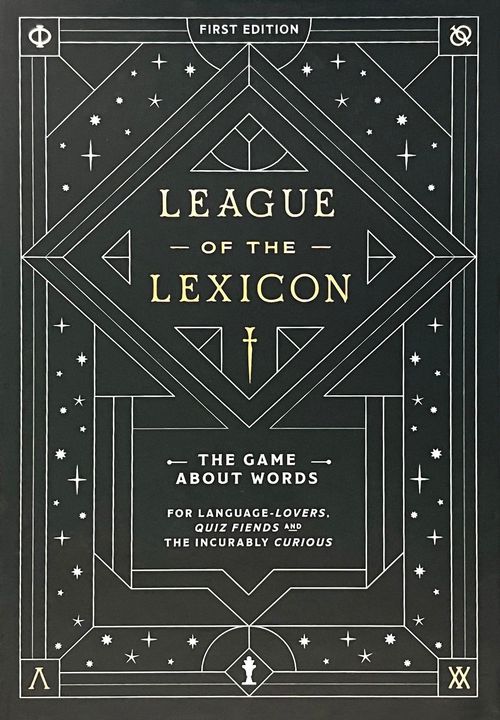
League of the Lexicon
League of the Lexicon Rulebook
Table of Contents
Table of Contents
The Game
With two thousand questions in five devilish categories, even seasoned wordsmiths will find themselves tested. And with two levels of difficulty, everyone can join in.
Components
- Four hundred Question Cards
- Forty-five rare lexical Artefacts (Artefact Cards)
- Six Character Cards
- One Die
Rules of Play
Object of the Game
Be the first player (or team) to win five Artefacts, then answer one final question to win the game.
Setup
Shuffle the Artefact Deck, but keep the Question Cards in the main box for convenience. Questions come in two difficulty levels: Tricksy (harder) and Ticklish (easier). Each player selects the difficulty level they wish to play.
Players then take a Character Card. These can be chosen or, to avoid argument, dealt unseen. Note the symbols at the bottom of each Character Card because these are important in the game.
Gameplay
The youngest player starts, rolling the die to select their question. The number on the die will match a category on the Question Card. (If the Player's Choice symbol is rolled, the player decides the category, but can't read the questions in advance.)
The question is read out by another player. The Turn Player may then read it themselves, unless it's a spelling question.
If answered correctly, the Turn Player draws an Artefact Card. If the symbol on the Artefact matches one on their Character Card, it counts towards their target score. (NB: having multiples of any one symbol is fine.) If there's no match, it doesn't count, but hold on to it to use as so:
- TWO Artefacts without a matching symbol can be traded at the beginning of a player's next turn for ONE new Artefact. (Discarded Artefacts go to the bottom of the Artefact Deck.)
- THREE Artefacts without a matching symbol can be played as a single 'matched' Artefact. (Such Artefacts can feature any symbol. You don't need a 'set'.)
With the question answered, and any Artefact drawn, the turn concludes and play continues clockwise.
Winning
The player who collects five matched Artefacts (or four matched and three unmatched) places them face up. They must now answer a Decider Question to win. However, the question category is chosen by rival players not the die (players cannot read the questions in advance).
A correct answer earns victory and a smug glow, and the game concludes. But if incorrect, play continues until a player successfully answers their Decider Question.
The Questions
Question Cards feature five categories that probe every corner of language.
- Lexicon Master: Synonyms, antonyms, categories and compounds.
- Meaning & More: Definitions, odd-ones-out and archaic words.
- Usage & Abusage: Mistaken identity, grammar and the devilish spelling bee.
- Word Sauce: Origin stories of words and phrases.
- Wordly Wisdom: A pot-pourri of linguistic trivia.
Levels of Difficulty
League of the Lexicon is for everybody. Choose from two levels of difficulty, indicated at the bottom of the question card. How brave do you feel?
- Tricksy: Harder questions to test even the most seasoned wordsmiths.
- Ticklish: Easier questions, perfect for less confident players.
We've taken great care to ensure questions include full and interesting answers. The game may be challenging, but we guarantee you'll know more at the end than when you started.
Variations
Fancy teaming up, playing alone or adding some wrinkles to the game? Here are six variations of League of the Lexicon to keep things interesting.
1. The All-For-One
Players work as a team to earn ten matched Artefacts in the fewest questions.
Draw one Character Card for the group and play as normal, answering questions together. The game concludes after ten matched Artefacts are won.
2. The Party-Play One
This version can involve any number of players and doesn't require Character Cards. Instead, players take an Artefact for every correct answer.
Play a set number of rounds, or until the Artefact deck is exhausted. The player with the most Artefacts wins.
3. The Solo One
Draw a Character Card and play to win five matched Artefacts. Play concludes when you've won your fifth matched Artefact.
Note: you'll need to re-roll the die for spelling questions.
4. The Quick One
Reduce the target number of matched Artefacts needed from five to four, then play as normal.
5. The Extended One
Increase the target number of matched Artefacts needed from five to six (or more) then play as normal.
6. The Devious One
As with normal rules, except for two wrinkles:
Wrinkle one: instead of drawing from the Artefact deck, a player with two unmatched Artefacts can, at the beginning of their turn, 'steal' an Artefact, unseen, from any other player. (The two unmatched Artefacts go to the bottom of the Artefact deck.)
Wrinkle two: if a player with five matching Artefacts gets their Decider Question wrong, they must return a matched Artefact to the deck. This means they must earn another matched Artefact to be eligible for their Decider Question.
FAQs
Can I read my own questions?
A player can inspect the question card once it has been read out by another player. In fact, some questions require reading. The only exception is spelling questions, for obvious reasons.
Is there a time limit for answering questions?
Questions have a two-minute time limit to keep play moving - although most can be answered more quickly.
No timer is included because it's not in the spirit of the game. We prefer common sense and a good sporting spirit to prevail. Remember: nobody likes playing with a time bully, but time hogs aren't much fun either.
What question level do I choose?
The Ticklish level is for less confident wordsmiths, while the Tricksy level is for everyone else. Play at the level you feel most comfortable.
Can I change my question level during the game?
If a player finds Ticklish questions too easy - or Tricksy too hard - they can change their level, but only once, and only within their first five turns.
I think the answer is wrong. What now?
Although answers have been researched carefully, you may disagree with what's on the card.
To make a challenge, a player must provide reliable evidence of the correct answer.
The League also invites players to inform us of mistakes, which will be corrected in future editions. See Notes and Queries for more information.
Can I contribute a question to the game?
League of the Lexicon will update future editions with new questions and welcomes contributions from fellow language lovers. Please check Notes and Queries for details.
Notes and Queries
Submitting Questions
If you would like to contribute a question to a future edition of League of the Lexicon, please visit the Writers' Room on the League of the Lexicon website.
Correcting Mistakes
Every effort has gone into checking questions for accuracy, but, being human, the odd mistake may have slipped through. Nor does it help that language itself is slippery, particularly where grammar, etymology and history are concerned.
If you spot a mistake or disagree with an answer, use the Contact Form on the website to let us know.
Sources
League of the Lexicon has drawn on hundreds of sources in the process of writing game questions.
To keep things simple, the Oxford English Dictionary (OED) is the ultimate arbiter, with Merriam-Webster (M-W) a close second. Sometimes you will see these sources in the answer, abbreviated to OED and M-W on Question Cards.
Etymology of words and phrases can often be a minefield, with many competing accounts to consider. Such matters have been researched thoroughly, avoiding highly contested terms and favouring the most widely accepted explanations.
Spelling and Such
Spelling, punctuation and grammar are based on UK English.
Expansion Packs
Three special edition question decks, each featuring 500 thoughtfully crafted questions in five custom categories.
- Slang Edition: 500 questions on slang, cant, swearing and everything pertaining to the vulgar tongue. Adult themes - suitable for ages 18+.
- Global Edition: 500 questions on the world of language, from ancient to modern, Aramaic to Zulu. Suitable for ages 14+.
- Junior Edition: 500 questions made for young word hounds to sink their teeth into. Suitable for ages 10+.