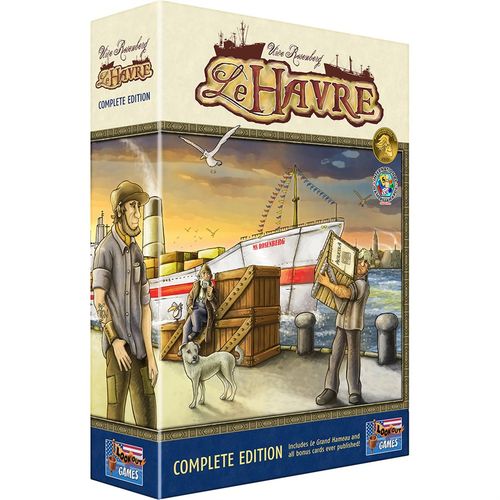
Le Havre
Le Havre Rulebook
Table of Contents
Table of Contents
Components
- 1 Rules booklet, 1 Rules appendix (Buildings overview), 3 game boards
- 5 Person discs and 5 Ship markers (one in each player color)
- 7 large round Supply tiles (each showing 2 game tokens), 16 Food production tokens, 1 Starting player tile
- 420 tokens: 48 "1 Franc" and 30 "5 Franc" coins (Francs are not goods); 60 Cattle (0 Food)/Meat (3 Food); 60 Grain (0 Food)/Bread (2 Food); 30 Iron/Steel (steel can be used as iron); 42 Clay/Brick (brick can be used as clay); 48 Wood (1 Energy)/Charcoal (3 Energy); 42 Fish (1 Food)/Smoked Fish (2 Food); 30 Coal (3 Energy)/Coke (10 Energy); 30 Hide/Leather. (You can make change for Francs at any time, but never for food or energy.)
- 110 cards: 5 "Game turn" overview cards (Buttery on reverse); 33 Standard building cards (including the Starting buildings: one Construction Firm and two Building Firms); 36 Special building cards; 20 Round cards (Ship on reverse — 7 Wooden ships, 6 Iron ships, 4 Steel ships, 3 Luxury liners); 11 Loan cards; 5 Round overview cards (one per 1–5 player count)
Setup
Le Havre can be played in a full or a shortened version.
| Players | 1 | 2 | 3 | 4 | 5 |
|---|---|---|---|---|---|
| Rounds (full) | 7 | 14 | 18 | 20 | 20 |
| Rounds (shortened) | 4 | 8 | 12 | 12 | 15 |
(The 5-player game is recommended only for experienced players.)
- Game boards. Place the 3 game boards side by side. The board with the Treasury is on the left, the board with the three Building Proposals is in the center, and the board with the Ship spaces is on the right.
- Playing pieces. Each player takes 1 Person disc, 1 Ship marker and 1 Game turn overview card (may be turned to show the Buttery).
- Supply tiles. Shuffle the 7 Supply tiles and place them face down on the round spaces. Place players' Ship markers beside the first game board, near the first Supply tile.
- Goods and food tokens. Place tokens on their Supply spaces (most can be left in the box and added as needed). There is a Supply and a corresponding Offer space for six goods types and for 1 Franc coins, but only Supply spaces for 5 Franc coins, coal, and hides.
- Upgrading goods. Each token has a standard side and an upgraded side (distinguished by borders). Only standard goods enter the game through the Offer spaces; these can be upgraded using Building actions.
- Starting offers. Place 2 Francs, 2 fish, 2 wood and 1 clay on the appropriate Offer spaces (full game).
- Starting money. Each player starts the full game with 5 Francs and 1 coal.
- Special buildings. Shuffle the special building cards and place 6 face-down on the "Special buildings" space. Return the rest to the box.
- Building cards. Two types: Standard building cards and Special building cards (shown by the anchor). Each has a building cost (top left), an entry fee (top right), a value (left of the name), an action, and a sort order number (top right).
Shortened version setup changes: Place 3 Francs, 3 fish, 3 wood, 2 clay, 1 iron, 1 grain and 1 cattle on the 7 Offer spaces. Each player receives 5 Francs, 2 fish, 2 wood, 2 clay, 2 iron, 1 cattle, 2 coal and 2 hides. Use the light-colored ticks to sort Standard buildings. Special buildings are not used. (In the 2-player shortened game, each player starts with a 2-value Wooden ship card; sort Round cards by the light-colored circles; use the shortened side of Round overview cards.)
Playing the Game
During the Round stage, players play a fixed number of rounds. A round consists of 7 individual player turns, followed by resolution of the applicable Round card. In the Final stage, each player carries out one final action; then players count their wealth.
Round Stage
The Starting Player (the player who lives closest to water) takes the Starting player tile. After his turn, players take turns clockwise. (The Starting player tile has no ongoing function; it does not change during the game.)
A Player's Turn
A turn consists of two Mandatory actions (first a Supply action, then a Main action) plus optional Additional actions (Buying and Selling, at any time during the turn).
Supply Action
- The player places his Ship marker on the next free Supply tile (in the direction of the arrow). In the first round, Supply tiles are face-down until occupied; once occupied, they are turned over and remain face up in place until the end of the game.
- Each Supply tile shows two different tokens (Goods or Francs). The player takes 1 token from each of these Supply spaces and places them standard-side up on the appropriate Offer spaces.
- The turn in which a ship is placed on the seventh Supply tile is the last in a round. At the end of it, the current Round card is resolved and turned over.
- Interest for Loan cards: The word "Interest" is written on one of the seven Supply tiles. Whenever any player places a ship on this tile, all players who have taken a loan must immediately pay exactly 1 Franc in interest (regardless of the number of loans). A player who cannot pay must sell a building/ship or take another loan, then pay the 1 Franc.
Main Action
The player chooses one of two Main actions:
A: Take goods from an Offer space. Take all tokens (Goods or Francs) from one of the seven Offer spaces. There is no limit to a personal supply; all goods and Francs are placed face up. (Coal and hides are only available through building actions.)
B: The Building Action.
- Entering a Building: To use a building's action, move your Person disc to an unoccupied building. You may enter buildings owned by the town or by any player. A player may not re-use a building that already contains his Person disc. Buildings still in the Building Proposals area have not been built and may not be entered.
- Entry Fee: There is often a fee to use another player's building (shown at the top right of the card), paid to the owner in food or Francs before entering. If food and money costs are separated by a "/", pay only one. You may never enter a building if you cannot pay the entry fee. A player entering a building must carry out its action. You do not pay entry fees to enter your own buildings; if a building belongs to the town, the fee is paid to the Treasury.
- Note: Food can always be replaced 1:1 with Francs, but Francs can never be replaced with food.
Additional Actions: Buying and Selling
Buying (at any time during your own turn, even before Supply/Main actions):
- Buildings: All buildings owned by the town and the top building of each of the three Building Proposal piles are available for purchase. The purchase price is usually the building's value (or a separately indicated "Cost"). You may buy more than one building from the same pile in sequence.
- Ships: Only the topmost face-up card on each ship pile may be purchased. The cost is higher than its value. Ships can be purchased even if no one has built a wharf yet (wharves are only required to build ships).
Selling (may even be taken during another player's turn, but not while she is taking an action): Buildings and Ships are sold to the town for half of their value. A sold building goes with the town's buildings; a sold ship goes on top of its ship pile. Person discs are returned to the player when a building is bought or sold. Buildings may not be sold and then bought again in the same game turn. Buildings and ships may not be sold to other players.
Buildings
Constructing new buildings. New buildings are built using the "Construction Firm" and the two "Building Firms" (owned by the town at start). A player who enters one can build any of the top buildings in the Building Proposals area by paying the building costs. (Brick can always be used instead of clay; steel instead of iron.) These starting buildings do not allow ships to be built, only buildings.
Building Ships. Ships reduce the food their owner must pay at the end of each round. At the end of each round a new Ship card is introduced. Ships may be built at a Wharf (one ship per visit). To build a ship, pay any entry fee to the Wharf's owner, then pay the building resources and 3 energy required (energy comes from wood/charcoal or coal/coke).
- Special Case: The first player to build a non-Wooden ship (Iron, Steel, or Luxury liner) at a particular Wharf must modernize the Wharf by placing 1 brick on it (remains for the rest of the game, for all players). Only a player building a ship may modernize a Wharf; you need not own the Wharf to modernize it.
End of a Round
After every seventh game turn, the top Round card is resolved. Refer to the line for the current number of players: the second number gives the round number; the cooking pot symbol dictates the food each player must pay; a building symbol may indicate the town constructs a building; the far right column shows a Starting player number.
Harvest. Players receive grain and cattle. A player with at least 1 grain receives 1 additional grain. A player with at least 2 cattle receives 1 additional cattle. In "No Harvest" rounds, neither is distributed. (A player may never receive more than 1 grain and 1 cattle during a Harvest.)
Feeding phase. Each player pays the food shown on the Cooking pot symbol. Each ship a player owns reduces the food owed by the amount on the ship card. A player who cannot pay must sell buildings or take a Loan card. (Each Franc counts as 1 Food. Even if a player's ships provide more food than owed, or a player cannot pay the exact amount, she may not take excess food.)
The town constructs buildings. A Standard building symbol: take the card with the lowest sort order number from the Building Proposals. A Special building symbol: turn the top card of the Special buildings pile face up.
New Ship card. Turn the Round card over to show the ship on its reverse; place it on its ship pile.
Final Stage
The Round stage ends when the last Round card is resolved. In the Final stage, each player has exactly one more turn and carries out a Final action — a Main action only (no Supply or Buying actions, and no Interest). Players may still repay loans and sell buildings/ships. In the Final stage only, Person discs may be moved to buildings already occupied by other Person discs (each player may visit one building of choice). The only building that may not be entered is the one your Person disc is already on.
Game End and Winner
The game ends immediately after the final actions. A player's wealth is:
- The indicated values of her buildings and ships;
- The additional value of buildings with a plus symbol (e.g. the Bank), which depend on other buildings owned;
- Her cash;
- Minus 7 Francs for each unrepaid loan.
Goods in a player's supply have no value (exception: the Storehouse). The richest player wins; ties are shared.
Important Rules Clarifications
- Construction vs. buying: Building is always a Main action requiring building resources, taken in a Construction building. Buying is always an Additional action requiring money. Only buildings in the Building Proposals can be built; buildings owned by the town can only be bought.
- No token limit: Game tokens are unlimited. If a good runs out, use the 5x multipliers on the back of the "2 Food production" tokens.
- Building Proposals emptied: If a Building Proposals pile is emptied, it stays empty for the rest of the game.
- Change money, but no change for food or energy: Exchange five 1-Franc coins for a 5-Franc coin (or vice versa) at any time; receive change if you overpay money. No change for overpaying food (entry fees or Feeding phase) or energy.
- Always round to the player's disadvantage: If you should receive half of something, round down; if you should pay half, round up.
Loan Cards
- Taking a loan: Only when you are unable to pay interest on existing loans, or cannot pay required food during the Feeding phase (after using all food and money). You receive 4 Francs per loan taken. Players are never obliged to sell buildings, and may never choose to take a loan just to invest.
- Repaying a loan: May be repaid at any time (even immediately before interest is paid) for 5 Francs. At game end, deduct 7 Francs for each outstanding loan.
The Buildings
There are five types of building card: Craftsman's (C), Economic (E), Industrial (I), and Public (P). The Marketplace, Clay Mound, Black Market, and other Non-buildings (N) have no icon. Most buildings allow visitors to take an action; others (e.g. the Bank) do not allow actions and have a padlock. Cards showing a Hammer or Fisherman symbol give bonuses to owners of the Clay Mound, Colliery, Fishery and Town Square. A "/" between requirements means either/or. An Arrow allows upgrading goods (any number of times unless a number above it restricts it); a condition over the arrow may require energy per upgrade or for the whole upgrade at once.
Standard Buildings (33)
- Marketplace (N, sort 01, value 6, entry 2 food/1 Franc, cost 2 wood): Select 2 different standard goods and take them from their Supply spaces (from fish, wood, clay, iron, grain, cattle, hides, coal). Take one additional standard good for each Craftsman's building you own (never more than one of the same type; at most 8 goods). Then look at the top two Special building cards and return them in any order.
- Sawmill (I, sort 02, value 14, no entry, cost 1 clay+1 iron): Like the Building Firm; build one top Building Proposal building (must use ≥1 wood), paying 1 fewer wood than required.
- Fishery (C, sort 03, value 10, no entry, cost 1 wood+1 clay, 1 Fisherman): Receive 3 fish, plus 1 additional fish per Fisherman shown on your building cards.
- Joinery (C, sort 04, value 8, entry 1 food, cost 3 wood, 1 Hammer): Pay 1–3 wood, take 5–7 Francs.
- Bakehouse (C, sort 05, value 8, entry 1 food, cost 2 clay): Upgrade any grain to bread; each bread costs ½ energy (rounded up). For every 2 bread baked, receive 1 Franc subsidy (rounded down).
- Hardware Store (C, sort 06, value 8, entry 1 food, cost 3 wood+1 clay, 1 Hammer+1 Fisherman): Receive 1 wood, 1 brick, 1 iron.
- Charcoal Kiln (C, sort 07, value 8, no entry, cost 1 clay): Upgrade any wood to charcoal (no energy required).
- Smokehouse (C, sort 08, value 6, entry 2 food/1 Franc, cost 2 wood+1 clay, 1 Fisherman): Upgrade up to 6 fish to smoked fish for 1 energy total. For every 2 fish smoked, receive 1 Franc subsidy (rounded down).
- Abattoir (C, sort 09, value 8, entry 2 Francs, cost 1 wood+1 clay+1 iron): Upgrade any cattle to meat; receive 1 hide for every 2 cattle slaughtered (rounded down).
Special Buildings (36)
Up to 5 Special buildings can be bought each game; 6 are laid out (due to the Marketplace). Face-up Special buildings can be bought but not built (exception: Football Stadium).
- Baguette Shop (E, value 4, entry 1 food): Exchange 1 meat + 1 bread up to 4 times for 6 Francs each pair.
- Bakery (E, value 6, entry 1 food): Exchange up to 6 bread for 3 Francs each.
- Brick Manufacturer (I, value 8, entry 2 food, 1 Hammer): Return 3 brick, show ≥10 Francs cash, receive 14 Francs.
- Business Park (N, value 10, cost 12, 1 Hammer): No action. At game end, each Industrial building adds 2 Francs.
- Clothing Industry (I, value 8, entry 2 food/1 Franc): Exchange pairs of 1 hide + 1 leather for 7 Francs each.
- Coal Trader (E, value 4, entry 1 food): Exchange 1 food for 1 charcoal; or 2 food for 1 coal.
- Diner (E, value 6, entry 1 food, 1 Fisherman): Exchange 1 wood + 1 smoked fish + 1 bread up to 3 times for 8 Francs each set.
- Farm (E, value 8, entry 1 Franc, 1 Fisherman): Receive 2 fish, 2 grain, 2 wood, 1 hide, 1 cattle.
- Feedlot (E, value 6, cost 8): No action. In each Harvest, receive 2 cattle instead of 1 if you have 2–6 cattle (7+: only 1 extra).
- Fish Market (E, value 4, entry 1 food, 1 Fisherman): Exchange up to 7 fish for 2 Francs each (not smoked fish).
- Fish Restaurant (E, value 6, entry 1 food, 1 Fisherman): Exchange any smoked fish for 3 Francs each.
Resource Reference
- Money (Francs): From the Francs Offer space; Joinery (sell wood); subsidies in Smokehouse/Bakery/Brickworks (½ Franc/good) and Tannery/Cokery (1 Franc/good); Shipping Line; Bridge over the Seine; Zoo and Plant Nursery and other Special buildings; selling buildings/ships for half value.
- Food: Fish (1 food) from the Fish Offer space, Fishery, Black Market; Smoked fish (2 food) in Smokehouse; Bread (2 food) in Bakehouse; Meat (3 food) at Abattoir; Grocery Market (8 food); Church (13 food); Hunting Lodge, Furriery, Town Square. (Grain and cattle are worth no food until upgraded; food can always be replaced by money.)
- Energy: Wood (1 energy), Charcoal (3, at Charcoal Kiln), Coal (3, at Colliery), Coke (10, at Cokery); Business Office; Black Market; Smelter, Town Square, Coal Trader, Labor Exchange, Wind Farm.
- Brick: Hardware Store; Brickworks (½ energy/brick); Kiln, Town Square; Masons' Guild (saves 1 brick per build); Business Office.
- Iron: Iron Offer space; Ironworks; Marketplace; Hardware Store; Black Market; Iron Mine and Coal Seam, Smelter.
- Steel: Steel Mill (5 energy/steel); Steelworks (1 iron + 15 energy → 2 steel); Business Office (4 goods → 1 steel). Steel can substitute for iron.
- Leather: Produced by upgrading hides in the Tannery. Sold via Shipping Line (4 Francs each), or Clothing Industry, Furriery, Leather Industry, Furniture Factory.