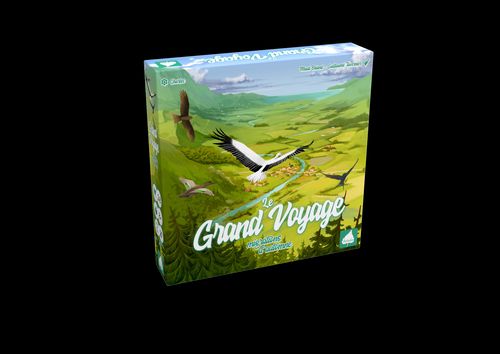
Le Grand Voyage
Le Grand Voyage Rulebook
Table of Contents
Table of Contents
Components
- 1 game board
- 55 cards
- 8 Species tokens
- 8 Scout boards
- 8 Scout tokens
- 8 Energy tokens
- 44 cubes
- ...and this rulebook
Setup
Deploy the game board at the center of the table.
- The cards are shuffled and placed in a pile near the game board.
Each player chooses a bird.
-
Each player places their Species token on their starting square, at the top of the game board.
-
Each player places their Scout token beside the game board, at the bottom left, under the Flight zone.
-
Each player places their Scout board in front of them.
-
Each player takes their Energy token and places it face down (blank face visible) next to their Scout board.
-
Each player places a Peril marker (a cube in their color) at the start of each peril gauge on their Scout board, on the leftmost (colored) square. In this state, the bird is said to be Rested.
Note: some birds have a blank peril gauge. In that case, the corresponding gauge has no marker, and that player is immune to that type of peril.
Objective
Each player chooses a migratory species: swallow, black kite, stork, common redstart, hoopoe, bee-eater, woodcock, or teal.
Players will try to be the first to lead their species to its destination.
Game Principles
A game is made up of a number of successive Flights, broken down into rounds.
During each Flight, you will move your Scout token forward along the Flight path, endure perils, and land before it is too late, so as to move your Species token forward along the chosen migratory route.
The Flight
A Flight is made up of 1 to 12 cards. It ends as soon as all scouts have landed or failed.
By landing your scout, you obtain a stage value (the number above the last card endured). This stage value represents the number of squares you must move your Species token forward.
The Peril Frequency Table
Be careful during your games not to expose yourself too much to these dangers, at the risk of seeing your flights fail!
This table shows the frequency of the different perils at the three altitudes. The size of each peril's symbol indicates how often it is encountered at that altitude; the bigger it is, the more frequent the peril is at that altitude.
So at high altitude, the most frequent peril is wind, the second most frequent is exhaustion, and so on.
Note: an empty circle indicates that some cards present no peril at that altitude. When you move your Scout token to an empty altitude square, no Peril marker advances.
Cards
Each card is made up of three zones: high altitude, medium altitude, and low altitude.
During the Flight, scouts progress from one card to the next, either staying at the same altitude or shifting by one altitude (it is forbidden to go from high to low, or the reverse, in a single move).
Note: to land, you must necessarily be at low altitude after your move.
Peril Gauges
Each Scout board shows 5 to 6 peril gauges. Birds have varying resistances to these perils. The more squares a gauge has, the more resistant the bird is to that peril.
Species Tokens
Species tokens start on their starting square and must reach one of their destination squares. They may be stacked.
Notes:
- For the sake of game balance, a bird's resistance is balanced against the distance needed to reach its destination.
- Some birds are immune to certain perils: the Teal, the Black Kite, and the Stork are not sensitive to Predation; the Redstart is not sensitive to Hunting.
How to Play
A game is made up of several Flights that follow one after another, until a player reaches their destination.
Each Flight is made up of several rounds, which also follow one after another.
Round Sequence
All players play simultaneously! They move their Scout and mark their peril at the same time!
-
At the start of each round, one player draws a card and places it in the first free space of the Flight. They call out, out loud, the perils present, from top to bottom.
-
On the first round: place your Scout token on the revealed card at low or medium altitude (you may not place it at high altitude!).
Then, on the following rounds: move your Scout token forward onto the card for the round:
- either staying at your altitude,
- or shifting by one altitude (from high to medium, from medium to high or low, from low to medium).
Scout tokens continue moving until they fail or land (see End of Flight, below).
-
Each player suffers the peril indicated at their altitude: move the corresponding Peril marker forward one space on your Scout board.
If the Peril marker goes past the end of its gauge: the peril suffered is fatal and your Flight fails. Remove your Scout token from the Flight (lay it down below the Flight). You no longer take part in this Flight and do not move your Species token.
In return, activate your Energy token by turning it face up (bird visible) if it is not already. See "Energy Tokens," below.
-
If you are at low altitude, after moving, you may decide to land and end your flight.
In that case, your Flight succeeds. Remove your Scout token from the Flight (lay it down below the Flight), and move your Species token forward a number of squares equal to the stage value shown above the card where your flight ended.
You no longer take part in this Flight.
Note: several Species tokens may occupy the same square.
Reminder: the first six cards of the Flight work in pairs: the stage value shown above the left-hand card is the same as the one shown above the card to its right.
-
If there are still players in play, start a new round for this Flight.
If there are none left, the Flight ends (see below).
End of Flight and New Flight
A Flight can end in one of two ways:
- there are no more players still flying (whether their flight failed or succeeded), or
- there are still one or more players once the twelfth card has been resolved: in that case, only those at low altitude may land and move their Species token forward 9 squares (the maximum). The others automatically see their flight fail.
Once the Flight is over, discard all the cards from the Flight and Rest the scouts.
Resting the scouts means resetting the Peril markers on all their gauges back to zero and moving the Scout token back to the start of the Flight.
Note: if the draw pile runs out, shuffle the discarded cards and form a new pile. If no player has reached their destination, start a new Flight.
Perils on the Board
At the end of a successful Flight, your Species token may land on a square showing a peril.
In that case, when Resting your Scout, make it suffer a peril of that kind, as if you had already crossed a card showing that peril.
Example: Leslie lands her redstart on a square showing Predation; at the start of her next flight, her Predation Peril marker will already have been moved forward one space to the right.
Energy Tokens
If its Bird face is visible, your Energy token is active and you may use it during a Flight. It acts as a joker, letting you ignore one peril. Once used, turn your Energy token face down.
Reminder: if, afterward, one of your Peril markers goes past the end of its gauge, making your Flight fail, reactivate this token (turn it back to the Bird face visible).
End of Game
A player is declared the winner at the end of the Flight during which they reach their destination square in Africa.
Note: the Species token must land on the diamond-shaped square!
That species has successfully completed its migration and can spend the winter in the warmth!
Several players may be declared winners. However, if you wish to break ties, favor the player (or players) who have not used their Energy token.
Notes: birds have several destination squares. It is up to you to choose which one to head for!
Expert Variant
In this variant, perils on the board no longer only apply at the start of your next flight — they also apply during the current flight!
So, before moving your Species token, check which square you will land on; if it shows a peril, immediately advance the corresponding Peril marker. If it goes past the end of its gauge, the flight fails!
You may also play without the Energy tokens, or even remove some or all of the cards that show no peril at a given altitude. Adjust it to your taste!
Youth Variant
For younger players, the Energy token may be activated at the start of the game.
Don't hesitate to adapt this to suit your children!
Tips and Reminders
- Stage values earned during a successful flight are mandatory; you cannot choose to move your Species token fewer squares than the value obtained.
- An absence of peril at an altitude means that zone is safe; moving your Scout token there, you suffer no peril.
- If you need to stack many Species tokens, don't hesitate to make two columns so they don't fall over.
Le Grand Voyage is a game of risk-taking. It is tempting to stay at High Altitude (where perils are less numerous), but keep in mind that you will need to land your scout in order to move your species forward, and landing requires being at low altitude. Be bold, but not reckless!
Birds have different resistances to perils: if some birds' destinations are closer, their capacity to endure perils is also much lower.
We recommend naming one player the Card Minister: it is their job to draw and place the cards, then announce the perils present (always from top to bottom). This role can change with each Flight.
From the Game to Reality
Since the dawn of time, at the end of every summer, many birds undertake a great journey from the northern hemisphere toward the south to escape the harshness of winter.
This journey presents many dangers, and many individuals do not reach their destination.
Over these thousands of years, however, the different species have developed a biological response to these perils. They have adapted by developing various strategies: building up reserves to fly farther and longer, flying higher or at night to escape predators, and so on.
However, through its activities, humankind has caused new perils to emerge that make bird migration more difficult.
Choose your species, and define your flight strategy according to the perils you will have to face!
Migratory Species
The Black Kite is a long-distance migrant. It migrates to Africa, where it spends the winter south of the Sahara. It is an opportunistic migrant that takes advantage of favorable weather conditions to migrate, favoring soaring flight, but capable of flapping flight when weather conditions or landscape topography force it to (strong wind, sea crossings). It most often makes short stages interrupted by stops to rest and feed. It is a species that avoids long stages over the sea and looks for the narrowest crossing points to reach Africa (the Strait of Gibraltar and the Bosphorus Strait).
The White Stork is a migrant capable of covering very long distances beyond the Sahara and as far as southern Africa. It migrates in groups that can number several hundred individuals. It takes advantage of favorable weather conditions to practice soaring flight, a mode of flight that costs little energy. It absolutely avoids crossing seas and always looks for the shortest crossing zones. It is frequently the victim of collisions or electrocution involving power lines.
The Common Redstart migrates to sub-Saharan Africa. It travels mainly at night. Before departure, it builds up reserves that will cover its needs for a direct flight over the Mediterranean, followed by a short stop in North Africa before crossing the Sahara. It feeds exclusively on invertebrates, and during periods of drought at its wintering sites, many birds fail to build up sufficient reserves for their return journey.
The Woodcock is a species highly prized by hunters. French populations are sedentary, but in winter they are joined by woodcocks coming from Russia and Northern Europe. These migrate as far as Spain and North Africa. This species migrates at night to escape its predators.
The Eurasian Teal is a very common species in winter. Coming from Northern Europe and Russia, teals migrate south in autumn, and stop over in marshes and ponds where they find abundant food and quiet areas. It is a species widely hunted in Europe, and it is also the prey of many ground predators. During periods of intense cold, teals may move further south.
The Barn Swallow is a great migrant between Europe and sub-Saharan Africa. It flies by day, making small daily stages, and can hunt while on the move. It can also build up enough reserves to make longer journeys, crossing the Mediterranean or the Sahara in a single stage. It is a victim of the degradation of the natural areas where it prefers to hunt.
The European Bee-eater is a great consumer of insects, and it leaves Europe as early as mid-summer to reach West Africa and southern Africa. It flies in groups, only by day, and practices soaring flight during the hottest hours of the day; it can reach high altitudes to make its journeys. The species is sensitive to the decline of insects and is also a victim of hunting in some Mediterranean countries.
The Eurasian Hoopoe is a migrant that winters throughout sub-Saharan Africa. It makes its journeys mostly at night, which lets it escape predators. It flies at moderately high altitudes (over 1000 m). It is a victim of drought periods in Africa that deprive it of food. It is also a species hunted in some Mediterranean countries.
Note: the distributions of perils encountered by birds and their resistance to them are approximate. They should not be taken with too much precision.
Perils
We distinguish between perils of natural origin and anthropic perils (of human origin).
Natural Perils
Exhaustion — Represents the bird's fatigue when its energy reserve runs low. Before starting their migration, birds eat a great deal to build up a fat reserve that they will draw on to sustain the incredible energy effort that the migratory journey represents.
Wind — Indicates the presence of headwinds endured by the birds. They have two harmful effects on migrants: they exhaust them further, and they can blow them off course or even strand them out over the open ocean, which condemns them to certain death.
Predation — Affects many migratory birds, especially the smallest among them. Most predators hunt by day: falcons and kites capture birds in flight. Nocturnal migrants are not entirely safe from predators either: the greater noctule bat (the largest bat in Europe) is capable of catching passerines in flight.
Anthropic Perils
Collisions — Cover the full range of human structures: buildings, wind turbines, glass facades, power lines, aircraft, and so on. This risk is increased at night and in densely populated areas.
Hunting — Also called hunting pressure, this affects migratory species, and specifically the Woodcock, the Eurasian Teal, and others. Excessive harvesting in certain regions threatens the long-term survival of the species targeted.
Pollution — Refers generically to other threats caused by human presence. Light pollution disrupts visual landmarks. Pollution from chemical and plant-protection products contaminates ecosystems and weakens organisms. The reduction of natural resting areas makes food resources scarcer and forces birds to travel greater distances to rest.