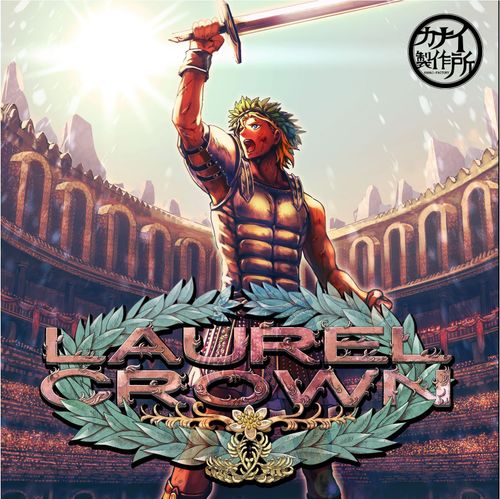
Laurel Crown
Laurel Crown Rulebook
Table of Contents
Table of Contents
Game Overview
The players are all rich sponsors of the fighters who battle in the Tournaments, and the goal of the game is to raise your honour as much as possible.
Of all the participants in the Tournaments, the players can choose freely whom they will back (take in their hand), but each player will in turn get the first pick, so you will not be able to always choose the strongest.
And it doesn't end just because you've picked a good fighter.
Only after five fights, the honour (victory points) that have been bestowed upon them, will reflect back on you.
The honour that can be gained from the first tournaments isn't much to be had, but in return, many participants can gain honour. In contrast, there is much honour to be had from the later tournaments, but only a few can gain it. You will need to plan and weigh, which of your fighters to send to which fights – sending out a fighter to a too fierce battle, you run the risk of getting him or her – and your reputation – severly wounded.
When all tournaments have been fought, the player whose combatants have gathered the most honour, and who has bestowed the laurel crown upon his champions, is declared the victor.
Components
This game includes the following components:
- 24 Fighter cards
- 16 Arena cards
- 1 game board
- 4 reward gold coins
- 8 player tokens in 4 colours
- 10 dice
- manual
Component Notes
Fighter cards
- Name
- Rank: A rough estimate of the fighter's power. Ranks go from C (lowest) to S (highest).
- Power: This is the power that they add to the tournament. They are represented by die icons and a number. The example to the left means to roll 3 dice and add 10.
- Ability
- Power marker: This is used as a pointer to point out the fighter's power in tournaments.
Arena cards
- Name
- Rank: There are three ranks: low (copper, 6 cards), intermediate (silver, 6 cards) and high (gold, 4 cards). Rank can be identified also by the backside.
- Honour / # of prize winners: The amount of honour bestowed upon the winner(s) of the tournament. The example shows that the top three strongest competitors will get honour: 10, 7 and 4 points respectively.
- Damage penalty: The loss of honour that the sponsor of those who did not get a prize will suffer. In the example, they will lose 3 honour.
- Special effect: Special conditions for this tournament. This may indicate which ranks and genders may participate, and if any effect will be applied on the competitors.
Game board
- Point / power track: Players place their pawns on the circle's inside to show their gained honour. On the circle's outside, the players place their fighter cards, to indicate their power in the current tournament. In the above example, the red player has 9 points, the blue player has 13, and the three fighters have powers 5, 7 and 8 respectively.
Reward gold coin
This is a marker the sponsors (players) can use to empower their fighters. They can be used once per game, and if left unused, will gain the player honour.
Preparations
This is the standard game setup. For those who wish, there are extra optional rules described under a separate section.
- Shuffle the 24 fighter cards to form a face down deck.
- Put the game board in the play area.
- Each player takes their 2 tokens, and places one of them on the '6' on the honour track. The other is kept, to show the player's colour.
- Each player takes a reward gold marker.
- Take 2 low-rank, 2 intermediate and 1 high-rank tournament card at random, and line them up, starting with the low.
This concludes setup.
Gameplay
This game is roughly divided into two parts: The first, in which the players employ fighters, and the battles, where the fighters battle it out.
1) Employment
In this part, players employ fighters and add to their hands.
- Determine start player in any suitable fashion.
- Draw, reveal and line up as many cards from the fighter deck as there are players, and then add one extra card, face down. In a 3 player game, 3 cards should be face up and one face down.
- Starting with the start player and clockwise, players take one of the fighters. On a player's turn to choose, he can either choose one of the fighters, or choose to "be last and take 2". Once a player has selected "be last and take 2", no one else can choose this option. The player who takes the face down card may hide its face up side from the other players until he/she uses it.
- When all players have chosen a card, the player to the left of the start player becomes the next start player; then return to step 2. Repeat this 6 times for 3 players and 4 times for 4 players.
2-player game: In a two-player game, line up fighters as in a 4 player game. Each player will take 2 turns in selecting.
Now, the players will have a hand of fighters. Please note that the information about the tournaments is very important, and this information is already available when the game starts. Use this to choose fighters wisely, after rank, number of prize winners, and tournament conditions. Each player should keep their cards so that no other player can see them.
2) Tournament
When all have their fighters, it's time for the tournaments. Tournaments will be held in order, starting with the low-ranked first, and going for 5 rounds. Each tournament states how much honour will be dealt to how many participants.
- Determine start player in any suitable fashion.
- Starting with the start player and going clockwise, players choose which of their fighters should be in the current tournament, and place them out face down. You may place more than 1 fighter. These cards need not be revealed until all players have placed all their cards. Sending out a fighter is not mandatory.
Reward gold: When selecting fighter to participate, you can add a reward gold to the fighter. If you do, all of your fighters in that tournament will get a +3 adjustment to their power. The reward gold must be placed at the same time as you place a fighter.
- When all players have placed their cards, they are revealed, and dice are rolled to determine each fighters power. Dice can be rolled in any order. When that is done, the fighters' cards are placed so that the top right arrow on the card points at the relevant number on the power track. If two fighters tie for the same power, the higher rank is tie breaker. If the tie remains, the fighter whose sponsor has lowest points breaks the tie. If the tie still remains, resolve it with a die roll between those players.
- Starting with the fighter with the highest power, and in descending power order, the fighters gain honour as per the tournament card. Move the player pawns accordingly on the score track (If a player passes 30 points, continue on a second lap and remember to add 30 points). Then discard all the participating fighters – they go to rest.
Wounds: If there are more fighters than there are prize winners for the tournament, those who fail to get a prize are wounded. All players who are sponsors for a wounded fighter lose as much honour as the tournament card states. Honour can never go below zero.
In the left example, only two fighters can win prizes. The first gains 16 point, the second 8 points, and the third and lower lose 8 points.
- The player with the highest honour becomes the new start player (In case of a tie, most points in the most recent battle breaks the tie). Return to step 2 to resolve the next tournament, and repeat this until all 5 tournaments have been held.
Example of battle
Tournament: Princess Roxanne's favour (intermediate rank, 1st place 9 points, second 8 points, third 7 points and penalty 6 points).
Each player chooses secretly which fighter to send out. The first to participate is player A, who aims for the top spot. He declares that he participates with one, and sends out Lucius, a rank S fighter. Player B is of the opinion that third place might be nice, and sends out one fighter; Goliath (rank B). Player C thinks he can claim both first and second place for himself, and push some penalty points on the others, declares participation with two fighters and sends out Catarina and Hannibal, both of rank A. All fighters are revealed, and the battle begins.
Player A's Lucius (2d6+11, one reroll, ability immunity), rolls two dice and gets 2 and 6. He rerolls the 2 and gets a 4. Lucius' power is thus 21 (4+6+11). Player B's Goliath (3d6+3, identical dice = critical hit) looks weaker than the others, but can do a critical hit. He rolls 3 dice and gets 3, 3, 4! Two are the same, so he gets a critical hit, and adds the critical hit bonus: two extra dice. The result is 6 and 3, so added up he gets 3+3+4+3+6+3, totalling 22! Player C's Catharina (2d6+9, support ally +3), and Hannibal (3d6+5, support female ally +5) is a combination that will support each other. Catharina rolls 2, 5, and Hannibal rolls 1, 2, 4. Catharina then totals 2+5+9+5=21, and Hannibal gets 1+2+4+5+3=18.
So the participants in power order are Goliath with power 22, then Lucius with power 21 and rank S, then Catharina with power 21 and rank A, and then Hannibal with power 18.
The player who played Goliath gains unexpectedly 9 points, Lucius gets 8 points, which is a little non-satisfactory for a rank S fighter. And player C, who pulled out a supporting combo, had real bad luck with the die rolls: Catharina gets 7 points but Hannibal was wounded and loses 6 points, so the total is just 1 point.
Game End
The game ends when all five tournaments have been done. Player who have their reward gold left gain an extra 3 points. The player with most points wins.
In case of a tie, position in the final battle is the tie breaker.
Ability Description
- Absolute ruler (Hyperion): If this fighter gets the same number as any other fighters, his power changes to 99.
- Cannot be wounded (Rosvisey / Nora): If this fighter doesn't get a prize, you may return it to your hand instead of discarding. You do not suffer any penalty.
- Reroll: X die/dice (many): Among the dice you rolled for power, you may reroll X of them.
- Immune against other abilities (Lucius): Cannot be affected by any other ability (except reward gold).
- Support (many): All support effects stack!
- Ally +3 (Catharina): All fighters (in this tournament) who belong to the same player gets a +3 in Power.
- Female ally +5 (Hannibal): All female fighters (in this tournament) who belong to the same player gets a +5 in Power.
- Male -3 (Aphrodite): All males in this tournament has their power lowered by 3.
- Castor/Pollux +5 (Pollux/Castor): The fighter with the relevant name gets +5 in Power.
- Self + 3x[allies] (Lonath): This fighter gets +3 per other fighter who participates in this tournament and belongs to the same player.
- Critical: 6 (Nora / Iron fist): If any of the dice show a 6, add another die to the total (as many times as it happens!).
Optional Rules
Any of the below rules can be added for extra spice.
- Draft (3+ players): Deal out all 24 fighter cards randomly to the players. Each player chooses one to keep face down before him, and sends the rest to the left. Since and repeat until you have no cards left to send.
- Rochester draft (any number): Line out all the fighter cards. All players get 20 seconds to consider, and then they choose in the bouncing order A-B-C-D-D-C-B-A-A-B-C…
- Auction (any number): Give each player 10 counters of any type (matches will do). Line up the fighter cards as per the normal rules, and determine first player by any suitable method. Then everyone does a hidden bid for first choice, reveal at the same time; highest bidder chooses first, second highest chooses second etc. If tied for a bid, closest position to starting player in clockwise direction breaks the tie. After each auction, player to the left of the highest bidder becomes the next start player. Remaining counters can be used as reward gold, that give a +1 adjustment (or 1 die for Balare), and a limit of 3 such counters per tournament.
- Changing tournaments: You may change the number of tournaments, and/or the distribution between low, intermediate and high ranks, or also change the order in which they are fought. Another idea is to come up with your own tournament, some of which may contain unknown information that is revealed as it starts.
Characters
The fighters, by name, gender and age as printed in the manual. Character backstories are flavour and are not reproduced.
- Leonidus the young lion (male), 18 years old
- Catharina the Battle Flower (female), 18 years old
- Hyperion the thunder Lord (male), 27 years old
- Rosvisey the Valkyrie (female), 23 years old
- Lucius the blizzard blade (male), 22 years old
- Victoria the Grande Rose (female), 22 years old
- Erastus the iron hide (male), 28 years old
- Hannibal the Handsome (male), 24 years old
- Aphrodite the Goddess of beauty (female), 20 years old
- Man Eater (male), age unknown
- Glacos the whirlwind (male), 40 years old
- Goliath the friendly giant (male), 30 years old
- Sheherazade the desert moon (female), 20 years old
- Balare the liar (male), 32 years old
- Iron Fist (male), 22 years old
- Lonath the lonely (male), 28 years old
- Castor and Pollux, the twin stars (male), 18 years old
- Nora the marksman (female), 16 years old
- Iriath, child of fate (male), 14 years old
- Maximus the great (male), 57 years old
- Lucia the steel lady (female), 23 years old
- Romy the mountain cat (female), 15 years old
- Camus the fair (gender and age unknown)