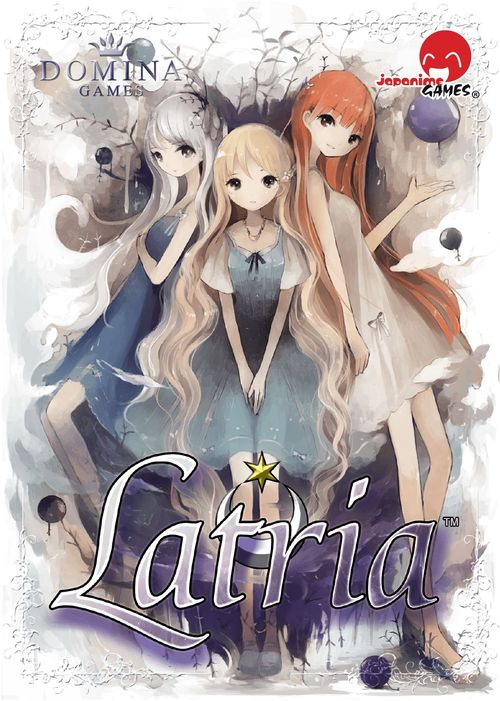
Latria
Latria Rulebook
Table of Contents
Table of Contents
Game Purpose
Use astrology to determine the power of the great stars. Make correct predictions to win the support of the people. But if you are captured by the power of the eclipse, you will lose that support. The player who gathers the most support becomes the king of Babylon and wins the game.
Card Types
There are 60 astrology cards and 39 celestial cards.
Astrology cards express the stars' direction. There are 15 cards each of the 4 types: the Sun, the Moon, Polaris, and Latria. The number from 1 to 15 at the top left of each card shows the power of the art. Some cards have victory points printed directly below the number and at the bottom of the card.
Celestial cards are the great stars that are the subject of divination. There are 13 cards each of the 3 types: the Sun, the Moon, and Polaris. Each card has victory points or an effect printed at the bottom. Some cards have a red symbol at the top left. The back of each card shows the ratio of the victory points it contains.
Boards and Tiles
There are 4 boards and 7 tiles. The board marked "LATRIA" is used only with the extension rules.
Boards show the state of the stars. There is one each for the Sun, the Moon, Polaris, and Latria.
Tiles (markers) are received at specific times. There is 1 hexagonal parent marker and 6 round eclipse markers.
Game Setup
- Remove cards (3 or 4 players only). For 3 or 4 players, remove astrology cards from the deck according to the number of players. The cards to remove are as follows.
- 3 players: every card with an icon at the bottom right (the 1 to 3 and 13 to 15 cards of all four types).
- 4 players: only the cards with a "5" icon at the bottom right (the 1, 14, and 15 cards of all four types).
- Deal astrology cards. Shuffle the astrology cards face down and deal them out evenly to the players. With 6 players each player receives 10 cards; otherwise each player receives 12 cards.
- Prepare celestial cards and boards. Shuffle the 3 types of celestial cards separately, face down, to make 3 draw piles. Place the Sun, Moon, and Polaris boards with the red "ECLIPSE" side face down, and place the draw pile of the matching celestial card below each board. From here on, the Sun, the Moon, and Polaris, or any of them, are referred to as "celestial bodies".
- Eclipse markers. Place a number of eclipse markers next to the draw piles equal to the number of players.
- Choose the first parent. The player who is most confident in astrology becomes the first player (the parent). Place the parent marker in front of that player, and setup is complete.
Game Flow
The game consists of several rounds. One round is made up of steps 1 to 6 below. (In the final round, the sequence stops at step 5.)
A player must use one card from their hand in every round. Repeat rounds until the hand of astrology cards has one card left.
Step 1: Reveal celestial cards. Turn the top card of each celestial card draw pile face up and place it on top of the board. If a card of the same celestial body is already there, place the new card on top of it so that the victory points below the older card remain visible. If the card that was just revealed has the mutation symbol at its top left, flip the corresponding board over. When a board's red "ECLIPSE" side is face up, that celestial body is in the eclipse state. Polaris has no mutation, so Polaris never enters the eclipse state.
Example 1: A Sun card with the mutation symbol was placed on the table, so the Sun entered the eclipse state. The eclipse is cancelled when another Sun card with the mutation symbol is placed.
Step 2: Parent plays a card. The parent chooses one astrology card from their hand and places it face up. If the parent plays a Latria card, the parent names one of the Sun, the Moon, or Polaris. In this round, the celestial body targeted is the same as the parent's card, or the one named.
Step 3: Children play a card. Every player other than the parent (a child) chooses one astrology card from their hand that matches the targeted celestial body or is a Latria card, and places it face down in front of them. If a child has no such card, they may choose any card from their hand and place it. When all players have played, reveal the cards at the same time.
Step 4: Acquire cards. The player whose astrology card has the highest number, counting the parent as well, acquires the celestial cards of the targeted celestial body on the table. If there are cards stacked on top of one another, acquire all of them.
- If the highest values are tied, priority goes in this order: the celestial body that matches the parent's card (or the one named), then Latria, then a celestial body different from the parent's. If the tie still cannot be resolved to one player, nobody acquires the cards.
- A child who played an astrology card with a lower number than the parent's card acquires that card itself, but only if the card has victory points or an effect.
- In either case, if the targeted celestial body was in the eclipse state, take an eclipse marker and place it on top of the cards acquired. From then on, cards acquired while that body is in the eclipse state are placed together under this eclipse marker. Victory points under an eclipse marker count as negative points at scoring.
- Acquired cards are placed face down in front of the player who acquired them. Only that player may look at them until scoring.
Example 2: The parent played a Moon astrology card, so in this round the children had to play Moon or Latria astrology cards whenever possible. The other children played Latria 8 and Moon 12. The player who played the largest number, Moon 12, acquires all the Moon celestial cards on the table. The player who played Latria 8, a card lower than the parent's number that has victory points, acquires that Latria 8 card itself. The parent acquires nothing.
Step 5: Set aside unacquired cards. Astrology cards that were not acquired are set aside together. Used astrology cards may be checked by anyone at any time. Sorting them by celestial body makes them easier to read.
Step 6: Next parent. The player who acquired celestial cards from the table this round becomes the next parent. That player receives the parent marker and starts the next round. If no player acquired any celestial card from the table, the same parent continues as parent.
When the round in which the hand of astrology cards is reduced to one card ends, the game ends and proceeds to scoring. The last card is not used in the game.
Scoring
Each player scores separately by following the steps below. The number of stars printed at the bottom of a card is its victory points.
- Separate the cards that have no eclipse marker on them by celestial body, and count the victory points of each group. Cards with "×2" or "×0" multiply the total of the same kind of card. Then add up these points.
- If there are no "×2" or "×0" cards, you may calculate everything together.
- Count the victory points of the cards that had an eclipse marker on them. The cards under the eclipse marker are not separated by celestial body; count them all together. "×2" or "×0" cards multiply the total of all the cards under the eclipse marker, regardless of celestial body.
- The points from step 1 minus the points from step 2 is the final victory point total. The total can fall below 0. The player with the most victory points wins. If players are tied, the player whose cards under the eclipse marker have fewer victory points (losses) wins. If that is also tied, the game is a draw.
Polaris card note: If you hold the card that appears among the Polaris celestial cards (the card with the two red symbols), at the start of scoring you remove any 2 of your acquired cards from your acquired cards. Removed cards are worth no points. You may choose cards under the eclipse marker. If you hold 2 or fewer cards, including this card itself, remove all of them. This card itself has no victory points.
Example 3: In step 1, the Sun is worth 10 points, the Moon 4 points, Polaris 12 points (3 × 2 × 2), and Latria 1 point, for a total of 27 points. In step 2, the cards under the eclipse marker are worth 10 points (5 × 2). In step 3, 27 minus 10 gives 17 points as the final victory point total.
Extension Rules
1. Simple
The rules are simple, so you can enjoy the game casually regardless of age or experience.
Change from the standard rules: "Celestial cards used". At the start of setup, look through all the celestial cards and remove the following 3 cards: the Sun card marked "×0", the Moon card marked "×2", and the Polaris card with the two red symbols (see the illustration in the manual).
Change from the standard rules: "Board used". In setup step 3, do not place the Sun, Moon, and Polaris boards. Instead, place only the Latria board, with the "ECLIPSE" side face down, in the centre of the three celestial card draw piles.
Change from the standard rules: "Eclipse". Regardless of celestial body, when a card with the mutation symbol is placed on the table, flip the Latria board over. All celestial bodies become eclipsed together, and if they were already eclipsed, the eclipse is cancelled. While the eclipse is in effect, acquired cards do not count as negative points. Instead, the strength of the astrology numbers is reversed: low-numbered cards become strong and high-numbered cards become weak.
Therefore, playing an astrology card with a higher number than the parent's card allows you to acquire it. (Translator's note: as printed, this sentence says a higher number is acquired. It does not follow from the reversed strength rule stated in the same paragraph, which would make a lower number stronger. The manual's examples do not settle the point. It is transcribed as printed.) Tie priority does not change.
If two cards with the mutation symbol are placed in one round, the board flips twice, so the state does not change. Because there are no negative points, eclipse markers are not used in this rule.
2. Star Eclipse
Set up the game as normal. At the start of the game, turn the Polaris board over so that the "ECLIPSE" side is face up. During this game Polaris stays in the eclipse state, and the eclipse is never cancelled. Otherwise the rules are the same as the standard game. This variant is recommended for players who want a hard game.
3. Campaign
Play a number of games in succession equal to the number of players, and decide the final winner by a score based on finishing position. In this rule, each player is the starting parent for one game, in turn.
In each game, the player in 1st place records a score equal to the number of players. Each player below 1st records one point less than the player above them. However, the player in last place records −1. If players are tied on victory points, they record the same score.
Example (4 players): If two players are tied for 2nd place, the player in 1st records 4 points, the two players in 2nd each record 3 points, and the player in 4th records −1 point. The player with the highest total score after all games wins.
Campaign score record example
| Player | Game 1 | Game 2 | Game 3 | Game 4 | Total |
|---|---|---|---|---|---|
| Player A | 4 | 3 | −1 | −1 | 5 |
| Player B | 3 | −1 | 4 | 3 | 9 |
| Player C | 3 | 2 | 3 | 4 | 12 |
| Player D | −1 | 4 | 2 | 2 | 7 |
Detailed Rules
- If a player has no astrology card matching the parent's celestial body (or the one named), and no Latria astrology card, they may play any card they like. In this case, only the state of the parent's celestial body (or the one named) is referenced. For example, if the Moon is in the eclipse state and the parent plays Moon 7, and a child responds with Polaris 2, the child's Polaris 2 is placed under the eclipse marker.
- Mutation cards from the Sun and Moon celestial card piles can appear at most 3 times each. The first makes the body eclipsed, the second cancels the eclipse, and if the third makes it eclipsed again, that body's eclipse is not cancelled for the rest of the game.
- Astrology cards that were placed on the table and not acquired are set aside together and may be referred to by anyone. Astrology cards that were acquired may be seen only by the player who acquired them.
Victory Point Distribution
Astrology cards
Victory points per card, by the number printed on the card.
| Celestial body | 1–4 | 5 | 6 | 7 | 8 | 9 | 10 | 11–15 |
|---|---|---|---|---|---|---|---|---|
| The Sun | - | - | 1 | 2 | 3 | 2 | 1 | - |
| The Moon | - | - | 1 | 2 | 3 | 2 | 1 | - |
| Polaris | ×2 | 2 | 2 | 2 |
Celestial cards
| Celestial body | 1 VP | 2 VP | 3 VP | 4 VP | Special |
|---|---|---|---|---|---|
| The Sun | 1 VP, mutation (3 cards) | 2 VP (3 cards) | 3 VP (3 cards) | 4 VP (3 cards) | ×0 (1 card) |
| The Moon | 1 VP, mutation (3 cards) | 2 VP (6 cards) | 3 VP (3 cards) | - | ×2 (1 card) |
| Polaris | 1 VP (6 cards) | 2 VP (6 cards) | - | - | Two red symbols (1 card) |