Latice
Latice Rulebook
Table of Contents
Table of Contents
Components
The Latice box contains:
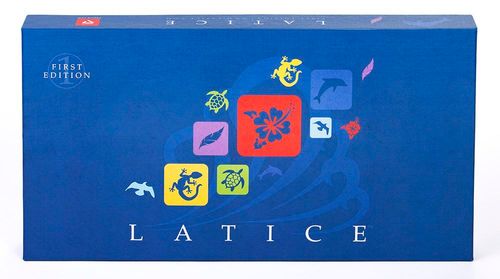
- 84 tiles (acrylic in the Standard Edition, cardboard in the Deluxe Edition), most showing one of six images (e.g., turtle, leaf, lizard, dolphin) in one of six colors, plus a number of special wind tiles
- A 14 inch game board (bi-fold in the Standard Edition, quad-fold in the Deluxe Edition)
- 4 tile racks
- 32 stones (acrylic)
- 2 bags for components (linen in the Standard Edition, clear plastic in the Deluxe Edition)
- Multilingual instructions (English, German, French, Spanish, Portuguese, Italian, Russian, Polish, Chinese, Japanese and Korean)
A Note About the Latice How To Play Booklet — Correct Diagram
Some customers may have received a copy of Latice with a How To Play booklet containing a misprint. The misprint is found in the "Taking Your Turn" section under "Regular Move," and shows three example moves. The middle diagram is meant to show an invalid move with different colors on all sides (where the misprinted diagram incorrectly shows matching colors on all sides). This diagram has been corrected in the rules below and in the downloadable rules PDF.
If you would like to receive a revised printed copy of the rules, contact [email protected] with your mailing address and a corrected version will be sent at no cost. A corrected version in a language other than English can also be requested.
Objective
The goal of the game is to be the first player to play all of the tiles from your pool, taking advantage of special tiles and squares on the board.
Setup
Player counts use different tile totals:
- 2 players: 42 tiles each
- 3 players: 28 tiles each
- 4 players: 21 tiles each
Put all tiles face down and shuffle them. Divide them into even player pools. Each player draws five tiles from their pool and places them on their rack.
Tournament style play: If you prefer more skill and less luck in your game, shuffle the colored tiles separately from the wind tiles when starting the game and divide them into even player pools. Then equally distribute wind tiles to each player and have them shuffle the tiles into their personal pool.
Taking Your Turn
First move: The youngest player goes first by placing one tile from their rack on the center (moon) square, then completes their turn by drawing one tile from their pool.
Regular move: On your turn you add one tile to the board next to an existing tile, matching all adjacent (not diagonal) tiles based on either color or shape.
Exchange: You can use a move, or spend stones (1 sunstone or 2 halfstones), to exchange some or all of your tiles for new ones (no peeking).
Pass: If you can't place a tile or make an exchange, you have to pass.
Ending a turn: At the end of every turn, draw tiles from your pool so you always end up with five tiles in your rack. Play continues clockwise.
On your turn, you can also spend stones to play extra moves or exchange tiles:
- 1 sunstone = 1 extra move
- 2 halfstones = 1 extra move
Stones & Extra Moves
Earning stones: To earn a stone, place your tile so it matches the color or shape of more than one tile already on the board. The more tiles you match in a single move, the more stones you earn:
- Double — play a tile that matches by color or shape on 2 sides: earn one halfstone.
- Trefoil — play a tile that matches by color or shape on 3 sides: earn one sunstone.
- Latice — play a tile that matches by color or shape on 4 sides: earn two sunstones.
Sunstone limit: If you have more than three sunstones at the end of a turn, the extra stones must be discarded. Halfstones are unlimited.
Wind Tiles
Wind tiles may be used to move a previously played tile up, down, left, or right to an open adjacent square. The tile you move does not have to match adjacent tiles. After playing a wind tile, discard it, and make one additional move.
Buying a wind tile: Three sunstones can be exchanged for a discarded wind tile (if you have space on your rack). In four-player games, reduce the cost of buying back a wind tile to two sunstones.
Sun Squares
When you play a tile on a sun square, you earn one sunstone. Using a wind tile to shift a tile onto a sun square doesn't count.
Ending the Game
You win by being the first player with no tiles left in either your pool or rack. If all players are forced to pass, the player with the fewest remaining tiles wins.
Frequently Asked Questions
What if you can't play a tile on your first turn? Let's say it's not your lucky day and you draw all wind tiles at the start of the game. This doesn't happen often, but if you are unable to play a tile on your first turn, you must exchange the tiles in your rack (any or all of them), or pass your turn to the next player. Tip: an exchange is usually the best option.
Can you spend sunstones and halfstones in the same turn you earn them? Yes, you can spend sunstones and halfstones in the same turn you earn them.
Can you buy back wind tiles with halfstones? No, only sunstones can be used to buy back wind tiles (the advantage of halfstones is that they are unlimited).
Can halfstones be used for an exchange? Yes, two halfstones can be used to buy an exchange when needed.
If I play all five tiles in my rack and still have stones available, can I draw and play new tiles from my pool? No, once you draw tiles from your pool to replace the tiles you have played, your turn is ended.
Can I use a wind tile to move a tile to a square that isn't adjacent to other tiles on the board? Yes, you may use a wind tile to move a tile to any open adjacent square on the board.
Can you play Latice with more than 4 players? Yes, as long as your group is comfortable playing in teams, Latice could be played with any number of people (divided into 4 teams, which could also help balance the game across players with varying levels of experience).
Why is the name spelled "LATICE" and not "LATTICE"? There are already many things that use the name "LATTICE," and a distinctive name that could be tied to the game long-term was wanted. "Latice" is actually an Italian word that, not surprisingly, means "Lattice."
Does Latice support color-blind players? Yes. Each colored tile has a unique texture that corresponds to that color. The colors were also chosen for a strong tonal distribution, tested by desaturating the colors and making sure the game still works.
How do the Standard and Deluxe editions differ? The Standard Edition includes a small (8 x 8 x 2 inch) box, a quad-fold 14 inch board, "German-quality" cardboard tiles, light blue tile racks and clear plastic bags for components. The Deluxe Edition includes a large (14 x 7.25 x 2 inch) box, a bi-fold 14 inch board, acrylic tiles, dark blue tile racks and a linen bag for stones. Both editions contain 32 acrylic stones and the 11-language instruction booklet.