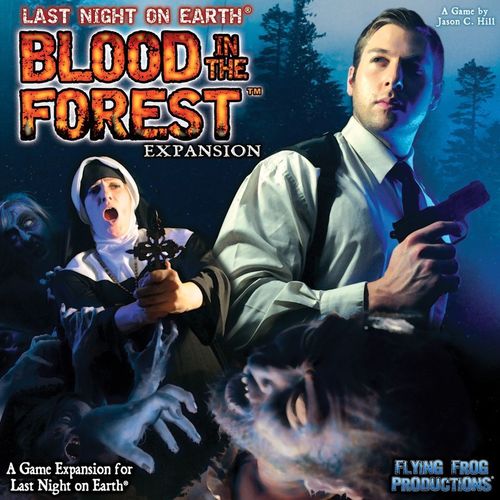
Last Night on Earth: Blood in the Forest
Last Night on Earth: Blood in the Forest Rulebook
Table of Contents
Table of Contents
- Contents
- New Cards
- Hero Upgrade Cards
- Zombie Upgrade Cards
- Two-Handed Items
- Zombie Champion Cards
- Item Tokens
- Experience Tokens
- Spawn Tokens
- Camp and Plane Tokens
- Trophy Tokens
- Other Tokens
- Forest Board Sections
- Forest Zones
- Line of Sight in Forest Zones
- Random Buildings and Forest Zones
- Additional Spawning Pits
- Fire in a One-Zone Building
- One-Zone Buildings
- Cliff Wall
- Setting Up the Board
- Experience
- Zombie Champions
- Scenario Rules
- New Characters
- FAQ
Contents
- 1 full-colour rulebook
- 1 central game board, "Thicket" / "Airstrip"
- 4 L-shaped "forest" board sections
- 4 rectangular "forest" board sections
- 2 unique Hero figures (grey)
- 6 Feral Dead figures (dark grey)
- 2 giant Zombie Behemoth figures (dark grey)
- 20 Hero deck cards
- 20 Zombie deck cards
- 5 melee weapon upgrade cards
- 5 ranged weapon upgrade cards
- 5 special Hero upgrade cards
- 6 Zombie upgrade cards
- 2 large character sheets
- 3 large scenario cards
- 2 colour sheets of tokens
New Cards
The Hero deck and the Zombie deck have new cards added to them. These are new kinds of weapons, items and events for the Heroes, and new, especially brutal, event cards for the zombies. The expansion also contains new upgrade cards, for both Heroes and zombies. If you want to add these to the Timberpeak expansion, simply shuffle them into the corresponding decks. Otherwise, these cards form new Upgrade decks, as described below.
Hero Upgrade Cards
This is a new set of cards that represents the essential skills Heroes acquire during battle. These cards are divided into three upgrade decks: "Melee", "Ranged" and "Special". The cards in these decks are marked with different symbols on their backs and must be placed on the table according to those symbols.
Each Hero upgrade card has the following parts:
- Upgrade type icon
- Card name
- Main text
- Boost price in experience points
- Boost effect
- Card back with the expansion icon
Zombie Upgrade Cards
Zombies also have new cards that model the fury of zombies that smell fresh blood. Unlike the Hero upgrade cards, the Zombie upgrade cards form a single deck. Many of them carry the phrase "Once", meaning the card must be discarded after it is played.
Two-Handed Items
Some Hero items are marked "TWO-HANDED". They count as two items (or as two weapons).
Zombie Champion Cards
Each of the new Zombie Champions has its own card, which describes its abilities and rules for use.
Item Tokens
This is a new element of game mechanics introduced in Blood in the Forest. It represents an item that can be used several times. The number of uses is shown by tokens and is printed on the card.
Experience Tokens
These tokens represent the experience gained by Heroes and Zombies. The reverse side of an experience token has a boost symbol, which shows that the boost of the given upgrade has been activated.
Spawn Tokens
These tokens show how many spawn points the zombie player has accumulated for summoning Zombie Champions. This lets the zombie players wait several turns in order to place more powerful Zombie Champions on the board.
Camp and Plane Tokens
These two tokens are used in certain scenarios.
Trophy Tokens
These represent various supplies, other survivors, or even zombie ambushes in the game.
Other Tokens
These tokens are not required for the basic game, but can be used to create your own scenarios and in future official expansions.
Forest Board Sections
The expansion contains three kinds of new board sections showing thick forest: L-shaped, rectangular and central. All of them show a new type of zone, the "Forest" zone, and these sections contain both large and small zones on the same section. Zones of different sizes work the same way, but they allow faster movement across the game board.
Forest Zones
Every board zone filled with tree images counts as a "forest zone". These zones are dangerous for Heroes, because in the dark forest zombies can lurk for them behind every tree.
Zombie players and Heroes in a forest zone roll an additional Fight die.
This means that zombies now have a better chance of winning a fight, since they have two Fight dice instead of one (a tie is still resolved in the zombies' favour). Heroes have a higher chance of rolling doubles, since they now have three Fight dice instead of two.
Line of Sight in Forest Zones
Forest zones also block line of sight for ranged attacks.
Heroes can see what is inside a forest zone and can see open space from a forest zone, but they cannot see through it.
(Diagram: Agent Carter sees what is located OUTSIDE the forest zone.)
(Diagram: Agent Carter sees a zombie in the forest zone.)
(Diagram: Agent Carter cannot see a zombie THROUGH the forest zone on the far side.)
Random Buildings and Forest Zones
Some forest zones contain a random set of numbers, as buildings do. These zones represent dense forest and can be determined by rolling a die when selecting a random building (or when choosing a building).
Such a forest zone is considered especially dense, and zombies may capture it (a "Captured" token is placed in the forest zone). It may also be very dark here (the "Lights Out" card may be played on forest zones). Such zones may be chosen as the target of a played card that is intended for buildings or for random building selection.
Note that these forest zones are not buildings in the strict sense, and Heroes cannot search them.
Additional Spawning Pits
The L-shaped forest board sections contain a new type of Zombie Spawning Pit, marked with a yellow "X". These are additional spawning pits.
Zombie players may double the number of zombies on the red spawning pits before placing zombies on the additional yellow "X" spawning pits.
Note that you may NOT double up zombies on the yellow spawning pits while every other spawning pit (red and yellow) still has no zombie on it.
Fire in a One-Zone Building
There is a special rule for fire in buildings that occupy a single zone. Such buildings are NOT destroyed automatically when every zone of the building is on fire (since there is only one zone here). Instead, during the Fire stage, if a 6 is rolled on the fire-spread roll, the building is considered destroyed.
One-Zone Buildings
Each of the L-shaped forest board sections contains one or more buildings that occupy one zone:
- Ranger's House
- Old Shack
- Stone Crusher
- Mine Shaft
- Radio Tower
These buildings count as ordinary buildings, so they can be captured, Heroes can search them, and so on.
Because these buildings occupy only one zone, each corner and each side of that zone counts as both a wall and a door. Heroes can therefore enter these buildings from any side, including diagonally, and make shooting attacks into and out of the building. This also means that zombies can use cards such as "Closed Door" to stop a Hero from entering or leaving the building. Buildings block a Hero's line of sight.
Cliff Wall
One of the L-shaped forest board sections also contains a "Cliff Wall" (on the section with the Radio Tower). This is a cliff of enormous height, impassable to both Heroes and zombies. On the game board it is marked along its edge by a red line, which cannot be crossed.
The Cliff Wall, however, does not block line of sight, so it is possible to see and shoot through it.
A Hero with the "Climbing Rope" item may cross this line of the Cliff Wall, or allow another Hero to do so (see the text of the card).
Setting Up the Board
There are three ways to lay out the Forest sections. They are described below.
Random Set
The default method is simply to shuffle all the sections together and create a random game board. This method is suitable when a scenario does not require a specific layout of sections (or a specific set of L-shaped sections).
Ring of Forests
This layout creates a board much larger than usual. Here zombies can spawn at the greatest number of spawning pits, and Heroes can take a shortcut through the forest to the town (after all, nothing bad can happen there, right?)
To create the "Ring of Forests", arrange at random the central section and the four L-shaped town sections. Then place the four L-shaped forest sections around the edges of the board, and the four rectangular sections with the Forest side up, so that the trees point away from the centre of the board. The diagram below shows one variant of creating the Ring of Forests.
(Diagram: one variant of the Ring of Forests layout.)
Random Buildings and the Ring of Forests
The process of determining a random building when setting up the Ring of Forests differs slightly from the standard. Roll a die and find the resulting number on the board section as usual, then roll another die to determine whether the building is in the "Inner Field" or the "Outer Field".
| D6 roll | Result |
|---|---|
| 1–3 | Inner Field |
| 4–6 | Outer Field |
Note that the rectangular sections also have random numbers in their forest zones. These numbers are determined not by a die roll but by the choice of the zombie or Hero players, or by the effect of a card that selects a building.
This method of creating the board, chosen by the players, may be used in any scenario that does not require a special Ring of Forests setup.
Dense Forest
This layout creates a very specific board and is used only in scenarios that require it.
To create a board using the "Dense Forest" rule, place the central "Thicket" board with the rectangular sections on its sides, with the trees pointing their tops away from the centre. [Translator's fix: the Russian text reads "four rectangular sections on each side", but the set contains only four rectangular sections, so this is read as one rectangular section on each of the four sides.] Then, in random order, place the four L-shaped forest sections. The diagram below shows one variant of this layout.
(Diagram: one variant of the Dense Forest layout.)
Note that there are very few buildings in such an area, so Heroes will find it harder to search. Scenario rules often contain special Search conditions that allow Heroes to start with several cards as well.
Random Building Selection in the Dense Forest
This process is the same as the standard one. However, you must ignore the rectangular sections. The random numbers on these sections are determined by the players or by card effects.
Experience
Blood in the Forest includes the experience system (first introduced in the Timberpeak expansion). Heroes and zombies can now accumulate experience tokens, which can be exchanged for upgrades.
Gaining Experience
A Hero gains 1 experience token each time it inflicts a wound on a zombie. Place this token on the Hero's character sheet.
Zombies gain 1 experience token each time they inflict a wound on a Hero. Zombies do not gain experience individually, as Heroes do; rather, they gain it collectively, as the whole horde. The zombie player places the experience token beside them. If there are several zombie players, each of them may use this shared supply of tokens.
Prevented wounds cancel the gaining of an experience token. There is no limit on the amount of experience gained in one turn, and no maximum possible total.
Note that a wound a Hero inflicts on a zombie indirectly does not count towards gaining experience. Zombies also do not gain experience if Heroes wound themselves (for example, as a result of an explosion or the use of an ability that requires inflicting a wound).
Hero Upgrades
A Hero may spend its experience tokens at any moment to obtain an "Upgrade".
A Hero upgrade costs 3 experience tokens, plus 1 additional token for each upgrade the Hero already has.
If Agent Carter has two upgrades, a third upgrade will cost her 5 experience tokens (3+1+1).
The Hero removes the spent experience tokens from its character sheet and takes an upgrade from the upgrade deck: "Melee", "Ranged" or "Special". Take the top card of the chosen deck and place it in front of you, next to the character sheet. The Hero now has the new ability shown on that upgrade card, in addition to the abilities it already has.
Upgrade cards are NOT considered Hero cards and cannot be cancelled, nor be affected by a card's effect or an ability.
Boosting an Upgrade Card
Each Hero upgrade card has a "Boost", whose effect is described at the bottom of the card. A Hero may pay the boost price at any moment to activate it immediately. Place the stated number of experience tokens (with the side reading "Boost" face up) on the price cell, as a sign that the boost has been activated; it now applies permanently.
If a Hero receives an upgrade card that is the same as one it already has, or similar by name to its character's ability, this counts as activating the boost of that card.
For example, if Jake Cartwright, who has the ability "Resourceful", receives the "Resourceful" upgrade card, that upgrade card's boost is activated immediately.
Zombie Upgrades
The zombie player also receives experience tokens, which represent not how the zombies "learn", but their growing fury. This is why most zombie upgrade cards carry the phrase "Once". These upgrades act on all zombies at once, not just on one zombie or one zombie player's zombies.
Zombie upgrades cost 3 experience tokens each.
Note that there is no additional cost for already-owned boost cards, unlike Hero upgrade cards.
Like Hero upgrade cards, zombie upgrade cards are NOT considered zombie cards, so they cannot be affected by a card or have their effect cancelled.
Most zombie upgrades carry the phrase "Once". The zombie player(s) may use such an upgrade at any moment (unless stated otherwise), after which the upgrade card is discarded.
Experience Tokens and Other Abilities
Some abilities or cards require Heroes or zombies to spend experience tokens. The cost is stated on such a card or ability.
Zombie Champions
In Blood in the Forest, Zombie Champions are introduced for the first time. These are special zombies that are more powerful than their ordinary brethren, and they are spawned using spawn points and spawn tokens. There are two types of Zombie Champion in this game: the frenzied Feral Dead and the massive Zombie Behemoth. Each has its own card, which states its spawn cost, movement points, combat dice, health and other abilities.
Spawn Cost
When a Zombie Champion is spawned, you may spend a number of spawn tokens. These are placed on the Zombie Champion's card and remain there until it enters play.
You may not hold more spawn tokens on a Zombie Champion's card than is stated on it. In other words, you cannot start collecting spawn tokens for several Zombie Champions of the same type at once.
If the number of spawn tokens on a Zombie Champion's card has reached the maximum, you may pay the stated number of experience points and bring the Champion into play in the Zombie spawning phase, following the rules and limits on spawning. When the Zombie Champion is spawned, remove all spawn tokens from its card.
Note that the game may contain any number of Zombie Champions in addition to ordinary zombies, Hero-zombies and other Zombie Champions, including any number of one type.
Zombie Champion Limits
Scenario rules that allow Zombie Champions to be used also state how many of each type the zombie players may have in reserve in that scenario.
For example, the rule "Feral Dead (6)" means that the zombie players may have no more than six Feral Dead in their reserve of Zombie Champions. If all six of these zombies are killed, no more Feral Dead may be spawned.
When a Zombie Champion is killed, it is removed from the board and from the game. Each Zombie Champion figure may be used only once per game.
Several Zombie Players
If there are two zombie players, they share the reserve of Zombie Champions, and both may add spawn tokens to the Zombie Champion's card. The zombie players also take turns controlling the Zombie Champions:
- the green player controls them during even-numbered turns;
- the brown player controls them during odd-numbered turns.
Zombie Champions in Any Scenario
Feral Dead and Zombie Behemoths may be added to any scenario, on condition that the Heroes are given Hero cards as follows:
- one starting Hero card each, if the Feral Dead number is 3 and the Zombie Behemoth number is 1;
- two starting Hero cards each, if the Feral Dead number is 6 and the Zombie Behemoth number is 2.
For players who use the rating system from the "Growing Hunger" or "Survival of the Fittest" expansions:
- Feral Dead 3 and Zombie Behemoths 1, each rule equal to rating 1 (●);
- Feral Dead 6 and Zombie Behemoths 2, each rule equal to rating 2 (●●).
Feral Dead
These are zombies that have been out in the woods for so long that their thirst for fresh flesh has become unbearable. Hunger gives them incredible fury. Their "Relentless" ability forces a Hero who has lost a fight to these dead to fight them again and again, until the Hero dies or the zombie loses the fight.
Zombie Behemoths
These are probably the most powerful zombies in the area. These huge lumberjacks roam the forest carrying roaring chainsaws, which they swing from side to side, crushing everything and everyone on their path. Their "Chainsaw" ability can tear a Hero to pieces, since Zombie Behemoths inflict an additional wound for each 6 rolled (on the die, without modifiers) if they win a fight.
Scenario Rules
Some scenarios of the Blood in the Forest expansion contain special conditions. These are shown in red text at the top of the scenario card.
Airstrip
In such scenarios the central section must be the central board section with the Airstrip. The Airstrip has no special rules.
Ring of Forests / Dense Forest
Such scenarios require the game board to have the corresponding layout (see the sections of the same name above).
Heroes Replenish Their Ranks / Heroes Always Become Zombies
When a Hero dies (or turns into a hero-zombie), the player controlling that Hero may immediately place a new Hero on the game board in place of the one killed. This new Hero enters the game immediately, according to the procedure described in the base rulebook.
Starting with the Timberpeak expansion, these rules have officially become a mandatory part of the game, and are included in the special scenario rules only for players who are familiar with the base game alone.
Automatic Zombie Spawning
The zombie player ALWAYS spawns new zombies at the end of the Zombie Turn (without a dice roll, per stage 6 – Placing new zombies). Thus, you may skip stage 3 – Rolling dice for spawning new zombies, as it is not needed.
[Translator's note: the Russian parenthesis reads "на бросок кубика" ("on a dice roll"). This contradicts the rest of the sentence, which makes clear that the dice roll of stage 3 is skipped, so "without a dice roll" is translated here as the intended meaning.]
Number Tokens (X)
If a scenario uses this rule, take the specified number of number tokens, shuffle them, and place them face down in random buildings (limit: 1 per building). These tokens apply to the whole building, not to one zone within it (except for numbered forest zones). A building or forest zone with such a token cannot be captured (reroll).
A Hero in a building or forest zone with such a token may, instead of moving and Searching, flip the token over.
The effect of the token's number when it is flipped is described in the individual scenario for which this rule applies.
Common Hero Card Deck (X)
At the start of the game, the Heroes draw a number of cards equal to X (as stated in the scenario) from the top of the Hero deck and look at them. The Heroes may divide these cards between themselves however they like (they are not required to split them evenly).
If a card for searching for an item specified by the scenario is drawn among the Hero cards, it is shuffled back and a card is drawn again.
Starting Hero Cards (X)
Each Hero starts with X cards in addition to any Hero cards it starts with under normal conditions (for example, when the Hero's starting location is not on the game board). This also applies to Heroes entering the game during play.
Cards are drawn from the Hero deck, so Jake Cartwright may use his ability "RESOURCEFUL", but the ability "TAKE" does not apply.
If a starting Hero card is a card for searching for an item specified by the scenario, it is shuffled back and a card is drawn again.
Feral Dead (X)
Zombie players may use the "Feral Dead" rule in the game. The number of them is X, and each Feral Dead may enter the game only once.
Note that some scenarios allow an unlimited reserve of Feral Dead. This means that when a zombie is killed, it returns to the reserve rather than being removed from the game.
Zombie Behemoths (X)
Zombie players may use the "Zombie Behemoths" rule in the game. The number of them is X, and each Zombie Behemoth may enter the game only once.
[Translator's note: the Russian text for this rule reads "каждый мертвец" ("each dead one"), which appears to be carried over from the Feral Dead rule. It is translated here as "each Zombie Behemoth".]
Trophy Collection Scenarios
Trophy collection scenarios contain trophy tokens, which are required for victory. They are placed on the game board face down, in random order, in random buildings and forest zones (according to the scenario card). These tokens apply to the whole building (or forest zone).
A Hero that has finished its movement in a building or forest zone containing a trophy token may, at any moment, turn that token over without spending an action point and resolve the result. After that, the trophy token is removed from the game board.
Trophy results:
-
Nothing: The Hero found nothing, and nothing happened to it.
-
Supplies: The Hero found valuable supplies and automatically gains 1 experience token as a reward for its efforts. If the trophy collection mission requires supplies for victory, this token is not discarded but is taken by the Hero. If the Hero is killed, the token remains in the zone where it died, and any other Hero passing through that zone may pick the token up without spending an action point.
-
Free Search: Take a card from the Hero deck, or use an ability that requires spending a "Search" action (for example, the building property "Take" or a character property).
-
Survivor: The Hero finds a survivor townsperson who was hiding from the dead. The Hero takes any "Event • Townsfolk" card from the Hero discard pile or from the Hero deck (shuffling the deck afterwards).
If the trophy collection mission requires gathering townsfolk, this token remains on the Hero's character sheet. If the Hero is killed, the townsfolk token is placed in the zone where the Hero died, and any other Hero passing through that zone may pick it up without spending an action point. Playing an "Event • Townsfolk" card does not affect the token itself (the townsperson is considered to help you without sacrificing themselves).
-
Zombie Attack: Zombies attack the Hero from the darkness! Each zombie player places one ordinary zombie in the zone with this Hero.
-
Zombie Champion: The Hero comes face to face with a giant Zombie Behemoth! The zombie player places a Zombie Behemoth in the zone with this Hero. This zombie comes in addition to the Zombie Champion limit.
If the trophy collection mission requires the Heroes to find a Zombie Champion, this token counts as a "Terrifying Zombie Behemoth" (a Zombie Behemoth with five health boxes) which must be defeated.
New Characters
Agent Carter, FBI
David Carter and his partner were sent on a secret assignment to Woodinvale and the neighbouring foothill town of Timberpeak. He will stop at nothing to obtain from the local residents the information he needs about the events taking place and the dark past of these places. Having recently failed to solve a similar case, he cannot allow it to happen again. Not this time. Not again!
Sister Ophelia, Penitent Nun
Ophelia grew up on the streets of a big city and was drawn into crime from an early age. The long years of criminal life led to the night when three hired killers broke into her home. Ophelia fled, leaving her hapless boyfriend with three corpses in a blood-soaked room. Hiding in the remote town of Timberpeak, she took holy orders, hoping to atone for her sins through prayer in her cell and to be free of the horrors of her past life forever.
FAQ
Q: Near the "Stone Crusher" building there are many trees. Does this zone count as a forest zone?
A: Yes.
Q: Can a Hero enter a building that occupies one zone diagonally?
A: Yes. It can enter the building from any adjoining zone, and it can also see what is inside from those zones.
Q: What happens if a Hero with the "Iron Will" upgrade is killed while having two "Infection" tokens (from the Timberpeak expansion)?
A: If the "Iron Will" upgrade saves the Hero, its number of Infection tokens is reduced to one.
Q: If a Hero rolls several 6s on combat dice while using the "Pickaxe", which "kills on the spot", does this mean that it kills the zombie several times?
A: Yes. However, this only matters if the zombie can somehow avoid wounds (for example, a Zombie Behemoth).
Q: If a Hero has a rifle, does it need a line of sight to another zombie if a 6 was rolled on the combat dice?
A: No. It can be any zombie in this zone or in an adjacent zone. "The shot was SO good!"
Q: Does the card "Close Call" allow the Hero to move if the wound was not prevented?
A: Yes.