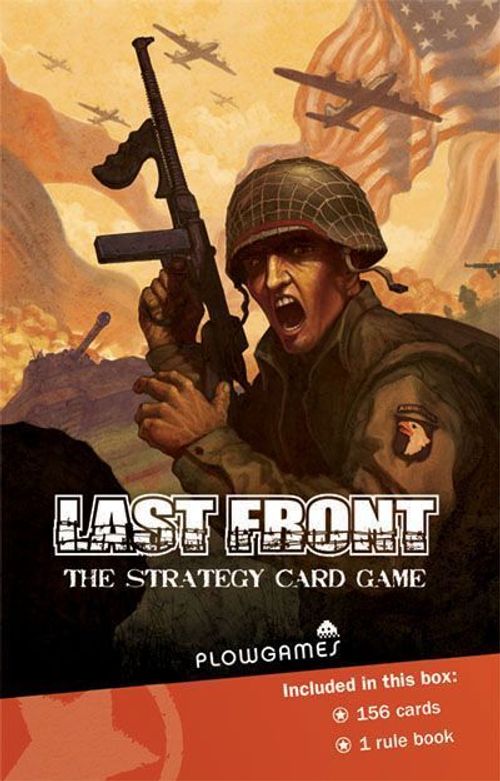
Last Front: The Strategy Card Game
Last Front: The Strategy Card Game Rulebook
Table of Contents
Table of Contents
Description
The goal of the game is to win battles and capture territories by outbidding your opponents.
Battles are fought over territories. Players take turns placing bids to control a territory until a winner is determined through attrition or capitulation. Once the territory has been won, the battle is over. The winning player adds the territory to their display and a new battle begins. The game ends when victory conditions are met. See Victory Conditions.
Cards
There are four card types used in the game: Territory, Territory Bonus, Battle and Event. There are 162 cards and one rulebook included in this game.
Territory Deck (12 cards)
These are the cards that players battle over. There are four different territory types: American (green), British (blue), Soviet (red) and German (gray). There are three cards of each territory type.
Territory Bonus Cards (4 cards)
Territory Bonus cards award special bonuses in battles based on the territory type and who has majority ownership. These bonuses are explained on each card. See Territory Bonuses.
Event Deck (18 cards)
The Event deck contains cards with special rules that can have a dramatic effect on a battle.
If a "Draw Event" card is played from their hand, the player must flip over the top card in the Event deck and follow the instructions.
All Event card effects are instantaneous, can't be blocked, and must be shown to all players. Effects of each Event are described on the cards.
Battle Deck (128 cards)
The Battle deck is used to make and strengthen bids during battles. There are four card types in the Battle deck: Unit, Special, Icon and Draw Event.
-
Unit cards (98): These cards have a numerical value and are used to create bids. There are four types of Unit cards: Troops, Tanks, Planes and Support.
Troops, Tanks and Planes are played at the values shown in the corner of each card. Unit card quantities in the Battle deck break down from most to least as: Troops (1, 2, 3 values), Tanks (2, 3 values) and Planes (2, 3, 4 values).
There are also Support Unit cards (1/2, 2/4, 3/6 values) that appear in the deck about as frequently as Tanks do.
Support Unit cards have two values: a Defense value and an Attack value. When a player uses a Support card to defend a territory that a player has captured they may use the higher Defense value (labeled with a "D"). If the players are attacking another player's captured Territory card or an open Territory card they may still play the Support cards at their lower Attack value (labeled with an "A").
-
Special cards (16): These cards have special abilities or rules that are described on each card. Special cards must be played on your turn unless otherwise noted.
-
Icon cards (10): These cards generally provide boosts to Unit cards; effects are specified on each Icon card.
-
Draw Event cards (4): These allow a player to draw from the Event deck. You may play these during your own turn at any time, although you are not required to. See Event Deck.
Face Values
Special cards and Icon cards also have a face value printed on the bottom right of the card. This allows the player to use those cards at their face value rather than using the cards' special ability.
For example, you could declare that you are playing the card at face value by placing it upside-down in your bid. The card would be counted toward your total bid value.
Once a player has declared that they are going to play a Special or Icon card at face value, the card retains that value. Its special ability cannot be used even if it is stolen by another player.
Example: A player plays the Patton Icon card (special ability: +2/card on Tank Unit cards) for its face value (3 points). The next player plays Lend-Lease Special card for its ability ("swap one card from any opponent's bid with one of your own") and takes the Patton card into their own bid. They do not get the special ability; rather they only get the face value for that card (3 points).
Set Up
Shuffle the Battle, Event and Territory decks individually and place all three face down within easy reach of all players. Place the four Territory Bonus Cards face up in the center of the table.
Deal six cards from the Battle deck to each player. Players may look at their hands.
Game Play
Whoever deals the cards goes first. Game play continues clockwise from the dealer.
When beginning a battle, the first player (dealer) flips over the top card from the Territory deck. The first battle of the game will always be for the Territory card drawn from the top of the Territory deck. In subsequent turns, players may choose to attack territories that have been captured by opponents instead of the one revealed from the Territory deck.
The first player must draw one card from the Battle deck to their hand. They must then make an opening bid by placing a Unit card (or cards) or a valid Special or Icon card from their hand face up in front of them. The player declaring the battle MUST make an opening bid. Players may put down as many cards from their hands as they like during their turn. The values of the cards along with any bonuses are calculated to determine the total bid value.
The next player takes their turn by drawing one card from the Battle deck. They may then either make a larger bid or withdraw from the battle. If the player decides to bid, they must play Battle cards from their hand, placing them face up in front of them until the cumulative face values of all player's cards, and their effects, equal at least one (1) higher than the value of the previous player's bid.
If the player chooses not to bid, then they withdraw from the battle. The withdrawing player should draw one more card from the Battle deck into their hand and discard any cards that they may have bid up to that point. A withdrawing player CANNOT participate in the rest of the battle. See Withdrawing from Battle.
Calculating Bids
Any bonuses offered to Unit cards by Special cards, Icon cards, Event cards or Territory Bonuses MUST be resolved in the correct order. For each card: Multiply/divide first, then add/subtract modifiers.
Example: Two Troop Unit cards with values of 2 and 1, respectively, have a "2x Troop Unit card value" bonus with "+1/Troop Unit card" bonus. Total value of Troop cards in the display below is:
(The example graphic shows the "X2/TROOP CARD" and "+1/TROOP CARD" icon cards, and the two Troop cards: (2x2+1=5) + (1x2+1=3) = 8 value.)
"Digging In" Rule (Optional)
The "dig in" rule allows players to protect their bids in increments of 10 points each. This simplifies the math in calculating bid values.
Once "dug in," these cards are no longer affected by modifiers or special abilities (both good and bad) unless otherwise noted on a card's description. Thematically, this allows players to commit cards to the battle without fear of them being removed by an opponent's Special and Icon cards or be affected by Event cards on subsequent turns.
"Dug in" cards are turned sideways and remain in the bid. As per the normal rules for withdrawing from battle, they are discarded at the end of a battle or when a player withdraws along with the rest of the cards in the bid.
The only valid "dig in" value is 10.
Any points from cards "dug in" over 10 are lost, so players may opt not to commit those cards until they have an even 10 points. Until the cards are "dug in," players MUST leave them spread out in their displays. The cards in the bid remain vulnerable to opponent Special and Icon card effects until players choose to "dig them in" on their next turn.
Example: A player has four Unit cards worth 3 points apiece, giving them a total of 12 points:
(The example graphic shows four "DUG IN" Unit cards, 3 + 3 + 3 + 3 = 12 value.)
The player may choose to "dig in" these cards to protect them, yet the point value will only be 10 (the maximum value of a "dug in" pile). The player loses the 2 extra points from their bid. Instead, the player may wait until a subsequent turn to "dig in" cards when the value of the cards adds up to an even 10 points. For example, a player may draw a card worth 1 point:
(The example graphic shows the "DUG IN" pile 1 + 3 + 3 + 3 = 10, and the drawn card +3 for a value of 13.)
"Digging In" with Special and Icon Cards
If effects from Special cards and Icon cards were used to reach those 10 points, the cards remain in the player's display separately from the "dug in" pile(s). This allows the cards to be used on subsequent turns to modify the value of future cards in the bid. If these cards are eliminated on subsequent turns, the values of the "dug in" piles do NOT change. However, if Special or Icon cards are played at face value to reach 10 points, they are treated like any other Unit card and are "dug in" with the rest of the cards in that pile.
Example: A player has Unit cards totaling 6 points. A Special card is played that modifies their value enough to equal 10. The player declares that they are "digging in" those 10 points. The Unit cards are placed in a single pile and turned sideways to indicate they are dug in. The Special card remains in play separate from the "dug in" pile.
(The first example graphic shows a "DUG IN" pile with a "+2/TROOP CARD" Special card: (3+2=5)+(3+2=5) = 10 value. The second graphic shows the same pile and Special card plus an additional Unit card: (3+2=5)+(3+2=5) = 10, + (3+2) = 15 value.)
A player may have multiple "dug in" piles, but each will be worth only 10 points. Players may not wait until they have 20 points in their bid and "dig in" a single pile of cards worth 20 points. It would need to be broken out into two separate 10 point "dug in" piles.
Blitz Cards
Certain Special or Icon cards can interrupt another player's action and can be played at any time. These cards will have a lightning bolt icon like the one shown. An opponent may use these cards to interrupt other players as they attempt to "dig in" a group of cards if they have NOT already withdrawn from the battle. This should be done as soon as players declare they are "digging in" points.
Withdrawing from Battle
If it is a player's turn, and they are unable or unwilling to play enough Battle cards to beat the previous bid, they may withdraw from the battle.
Any cards already in the bid (including those that have been "dug in" as well as Icons and Specials) must be discarded, and the player may not participate further until a new battle has begun. Upon withdrawing, a player should draw one more card into their hand from the Battle deck. They may not draw any more cards for the rest of that battle.
A player who has withdrawn is immune to any Special, Icon or Event card effects for the rest of that battle.
Winning the Battle
Players must beat the previous player's bid by at least one point. The player who does not withdraw wins the battle and adds the captured Territory card to their display. If a player wins, he or she may also draw one extra card to his or her hand from the Battle deck.
Note: The second-to-last player also draws one card, as it still counts as a withdrawal.
All cards in a player's bid are discarded at the end of a battle, including "dug in" piles and Special and Icon cards played.
The winner of each battle will declare the next battle to take place. If a Territory card from the top of the Territory deck has been captured, a new card is always flipped over from the top of the Territory deck before the next battle is declared. The winner may either attack a new territory from the Territory deck or attack a captured Territory card held by another player.
All players participate in battles, so attacking another player is a good way to pit opponents against each other or weaken a stronger competitor. The winner makes the first bid, and the battle continues as normal until a winner is declared. See Victory Conditions to determine who wins the game.
Territory Bonuses
The goal of the game is to capture Territory cards. Each territory offers a unique bonus ability to the player with a majority of that territory type.
Territory Bonus cards don't count toward victory conditions. They provide special abilities that remain in effect from battle to battle. A player must have a controlling share of a given type of Territory card in order to keep this bonus.
The diagrams in the rulebook show two scenarios:
- Scenario 1: Player 1 is shown with "Bonus!" and Player 2 with "No Bonus."
- Scenario 2: Player 1 and Player 2 are each shown with "No Bonus," and the Territory Bonus card is shown at the "Center of Table."
Victory Conditions
These are suggested conditions for winning the game. You can play even faster games by removing territory types.
- Normal game length (45 minutes)
- 2 of the same territory type OR
- 3 different territory types
- Quicker games (20 minutes)
- 3 of ANY type of Territory cards
Quick Play Guide
Turn Order
- Player draws one card from the Battle deck.
2a. If player makes a bid: (First player must choose a Territory Card to fight for and must make an opening bid)
- Place card/cards face up in front of you to make a bid
- Declare any Special or Icon cards played at face value and turn them upside down in the bid
- Add modifiers from Captured Territory Bonuses, Special and Icon cards, etc. to calculate total bid value
- Declare any "dug in" points
- Declare you are finished
2b. If player withdraws:
-
Declare you are withdrawing
-
Draw one card to your hand
-
Discard all cards in bid (if any)
-
Next player's turn (clockwise): Player must bid one point more than previous player or withdraw.
Battle continues until only one player remains.
The winner draws a card from the Battle deck and chooses the next Territory Card to fight for from either the Territory deck or another player's display. The next battle begins at step 1.
Two Player Variant: Soviet Assault
The following two-player rules are the official Plow Games "Last Front: Soviet Assault 2 Player Rules" sheet, appended after the main rulebook.
The theme of the two player game is the invasion of the Soviet Union. A dummy player begins the game with control of the USSR Territories and Territory Bonus and defends the cards in the Territory Deck against the players using only the Support Unit cards that have been pulled from the Battle Deck.
The primary difference in a two player game is the dummy player. The dummy player defends the Territory Deck by playing Support Unit cards one at a time on its turn. The second difference is that battles are always fought over the top card on the Territory Deck. Players may not attack each other as they can in 3+ player games. The dummy player also begins the game with the USSR Territory cards and Bonus.
Note: The dummy player is immune to all Special, Icon and Event card effects.
Gameplay (Two Player)
Before you begin, remove all Support Unit cards from the Battle Deck and set them aside in their own pile. Remove all USSR Territory cards from the Territory Deck and the USSR Territory Bonus card.
Shuffle the Battle Deck, Territory Deck, Event Deck and the separate pile of Support Unit cards and place them all face down in the center of the table. Place the Support Unit card pile and the USSR Territories and Territory Bonus cards next to the Territory Deck. The dummy player will make bids with the Support Unit cards only and apply the USSR Territory Bonus to their bid.
Deal six cards to both players as you normally would. Flip over the top card on the Territory Deck. This will be the card that you will fight for this battle. Unlike the regular 3+ player game you will never attack each other. Each battle will be for whichever card is on the top of the Territory Deck.
Next, take the top card from the Support Unit pile and place it face up next to the face up Territory card. The dummy player uses the higher "D" value on the card and applies the +1/card USSR Territory Bonus. This will establish the opening minimum bid.
The player to the left of the dummy player goes first, drawing one card from the Battle Deck to begin their turn. Next they make their bid. They must exceed the value of the dummy player's bid by at least one point in order to continue. If they choose not to or are unable to they may instead withdraw. The withdrawing player takes one card into their hand from the Battle Deck. They may no longer participate in the battle once they have withdrawn.
The second player must then beat the highest bid by at least one point. They draw one card from the Battle Deck to their hand to begin their turn. They may then choose to either bid or withdraw.
Once the second player makes their bid the dummy player flips over the next card off the top of the Support Unit card pile. The dummy player will only play one card at a time. If the value of the cards in the dummy display are not higher than the either player's bids, the dummy player is eliminated for this battle. Otherwise the bidding continues until the players have either both withdrawn or only one remains. The winning player takes the Territory card into their display as well as the Territory Bonus card (if applicable).
If neither player wants to outbid the dummy they may withdraw as normal. If the dummy player wins the round they receive no awards or Territory cards. They have simply defended that Territory. The next battle will be for the same Territory Card.
The next round starts as before: a new Territory card is flipped face up on the Territory Deck and the dummy player plays the top card from the Support Unit card pile to create an opening bid. The winning player goes first. If the dummy player won the previous battle, the player to the left of the dummy plays first.
Victory Conditions (Two Player)
Victory conditions are the same for the two player game: 2 of a kind or 3 of any Territory Card.