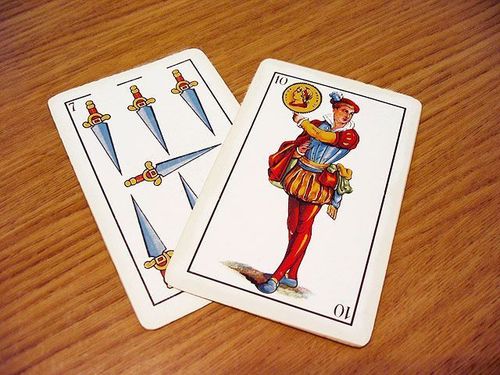
Las siete y media
Las siete y media Rulebook
Table of Contents
Table of Contents
Objective
The aim is to reach seven and a half, that is, for the total value of a player's cards to equal seven and a half points, or to get as close to that value as possible without going over. The bank plays against each player individually, and its hand must beat or equal each player's hand. In case of a tie, the bank wins.
Card Values
Each figure card (court card) is worth half a point. All other cards are worth the value shown by their number (their index).
The Deck
The game is played with the 40-card Spanish deck.
Dealing and Setting Up the Bank
To start the game, it must be established which player will be the first to hold the bank. This can be decided by lot, though it is also common for a player to buy the bank by paying a compensation to each of the other players.
Playing the Game
After shuffling and having the cards cut, the bank deals one card to each player, including itself, going counter-clockwise.
Each player may look at their card, but does not make any move until their turn comes.
The first turn belongs to the player seated to the right of the bank. On their turn, the player places their bet and asks for a card, or stands. If they stand, the turn passes to the player on their right. If they want to ask for a card, before doing so they may reveal the card they already have or leave it face down. In the first case, they must receive the other card face down; in the second case, they receive it face up, since each player may have at most one face-down card. To decide whether to hide or reveal cards, the general advice is that high cards are best kept hidden and low cards revealed.
When asking for a card or when standing, the player may place a new bet, without exceeding the established maximum. The bet cannot be increased after the player has reached seven and a half.
On receiving the second card, three things may happen:
- The total value of the cards exceeds seven and a half. In this case, the player has lost: they hand over the value of their bet to the bank, and the cards go to the discard pile to be shuffled for the next hand.
- The total value of the cards does not reach seven and a half. In this case, the player may ask for a new card or stand.
- The total value of the cards is exactly seven and a half. Obviously, the player stands.
When a player stands or passes, their turn ends and the turn passes to the player on their right.
After the turns of all players have ended, the bank's turn comes.
The Bank's Turn
The bank plays with all its cards face up. First it reveals the card it was dealt in the initial deal. At that moment, it may choose either to stand or to ask for a card. The bank may decide to stand either because it has reached seven and a half, or because it considers the value of its cards sufficient to beat all or several of the players who have not gone over. If the bank stands, it beats every player whose hand has a value less than or equal to its own, and it loses to every player whose hand has a higher value.
If the bank goes over, it has lost and must pay the players who have stood. If the bank has reached seven and a half, it beats all players and every player hands over their bet to it.
Payouts
The bank pays an amount equal to the value of the bet to every player who has won, except for hands that obtained seven and a half, which collect double the amount bet.
Change of Bank
If during the hand one or more players have reached seven and a half, but not the bank, the first of them has the right to the bank, and the current bank must give up its position. If no player has reached seven and a half, the bank does not change hands unless it is sold or transferred by the player who holds it.
End of the Hand
After the transactions, the player holding the bank collects the cards, shuffles them, and has them cut, thus beginning another hand.
Supplementary Rules
The following rules are not used in the basic game, but they are accepted by most players. In any case, the players must agree beforehand which of them will be valid during the game and which will not.
Calling Seven and a Half
The first player who obtains seven and a half announces it, in order to force the bank to try to obtain this same hand.
This increases the bank's risk of going over and therefore increases the chances of the players who follow.
Opening (Abrirse)
When a player opens, they multiply their chances of winning and also of losing.
To open, the first two or three cards a player receives consecutively must be of the same value. This possibility may also be agreed beforehand, without requiring the cards to be of the same value.
The number of times a player may open must be established beforehand. It is determined by the number of players: if there are two or three players, they may open up to three times; if there are four or five, once; and if there are more, it is better not to allow this possibility.
The mechanics of opening are simple. The player holds the card from the initial deal, normally a figure. On their turn, they expose it, place their bet, and ask for a card. If they are given a card other than a figure, they continue playing as indicated in the basic game, standing or asking for another card. If they are given another figure, they have the option of placing it with the other one and continuing to play as in the previous case, or placing it beside it and betting on it as if it belonged to another player. The two hands are independent: a maximum bet may be placed on each of them. Furthermore, losing one of them does not automatically mean losing the other. Cards cannot be exchanged between the two hands.
After opening, the play continues with the first card. After the first hand ends, either by standing or by going over, the player moves on to play with the second card. They place their bet and ask for a card. If they now receive a new figure and still have the possibility of opening a third time, the player may open again.
If they can no longer open, the card becomes part of this hand, which continues until the player goes over or stands. The player's turn ends when they have made all their hand choices.
The Four (El cuatro)
Fours are very awkward cards: they are the lowest of the high cards and the highest of the low cards. For all these reasons, a possibility that is often adopted as a supplementary rule is to change the card of this value when it is the first card a player receives. This change is not made immediately upon receiving it in the initial deal, but at the start of the player's turn and before placing the bet.
When the turn of the player holding the four arrives, they turn the card over and return it to the banker, exclaiming: "Los cuatro se cambian" ("Fours are changed"). The banker gives the player the first card of the deck and places the four inside the deck, roughly halfway through. If the player was given another four, they have the possibility of changing it again, up to four times in all. When the player receives a card that is not a four, they continue their hand normally until they stand or go over.
It must also be made clear whether changing the four is a possibility or an obligation.
Shooting (Fusilar)
To make this play, the initial card must be a seven. This is undoubtedly a very risky play, since if the player stands they have a good chance of winning, but if they ask for a card, it is easy to go over.
On their turn, the player turns over their seven and says "¡Fusilo!" ("I shoot!"). The banker places the first card of the deck under the seven without turning it over and taking care that no player sees it. On top of the seven, the player places their bet. The banker must act as if seven and a half were there, and if it were, would pay four times the bet.
Betting
A player bets on their own hand or hands, if the possibility of opening exists. It may also be established that players may bet on the hands of others, although all decisions will be made by the player whose turn it is.
Obligation of the Bank to Reach Seven and a Half
It may be established that the banker may not stand before reaching seven and a half if any player has obtained this hand on their turn and has declared it.