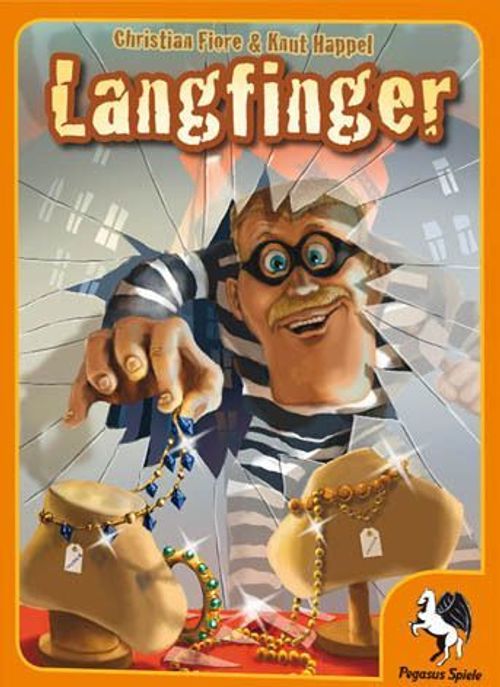
Langfinger
Langfinger Rulebook
Table of Contents
Table of Contents
Game Components
- Game board, with five places: City, Villa, Ruin, Museum, and Harbor. The small numbers just above the placement squares tell you how many cards will be placed there, depending on the number of players.
- Money Tracker
- 30 Loot cards
- 5 Scoundrel cards
- 5 Scoundrel playing pieces
- 15 Scoundrel tokens
- 14 Fence cards
- 1 Starting player card
- 60 Tool cards
Preparing for Play
Place the game board in the middle of the table.
Each player chooses a scoundrel card and places it in front of him, along with the 3 scoundrel tokens of matching color. He places the matching scoundrel playing piece on square 0 of the money tracker on the game board.
Divide all tool cards, loot cards, and fence cards into 3 separate piles. Shuffle each pile and place it to one side of the playing field, face down.
These are the draw piles. You use them when you draw cards for your hand or when you turn cards face up. Leave some space next to the draw piles so that you can create discard piles later in the game. Whenever one of the draw piles runs out of cards, you shuffle the respective discard pile and use it, face down, as the new draw pile.
The player with the longest fingers becomes the starting player. He gets the starting player card. The starting player now draws 2 tool cards from the appropriate draw pile; the player to his left draws 3 tool cards, and all other players draw 4 tool cards. The players take these cards into their hands.
There are five places on the game board: City, Villa, Ruin, Museum, and Harbor. Place as many tool cards face up next to the City as instructed as per the number of players.
Repeat this step for the Villa and the Museum, but use loot cards for these two places. Be sure to place these loot cards face down!
Finally, you place the indicated number of fence cards next to the Harbor. These are placed face up.
Now you're all set!
Example: There are three players. Thus, you place 6 tool cards next to the City, face up. You place 2 loot cards each next to the Villa and the Museum, all of them face down. Finally, you place 3 fence cards next to the Harbor, face up.
Playing the Game
The game is played in rounds. A round consists of 3 phases:
- A) Place scoundrel tokens
- B) Perform actions
- C) Prepare for the next round
A) Place Scoundrel Tokens
Placing your scoundrel tokens determines at which place and in which sequence you may perform your actions later in that turn.
The starting player begins by placing 1 scoundrel token onto the game board. In a clockwise direction, the other players now also place 1 scoundrel token each. You may never place more than 1 scoundrel token at once when it's your turn in this phase. Repeat this procedure until all players have placed all 3 of their scoundrel tokens. Once this is done, the phase is over.
Each of the 5 places has 5 squares on which to place scoundrel tokens. Each square may hold no more than 1 token. You may place more than one token at the same place, provided there are still open squares.
Example: Hans begins and places 1 brown scoundrel token onto square 1 of the Harbor. Now it is Yoshiko's turn; she places 1 yellow token onto the first Museum square. Next is Tommaso; he places 1 green token onto square 1 of the City. Now it is Hans's turn again and he decides to place his second token onto the second Museum square. Yoshiko then chooses square 2 at the City, while Tommaso opts for square 2 at the Villa. During the third (last) placement turn, Hans chooses the Villa, Yoshiko opts for the Ruin, and Tommaso goes for the Harbor.
B) Perform Actions
Each player who has placed scoundrel tokens at one of the 5 places now performs 1 action per scoundrel token. Places are resolved as indicated by their numbers.
The player who has placed his token on square 1 of the place in question gets to perform his action there first. The player with the scoundrel token on square 2 is next, followed by the player whose token is on square 3, etc. Once an action is finished, the player removes his respective scoundrel token from the game board and places it in front of him until needed again next round.
Depending on place, players may perform these actions:
1. City
Spending 1 action allows you to take 2 of the tool cards placed here into your hand. You choose those 2 tools freely. If all tools have already been collected by other players before it is your turn, you will have to leave empty-handed.
The tool cards are: welding equipment, hammer, lock pick, map, pliers.
Example: Square 1 of the City holds a green scoundrel token, which means that Tommaso gets to take his action first. From among the tools placed here, he chooses the hammer and a lock pick. Then he takes his scoundrel token and places it in front of him. Yoshiko's action is next. She takes the two maps into her hand and also places her scoundrel token in front of her. Since there are no further scoundrel tokens, the City has been dealt with and the Villa is next.
2. Villa
Spending 1 action allows you to take 1 of the loot cards placed here – provided you have the appropriate tools. Each loot card shows 2 or 3 tools. In order to take a loot card, you need to place the tools depicted from your hand onto the discard pile.
Take a look at your scoundrel card: It also depicts one tool. You may use this tool instead of a tool card to acquire a loot card. However, you do not need to discard your scoundrel card! You may use your scoundrel card once per round and per place, but you can't use it for more than one loot card per place, and you can't use it more than once for the same loot card.
Each loot card shows 1 of 4 different types of security: chest, safe, showcase, pillar.
If you get a card depicting a chest, you may cash it in immediately. Turn the card with the chest face up. Now you see a money bag and a numerical value. Advance your scoundrel piece on the money tracker by an amount of spaces corresponding to the value of the money bag. Then you place the loot card onto its discard pile.
If you acquire a card depicting a safe, a showcase, or a pillar, you may not cash it in immediately. Place the loot card face down in front of you until you can cash it in later in the game by visiting a fence at the Harbor. You may look up the value of your face-down loot at any time.
Example: Tommaso gets the first action at the Villa. He takes the loot card showing the pillar. To do so, he plays a lock pick, a hammer, and a map from his hand and then puts the cards onto the tool cards discard pile. Since his loot is protected by a pillar, he cannot cash it in immediately. He takes a brief look at the face of the card and then places it face down in front of him.
Now it is Hans's turn. He takes the remaining loot card. Hans's scoundrel card shows a hammer that he can use here. Thus, he only needs to play the pliers from his hand. His loot is protected by a chest, so he turns over the card immediately. The money bag on its face has a value of 2. Hans advances his playing piece by 2 spaces on the money track. Then he places the loot card onto its discard pile.
3. Ruin
You may exchange tool cards here. Next to the squares for the scoundrel tokens, there are 5 exchange squares with different exchange rates. Take your scoundrel token for this action and place it onto an empty exchange square. Place the number of tool cards indicated by the first number in the exchange square from your hand onto the appropriate discard pile. Now draw the number of tool cards indicated by the second number in the exchange square from the draw pile.
Note: After this action, do not place your scoundrel token in front of you as usual, but leave it on the respective exchange square. This square is now closed to other scoundrel tokens. It is not until all players have finished their actions at the Ruin that they take back their scoundrel tokens.
Example: Only Yoshiko has placed a scoundrel token at the Ruin. She moves the token onto the exchange square 1>2. She then discards 1 lock pick and draws 1 pliers and 1 lock pick. Since all tokens at the Ruin have been dealt with, Yoshiko picks her token up again.
4. Museum
The Museum action is identical to the action at the Villa. This means you may spend 1 action to take one of the loot cards placed here if you have the appropriate tools.
You may make use of your scoundrel card here, too, regardless of whether you have already used it at the Villa or not. You may use your scoundrel card once per round at each the Villa and the Museum, but you may not use it more than once at the same place.
Example: Yoshiko discards two maps and takes the loot card to the left. (She's got the required welding equipment on her scoundrel card.) Hans then takes the remaining loot card, discarding welding equipment. He may use the hammer, which he has already used at the Villa, a second time.
5. Harbor
Spending 1 action allows you to turn 1 loot card into cash. The face of each loot card depicts the type of loot: gold, jewelry, coins, statue, paintings.
To cash in a loot card, a fence card with the appropriate loot type needs to be present at the Harbor. If this is the case, you turn your loot card over to its face and advance your scoundrel piece on the money tracker by an amount of spaces corresponding to the value shown on the loot card. Place the loot card and the fence card used onto their respective discard piles.
If a fence card shows the same loot type twice, you may, as an exception, sell 2 loot cards of this type to that fence for 1 action. However, you may never cash in 2 different loot types for 1 action.
If a fence card does not show a particular type of loot, then the fence does not buy loot of this type.
Some fence cards show a +1 or +2 entry. Such a fence pays off a bonus of +1 or +2 for the respective loot type. This means that you may advance your playing piece an additional 1 or 2 spaces on the money tracker when selling the appropriate loot card to this fence.
Example: The fence in the middle either buys 1 gold or 1 jewelry at a +1 bonus or 1-2 statues or 1 painting. A player with 2 statue cards may thus sell both statues to this fence for 1 action.
Hans goes first at the Harbor. He has exactly one loot card. Its face shows coins with a value of 2. Only the fence to the left deals in coins and thus Hans sells his loot to him. He turns the loot card face up and advances his playing piece by 2 spaces on the money tracker. He then discards both the loot card and the fence card he used onto their respective discard piles.
Next is Tommaso. He has a loot card with a painting of value 3. Now there are only 2 fences left at the Harbor, but fortunately both buy paintings. One of them even pays a bonus of +2 and of course this is the one Tommaso chooses. He turns his loot card face up and advances his playing piece by 5 (3+2) spaces on the money tracker. Then he discards both loot and fence.
C) Prepare for the Next Round
After the actions at all 5 places have been resolved, you prepare for the next round.
Replenish the tool cards at the City until there are again as many tools there as indicated for the number of players. Repeat this process with the loot cards at the Villa and the Museum as well as with the fence cards at the Harbor. The current starting player then hands the starting player card to the player to the left, who thus becomes the new starting player in the next round.
End of Game
Once a player's scoundrel piece has passed the 20 mark on the money tracker, simply continue to advance the piece, treating space 1 as 21, space 2 as 22, and so on. Just keep in mind that this playing piece has already crossed the 20 mark. Once a player has advanced to at least 20 on the money track at the end of a round, the game ends. The player who has the most money wins. In case of a draw, all tied players win.