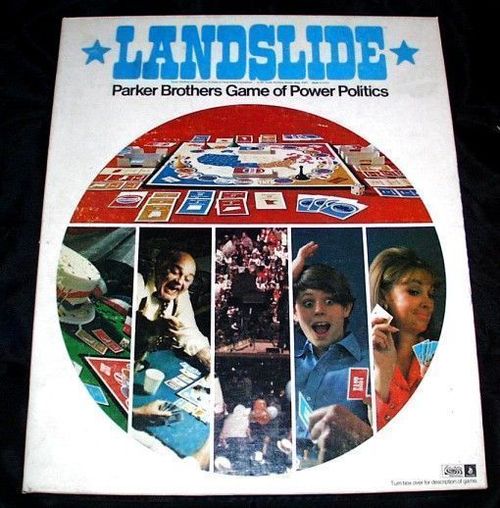
Landslide
Landslide Rulebook
Table of Contents
Table of Contents
Preparation
Sort out the six decks of cards: Vote Cards, Politics Cards, and four decks of State Cards color coded by area (i.e.: East, South, Mid-West and West). Shuffle each deck separately. Place State Card decks face down in the plastic trays provided. Put the trays in a convenient location near the board. Deal out five Vote Cards to each player. Place the remaining Vote Cards face down in a pile on the board above the map, and place the Politics Cards face down in a pile below the map. Each player selects a token and places it on the Home State space on the corner of the board to his right. He becomes the Favorite Son of that Home State for the duration of the game.
Action
Players roll the die to determine who plays first. The high player rolls again and moves his token clockwise the appropriate number of spaces. Players play in turn.
State
When a player's token lands on a space marked "State", he takes the top State Card from the deck of the matching color. He alone may look at the name and electoral vote value of that state. The state immediately goes up for bids from all players (including the player who drew the card) who use their Popular Votes for bidding. (See rules for bidding.) The highest bidder gives the appropriate quantity of Popular Votes to the player who drew and auctioned the State Card. If the highest bidder is the player who drew the State Card, he returns the proper quantity of Popular Votes to the Vote Card pile which he shuffles. (If all State Cards of a particular color are gone, select the top State Card from any other pile.)
Open Ballot
When landing on "Open Ballot", the player may, if he wishes, contest any state in the possession of another player and that state goes up for bids from all players, including the former owner. (See rules for bidding.) The former owner receives the high bidder's votes. However, if he is high bidder, his votes go into the Vote Card pile on the board. There is no action if no one has a state in his possession.
Secret Ballot
When a player's token lands on "Secret Ballot", four State Cards, one from the top of each State Card deck, are auctioned "blind." All four cards are placed face down in the center of the board and are up for bids in a single auction. The high bidder gives the proper quantity of Popular Votes to the player who landed on "Secret Ballot". If that player should be high bidder, his votes go into the Vote Card pile on the board. (If only three decks remain, then only three states are auctioned, etc.)
Home State
A player who lands on someone else's Home State must allow its Favorite Son to select (sight unseen) one of his Vote Cards. If he lands on his own Home State, he takes two Vote Cards from the board.
Politics
A player landing on a "Politics" space draws the top card from the Politics pile. He may follow instructions at once or hold the card for future use. "Stop" cards should be used strategically at crucial times and are usually held. "Any action" is defined as all activity which results when a player lands on a space or plays a Politics Card. A "Stop" card may be played during any action except bidding (see below) and cancels that entire action.
Regardless of instructions, no Politics Card may be played on a turn from the time any bidding starts until the high bidder receives his state or states.
There is no limit to the number of Politics Cards which may be played by one or more players at any time.
Win Votes
When a player lands on "win VOTES" he draws one Vote Card from the top of the Vote Card pile. If there are no Vote Cards left he doesn't draw one.
Fly Anywhere
A player moves his token clockwise to any space (except as noted here) and proceeds as if he landed there by roll of the die. His token may not move more than one circuit of the board. It may not land on "Fly Anywhere" or the player's own Home State. If his token passes his Home State, however, he draws a Vote Card.
Rules for Bidding
- The player on whose turn bidding occurs must open the bidding or pass. Bidding proceeds clockwise around the table, each player having an opportunity to bid or pass in turn. A player who passes may bid later.
- Bidding ends when all but one player concedes.
- The open bid must be not less than 250,000 votes.
- States in the bidder's possession may be used in bidding up to their Popular Vote values; i.e., New Hampshire has 400,000 Popular Votes; therefore it can be used for bidding up to that value. The state so bid must be given up in the same manner as Vote Cards. State Cards returned to the board should be shuffled into their appropriate color decks.
- If the winning bidder is unable to make up the exact number of Popular Votes that he has bid from his Vote Cards and/or State Cards, he must give up more than the amount bid; i.e., if a player has bid 4,500,000 votes for a state and has only a 5,000,000 Vote Card, he must give up that card. No player may ever "make change."
- Any player who bids more than he has and wins the bidding, must forfeit his most valuable state which is returned to the board and shuffled in. If he has no states, his highest vote card is returned to the board and shuffled in. Bidding begins over again for all players.
Important General Rules
- State Cards must be displayed face up by their owners at all times.
- Whenever State or Vote Cards are returned to trays or to the board, the decks involved should be shuffled. Politics Cards are returned to the bottom of the Politics deck.
- It is helpful if one player is made responsible for keeping a tally of each player's electoral vote count which he supplies on request.
- Whenever a player's token passes his Home State, he draws one Vote Card from the board. If he lands directly on his Home State, he receives two Vote Cards.
Ending the Game
The game is over when the last State Card is acquired by a player. The player with the most electoral votes wins.