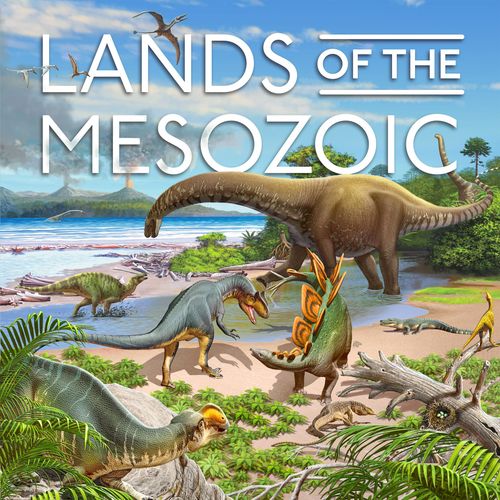
Lands of the Mesozoic
Lands of the Mesozoic Rulebook
Table of Contents
Table of Contents
Game Components
- 55 Land cards
- 63 Herbivore cards
- 42 Carnivore cards
- 18 Period cards
- 9 Major Extinction Event cards
- 15 Goal cards
- Rules
- Active player token
- Turn Tracker Token
- 20 player wooden tokens in 4 different colors
- Victory Point Tokens of values 1, 2, and 3
- Player Boards
- Goal Board with turn track
- Cards Tray
- Play Book
Game Overview
In Lands of the Mesozoic, players will create and manage their own Mesozoic ecosystems using 3 main types of cards that symbolize the different levels of the food chain.
Players will first lay down Land cards that represent the habitats that provide shelter and plant/insect/fish food. There are 5 types of land: Forest, Prairie (Grassland), Dryland, Water, and Wetland.
Land cards in play are used to pay for the cost of Herbivore cards. These are the animals using the resources generated in those specific types of lands. There are 3 different types of herbivores by size: Small (S), Medium (M), and Large (L).
In turn, Herbivore cards in play can generate the resources necessary for playing Carnivore cards. These are the animals at the top of the food chain, and they control the population size of herbivore species in the ecosystem. There are 2 types by size: Small (S) and Large (L).
All 3 types of cards need to be in balance for the ecosystem to be sustainable in the long term. However, competition between species and the shifting nature of the surface of the Earth, will trigger extinction events of animals and habitats that, in turn, will open niches for new species to appear and spread.
Now that you are familiar with the main symbols and concepts of the game, you are ready to set it up.
Set-up
Start by shuffling the Land, Herbivore, and Carnivore decks and put them, in that order, in the center of the playing area, with a space next to each of them for creating 3 discard piles.
Next, we will create the Period deck. This deck acts as a timer for the game and will produce different benefits or penalties for all players each round. Start by separating and shuffling the first, second and third Period cards, creating 3 small card stacks. Then, shuffle the Major Extinction Event cards (with volcano symbols at the back) and place one of them face-down, on top of the second and third Period card stacks. You may return the remaining Major Extinction Event cards back to the box, they won't be used in this game. Finally, place the 3 Period card stacks on top of each other creating a single deck, with the third Period cards at the bottom and the first Period cards on top.
Now, place the Period deck and the board with the turn track somewhere near the main decks. Shuffle the Goal card deck and place one in the Common Goal spot face up on the board.
Then place 2 Victory Point tokens of values 1 and 2 for each of the Race Goals on the circles to the left, with the tokens of value 2 on top of the tokens of value 1. Finally, put the Turn Tracker Token on the arrow space of the turn track.
Near the Board, create a supply of Victory Point Tokens. The most ancient player gets the Active Player Token. Each player places their player board in front of them and collects 5 wooden cubes of the same color. Now, starting with the active player, each player draws 3 Land cards, 2 Herbivore cards, 1 Carnivore card, and 2 Goal cards; do not reveal these cards to other players. Then, each player chooses one Goal card to keep and discards the other one face down. You may put the rest of the Goal cards with the discarded ones, back in the box. You are ready to start playing.
Game Overview (Rounds and Periods)
The game consists of 3 periods of 7, 6, and 5 rounds respectively. At the beginning of each round, move the Turn Tracker Token one space to the right. Flip the card at the top of the Period deck. In turn order, every player applies its effect immediately (e.g., draw one Herbivore card). Then, starting with the active player, every player takes a turn.
Once all players have completed their turns, the round is finished, and the Turn Tracker Token is moved one space to the right. If it reaches a space with a volcano symbol in it, that means that the current period has come to an end. The card at the top of the Period deck should have the volcano symbol in it. Flip it face-up and, in turn order, every player applies its effect(s). Then, a major extinction is triggered (see the Major Extinction Events section). After applying all the end-of-period effects, put the Turn Tracker Token on the first space of the next period and continue the game, starting by drawing the next period card and applying its effects.
If the Turn Tracker Token reaches the last space of the turn track, which shows a symbol with a meteorite hitting Earth, all cards in play (on their player board) go extinct. The game is over, and the players add up their final scores. Players gain points from 3 sources:
- Played card victory points
- Victory Point Tokens
- Goal card victory points
The player with the highest score wins.
Player Turns
In their turns, players can play cards from their hands and/or activate cards already in play, in any order. Additionally, once per turn players can discard any two cards from their hands as a Special Action for a benefit of their choice. See Special Action.
During the game, there is no limit to how many cards players may hold in their hands. Cards in play may be used for their ability or to generate a resource to pay for other cards. Using a card in play will usually exhaust that card (turn it on its side) until the next turn. Players will do this until they cannot or do not want to play or activate any more cards.
Important: any time a player draws a Land, Herbivore, or a Carnivore card, she/he can choose to draw it from the corresponding deck or from the top of the discard pile of that type of card. If the discard pile is empty, the card must be drawn from the deck. In the rare case of a player drawing a card of a certain type and both the deck and the discard pile being empty, the player will instead draw a card from either of the other 2 decks, but not from their discard piles.
At the end of each turn, players will check if their ecosystem is sustainable according to the ecosystem balance rules (see the Ecosystem Layout and Balance section). If it is not, players will take an extinction action to restore the balance. Then, the active player refreshes all exhausted cards in play, so they are ready to be used the following turn. This means that cards in play that are on their sides are straightened-up at the end of the turn. Finally, the active player gives the Active Player Token to the next player in turn order to indicate that her/his turn is over. The next player is now the active player and may begin her/his turn.
Land Cards
Land cards are the simplest of the 3 main types of cards. The cost to put them in play on the Player Board is to discard as many cards of any type from your hand as indicated in the cost of the Land card. Cards from your hand are always played exhausted (turn 90 degrees). The card will refresh (turn to its normal position) at the end of the turn as explained before. This means that normally, newly played cards won't be available to be used until the following turn.
Anatomy of a Land card: cost to play (top left), name, victory points, ability of card, attribute.
For Example: To play the Swamp land card, you need to discard 2 cards of any type from your hand. The Swamp card generates a Wetland resource. The Swamp card can be exhausted to draw one Land card from the Land deck or the top of the Land discard pile.
When discarding cards, return them to their corresponding discard piles by card type. Land cards will have a cost of 1, 2, or 3 cards from your hand and they all give 0 victory points at the end of the game.
If a Land Card is not exhausted, it can be used in 2 ways:
- While paying the cost to play an Herbivore card (a few Carnivore cards also require land resources) or the cost for the activation of certain abilities, exhaust the Land card to generate a resource of its attribute.
- Exhaust the card to use its ability if it has one. The exhaust symbol in a card indicates that you need to exhaust the card to activate its ability.
Once exhausted, the card cannot be used again for any purpose until it is refreshed. However, exhausted cards can become extinct as the result of an ability, the special action, overgrazing, or major extinction events.
Herbivore Cards
Although the animals in this group are labeled as herbivores for simplicity, they represent the second trophic level of the food chain. Besides plant matter, some of the animals depicted may also eat invertebrates, fish, etc. Herbivore cards are relatively easy to obtain but cannot be played until there are Land cards already in play. Also, remember that there is a limit on how many Herbivore cards of each type (Small, Medium, and Large) can be in play during any given period. Herbivore cards have a cost to play that is a combination of land resources (that are generated by exhausting Land cards in play with the corresponding land attributes) and discarding cards from the player's hand.
Anatomy of an Herbivore card: cost to play, name, type (Small/Medium/Large), victory points, attribute, ability of card, secondary attribute.
For Example: To play the Iguanodon in a player's ecosystem, the cost is to discard 3 cards of any type from hand and to pay one dryland resource and one water resource, which are generated by exhausting Land cards with those attributes. Just like when playing a Land card from your hand, Herbivore cards go into play exhausted.
Herbivore cards can be used in the same 2 ways as Land cards:
- While paying the cost to play a Carnivore card or the cost for the activation of certain card abilities, exhaust the Herbivore card to generate a resource of its attribute. The Iguanodon card generates a Medium Herbivore resource.
- Exhaust the Herbivore card to activate its ability. The Iguanodon card can be exhausted to discard any one card from hand to then draw one Carnivore card from the Carnivore deck or the top of the Carnivore discard pile.
However, unlike Land cards, activating the ability of some herbivores doesn't require exhausting the card. These abilities are:
- When Played: this type of ability is only triggered when the card is put into play from a player's hand. After that, the card is considered to not have an ability for any purposes.
- End of a Period: This ability triggers at the end of all 3 periods (e.g., Vintana), as long as the card is in play and not in the extinction stack pile. Resolve the ability just before resolving Major Extinction Events or the final scoring at the end of the game. This means that the card with the end of a period ability may go extinct as result of the Major Extinction Event, but it will have used its ability first.
- End of Game: these abilities take effect at the end of the game during the final scoring phase (e.g., Apatosaurus). It doesn't matter if the card was in play or in the extinction pile at the end of the game, the ability will be applied regardless.
- Active: active abilities are effective at all times the card is in play, whether the card is exhausted or not (e.g., Plagiosaurus). This means that as soon as the card is played, the benefits of the ability are applied. If the card with the active ability goes extinct, the ability is no longer active.
Herbivore cards have 1 or more secondary attributes. These attributes are only used in the final scoring phase for goal scoring cards and end of game abilities, at the end of the game, and they have no effect during the game. When exhausting any card for generating a resource of any type, only the primary attribute directly under the card point value of the card is used; any other icon underneath is ignored (e.g., the Plagiosaurus card cannot generate water resources because it is a secondary attribute only used for scoring purposes at the end of the game).
Carnivore Cards
Anatomy of a Carnivore card: cost to play, name, type (Small/Large), victory points, attribute, ability of card, secondary attribute.
For Example: To play the Ceratosaurus, a player must have space for a Large Carnivore in her/his ecosystem and then, she/he must discard any 2 cards from hand and exhaust 1 Medium and 2 Large Herbivores in play. Like every other card that enters play from a player's hand, the Ceratosaurus is added to the ecosystem exhausted.
Small carnivores represent small to medium meat-eaters, while large carnivores are the apex predators of the food chain. Carnivore cards are the hardest to get. However, the abilities of most Carnivore cards provide players with ways to gain Victory Point Tokens. Also, Carnivore cards are necessary to maintain a balanced ecosystem with more than 2 Herbivore cards in play (to avoid Overgrazing). As with every other type of card, Carnivore cards are played exhausted.
The Victory Point Token symbol refers to Victory Point Tokens players earn by using some card abilities. The number inside indicates how many victory points that token is worth at the end of the game. Players should keep their Victory Point Tokens near their ecosystems.
Although Victory Point Tokens are obtained mostly with Carnivore cards, claiming Race Goals and some Herbivore cards can also produce them.
Carnivore cards can also generate Carnivore resources of their attribute to pay for playing cards and activating abilities, but only a few cards require Carnivore resources, so this is not common.
Like Herbivore cards, some Carnivore cards have When Played, End of a Period, and Active abilities that do not require for the activated card to be exhausted. Carnivore cards also have secondary card attributes that are used for scoring purposes at the end of the game.
Reshuffling
During a game of Lands of the Mesozoic, players will draw and discard a lot of cards of all 3 types. Have in mind that playing any card will require to discard at least 1 card, and some cost as many as 4. Consequently, the decks will run out of cards from time to time.
When this happens, quickly check all 3 discard piles to locate any misplaced cards that may have ended up in the wrong discard pile. This takes only a few seconds when looking at the top left corner of the cards in the piles. A card from a different deck will stand out quickly and can be relocated. Then, shuffle the discard pile of the empty deck and continue playing normally.
Special Action
At any point during their turn, but only once per turn, players may take the following special action:
Pay 2 cards from hand: Draw 2 Land cards, or 1 Herbivore card, or 1 Carnivore card, or make any one card in play go extinct.
- The "2" symbol refers to cards of any type in a player's hand. The number depicted indicates that amount of cards in hand. To pay cards in hand simply means to discard them into their corresponding discard piles.
- The extinction symbol represents the action of making a card go extinct. Take the target card and place it face down in your extinction pile. Cards in the extinction pile count towards the final scoring, but they are out of play for any other purpose.
So, this action allows players to, once per turn, discard any 2 cards from their hand to draw (from the deck or the top of the corresponding discard pile) 2 Land cards, or 1 Herbivore card, or 1 Carnivore card, or to make any one card in play, go extinct.
Ecosystem Layout and Balance
At any given time during the game, players can only have up to 5 Land cards in play. Once 5 Land cards are in play, additional Land cards can only be played by making the ones already in play go extinct first. This can be achieved with the Special Action described above or by other extinction mechanisms.
As Land cards are put in play, ecological niches open for animals to live in. Land cards are played at the bottom of the ecosystem.
Only up to 3 Herbivore cards can be in play simultaneously in the first period, and up to 4 in the second and third periods. Herbivore cards are played above Land cards.
Once Herbivore cards are in play, Carnivore cards may be played at the top part of the ecosystem. Only up to 1 Carnivore card can be in play in the first period, up to 2 in the second period, and up to 3 in the final period of the game.
Maximum number of cards of each type that can be simultaneously in play during each period (as shown on the player board; each slot accepts the card sizes shown):
| Period 1 | Period 2 | Period 3 | |
|---|---|---|---|
| Carnivores | 1 slot: Small | adds 1 slot: Small or Large | adds 1 slot: Large |
| Herbivores | 3 slots: Small; Small or Medium; Medium or Large | adds 1 slot: Large | No change |
| Lands | Up to 5 of any type | No change | No change |
Once in play, cards on player's boards can be moved to empty slots that can accommodate them.
For example: A small herbivore in the small/medium slot can be moved to the small herbivore slot if it is empty to make space for playing a medium herbivore.
There are no restrictions on what type of Land cards a player can play, but there are restrictions on the number of specific types of Herbivore and Carnivore cards that can be in play at the same time in each period.
During a turn, cards may never be played from a player's hand if that would cause a row to exceed the number of cards already in play in the row immediately below, but a player may play a card that would cause for a row to have the same number of cards as the row immediately below.
For example: If a player has 3 Land cards in play, she/he may play up to 3 Herbivore cards, but not 4 because that would cause for the number of Herbivore cards to exceed the number of Land cards in play.
Food-Chain Balance rule: at the end of a player's turn, if the number (#) of cards in play in any row are the same number or higher than the row below it, a Food-Chain Imbalance is triggered. There needs to be more lands than herbivores in play and more herbivores than carnivores in play. In case of Food-Chain Imbalance, one or more cards will go extinct until balance is re-established. Players get to decide which card(s) go extinct, but they cannot make extinct more cards than strictly necessary to re-establish the balance. It is irrelevant if cards in play are exhausted or not when checking if there is Food-Chain Balance at the end of a turn.
Overgrazing: In addition to the Food-Chain Balance rule, if the number (#) of Herbivore cards in play minus the number of Carnivore cards in play is more than 2 at the end of a turn, a player will have to make one of her/his Land cards in play go extinct. This may cause a Food-Chain Imbalance that needs to be resolved immediately.
Players check first for Food-Chain Imbalance and then for Overgrazing.
In Summary
- Food-Chain Balance rule (at the end of a turn): # Lands > # Herbivores > # Carnivores, otherwise make cards go extinct until balance is re-established.
- Overgrazing (at the end of a turn): If # Herbivores - # Carnivores > 2: make one Land in play go extinct, then check for Food-Chain Imbalance.
Ecosystem Layout and Balance Example
During her turn, Sarah makes her Water Land card go extinct into the extinct pile and she does not play any new Land card to replace it. After that, she plays 1 Small Carnivore and 1 Large Carnivore from her hand by paying their cost (she is allowed to play as many Carnivore cards as there are Herbivore cards in play, as long as she complies with the ecosystem layout restrictions for that period). She also uses the abilities of some of her cards by exhausting them.
At the end of her turn, Sarah's ecosystem is not sustainable. According to the Food-Chain Balance rule, 3 Land cards in play can only sustain 2 Herbivore cards, and 2 Herbivore cards can only sustain 1 Carnivore card. This is an example of a chain-reaction extinction, where the extinction of one card triggers the extinction of another card in a higher row. Those cards are placed face-down on the extinction pile to the right.
Sarah's ecosystem is now rebalanced and the number of Herbivore cards in play (2 cards) minus the number of Carnivore cards in play (1 card) is lower than 3. Finally, Sarah refreshes all her exhausted cards (cards on their sides) and gives the Active Player Token to the next player in turn order.
At the beginning of her turn during the third period of the game, Sarah has 4 Land cards, 3 Herbivore cards and 1 Carnivore card in play. This is an example of a sustainable ecosystem.
Major Extinction Events
At the end of the first and second periods, a Major Extinction Event is triggered. If there are one or more cards in play with 'End of a Period' abilities, resolve them now (see Herbivore cards section). Then, flip over the Major Extinction Event card at the top of the Period deck and all players apply its effect(s).
During the game, there is no limit to how many cards players may hold in their hands. However, during Major Extinction Events, players may be forced to discard down to a specific number of cards or, they may have to discard a card from their hands. If a player has less cards in hand than what is required by a Major Extinction Event card, the player is not affected by that effect.
Additionally, some extinction cards may have other negative effects besides discarding cards from players' hands. These effects include causing some types of cards in play to be exhausted. This means that affected cards start the first round of the next period exhausted, and players won't be able to use them until the second round. Only players that have in play the card types specified by the Major Extinction Event card are affected.
Example of a Major Extinction Event card (Major Volcanic Period): "Every player discards down to 6 cards in hand. Then, exhaust all of the following Land cards in play: Forest, Prairie." This Major Extinction card indicates that players with more than 6 cards in hand must discard down to 6 of their choice. Then, all Forest and Prairie Land cards in play must be exhausted immediately. These cards won't be refreshed until the end of the first turn of the next period (unless they are refreshed before by the ability of a card in play). If a player has no Forest or Prairie cards in play, it is not affected by that effect of the Major Extinction Event card.
Extinction of Land cards: After applying the effect(s) of the Major Extinction Event card, all players make Land cards in play go extinct until there are only 3 or less left. This will often create Food-Chain Imbalance; if so, resolve it immediately. This means that only up to 1 Carnivore card, 2 Herbivore cards and 3 Land cards in play will survive to the next period. If a player already had 3 or less Land cards in play, she/he is not affected by this process. Cards exhausted by the effects of the Major Extinction Event card may be chosen to go extinct in this step.
In summary, to resolve a Major Extinction Event at the end of the first and second periods of the game:
- Resolve 'End of a Period' card abilities if there is any in play.
- Reveal the Major Extinction Event card at the top of the Period deck and all players apply its effects in turn order.
- All players make Land cards in play extinct until they have 3 or less left. If this creates a Food-Chain Imbalance, players resolve it immediately as they would do at the end of a turn.
- Place the Turn Tracker Token in the first space of the next period.
- Start the first round of the next period normally by revealing the top card of the Period deck.
Goal Cards
Each player will have an individual Goal card that will generate points at the end of the game. Additionally, the board in the middle of the playing area also has a Goal card that is shared by all players. Players will score points from both.
The mechanism of a Goal card is very simple, each goal gives victory points for each card played during the game that aligns with that goal.
Example of a Goal card: The Triassic Collector Goal card gives 2 victory points at the end of the game per each played card with the Triassic (T) secondary attribute. It doesn't matter if the cards went extinct at some point or if they were in play when the game finished, all cards played count towards the goal. Therefore, if a player had played 6 cards with the Triassic secondary attribute, this card would provide 12 victory points in the scoring phase at the end of the game.
Race Goals
Next to the common Goal in the central board, the following 5 Race Goals are listed:
- Have 5 Land cards in play at the same time (2 VP / 1 VP)
- Have 4 Herbivore cards in play at the same time (2 VP / 1 VP)
- Have 3 Carnivore cards in play at the same time (2 VP / 1 VP)
- Use the extinction ability of a played Herbivore card (2 VP / 1 VP)
- Gain a Victory Point Token using the ability of a Carnivore card (2 VP / 1 VP)
These are 5 different milestones that, as indicated, the first player to achieve any of them, will be able to put in a claim for a Victory Point Token in the stack of that Race Goal. Although putting a claim for a Race Goal takes place during a player's turn, the claim itself is not resolved until the end of the round and different players may claim the same goal in the same round. When a Victory Point Token is removed, a second token of lower value is revealed and the second player to achieve the same milestone will be able to claim it. The same player may not claim more than one token for the same Race Goal.
When a player fulfills the requirement of a Race Goal during her/his turn, she/he places one of her/his wooden tokens on the goal to put in a claim for it. At the end of the round, before moving the Turn Tracker Token, that player will collect the Victory Point Token at the top of the stack. If there are 2 or more new claims on the goal at the end of the same round, one player takes the Victory Point Token at the top of the stack, and the rest of tied players take an equivalent token from the supply. Leave the wooden tokens on the right end of the Race Goal to indicate that the same player cannot claim any more tokens for that Race Goal.
The first 3 race goals consist of filling the Land card row, the Herbivore card row, and the Carnivore card row respectively. As soon as a player fills the corresponding row, she/he may place one of her/his wooden tokens on the goal to claim it at the end of the round. After that, the player may make cards of that row go extinct without affecting the claim for the goal. Because some of the slots for playing Herbivore and Carnivore cards are locked at the beginning of the game, the second goal cannot be claimed until the second period and the third goal cannot be claimed until the third period.
The fourth Race Goal requires the player to use the extinction ability of an Herbivore card. This must be achieved using a card ability and not through the special action nor as a result of a Food-Chain Imbalance. This Goal can be achieved at any point of the game.
The last Race Goal can be claimed by obtaining a Victory Point Token of any value using the ability of a Carnivore card. This can be achieved with an ability that is activated by exhausting a card or with a When Played ability, but not with an End of a Period ability because these abilities are triggered outside of a player's turn.
Final Scoring
When the Turn Tracker Token reaches the last space of the turn track on the board, all cards in play go extinct into the extinction pile. Separate the cards by type (Land, Herbivore, Carnivore) and overlap them, leaving the rightmost part of all cards visible. Victory points from played cards are added up, these are the victory point symbols with the black background in the bottom-right corner of all cards.
Finally, players score victory points from Goal cards. The player with the most Victory points wins the game. In case of a tie, the player with the most leftover cards in hand wins. If players are still tied, the player with the most Victory Point Tokens collected wins. If there is still a tie, all players share the victory (including those with lower victory points).
For example: There are 7 Land cards, 6 Herbivore cards, and 4 Carnivore cards. This player also has 13 points in Victory Point Tokens collected during the game and the Goal Triassic Collector. The common goal for this game was Large Herbivore Tracker, which gives 3 points per Large Herbivore card played.
There is one Herbivore card with an X value. This card is worth 1 victory point per Forest primary or secondary attribute in cards at the end of the game. Because there are 3 Forest Land cards and 1 Herbivore card with a Forest as secondary attribute, this card is worth 4 points. Therefore, the final score from cards is 22 victory points.
This player gets 8 points from Triassic Collector (2 points per card), and 6 points from Large Herbivore Tracker for a total of 14 victory points.
The final score is: 22 (Card VP) + 13 (VP Tokens) + 14 (Goal VP) = 49 Victory Points.
Solo Mode
Lands of the Mesozoic can be played with only one player. Set the game as you would for 2 to 4 players except that you only need to place a single Victory Point Token of value 1 in each of the circles to the left of the Race Goals. Then, play normally with the only exception that, when achieving the conditions of any of the Race Goals, the corresponding 1-point token is collected immediately. This means that Race Goals can only be claimed once, and they only give 1 victory point each. The game flow and scoring work the same as in multiplayer games. While other players won't be adding cards to the discard piles, thus reducing the choice of cards to draw during the game, this is compensated by the total control that solo players have over the discard piles.
The rank of the solo player depends on the final score:
- Protoceratops: less than 40 victory points
- Microraptor: 40 to 49 victory points
- Stegosaurus: 50 to 59 victory points
- Argentinosaurus: 60 to 69 Victory Points
- Tyrannosaurus: 70 victory points or more
Besides challenging themselves to get the highest rank possible on every game, solo players can try to become a master of Lands of the Mesozoic by completing all the achievements listed below. Whenever solo players meet the conditions of any of these achievements, they can tick it off the list.
- Claim all 5 Race Goals in a single game.
- Claim 3 Race Goals during Period 1.
- Play 8 or more Small Herbivore cards in 1 game.
- Play 4 Large Herbivore cards in one game.
- Play 5 or more Large Herbivore cards in one game.
- Play 7 or more Small Carnivore cards in one game.
- Play 4 Large Carnivore cards in one game.
- Play 5 or more Large Carnivore cards in one game.
- Play 10 or more cards with the same secondary attribute (T/J/C) in one game.
- Get 35 or more victory points in Card Victory Points in one game.
- Get 20 or more victory points in Victory Point Tokens in one game.
- Get 30 or more victory points in Goal Victory Points in one game.
- Get a final score of 75 victory points or higher in one game.
- Play the Tyrannosaurus card and use its ability at least twice.
- Meet the conditions of 3 of the achievements listed above in one game.
- Tick off all the other achievements listed above. Congratulations, you are a master of LOTM!