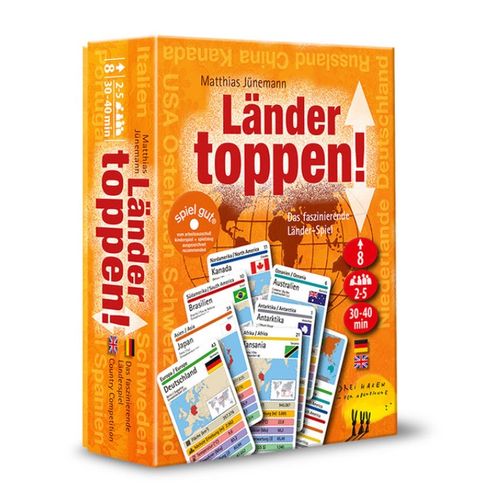
Länder toppen!
Länder toppen! Rulebook
Table of Contents
Table of Contents
Country Cards
Important information:
Right at the top of the country cards you will find the corresponding continents. In the middle you will see the countries' locations (in red) on the world map. The same six categories for each country as on the folded paper strips are on the bottom half of the cards.
Additional information:
As nonessential information you will also find the capital of the country and the name of the highest mountain below the country name, then the population density, the corresponding flag and the English name of the country.
Categories
- area (in square meters)
- highest peak (in meters above mean sea level)
- average annual temperature (in °C, measured in the respective capital)
- number of inhabitants (in millions)
- average life expectancy (in years)
- average gross domestic product per capita (in US Dollars, adjusted for purchasing power)
Game Preparation
Each player gets a folded paper strip. Place it in front of you with enough space to potentially put down 12 cards around it like this:
- 6 cards above the strip
- 6 cards below the strip.
All country cards are shuffled well including the joker cards and put face down in a reserve pile.
The number of players determines how many rounds will be played as well as how many hand cards everybody receives.
| Players | Cards | Rounds |
|---|---|---|
| 2 players | 10 cards | 6 rounds |
| 3 players | 10 cards | 4 rounds |
| 4 players | 8 cards | 4 rounds |
| 5 players | 8 cards | 3 rounds |
| 6 players | 7 cards | 3 rounds |
According to the number of players, a varying number of categories will remain free.
The challenge is to place your cards skillfully according to the related categories and to "sacrifice" unfavourable cards where appropriate.
Course of the Game
Placing Cards
Afterwards all players place their hand cards face down to the categories on the paper strip - the highest value above the paper strip and the lowest value below the strip.
Example above the paper strip: Player A's card shows the area "Bolivia, 1.098.581 km2", player B's card "Sweden, 447.420 km2", player C's card "Kazakhstan, 2.724.900 km2", player D's card "Morocco, 446.550 km2". Player C's card is of the highest value. He takes the trick (= all four cards).
Example below the paper strip: In the category inhabitants player A's card shows "Greece,11,0 M", player B's card "Belgium,11,3 M", player C's card "Jamaica, 2,9 M" and player D's card "Kenya, 46,8 M". Player C's card is of the lowest value and he takes the trick once again.
Turning Over the Cards
As soon as all players have placed their cards they turn over the card of the first category simultaneously (from left to right, beginning with "Area") - and always first above, then below the folded paper strip (see figure).
Tricks
The player who played the highest or lowest value of one category gets all country cards that were placed for this high or low category (trick) but not the joker cards, though. (See Joker Cards.)
Hence, a trick consists of a various number of cards depending on how the players assigned their cards to the categories and which they left empty.
Splitting the Tricks
If a trick consists of two or more country cards it needs to be split. To do this each player builds one face down pile and for each continent one face up pile (see Scoring and Evaluation).
Everyone needs space in front of or next to him or her for a maximum of 8 piles.
- At least one card of a trick will be placed on the face down pile.
- At least one card of a trick will be placed on a corresponding face up continent pile.
It is the player's choice how he splits the rest of the cards of one trick - should they exist - on his piles.
Example: Player C might put the cards Belgium and Greece on his Europe pile, Kenya on his Africa pile and Jamaica on the face down pile. He might also put Jamaica on the North America pile and the other three cards on the face down pile. Or he could put Belgium and Greece on his Europe pile and the other two cards on the face down pile.
Which choice is more advantageous depends on the course of the game and one's strategy.
If a trick consists exceptionally of one card only (as all other players left the category empty or placed a joker card) it is the player's choice where he puts this card.
In the rare case of several players having the highest or lowest value of one category each of these players only gets his own country card. It is their choice where they put it. In this exceptional case nobody gets the remaining country cards. They are taken out of the game.
Joker Cards
If a player gets dealt one (or even several) joker cards he places them face down to one of the categories pretending it is a country card.
When the cards are turned over the joker card is not part of the trick- and it is not possible to take a trick with it! Instead the player takes his joker card back and puts it face up on one of the corresponding continent cards that are shown on it. Occasionally the player might have to start a new continent pile with the joker card.
Example: The players X, Y and Z place country cards in the categories "highest peak". Player J places his joker card "Europe - South America", though. Player X, Y and Z evaluate their tricks as described above. Player J takes back his joker card and may put it on his Europe pile or on his South America pile (or start one of the two piles).
Rounds
As soon as the last trick (category lowest value "GDP per capita") has been taken the first round ends. Now new cards from the face down reserve pile are dealt to the players and placed in the categories on the folded paper strip as before in the first round. All further rounds are played like this.
The face down piles of the players and their continent piles are filled with more and more cards during the course of the game.
End of the Game
The game ends as soon as all rounds have been played. According to the number of players some cards may be left over (only in a 4-player-game will all cards be used).
Scoring and Evaluation
Scoring is done as follows:
1. Points for face up continent piles
Every player counts his country cards per continent pile (in the order North America, South America, Europe, Africa, Asia, Oceania, Antarctica) and announces the figure.
Only the one with the most cards per continent gets points - namely one point for each country card and each joker card of a continent pile.
Example: Player A has 12 Europe cards, player B 11 and player C 5 Europe cards. Player A gets 12 points, B and C none.
If several players have the same amount of cards of the same continent the points for it are divided. If necessary points will be rounded up.
Example: Player A and player B both have 11 cards in the continent pile Asia. They get 6 points each (11 : 2 = 5,5 - rounded up to 6).
Player C, D and E each have collected 11 cards of the same continent. Each one of same gets 4 points (11 : 3 = 3,66 - rounded up to 4).
2. Points for the face down pile
Afterwards the face down piles are counted - one point for each card.
Then the figures for the face up continent piles and for the face down piles are added up.
Winner
The winner is the one who collected the most points!
The one who splits his tricks cleverly may win even if he or she has not won the most tricks.
If there is a tie the owner of the Antarctica card wins. If this card has not been dealt there are just several winners.
Have fun playing "country competition!"
Alternative for a Faster Game
The game may be played without splitting the tricks. In this case every player collects the cards he won on a face down pile and the one with the most cards in the end wins the game.
Card Notes
The specific card notes below are printed only in German in the official rulebook; they are translated here for completeness, as they affect gameplay.
Country card "Antarctica"
This exceptional card only has dashes in the categories "inhabitants", "life expectancy" and "GDP". There is no data here because the continent is not permanently inhabited; the card may also not be placed in these three categories on the paper strip.
Country card "France"
The area of France does not include overseas territories.
Country card "Denmark"
Only the core national territory - without the Faroe Islands and Greenland.
Country cards "Russia" and "Turkey"
Both countries belong to Asia and to Europe. Therefore these may be assigned to either Asia or Europe during scoring.
Precise designation / pronunciation
1,000 million = 1 billion (e.g. for China).