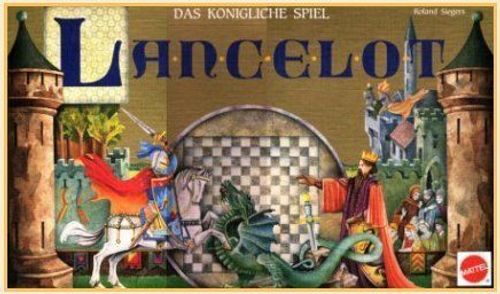
Lancelot (1985)
Lancelot (1985) Rulebook
Table of Contents
Table of Contents
Playing Area
The size of the game board depends on the number of players:
- 2 combatants on an 8 x 8 grid of squares
- 3 combatants on a 10 x 10 grid of squares
- 4 combatants on a 12 x 12 grid of squares
- 5 combatants on the full game board
The Beginning
Each combatant receives 30 shields in one colour. If you play by the rules for advanced players, each player also receives one additional white shield.
One player places a shield on the board, and the others follow in clockwise order.
Placing Shields
When a combatant is on turn, he may place one of his shields on any free square of the board. After it has been placed, that shield can no longer be moved. At most, it can be captured by an opponent and removed from the board.
A shield can therefore only be placed and never moved.
A player must always place a shield when he is on turn.
The Code of Chivalry
When placing a shield, the code of chivalry must always be taken into account.
This code states that a knight may never place more than two of his own shields beyond the total number of shields of all his opponents together on the same line (vertical or horizontal).
This means that a knight may never place more than two shields in a row or column if there are no other shields already standing there.
Capturing Shields
If a knight manages to have two more shields in a row or column than the total number of foreign shields mixed together on that same row or column, then all the foreign shields are captured and come into the possession of that knight.
The knight takes the shields from the board and lays them out in front of himself, so that all opponents can clearly see how many shields that player has already captured.
It is also possible for a knight to capture shields on a row and a column at the same time.
Of course, a knight who captures shields in this way may at that moment have more than two of his own shields in a row or column. This is only allowed after a capture. As compensation, the other knights may then add shields to this row or column without being captured themselves.
End of the Game
The goal of the game is to capture a certain number of shields:
- with 2 knights: 7 foreign shields
- with 3 knights: 8 foreign shields
- with 4 knights: 9 foreign shields
- with 5 knights: 10 foreign shields
Experienced players may agree among themselves to raise the number of shields that must be captured.
Rules for Advanced Players
First Option
Diagonals of at least 4 squares also count.
Second Option
A knight may seek the favour of King Arthur. The power of King Arthur is represented in the game by the sword in the stone.
Before the start of the game, the first knight to the right of the starting knight places the "sword in the stone". From that moment on, all knights may invoke the power of this stone as a kind of extra foreign shield. If this special stone stands in a row, column or diagonal where shields are being captured, it simply remains standing there.
Third Option
Each player adds a white shield to his collection.
During the game, each knight may invoke the special power that is in this stone once. He does this by, in addition to placing one of his own shields, also moving the special stone. At that moment, the stone becomes a shield of his own colour.
As a sign that he has already invoked the power, the player in question returns his white shield to the box.