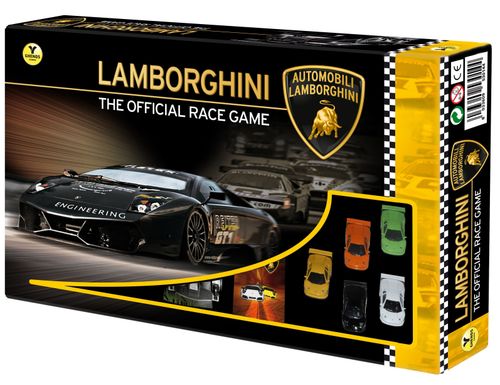
Lamborghini: The Official Race Game
Lamborghini: The Official Race Game Rulebook
Table of Contents
Table of Contents
Contents
1 game board, 5 Murciélago Lamborghini miniatures (1:87 scale), 5 Car cards, 10 Driver cards, 39 Technology cards (13 Red supplier, 13 Yellow supplier and 13 Blue supplier), 39 Manoeuvre cards, 39 Banknote cards (13 of 1.000$, 13 of 5.000$, 13 of 20.000$).
Game Turns
The game is played on 3 turns:
- Strategic – Economic
- Set-up and Qualification
- The race
Game Preparation
Choose to play a Short game (one single race without the money) or a Long game (several races with an Economic phase included). In this last case decide for a number of races: from 1 up to 2 races run on each track.
- Place the board on the table and choose which track to play.
- Separately shuffle the Car cards and the Driver cards and place them face down in two different decks on the board. Each card indicates the cars' characteristics and the drivers' abilities.
- Separately shuffle the Manoeuvre cards and the Technology cards and place them face down in two different decks on the board.
- Choose to play with one Murciélago each (3, 4 or 5 players) or two Murciélago each (2 players), but do not take the miniatures yet. Each Murciélago will have one driver, but any Technology and Manoeuvre cards.
- Give 60.000$ (from 2 up 4 players) or 52.000$ (with 5 players) to each player if you are playing a Long game. No money is needed if you play a Short game.
Strategic – Economic Phase
During the Strategic – Economic phase, players choose their car, the corresponding driver and the Technology and Manoeuvre cards. The choice order is different in the Short and in the Long game.
Turn over the first 2 cards of each of the 4 decks: 8 cards altogether (2 Car cards, 2 Driver cards, 2 Technology cards and 2 Manoeuvre cards) will be faced up.
Short Game
In the Short game, the first player to play is the one who last saw a real Lamborghini. The other players follow clockwise.
How to choose the Car, the Driver and the Manoeuvre & Tech cards
The 1st player chooses one of the 8 faced up cards and places it well visible in front of him. The 2nd player turns 2 cards: 1 from the Tech cards deck or Manoeuvre cards deck and then 1 from the Driver cards deck or the Car cards deck. He chooses one card among all the ones now faced up (9) on the table. The 3rd and the 4th player follow in the same way. The last player turns 2 cards as the previous players, but he has 2 choices in order to counterbalance the fact he is the last player to choose.
After the last player's choice, the turn order of turning and picking the cards goes back to the first player starting from the second last who has only one choice. The order fluctuates from the first to the last (who is always the only player to choose 2 cards) and back to the first until each Murciélago in the race is linked to a car card and a driver card. Once the last match car-driver has been completed, this phase ends. In the short game the Car card and the Driver card are free.
Long Game
In the Long game, the choice order is determined by an auction. Players secretly decide the amount of money they want to bet and put the banknote/s under their hand (be sure to have enough money later to buy your Car and Driver cards!). Then, they simultaneously reveal their bet. The winner of the auction is the 1st player to choose, the 2nd is the second in the auction and so on. The amount of money can also be zero. In case of a tie, the first player is again the last who saw a real Lamborghini. All the money offered in the auction is lost and given back to the bank.
How to choose the Car, the Driver and the Manoeuvre & Tech cards
The "turning and picking the cards phase" follows the same rules as the Short game. The only difference is that the Technology and Manoeuvre cards are free, whereas the Driver and Car cards have a price printed on them: each player has to pay the printed amount of money in order to buy them.
Sidebar, as printed: The first player chooses 1 card among 8, the second 1 card among 9, the third 1 card among 10, the fourth 1 card among 11 and the fifth 2 cards among 12. The fourth 1 card among 12 and so on.
Important! The Tech cards come from different suppliers: the blue, the yellow and the red one. Each Murciélago can take the technology from only one supplier. Therefore, once a player has chosen his first Technology card, he has an agreement with that supplier and he is forced to choose only that colour in the following turns. However, if you are playing in 2, you are allowed to choose 2 different suppliers: in the following set up phase, one supplier must be linked to a car and the other supplier to the other car.
If the proper coloured cards are finished, the player can take only cards from a lower Technology supplier; this means that in case of red technology the player would not receive any card.
If the correct coloured cards are finished (they have all been drawn in the strategic – economic phase) the player would not receive any additional card.
Note: It may occur that one or more players do not choose Tech cards in the strategic – economic phase. Therefore, they do not have any agreement with any supplier. In this case, when their Murciélago must receive its Technology cards for the set-up, this will be done at random, mixing the suppliers and progressively revealing the cards until that symbol is found, regardless from the colour.
- Rearrangement of the remaining cards: the Speed cards. Remove from the game the left over Car and Driver cards. Shuffle together the remaining Tech and Manoeuvre and Banknote cards. Place them faced down on the board in order to form the Speed cards deck. Players draw one Speed card at the beginning of their turn. The value on the bottom of the cards determines the cars' speed. Therefore all the Tech, Manoeuvre and Banknote cards in this deck are played from now on just for the Speed value and no more for their original meaning. Once all these cards have been drawn, the deck is shuffled again and made available for the next turns.
Set-Up Phase and Qualifications
At the end of the strategic – economic phase, players take the Murciélago corresponding to their Car card. Then, they look at their chosen cards for the set-up.
- If they play with 2 Murciélago, they link one driver to each car. Then, they link a certain numbers of the Tech and Manoeuvre cards in their hands to each Murciélago.
- Players receive further Technology and Manoeuvre cards (set up phase). Actually each Car card and Driver card indicates additional characteristics and abilities. Players must receive for the couple car/driver all the Tech/Manoeuvre cards represented on their Car and Driver card. The Tech cards must be only of the previously chosen colour.
Example: if a player has chosen the "red technology" he can only receive Red technology cards.
- It is now the time to start the Qualifications and define the starting grid. Players draw a card from the Speed deck and add this speed value to the speed values printed on their Driver and Car cards. The player with the highest value is in pole position. He places his Murciélago first on the grid. The other players follow in a decreasing order. In case of a tie, players should repeat the qualification procedure until one of them wins the tie.
If a player is playing with 2 Murciélago, before drawing the card he must declare which car he is playing for. The next card will be related to his other car. In this phase players are not allowed to play Tech and Manoeuvre cards.
The Race
The Murciélago cars move along the tracks' squares. The number of movements is given by the cards' values.
- The Murciélago move ahead or diagonally (through squares in touch), never sideways.
- The Murciélago can never go through or stop on occupied squares.
During their turn, players draw a Speed card from the deck (values from 5 to 12). Players add their own Car card's speed value and their Driver card's (eventual) speed value. To this value, they can also add 1 Manoeuvre or 1 Technology cards' value. Players can choose to play maximum one card each turn among their Tech and Manoeuvres cards.
Speed card value + Car card value + Driver card value + Tech & Maneuver card value (eventual) = Murcielago speed
The total speed value is the total number of squares the Murciélago is moved on the track. The Murciélago MUST use all of the movement. There are no ways to brake or slow down.
- If a Murciélago passes between 2 cars in diagonal, moving on the opposite diagonal, it must risk a manoeuvre. The player draws a Speed card and sees the consequences (see "Manoeuvres").
- If a Murciélago reaches completely occupied squares, it is forced to cause a crash (see "Manoeuvres").
The cards lose their effect as soon as they are played. The Speed cards are always discarded. The Tech and Manoeuvre must be discarded if you are playing a Short game. If you are playing a Long game, the Tech and Manoeuvre played cards are turned face down near to the player; they cannot be used for that race, but they will be activated again in the next races. During his turn, a player is free to decide when to play the cards.
The first Murciélago to play is the first on the starting grid. The others follow according to their position. From the second turn, the turn order is determined by the ranking position of the cars: the first car to move is the first on the track, the second is the second one on the track and so on. If a Murciélago reaches another car, the first to move is the one who was first in the previous turn.
Slipstreaming
A Murciélago that reaches, with its movement, the square exactly behind another car, will immediately enjoy the benefit of one free movement. The car is placed on one of the squares beside the reached Murciélago and can continue its movement if it has movements left. Should the square be occupied, the Murciélago must run a risk.
A car can benefit of the slipstreaming only once per movement.
The Cards
Technology Cards
There are 3 Technology cards suppliers: Blue, Yellow and Red. The Blue Technology is the best, the Yellow is the second best and the Red one is the worst. However, the differences among the technologies are not huge, although the player with the Blue Technology will have more advantages during the race.
| Card | Effect |
|---|---|
| Aerodynamics | The speed is increased by +3 or +4 squares (depending on the Technology), but the car must not change lane during that turn. |
| Brakes | The card prevents a number of damages as shown on the card (depending on the Technology). The card must be played before the damage. |
| Set up | The manoeuvre check is increased by +1, +2, +3 (depending on the Technology). |
| Engine | The speed is increased by +2 or +3 (depending on the Technology). |
| Tyres | The speed is increased by +1 for 2 or 3 following turns (depending on the Technology). During these turns another card can be played, but it must not affect the speed.* |
| Petrol tank | The speed is increased by +1 for 2 or 3 following turns (depending on the Technology). During these turns another card can be played, but it must not affect the speed.* |
| Team | The driver chooses to repair damage and/or increase by +1 the manoeuvre check. |
* In order to remember the progressive use, we suggest you place the card under another one and move it according to the number of labels.
Manoeuvre Cards
| Card | Effect |
|---|---|
| Skill | The speed is increased by +3 squares. However, the total movement must not be more than 12 squares. |
| Hazard | It allows passing through two cars in diagonal without a risk of manoeuvre. |
| Fortune | It allows drawing a new Speed card replacing it with the previous one. |
| Manoeuvre | The manoeuvre check is increased by +2. |
| Slipstreaming | The slipstreaming effect is increased by +1 square (sure it allows overtaking). |
| Engagement | The car willingly crashes or pushes an opponent's car (see rule). The car that engages increases its manoeuvre check by +1; the car that suffers the engagement decreases its manoeuvre check by -1. |
| Fast car | The speed is increased by +4 squares. However, the total movement must not be more than 14 squares. |
| Winning | Benefit of +2 speed squares if the car is 2nd or 3rd. |
| Will | Benefit of +3 speed squares if the car is last. Benefit of +2 speed squares if the car is 2nd last. |
Crazy Murciélago
Speed cards with 10 on a yellow arrow, 11 on an orange arrow and 12 on a red arrow values indicate that the speed is too high. The Murciélago loses control and the driver must check its Manoeuvre ability.
If a player draws one of these values, the driver must verify the Manoeuvre by drawing a new Speed card. The more the first Speed is high, the more it is easy to fail.
In fact, if the speed is:
- 10 on a yellow arrow, the Manoeuvre value is counted as normal;
- 11 on an orange arrow, the Manoeuvre value is reduced of -1;
- 12 on a red arrow, the Manoeuvre value is reduced of -2.
Once the Manoeuvre check is over and the possible damages and position changes are applied, the race moves on.
Crashes and Pushes
Players can crash and push opponents' cars in order to damage them. If a player places his Murciélago:
- behind an opponent's car and declares a crash, a crash occurs;
- beside an opponent's car and declares a push, a push occurs.
Both the cars must check the result of the engagement with a check of Manoeuvre: the attacking car is first and the defending car is second.
The touched cars can start a pileup.
Manoeuvres
Whenever a driver is willing or is forced to manoeuvre, it must verify the effects.
The player draws a Speed card (the yellow, orange and red are not taken into account) and changes the value with:
- the manoeuvre values of the Car and of the Driver cards
- the Manoeuvre/Technology card the player wishes to play, because related to the manoeuvre
- the penalties due to crazy Murciélago (if any).
Manoeuvre checks for: high speed, crashes and pushes
- Speed card value
- + manoeuvre value of the car
- +/- manoeuvre value of the driver
- - crazy Murcielago penalty (if any)
- + Manoeuvre/Technology card (if any)
The result is compared to the consequences reported in the table.
Manoeuvre Check
| Value | Consequence |
|---|---|
| 5, 6 or 7 | Accident = damage (see Car accident) |
| 8 - 9 | Nothing occurs |
| 10 - 11 | +1 square movement |
| 12 or more (printed "12 o +") | +1 square movement (in case of crashes and pushes, -1 to the manoeuvre check to the car that suffers). |
Every Murciélago is allowed 2 manoeuvre checks per turn. If the player uses them both, the car can pass through occupied squares when the width of the route is completely occupied so ending its movement.
Car Accident
If the Manoeuvre check implies a car accident (manoeuvre values 5, 6 or 7), the Murciélago who suffered the car accident:
- must immediately draw a Speed card and see the direction the car takes in this (if the car that crashes or pushes has not ended its moves) in the next turn. Direction is the first square of the movement.
Ranges as printed; the 8 - 10 and 9 - 11 rows overlap in the source.
| Value | Consequence |
|---|---|
| 5, 6 or 7 | The player at the right chooses the car's direction |
| 8 - 10 | Diagonal to the right |
| 9 - 11 | Diagonal to the left |
| 12 | Free choice of the car's direction (ahead, right or left) |
If the first square is out of the track, the speed is reduced of –3 in that turn.
- suffers a damage. Every damage involves a permanent reduction of the speed and of the manoeuvre ability. Every Murciélago can suffer a maximum of 2 damages in each turn.
| Number of damages | Consequence |
|---|---|
| 1st | The speed and manoeuvre are reduced of -1 |
| 2nd | The speed and manoeuvre are reduced of -2 |
| 3rd | The Murciélago suffers a permanent damage and goes on until it ends its movements. The car suffers a -3 speed reduction in that turn. From the following turns, the speed is reduced of -1 each turn (-4, -5…) until the car stops. The Murciélago is left on the track and is considered an obstacle. |
A damaged Murciélago that crosses the finishing line can win as any other car.
End of the Race
The race ends when all the cars cross the finishing line after 3 laps. The cars must end their last movement. The car who first crosses the finishing line and in the same turn is not overtaken by another car is declared the winner.
Example, the green car is first and ends its move 7 squares after the finishing line. The black car is second, but ends its move 10 squares after the finishing line. The black car is the winner of the race.