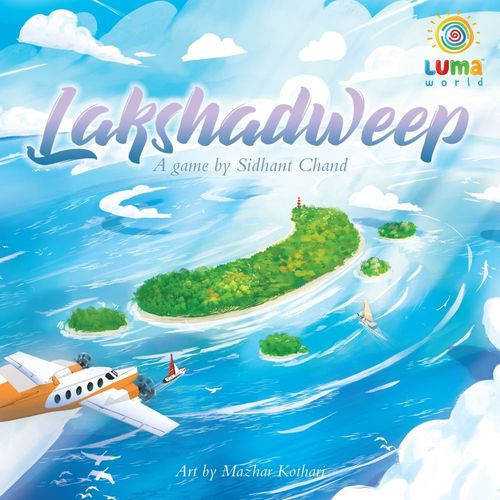
Lakshadweep
Lakshadweep Rulebook
Table of Contents
Table of Contents
Game Objective
Players build the exotic islands of Lakshadweep, tile by tile, populating it carefully with Houses, Fisheries, Hotels, Ports, Forests and Corals! The game ends when all tiles have been placed and the player with the highest score wins the game!
Components
- 28 Double Sided Island Tiles
- 16 Fishing Tokens (values: 5 x2, 4 x2, 3 x5, 2 x5, 1 x2)
- 6 Island Completion Tokens (8 x1, 5 x1, 4 x2, 3 x2)
- 2 Reference Sheets
- 8 Double Sided Bonus Tokens (Advanced Gameplay Only)
- Scoring Sheets
The following rules describe the setup and gameplay for the 'Base Game' which is recommended for your first time. The rules for the 'Advanced Game' are explained at the end of this book.
Setup (Base Game)
I. Take all the 28 Island tiles and randomly flip some of them. Shuffle the tiles and place them in a stack on the table. This is the Main Deck.
II. From the top of the Main Deck, draw 2 Tiles and place them to its right. These two tiles + top tile of the Main Deck, together form the Marketplace.
III. Take all the 16 Fishing Tokens, shuffle them and keep them face down beside the Main Deck.
IV. Take all the 6 Island Completion Tokens and arrange them in descending order of value. Keep them face up in a stack beside the Main Deck. (Highest number on top)
V. Choose a colour (Purple or Orange) and take the reference sheet of that colour. Give the other to your opponent.
Randomly decide who will start the game. Players continue to alternate turns till the end game condition is reached, i.e, when the Marketplace is empty.
Core Concepts
Island Tiles
The game consists of 28 two-sided Island tiles. Each tile has a combination of two terrains: Land and Water. Each tile has identical features on either side with only the player colour reversed.
Island
An island is a continuous body of land. It could be on a single tile or created by joining multiple tiles. In the game, islands may be incomplete or complete. They are said to be complete when they are closed.
NOTE: Islands and tiles are not the same! An island could be a single tile or a connection of many tiles. Some tiles even have 2 islands on them.
Features
There are 6 features: House, Hotel, Fishery, Port, Forests, Corals.
Only corals are in the water, all other features are on land. The feature's colour determines which player scores points for it!
NOTE: Placing a tile with a feature on it also builds it. This action is irreversible.
Marketplace
The 2 open tiles plus the top tile of the Main Deck form the marketplace. Players, on their turn, pick tiles from the marketplace only.
How to Play
- Players take turns to pick and place all the 28 tiles.
- Then, at the end of the game, they calculate their final scores.
A Player Turn
Pick a tile, place the tile, end of turn.
Picking Tiles
Players start their turn by picking a tile. They may, however, pick only ONE tile from the marketplace:
A. Either of the two tiles next to the Main Deck, OR
B. The top tile of the Main Deck
Players always have 3 tiles to choose from unless there aren't enough left.
If a player chooses option A, they may rotate AND/OR flip the tile before placing it on the map. Replace the picked tile with the top tile from the Main Deck.
If a player chooses option B, they may rotate it freely but must NOT flip it to use the other side. After this tile is picked, no replacement is needed; the tile below it will replace it automatically.
Placing Tiles
After picking a tile players must immediately place it. If it's the first turn of the game, the player simply places the tile in the centre starting a common, shared map.
When a tile is placed, players must follow the conditions below:
- The tile must share at least one edge with another tile already on the map.
- Terrains must match! This means that for common edges on adjacent tiles, the terrain should be continuous (land must meet land and water with water).
- Edges must match! This means that tiles must be placed edge-to-edge without any overlaps! A tile must not share partial edges with other tiles, even if the terrains match!
NOTE: When placing tiles it is NOT necessary to complete islands. You will score points even for 'incomplete' islands. You may also start 'new' islands without completing others!
Players must also meet certain conditions for the features they build:
Hotels
- Every island is permitted to have only 1 hotel. It could be of either player colour, not both.
Fisheries
- When a Fishery is built immediately add Fish Token(s) to it.
- Check how many fisheries are already present on the tiles surrounding it (the 8 surrounding positions).
If there are no other Fisheries: place 2 Fish Tokens.
If there is at least 1 other Fishery: place only 1 Fish Token on it.
- When adding fish tokens, pick 1 fish token at a time and place it on the newly added fishery, face down. Its value will only be revealed during scoring.
Houses, Ports, Forests & Corals
- When placing these, just follow basic conditions on page 6.
NOTE: Placing a tile with a feature also builds it!
Island Completion Tokens
Whenever a player completes an island anywhere on the map, they immediately collect an Island Completion Token from the top of the stack. The value on it counts towards their final score.
Once a player has placed the tile, their turn ends and the other player's turn begins. Players continue to alternate turns. The build phase ends when the last tile has been placed (by either player) and the game proceeds to the scoring phase.
NOTE: When there are 3 (or less) tiles left in the marketplace, players may flip and/or rotate any.
Scoring
Each player scores for their own coloured features on the map. The sum total of all these scores, is their final score.
NOTE: All features score points at the end of the game, whether they are on complete or incomplete islands!
House
On each island, only the player with the most houses scores points. If it's a tie, both players score points.
- Count the number of your houses & square that number. That is your score of houses from that island. (Example: Purple has 3 houses, 3 squared = 9 VP. Orange does not score for houses on this island.)
- Do the same for all such islands, and add all the scores. The sum total is your score of Houses.
| No. of houses on an island | 1 | 2 | 3 | 4 | 5 | 6 | 7 |
|---|---|---|---|---|---|---|---|
| Score (VP) | 1 | 4 | 9 | 16 | 25 | 36 | 49 |
Houses Score: Island 1 + Island 2 + Island 3, etc.
Hotel
Each island may have only one hotel, so only one player scores for it on that island.
- Check for each island where you have a hotel of your colour. Count the number of people on that island. This is your score of hotels on that island. (Example: people on the island of 1 + 2 + 2 = 5 VP.)
- Do the same for all such islands, and add all the scores. The sum total is your score of Hotels.
Fishery
Take all the face down fish tokens on the fisheries of your colour.
- Flip them faceup and add all the values. The sum total is your score of Fisheries.
Port
For each port of their colour, players score points based on other features (of their colour only) on that island.
- Check for islands where you have a port.
- Check for unique features of your colour (buildings+forest) on that island.
- Count each feature only once. You may include your port. (If you have 3 houses on the island, it counts as 1 unique feature.) Example: a player has 3 unique features - Port, Forest & House.
- An island may have a maximum of 5 unique land features (house, hotel, fishery, port & forest). Score each port as per the table below and add all of them. The sum total is your score of Ports.
| Unique Features | 1 | 2 | 3 | 4 | 5 |
|---|---|---|---|---|---|
| Score (VP) | 1 | 3 | 6 | 10 | 15 |
Forests
For each forest of their colour, players gain 3 VP. Add up scores from all forests of your colour. The sum total is your score of Forests.
Corals
Each player counts all corals of their colour, on the entire map. Only the player with the most number of corals scores 10 VP. The opponent scores nothing. If tied, both players score 10 VP.
Island Completion Tokens
Add all the island completion tokens you gained during the game. The sum total is your score of Islands.
The sum total of all the features plus tokens is your final score.
Scoring Example
Ria and Sid have just placed all tiles on the map. It's time to score!
Fisheries: They collect all their fishing tokens from their respective fisheries. Ria has 8 tokens from 5 fisheries while Sid has 4 tokens from 3 fisheries. Ria scores 18 VP (5+3+2+2+2+2+1+1) while Sid scores 15 VP (5+4+3+3).
Houses: Next, they count the number of houses they have on each island. Ria has 2 houses on an island and 1 house each on 6 islands. Sid has 3 houses on an island and 1 house each on 3 islands. Ria scores 9 VP (2²+1+1+1+1+1) while Sid scores 12 VP (3²+1+1+1). Note: Ria doesn't score for her house on the island where Sid has 3 houses!
Hotels: Ria and Sid have 2 hotels each. Ria scores 19 VP while Sid scores 13 VP.
Ports: Ria and Sid have 3 ports each. One of Ria's ports has 4 unique features on the same island, another has 3 and the last has 2. She scores 19 VP (10+6+3). Sid scores 12 VP (6+3+3).
Forests: Ria has 3 forests while Sid has 5. Ria scores 9 VP and Sid 15 VP.
Corals: Sid has more corals (19) than Ria (18) hence he scores 10 VP.
Island Tokens: Ria collected 2 island completion tokens worth 8 & 4 each, scoring 12 VP. Sid collected just 1 island completion token scoring 5 VP.
Their total scores are: Ria 86 (9 + 19 + 18 + 19 + 9 + 0 + 12) and Sid 82 (12 + 13 + 15 + 12 + 15 + 10 + 5).
How to Win
The player with the highest final score, wins! If there is a tie, the player with the highest corals wins!
Advanced Gameplay
The advanced game has the same rules as the base game, with a few differences.
- Use the 8 Bonus Tokens instead of the 6 Island Completion Tokens
Bonuses
Players trigger bonuses during the game either when:
- They place a tile that completes an island, OR
- They place a tile that adds their 2nd, 4th, 6th or 8th forest.
When a player triggers a bonus, they immediately pick an available bonus token and play it. If a player triggers BOTH conditions in a single turn, they pick 2 bonuses instead of 1.
NOTE: Each bonus may be claimed by 1 player only. So, make sure to place the bonus according to your player colour!
Scoring
Score as per the base game. Just add the points gained from the bonuses you've claimed.
Green Bonus
- Green Building: Add 1 House of your colour
- Green Port: Add 1 Port of your colour
- Green Hotel: Add 1 Hotel of your colour
- Green Fishery: Add 1 Fishery of your colour
Yellow Bonus
- Sustainable Tourism: Gain 2x VP from one hotel
- Sustainable Fisheries: Gain 2x VP from one fishery
Blue Bonus
- Reef Conservation: Gain 1 VP per tile of corals of your color
- Plantation: Gain additional 2 VP per forest of yours
For the Green Bonuses place it on an island where you want to gain that bonus. (Example: with the added bonus, Purple has 3 houses, 3² = 9 VP.)
For the Yellow Bonuses place it on the feature where you want to gain the bonus. (Example: Orange scores 1+2+1+2 = 6 VP from the hotel's island; with the added bonus, Orange gets 2x VP for one hotel: 6 x 2 = 12 VP.)
For the Blue Bonuses take the Bonus Token and keep it with you.