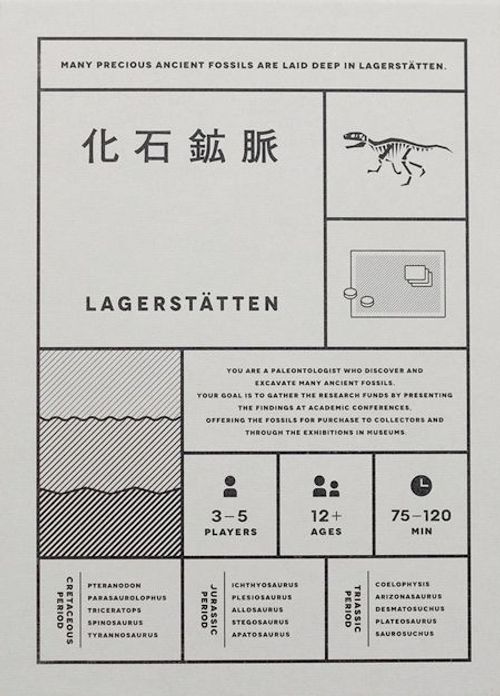
Lagerstätten
Lagerstätten Rulebook
Table of Contents
Table of Contents
Components
- Fossil cards: 96
- Exhibition cards: 15
- Request cards: 15
- Player markers: 7 each in 5 colours
- Round marker: 1
- Game board: 1
- Rulebook: 1
Game Overview
Each player becomes a paleontologist, dispatching assistants to various sites. Players gain research funds by excavating and restoring fossils, presenting at the academic society, selling to collectors, and exhibiting in museums.
At the end of the game, the player who has gained the most research funds wins.
Card Descriptions
Fossil Cards
- Front (fossil): shows the name of the dinosaur (for example TYRANNOSAURUS). A number in a red box shows the number of parts needed to complete a skeleton specimen (骨格標本). The period (紀) of the fossil card is printed at the bottom (for example CRETACEOUS PERIOD).
- Back (rock): shows the period of the card.
Terms:
- Rock (岩石): a fossil card face down.
- Fossil (化石): a fossil card face up.
- Skeleton specimen (骨格標本): the state in which all of the fossil parts of one dinosaur are complete.
Each player may hold up to 6 rock cards and up to 6 fossil cards. By performing "3: Presentation at academic society" and gaining renown (名誉), a player can raise the holding limits for rock and fossil cards.
Request Cards
- Front: shows the period of the fossil card to be sold, the number of parts of the skeleton specimen to be sold, and the research funds gained when selling, by round:
- Rounds 1-4: 30 research funds
- Rounds 5-6: 20 research funds
- Rounds 7-8: 15 research funds
- Back: REQUEST.
Each player may hold up to 3 request cards.
Exhibition Cards
- Front: shows the name of the dinosaur (for example TYRANNOSAURUS) and a track showing the research funds gained each round according to the number of exhibition cards held:
- 1 exhibition card: 3 research funds per round
- 2 exhibition cards: 5 research funds per round
- 3 exhibition cards: 10 research funds per round
- Back: MUSEUM.
Each player may hold any number of exhibition cards.
Setup
- Place the game board in the centre, within reach of all players.
- Place the round marker on "1" of the Round track.
- Each player chooses a colour and takes the 7 player markers of that colour. Place one of them on START of the Research Funds track and one on START of the Renown track.
- Determine the turn order randomly. Place one player marker of each player on the Turn Order track.
- Sort the fossil cards into draw piles by period (Cretaceous, Jurassic and Triassic), turn them face down and shuffle. Then place the specified number of fossil cards of each period on the three locations of "2: Excavation Survey": North (北部), Central (中部) and South (南部). The remaining fossil cards are placed beside the game board as draw piles.
- Turn the request cards face down and shuffle them. Turn the top 3 request cards face down and place them on "5: Requests from Collectors". The remaining request cards are placed beside the game board as a draw pile.
- Place all exhibition cards face up on "6: Exhibition at Museums".
Translation note: the printed setup and replenish text refers to "the specified number" of fossil cards for each excavation area without restating the number on these pages.
Board Overview
The board has the following areas, each containing numbered action spaces that players place their markers on:
- 0. Geological Survey (地質調査): the action space for a geological survey, with numbered slots for 3, 2 and 1 players.
- 1. Advance Preparation (事前準備): numbered slots 1st, 2nd and 3rd.
- 2. Excavation Survey (発掘調査): three areas, North (北部), Central (中部) and South (南部), each with numbered slots 1st to 5th.
- 3. Presentation at Academic Society (学会での発表): numbered slots 1st and 2nd.
- 4. Preparation (プレパレーション): numbered slots 1st to 8th.
- 5. Requests from Collectors (収集家からの依頼): numbered slots 1st to 3rd.
- 6. Exhibition at Museums (博物館への展示): numbered slots 1st to 3rd.
- Research Funds track (研究資金): from START, with values labelled 0, 5, 15, 20, 25, 30, 35, 40, 45, 50, 55, 60 and 65.
- Renown track (名誉): numbered 0 to 9.
- Round track (ラウンド): rounds 1 to 8.
- Turn Order track (手番順).
Game Flow
The game consists of 8 rounds. Each round has Phases 1 to 4 below.
Phase 1: Replenish
Advance the round marker by 1, then:
- Replenish fossil cards in each of the three areas of "2: Excavation Survey" (North, Central and South) so that each area holds the specified number of fossil cards. If a draw pile has no fossil cards left, no replenishment is needed.
- Replenish the request cards on "5: Requests from Collectors" so that the specified number is in place. If the draw pile has no request cards left, no replenishment is needed.
Phase 1 is not performed in round 1.
Phase 2: Placing Assistants
Each player, in turn order, places their 4 assistants (player markers), one at a time, on action spaces.
- If several action spaces are free, assistants are placed on the free action space that is leftmost or uppermost, in order.
- A new assistant cannot be placed on an action space already occupied by an assistant.
- The same player may place more than one assistant on the same action.
Phase 3: Executing Actions
Execute the actions on which assistants have been placed, in numerical order.
Phase 4: Gaining Research Funds
Each player, in turn order, does the following:
- If the player holds a skeleton specimen (骨格標本) that is the sale target of a request card, the player may (optionally) discard the request card and the skeleton specimen to gain research funds according to the current round (see Request Cards above).
- A player holding exhibition cards gains research funds according to the number of exhibition cards held (see Exhibition Cards above).
End of Game
After round 8 has ended, the player who has gained the most research funds is the winner.
Action Descriptions
Each action is executed in Phase 3 (Executing Actions) in the numerical order below. However, only "0: Geological Survey" is executed immediately after an assistant is placed on it. The execution order of each action follows the number printed on its action space.
Icons:
- Rock (岩石): a fossil card face down.
- Fossil (化石): a fossil card face up.
- Skeleton specimen (骨格標本): a complete set of parts of one dinosaur.
- Yellow card: request card.
- Blue card: exhibition card.
0. Geological Survey (地質調査)
Icon: eye → fossil.
Executed immediately after the assistant is placed. Choose as many excavation sites from "2: Excavation Survey" (North, Central and South) as the number printed on the action space the assistant was placed on. The player may check the contents of all fossil cards placed at each chosen site.
1. Advance Preparation (事前準備)
Icon: flag.
Change the turn order for the next round to the order printed on the action space the assistant was placed on. The other players' turn order keeps its current order and shifts down accordingly.
2. Excavation Survey (発掘調査)
Icon: + rock.
The player who placed an assistant on the "1st" action space of North (北部) does the following:
- Take fossil cards from the top of the North site, in a number equal to the total number of assistants placed by all players on the North action spaces. Check their contents.
- Choose 1 of them and keep it face down as a rock.
- Pass the remaining fossil cards to the player who placed an assistant on the "2nd" action space of North.
Continue in the same way: each player in turn chooses one fossil card and keeps it face down as a rock.
- If the same player placed assistants on both the "1st" and "2nd" action spaces, the player continues by choosing one more card and keeping it face down as a rock. The same applies from the "3rd" action space onward.
- If keeping a rock would take the player's rock holding above the limit, the player cannot execute the action.
After the North action is executed, execute the same action in order for Central (中部) and then South (南部).
3. Presentation at Academic Society (学会での発表)
Icons: rock + fossil → renown (名誉); 2 research funds → + rock.
Place rocks and/or fossils from your hand on this action space face down. The total number of rocks and fossils placed advances your player marker on the Renown track by that number.
- At least one rock or fossil must be placed.
- Any number of rocks and fossils of the same period may be placed at the same time.
- Rocks are placed face down and are not turned face up.
- Advancing the player marker on the Renown track increases the holding limit for rocks and fossils.
After checking the contents of all fossil cards placed on "3: Presentation at Academic Society", a player may (optionally) buy any of them for 2 research funds each. A purchased fossil card is kept face down in hand as a rock.
- Any number may be bought at the same time, regardless of period.
- If buying would take the player's rock holding above the limit, the fossil card cannot be bought.
4. Preparation (プレパレーション)
Icon: rock → fossil.
A rock may be turned face up to become a fossil.
- Any number of rocks of the same period may be turned face up at the same time.
5. Requests from Collectors (収集家からの依頼)
Icon: + request card.
After checking the contents of all request cards placed on "5: Requests from Collectors", choose 1 and keep it face down in hand.
If this gives the player 4 request cards in hand, the player chooses 1 of them and places it face down on "5: Requests from Collectors".
6. Exhibition at Museums (博物館への展示)
Icon: skeleton specimen → exhibition card.
If the player holds a skeleton specimen, the player may discard it to acquire the exhibition card of the corresponding dinosaur.
- Any number of skeleton specimens, regardless of period, may be discarded at the same time to acquire exhibition cards.
- If the exhibition card corresponding to the discarded skeleton specimen is already held by another player, the player receives that exhibition card from that other player.
Skeleton Specimen List (骨格標本一覧)
The list gives, for each dinosaur, the number of parts needed to complete one skeleton specimen and the number of sets, as printed.
Cretaceous Period (白亜紀)
- Pteranodon (プテラノドン): 2 parts × 3 sets
- Parasaurolophus (パラサウロロフス): 3 parts × 3 sets
- Triceratops (トリケラトプス): 3 parts × 3 sets
- Spinosaurus (スピノサウルス): 4 parts × 2 sets
- Tyrannosaurus (ティラノサウルス): 4 parts × 2 sets
Jurassic Period (ジュラ紀)
- Ichthyosaurus (イクチオサウルス): 2 parts × 3 sets
- Plesiosaurus (プレシオサウルス): 2 parts × 3 sets
- Allosaurus (アロサウルス): 3 parts × 2 sets
- Stegosaurus (ステゴサウルス): 3 parts × 2 sets
- Apatosaurus (アパトサウルス): 4 parts × 2 sets
Triassic Period (三畳紀)
- Coelophysis (コエロフィシス): 2 parts × 2 sets
- Arizonasaurus (アリゾナサウルス): 2 parts × 2 sets
- Desmatosuchus (デスマトスクス): 2 parts × 2 sets
- Plateosaurus (プラテオサウルス): 3 parts × 2 sets
- Saurosuchus (サウロスクス): 3 parts × 2 sets