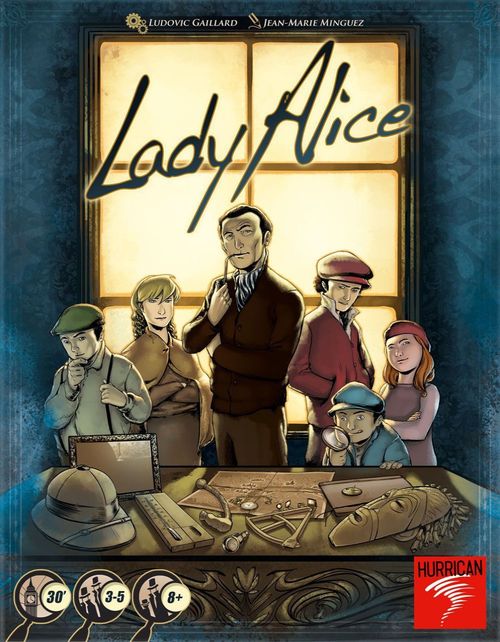
Lady Alice
Lady Alice Rulebook
Table of Contents
Table of Contents
Components
To solve the mystery, I will provide you with:
- My desk, on which you will find all the clues that will help you "visualize" your deductions. (the game board)
- 1 spiral notebook in which I have gathered all the clues. It is divided into four categories, each with eight clues:
- Suspects
- Places
- Times
- Objects
- 32 cards representing the clues. This way you can replay endlessly, changing the parameters of the case, until you reach my level of skill… not an easy goal to reach! These cards are sorted by category, shuffled, and placed into four face-down piles. The piles are then shuffled around so that none of you knows which pile corresponds to which category.
- 4 sets of nine Deduction counters that you will use to confuse your colleagues. I strongly suggest keeping them hidden. There are three counters with a value of Zero, three with a value of One, and three with a value of Two. Each of you receives one complete set. For convenience each set is a different color, and while you're at it, take the set with your own picture on it, so you can easily remember your color!
- 28 of my business cards… For now leave them next to my desk, but above all please don't fold them!
- 4 Verdict folders, one for each of you. On the two inner "faces" you will see two pictures of me… on one side I'm smiling and holding a penny in my hand, which will tell you that you've discovered a piece of evidence, while on the other I have a scowling look: hint, concentrate harder!
Setup
Now we are ready. Without looking at them, I take the first card from each category, shuffle them, and… voilà… I give one to each of you at random. Look at it without revealing it to the other players and place it face down in front of you. This card is one of the four "pieces" of evidence that will let you solve the puzzle.
Ah, I almost forgot, taking notes is forbidden! And in any case you will soon find out it isn't necessary…
(Publisher's note: you will find an illustration of the initial setup on the first page of these rules.)
Playing the Game
Let's move on to the actual game now. It is played in turns, each of which has three phases:
- First phase: Suspicions
- Second phase: My Verdict
- Third phase: the Deductions game
When one of you has found the solution to the puzzle, the game will end and that player will be awarded a penny.
Good!
The first phase: Suspicions
One of you takes the spiral notebook, chooses a Suspect-Place-Time-Object combination, and shows it to the other players, using the ritual phrase:
"I suspect that ....... was seen at ....... around ....... in possession of ......."
For example: "I suspect that Mary Kingsley was seen at Waterloo Station around 5 p.m. in possession of a compass."
Careful, here is some additional information:
- On the next turn you will pass the notebook to the player on your left, who will announce their suspicion, and so on.
- You are free to include or exclude the evidence in your possession from the combination you choose.
- You cannot choose the same combination as the player who went before you.
- You cannot choose a combination made up exclusively of clues you know to be red herrings; you will understand this detail shortly.
You should also know that it is mandatory, when it is your turn, to share your suspicions!
The second phase: My Verdict
As soon as the active player has finished declaring their suspicion, you must ALL take your Verdict folders.
- If the evidence in your possession is part of the combination shown, you MUST show the side with my smiling picture, inside the folder.
- If the evidence in your possession is not part of the combination shown, you MUST show the side with my scowling picture.
Now, set your folders down next to my desk. The player who chose the combination takes them, making sure no one can tell which folder belongs to which player. Without examining them, that player shuffles them and places them one by one on the desk. This way you will find out how many red herrings, or how many pieces of evidence, are part of the chosen combination.
If there are only red herrings, I authorize you to cover the four clues of this combination using my business cards. But be careful, don't fold them! If there are counters on the clues, cover them with the business card.
The third phase: the Deductions game
Starting with the player to the left of whoever chose the combination and continuing clockwise, you may, if you wish, share your deductions in order to solve the puzzle.
On your turn you may do one of the following:
a) place one of your counters on a clue, b) say "pass," c) attempt an accusation, in order to end the investigation.
a) How to place a Deduction counter on a clue
Choose a clue on my desk and place one of your counters on it, with the number hidden, on the matching space. If another counter is already present in that space, it must be revealed: turn it over so its number is shown.
Here is some useful information:
- Placing a counter is final.
- A counter can neither be taken back nor moved.
- A space cannot hold more than four counters.
- At the end of the game, counters with a value of 1 or 2 earn points if they are on clues that make up the solution to the puzzle.
b) Passing
You may decide not to place a counter and clearly say "pass." The Deductions game can continue until all players pass in an unbroken sequence! It is therefore possible to place more than one counter during the Deductions phase. You can start by passing to make your opponents reveal their ideas, and then hope to place a counter later, if all the other players have not said "pass."
Example: Helen starts the Deductions phase and decides to pass. Gordon places a counter on Waterloo Station. John places a counter on Mary Kingsley. Audrey passes. Helen places a counter on Mary Kingsley, revealing John's: a Zero! Gordon places a counter on 7:00, and then all the players say "pass" one after another. The Deductions phase ends.
When the Deductions phase ends, a new turn begins. The player to the left of the one who declared their suspicion takes the notebook and chooses a new combination.
c) Attempting an accusation
Careful, I'd better warn you! You must think carefully before embarking on this move! If, when the verdict is revealed, there are one or more red herrings, you will lose my respect. Your counters will remain in place and you will keep taking part in verdicts, but you will no longer be able to share your suspicions or your deductions. The game is therefore lost for you, while the other players continue to play Deductions: placing, passing, or accusing. So think carefully before making accusations!
Example with an accusation: Helen starts the Deductions phase and chooses to pass. Gordon places a counter on Waterloo Station. John passes. Audrey accuses, but her accusation is wrong. Helen passes, Gordon passes. The Deductions phase ends.
All right, now that you've been warned, if you still decide to make an accusation, take the notebook and prepare the Suspect-Place-Time-Object combination that, in your view, is solid proof of the solution to the puzzle of Stanley's disappearance, and say the phrase:
"I accuse (the suspect) of being seen at (place) around (time) in possession of (object)."
Once the accusation has been made, ALL of you take your Verdict folder.
- If the evidence in your possession is part of the combination shown, you MUST show the side with my smiling picture, inside the folder.
- If the evidence in your possession is not part of the combination shown, you MUST show the side with my scowling picture.
Now place all your folders face down next to the desk, and the accuser proceeds as in phase two.
If you see me smiling in all the folders, you have solved the case. I would gladly give you a penny… but you might not be the winner!
End of the Game
If, when an accusation is made during the Suspicions phase, you see me smiling in all the folders, the game ends. Now get ready to score points by carrying out the following actions, in this order:
I. Every player shows their own piece of evidence. II. All counters present on clues that are not part of the solution are removed from the desk and put back in the box. III. All counters belonging to players who have been excluded for making false accusations are removed, even if they had been placed on the correct clues. IV. All remaining counters are turned face up. V. All counters with a value of Zero are removed and put back in the box.
Now you can count your points:
VI. Each player adds up the value of their own counters still on the desk. VII. If you have a counter on each of the correct clues, you get two extra bonus points. VIII. If you chose the correct combination during the Suspicions phase, I'll be kind and give you one bonus point. IX. If you made a correct accusation, you receive three bonus points.
The player with the most points wins the game.
A couple more useful pieces of information:
- If several players end up tied for the highest score, I declare them joint winners, unless one of them made a correct accusation; in that case I award the win to that player.
- If, after several false accusations, only one player remains, that player is the winner.
Playing with Five
Ah, good morning! I see a fifth player has joined us to solve this puzzle…
Not a problem, we'll adapt to the situation! When the clues are dealt, instead of taking one card from each category, I will take:
- ONE from each of the first three categories.
- TWO from the fourth category.
As always I will take great care to make sure none of you clever ones can tell from which pile I took two clues, and I will deal one of these cards to each of you. Each of you will therefore have one piece of the evidence.
For this investigation, one category will have two pieces of evidence, so there will be:
- two culprits, or
- two kidnapping locations, or
- two different times, or
- two objects belonging to Stanley.
Since there are five of you, it is possible to place up to five Deduction counters on each of the clues on my desk. Your proposals for suspicions or accusations (made using the notebook) will always contain only four clues (Suspect-Place-Time-Object). Also, seeing me smile on four of the five Verdict folders ends the investigation.
Scoring is calculated the same way, but with one extra bonus: after removing the Zero counters, whoever among you managed to figure out which category contains two clues earns a bonus of two points! This requires having played counters on both of those clues.
Playing with Three
Hey… only three brave souls today…
As you can imagine, I had foreseen this situation! While the clues are dealt, I will simply remove one of the four categories of clues… So you will only have three clues to find. Naturally, I will make sure that none of you can tell which category I removed. Don't expect me to make things too easy for you!
Since there are only three of you, you can place only three counters on each space of the desk. Be careful not to be caught out by your opponents when you're sure of yourselves!
The phases of play proceed as normal. Even though there are only three clues to find, choose the combination in the notebook using all four categories. It is enough to see three of my smiling faces in the Verdict folders to end the game and calculate points.
Don't think making an accusation is any easier though… When you make an accusation, you must show only the three clues that are the subject of your suspicion. To do this, turn the cards of the missing category in the notebook so that only their black backs are shown. So you MUST know the missing category…
- If the evidence in your possession is not part of the combination shown, you MUST show the side with my scowling picture.
Again, if three Verdict folders show me smiling, you have completed the investigation, but if one of them shows my scowling look, you have lost.
The flow of play and the scoring calculation do not change.
Watson's Tips
Oh, I almost forgot, our dear friend Watson has some tips for you:
Should I include my own evidence when I choose a combination? Including your own evidence can be useful if it leads to showing a single Sherlock Holmes smile. In that case, you will be the only one to know it, and you'll be ahead of your opponents in the search for the truth. But don't overdo it, or your opponents will quickly figure out what you're up to. Not including your evidence removes a clue from your opponents… unless Sherlock Holmes's verdict shows only red herrings. In that case, however, the business cards are placed on all the eliminated clues, benefiting all players equally. In short, including or leaving out your evidence can help you throw your opponents off track, but you have to choose the right moment to do it.
What are the "0" value Deduction counters for? They are decoys… When you place a counter on a clue, you place it with the number hidden. Your opponents might think you placed this counter on the evidence in your possession. They will then be tempted, on their turn, to place a counter with a value of 2 to maximize their victory points. Have fun watching their shocked look when they discover you placed a 0! Using the counters (0-1-2) well, with a touch of mischief, is vital to winning…
How many counters can I place during the Deductions phase? This phase of the game only ends when all players have said "pass" in an unbroken sequence. Until that happens, you can place a counter on your turn. However, you only have nine counters… and three of them are decoys. You must play them at the right moment, without waiting too long, because a space cannot hold more counters than there are players. If you wait too long you risk not being able to place a counter. If you rush, you might reveal your strategy… unless you're bluffing…
The Cast
Sherlock Holmes and the Baker Street Kids — Sherlock Holmes, the famous London detective, needs no introduction. But it is less well known that the great detective often made use of a gang of street urchins, the Baker Street Kids, to look for clues on the cases he was working, rewarding each piece of information with a penny.
The Lady Alice — Stanley had a boat built for his African explorations specifically to sail the continent's lakes and rivers. This boat was carried in pieces and assembled when needed.
Henry Morton Stanley — British explorer and journalist, famous for his explorations of Africa and his search for David Livingstone, who was believed lost forever.
Charles Chaillé-Long — Descended from a family from La Rochelle, born in Baltimore. After numerous extraordinary adventures, he was the first explorer to sail the Nile from its mouth to its source.
Samuel White Baker — British explorer, also known for his search for the sources of the Nile. He discovered Lake Albert and proved that the Nile flowed through it from one side to the other.
Mary Kingsley — English explorer and writer. She greatly influenced the way Europeans viewed Africa and Africans. She discovered unknown species of fish and was the first to climb Mount Cameroon (4,100 m) by a route unknown to Europeans.
Joseph Marlow — This character is a tribute to Charles Marlow, a fictional character from the novels of the English writer Joseph Conrad. He is the author's alter ego in many African adventures.
Ajayi Crowther — The first Black Anglican bishop of southern Nigeria, counted among the most convinced supporters of European influence in Africa. He defended African dignity and encouraged his people to take charge of their own destiny… as long as that destiny included conversion to Christianity.
John Hanning Speke — English explorer of East Africa. A former officer in the British army in India, he organized three journeys to Africa in search of the sources of the Nile.
Tippu Tip — A slave trader originally from Zanzibar, he knew and helped a good number of the great European explorers of the dark continent, including Stanley.
Alexine Tinné — Dutch explorer and the first European woman to cross the Sahara. She also took part in several expeditions in search of the sources of the Nile.
Ludovic Gaillard — A French author with a promising future, exploring the fundamentals of the mechanics of fun. He has never been to Africa and has proven to be a mediocre investigator… even though he was the first world champion of Mr Jack under the pseudonym Jack Ace. From time to time he goes fishing on the Rhône in the company of the Lady Alice.
A thought from the author: a big thank-you to the 4L team, ll4ll.net and its affiliates, the members of the Kess ke tu fou club, Tiphaine, Merlin, Basile, Lina, and the organizers of the Swiss Game Designers Meeting. Special mention to Panda des Montagnes.