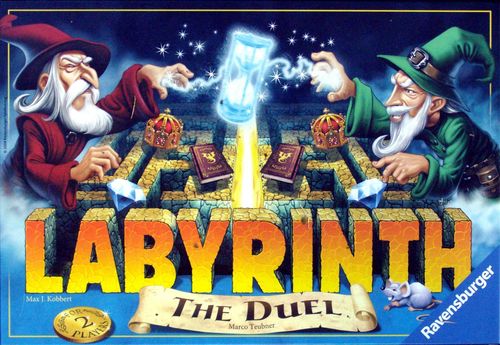
Labyrinth: The Duel
Labyrinth: The Duel Rulebook
Table of Contents
Table of Contents
Contents
- 2 game boards
- 2 x 15 tiles (15 of each color: red and blue)
- 16 object cards
- 2 magicians (golden playing pieces)
For one or two players aged 8 and older.
Preparation (first game)
Before you start playing for the first time, you have to prepare the contents carefully to guarantee full enjoyment of the game.
First, you separate the square plastic tiles according to their color so that you have both a red and a blue group on the table in front of you. The rings on the surface of the tiles must face upwards.
Then you remove the square maze cards (straight, t-shaped and right-angled sections of pathway) carefully from the original panels. The next step is to separate these maze cards according to the color on the reverse side of the cards (also red or blue) and then to clip them into the appropriately colored plastic tiles. You must ensure that all the maze cards which are colored red on the reverse side are inserted into red tiles and, similarly, that all those with a blue reverse side are inserted into blue tiles. The maze cards are to be inserted so that the pathways are visible.
Finally, you remove the object cards carefully from the original panels.
Now you are ready to start the game!
Object of the Game
Both players try at the same time to create a connecting pathway between two objects on the frame of their boards. The player who moves the tiles quickly and skilfully has a very good chance of winning the game.
Preparation
Before starting the game each player receives a game board and fifteen tiles in the same color as the middle section of his board (red tiles-red board / blue tiles-blue board).
The players place their tiles on the middle square section of their boards. One space is left open to enable the players to slide their tiles over the board.
The players must ensure that the pathways of a particular type of card are pointing in different directions, as the tiles may neither be removed from the board nor turned around once the game has started. For example, you should have some pieces of straight pathway pointing vertically (upwards) and others pointing horizontally (sideways). The same applies to the t-shaped pieces of pathway. The right-angled pieces should not all be facing downwards.
The illustration of the game board shows an example of how to position your tiles correctly before you start the game.
Now each player chooses a golden magician.
How to Play
One of the players shuffles the 16 square object cards well and then puts the stack face down on the table. The top card is then turned over and placed face up next to the stack. The object on the card is the starting point for both players. Both players then place their magicians on the picture of this object on the frame of their game board.
One of the players turns over the next object card and places it face up on top of the first card next to the stack.
This card indicates the target object which both players must try to reach by shifting their tiles as skilfully as possible into position in order to create a pathway between their starting point and the target object.
Example: The first card drawn is the one with the hourglass. Both players place their magicians on the hourglass on the frame of their game board. This is the starting point for both of them. The next card turns out to be the ring. Now the players must shift their tiles and create a pathway which connects the hourglass with the ring.
Important rules
- Both players start playing at the same time. By shifting the tiles on their own game board they try to create a clear pathway between starting point and target object.
- The players are allowed to shift one tile at a time as well as any number of tiles in the same row.
- Players may only slide the tiles. They are not allowed to take them off the board or to alter their position by turning them!
Once a player has created a route to the target object, he shouts "Stop" and then both players check his game board to see if he really has managed to create a clear pathway between starting point and target object.
If he has succeeded in creating a pathway he takes the object card and then moves his magician through the pathway to his new starting position for the next round.
The player who did not manage to win this particular duel does not change his starting position for the next round. His magician stays in his original position.
If the player who has shouted "Stop!" has made a mistake and has not actually connected the two objects with his pathway then his opponent receives the object card. If this happens both players start the new round from their original starting position.
Important! If both players create a pathway and shout "Stop!" at the same time, neither player receives the object card. This card is put aside and the next card is drawn. If this happens, the magicians remain in their starting positions for the next round.
The player who has just won a duel draws the next object card and both players start immediately to find a new pathway between their starting position and the new target object.
The same procedure is repeated for every round of the game.
End of the Game
The game is over when one of the players has gained eight object cards. This player has shown the way with great skill and awareness. This player is the overall winner of the duel.
Variation for One Player
You can also play this game on your own. You select one of the boards, the corresponding tiles and a magician.
You shuffle the object cards and place them face down at the side of the board. You draw the top card which indicates the starting point for your magician.
Now you draw the object card for the first round. As soon as you have created a clear pathway by shifting the tiles around you check your game board carefully. If your pathway connects the starting point and target object successfully, you position your magician on the target object and draw the next object card for the next round. This procedure is repeated for every new round.
You can use this solo-variation either for the purpose of practice when you do not wish to play under pressure or you can play against the clock. If you play against the clock, you might try to find as many pathways as possible within a certain period of time e.g. within five minutes.