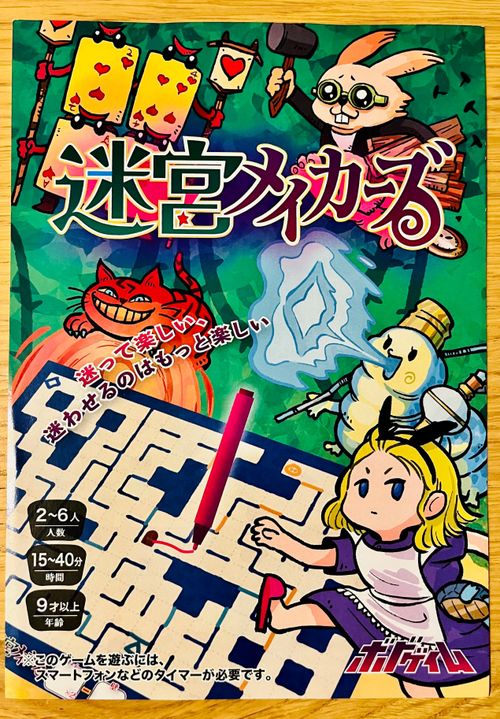
Labyrinth Makers
Labyrinth Makers Rulebook
Table of Contents
Table of Contents
Components
- Peephole sheet: 1
- Maze sheets: 40
- Coloured pens: 6
- Masking tape: 1
Players also need a timer (a smartphone or similar) that counts one minute.
Player count: 2 to 6 players. Play time: 15 to 40 minutes. Age: 9 and up.
Setup
1. Game Preparation
1.1 Choosing the Maze Sheet
Decide together which one maze sheet to use this game. There are 4 maze sheets in total. Only the one chosen is used during the game.
1.2 Handing Out Maze Sheets and Pens, Writing Your Name and Mark
Give each player one of the chosen maze sheets and one coloured pen.
Each player writes their name and a favourite mark on the maze sheet they received. The mark may be ★, ◆, ♠, ●, or any mark the player likes. Players may use the same mark as others.
1.2 Passing the Maze Sheet to the Left
Each player passes their maze sheet to the player on their left.
Note: the source prints "1.2" twice in this section. The second heading is printed as given here.
Maze Building Phase
In the maze building phase, all players other than the owner draw walls and treasure on each player's maze sheet. For example, in a 4-player game with players A, B, C and D: the maze sheet with A's name is filled in by B, C and D, each drawing treasure and walls. The maze sheet with B's name is filled in by A, C and D. In the solving phase, each player solves the maze bearing their own name, and so becomes the solving player for that maze.
2.1 Drawing Walls and Treasure
Each player draws walls and treasure on the maze sheet in front of them. All players draw at the same time. The number of walls and treasures depends on the number of players. See the table below. There is no time limit for drawing.
Walls
Draw wall lines along the dotted lines of the maze. Each single-square segment counts as one wall. The solving player may not pass through a wall.
A wall must not be drawn so that treasure cannot be reached from the start/goal point (the door mark).
Treasure
Draw your treasure mark (★ or similar) in a square where no other treasure has been drawn. Treasure must not be drawn in a square that cannot be reached from the start/goal point. The solving player scores points by touching treasure.
Walls and Treasure per Player Count
For example, in a 4-player game with players A, B, C and D: each of B, C and D draws 8 walls and 2 treasures on A's maze sheet. The finished maze therefore has 24 walls and 6 treasures in total.
The source prints the full per-player-count table as an image; only the 4-player example is given in the text.
2.2 Checking the Drawn Treasure
After drawing walls and treasure, check that no treasure has been placed where it cannot be reached from the start/goal point. This includes treasure drawn by other players.
If any treasure on the sheet (including treasure drawn by others) cannot be reached from the start/goal point because of a wall you drew, mark the blocking wall with a ✗ as shown in the source example, so that the treasure becomes reachable.
You may not draw any additional walls after adding a ✗.
2.3 Passing the Maze Sheet to the Next Player
If the maze is complete (every player other than the owner has drawn walls and treasure):
All players turn their maze sheets face down. Go on to 3. Maze Solving Phase.
If the maze sheet is not yet complete (some player has not yet drawn on it):
Pass the maze sheet to the player on your left and return to 2.1 Drawing Walls and Treasure.
Maze Solving Phase
One player at a time, in turn, solves a maze using the peephole sheet. The maze to solve is the one bearing that player's own name. The aim is to collect as much treasure as possible within one minute and reach the goal.
3.1 Deciding the First Solving Player
Decide the first solving player by choosing the player who most recently went into a labyrinth, or by any other fair method.
3.2 Preparing to Solve
3.2.1 Preparing the Maze Sheet
First, while the maze sheet is being prepared, the solving player closes their eyes so that they do not see their own maze sheet.
The other players place the maze sheet in front of the solving player and fix its four corners with masking tape.
3.2.2 Checking All Treasure
Each player other than the solving player checks whether the treasure they drew can be reached from the start point. If any treasure cannot be reached because of a wall that player drew, the player who drew that wall marks it with a ✗, so that the treasure can be reached.
Note: the source refers to this check as "3.1.2. 全ての宝のチェック" in one place and as "3.2.2" in the heading. The heading number is used here.
If there is one or more ✗ marks, drawn either in "2. Checking the Drawn Treasure" or in "3.2.2 Checking All Treasure", tell the solving player how many there are.
3.2.3 Preparing the Peephole Sheet
Lay the peephole sheet over the maze sheet so that the start/goal point (the door mark) is at the centre of the peephole.
When everything is ready, tell the solving player they may open their eyes.
Place the timer (1 minute) where the solving player can reach it easily and where it will not get in the way of the peephole sheet.
Example: the source shows a picture of a prepared maze sheet 1 here.
3.3 Solving the Maze
The solving player starts at the start/goal point (the door mark). Without lifting the pen, they draw a line with the pen, touching as many treasures (★ or similar) as possible before returning to the start/goal point. (This is drawn as one continuous stroke.) While the solving player is solving, all other players watch together to make sure there is no cheating.
The solving player starts the timer.
Using their own coloured pen, the solving player touches as many treasures as possible in one continuous stroke from the start point. Each treasure is worth 2 points.
While solving, draw the line with the pen and move the peephole sheet with the other hand to keep your view clear. You may move the peephole sheet by touching the paper or by holding its edge. Be careful that the hole of the peephole sheet does not lift up.
The solving player reaches the goal by returning to the start/goal point and lifting the pen from the sheet. When the solving player reaches the goal, stop the timer. Reaching the goal adds 2 points.
Notes While Solving
Take care when solving:
- Do not touch walls drawn on the maze (including walls drawn by other players). Each place touched costs −1 point.
- If the solving player passes through a wall drawn on the maze (including one drawn by another player), they are disqualified and eliminated from the game, unless they immediately return to the square they came from.
- A wall marked with ✗ may be passed through as if it were not there.
- Treasure may be touched in any order.
- Treasure and the start/goal point may be passed through.
- Lifting the pen from the sheet at the start/goal point counts as reaching the goal. The 2 goal points are then scored.
- A player may not restart after reaching the goal.
- The solving player may reach the goal before touching all the treasure.
- There is no penalty for failing to reach the goal within the time limit.
3.4 Checking the Solution
All players check the solved maze sheet together, and confirm the number of treasures taken, whether the goal was reached, and whether the coloured pen touched any wall.
After checking, write the results on the maze sheet as follows:
- In the "Treasure/Goal" box, write the total of the number of treasures taken and the goal flag (1 if the goal was reached). Treasure and the goal are each worth 2 points.
- If the goal was reached, write the remaining time on the timer in the "Remaining Time" box.
- In the "Wall" box, write the number of times walls were touched. Each touch of a wall costs −1 point. A touch counts when the pen line overlaps the picture of a wall, as shown in the source's examples of wall contact.
Example: the source shows pictures of wall contact here.
Scoring Table
The scoring table is printed as an image on the source page and is not reproduced here.
3.5 Changing the Solving Player
When every player has been the solving player, go on to 4. Deciding the Winner.
Otherwise, the solving player role passes to the player on the left, and return to 3.2 Preparing to Solve.
Deciding the Winner
Check every player's maze sheet and decide the winner.
4.1 Checking the Bonus Points
Check every player's maze sheet. Count the number of your own marks that were not taken (not touched by a solving player). Write that number in the "Bonus" box of the maze sheet. Each untaken own mark is worth 3 points.
4.2 Checking the Total and Remaining Time
Each player writes their total score in the "Total" box of their maze sheet. The player with the highest total score is the winner of the game.
If two or more players are tied on total score, check the "Remaining Time" of those players. The player with the most remaining time wins.
Example scoring (from the source):
- Treasure and goal: 5 × 2 = +10 points
- Walls touched: 0 × −1 = −0 points
- Bonus: 2 × 3 = +6 points
- Total: 16 points