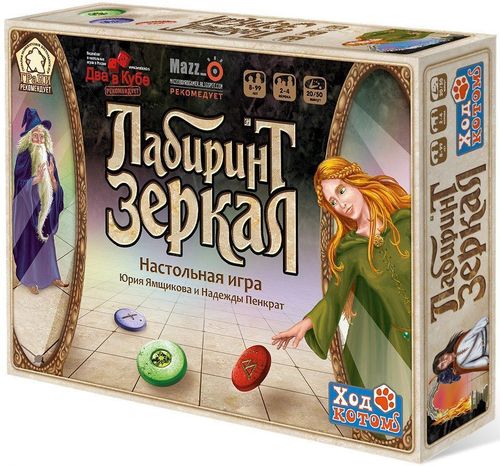
Лабиринт зеркал
Лабиринт зеркал Rulebook
Table of Contents
Table of Contents
- Components
- Basic Rules
- Advanced Rules for Experienced Players
- Difficulty Level Adjustment
- Tips
- Appendix: Meaning of the Symbols on the Amulets
- Passing Through Mirrors
- Passing Through Opponents
- Passing Through Portals
- Passing Through 1 Any Obstacle
- Restoring Another Amulet
- Turning Your Mage
- Turning a Portal (1) or a Mirror (2)
- Reversing a Portal
- Swapping Amulets
- Passing Through Amulets and Runes
- Moving Amulets and Runes
- Moving a Mirror (1), Your Mage (2) and One of the Opponents (3)
- Moving a Portal
Components
- 16 rune tokens (4 of each colour)
- 16 amulet tokens (4 of each colour)
- 4 board sections
- 4 wooden portal figures
- 16 wooden mirror figures
- 4 wooden mage figures
- 40 initiative cards
- 4 double-sided task cards
- 4 double-sided reference cards
Basic Rules
Goal of the Game
The goal of the game is to collect runes with the greatest combined strength. Each rune has a strength from 1 to 4. Strength is shown by the number of dots on the front side of the token.
Setup
- Lay out the game board in the middle of the table, assembled from its 4 sections.
- Sort the rune tokens by colour, shuffle them, and place them face down in four stacks next to the board, so that each stack contains runes of one colour in random order. Return the amulet tokens to the box; they are used only in the game by the advanced rules (see page 7).
- Place all mirrors and portals at random, together with one rune from each stack, on the starting positions: the intersection points marked with dots on the board. Portal figures are placed along the vertical or horizontal lines of the board, and mirrors are placed on any diagonals adjacent to them (at a 45-degree angle). See the example of the initial setup below. It is recommended to place 1 portal, 1 rune and 3 mirrors in each quarter of the board.
- Turn the tokens placed on the board face up.
- Shuffle the deck of initiative cards and place it next to the board.
Example of the initial setup. You may use it for your first game.
Playing the Game
Players take turns, passing the turn clockwise. The youngest player begins the game.
In the first turn, players take turns placing their mage on any free starting position (a point at the intersection of lines on the board) and make a move according to the rules described below.
Subsequent turns begin from the positions where the mages were left at the end of the previous turn. On his or her turn, a player must make one move in a direction of their choice along the lines of the board.
Moving the Mages
Mages move along the lines on the board. A mage's movement always begins and ends at an intersection of these lines. On your turn, choose a direction and move the mage along the corresponding line for the desired distance (usually, up to the first rune). If an object is on the mage's path, you must act according to the rules described below.
Reflection from Mirrors
If a mirror is on the path, the mage is reflected from it, changing its direction of movement by 90 degrees. A mage cannot stop on an intersection with a mirror.
Some mirrors are located on the board on stands; others are depicted at the edge of the board. Mirrors on the board have 2 sides; mages are reflected from either one of them.
The number of reflections from mirrors during one move is not limited.
Passing Through Portals
Each portal figure on the board has two sides, each occupied by a portal of one of the 4 elements. The element of the portal on the opposite side of the figure can be identified by the colour of the stained glass at the top of the arch (see the illustration on the right).
If a portal is on the path, the mage must enter it and exit from any other portal of the same element. A mage cannot stop on an intersection with a portal.
Apart from the portal figures placed on the board, there are also portals located at the edge of the board.
Portals and mirrors may be used in any quantity and combination during one move.
Obstacles on the Board
If the path contains the side of a portal or an opponent, the mage must stop short of it.
Runes
The mages' aim is the runes. For each colour there is a set of runes with strengths from 1 to 4. A rune's strength is shown by the number of dots on its token.
To take a rune, a mage must end its turn on the intersection where the corresponding token lies.
Important: a mage cannot pass through an intersection with a rune without stopping on it. When a mage stops on an intersection with a token, it must take that token.
Collected runes should be kept in front of the player. If they wish, a player may turn their collected runes face down and not show their strength to opponents. However, the number and colour of the tokens taken are open information for everyone.
As soon as a player takes a rune, one of the remaining runes of the same colour must appear on the board (see below, section "Appearance of New Runes on the Board"). At every moment there is exactly 1 rune of each colour on the board, until they run out.
Important: if a player takes a rune of strength 1, they take an additional turn.
Appearance of New Runes on the Board
After taking a rune, the player must immediately place the top rune from the stack of the same colour on the board (unless all runes of this colour have already been taken by the players). To determine where it appears, they reveal the top card of the initiative deck. The coordinates shown at the bottom of the card (a letter with a digit) determine the intersection where the new rune is placed. The letters and digits of the columns and rows are shown around the perimeter of the board.
If the intersection is already occupied (by any object), the player takes the next card from the deck, until they find a card with the coordinates of an empty intersection. The used card(s) go to the discard pile.
Note: if you forgot to place a new rune (or several runes) on the board, simply do it at the moment you remember, without going back: even mages have no power over time, and they cannot turn it back.
End of the Game and Determining the Winner
The game ends in one of two cases: 1) the last rune is taken; 2) all players in a row do not take a single rune on their turn.
At the end of the game, the strengths of the runes collected by each participant are added up. The one with the greater total strength of runes is the winner. In case of a tie, the player with the smallest number of runes wins. If this still does not determine a winner, the game ends in a draw.
Advanced Rules for Experienced Players
This version of the rules is recommended for players who are familiar with modern board games. It is more complex, but it allows participants to have a greater influence on the outcome of the game, reduces the role of chance, and gives more room for both strategic and tactical decisions.
Setup
Setup is done the same way as with the basic rules, but with the following differences:
- Rune stacks are placed face down. In this way, players now know the strength of the rune that will appear on the board next.
- Amulets are also used in the game. Place the amulet tokens face down in stacks by colour, next to the rune stacks. After that, place one amulet from each stack on the free starting positions of the board. Amulets give additional one-time abilities and change the way points are scored (see below, section "Amulets").
- Shuffle the deck of initiative cards, and each player receives 3 initiative cards, keeping their value secret from opponents.
- Turn the double-sided task cards over at random, shuffle them, and place them next to the board. Then slide the top card to the right, revealing half of the card underneath it.
These three tasks are available to every player throughout the game. The essence of the tasks is collecting combinations of amulets of certain colours. The strengths of the combinations are shown on the task cards. Each amulet combination may be collected by one player several times (the strength of each set of amulets is counted), and each amulet may take part in the combinations of several different tasks.
A task showing an image of three grey tokens gives a reward for three amulets of one colour.
Initiative Cards and Turn Order
- In the rules for experienced players, the order of turns changes. The game is now divided into rounds, during which each of the players takes their turn.
- At the beginning of each round, including the first, each player chooses 1 initiative card from those they hold and places it face down in front of themselves. When all players have done so, the chosen cards are revealed simultaneously. The numbers at the top of the revealed cards determine the turn order: the one with the lower number goes first.
Example: the players chose and placed in front of themselves cards with the numbers 3, 17 and 39. The first to act will be the player who placed the card with the value 3, second the one who chose number 17, and last the one who used the card with 39.
After a turn, the player sends the initiative card they used to the discard pile and draws a new one from the deck, so that they again have three cards. When the initiative deck runs out, shuffle the discard pile and use it as a new deck.
First Round
In the first round, players simply place their characters on the remaining free starting positions, choosing the direction in which their characters will face (this will matter for the rest of the game). No movement takes place in the first round.
Moving the Mages
Starting from the second round, each player on their turn must move their character. Reflection from mirrors, passing through portals, and the movement itself are carried out in the same way as in the basic rules, except that a mage must always move facing forward. A player may turn their character's figure only once per turn: before the start of the movement or after it ends, and only by 90 degrees. Experienced mages do not turn as easily as beginners — it shows their respectable age.
Amulets
Amulets are placed on the board and collected by players in the same way as runes. In the game they have three functions:
- They allow players to score points for the strength of runes. When playing by the advanced rules, any rune gives victory points only together with an amulet of the same colour. Any rune without a pair is considered to have strength 0, regardless of the values shown on its token.
- They allow players to score additional victory points for combinations of the amulets themselves. See the section "End of the Game and Determining the Winner."
- They allow players to use the abilities they give once per game. A player who owns an amulet keeps it with its symbol side up. When an amulet is used, the player performs the ability shown on it (for the decoding of the symbols, see the Appendix) and turns the token over, marking that the amulet has already been used and can no longer be applied.
Note: regardless of any amulet abilities, during one turn a player may take only one token (a rune or an amulet) — the one on which the mage ended its mandatory movement. When a player takes a rune of strength 1, they receive an additional turn and, accordingly, the opportunity to take one more token.
Appearance of New Runes and Amulets on the Board
Immediately after taking any amulet, just as after taking any rune, a token of the same colour and type as the one taken must be placed on the board (if there are still some in reserve). Thus, there should always be 1 amulet and 1 rune of each colour on the board, until they run out. The coordinates of the new amulet's position are determined using initiative cards, in the same way as for runes.
End of the Game and Determining the Winner
The game ends after the round during which no rune or amulet tokens remained in the stacks next to the board (though they may still remain on the board). The game also ends after a round during which none of the players collected a single rune or a single amulet.
To determine the winner, the combined strength of the collected runes and amulet combinations is calculated.
An amulet combination has the strength shown on the corresponding half of the task card (in each game 3 task combinations apply, which have strength). Each amulet combination may be collected by one player several times (the strength of each set of amulets is counted), and each amulet may take part in several different combinations.
A task with three grey tokens means that the combinations of three amulets of one colour have strength.
When calculating the strength of runes, only those runes are counted for which the player has an amulet of the same colour (one amulet per rune). If there are more runes than amulets, the stronger runes are counted.
When calculating the strength of runes and amulets, it does not matter whether an amulet's ability was used during the game.
The one with the greater total strength of runes and amulet combinations is the winner. In case of a tie, the winner is the player with the greatest number of rune–amulet pairs of one colour. If this still does not determine a winner, the game ends in a draw.
In the example shown, the strength of the blue amulets is 1 each; the green and yellow ones are 0 (because they have strength only in combination with the red ones). The strength of the red rune is also 0 — there is no red amulet to pair with it. Two blue amulets give strength (2 and 4) to the two most powerful blue runes. The green rune has strength 3 thanks to its paired green amulet, and the yellow one has strength 1 thanks to its paired yellow amulet. The total strength of all runes and amulets is (1+1)+(2+4+3+1)=12.
Difficulty Level Adjustment
If the basic rules seem too simple to you, and the advanced rules too complicated, you can choose the difficulty level yourself, selecting one or more complications:
- Play by the basic rules, but add amulets to the game. Place them on the board and collect them exactly as you would runes, but always keep them face down. Score points only for those runes for which you have a paired amulet (one amulet per rune). This complication adds a strategic element to the game.
- Play by the basic rules with complication no. 1. Place amulets on the board face down. Each amulet you take allows you to use the ability shown on its token once (after use, the token is turned over). Mages may move only forward. Only once per turn — before or after the movement — may they turn by 90 degrees. This complication expands the players' options and makes the gameplay more varied.
- Play by the basic rules with complication no. 1 or no. 2. Before the start of the game, turn the task cards over at random and shuffle them. Slide the top card to the right so that half of the card underneath it is revealed. This way you get 3 tasks for the game, the essence of which is collecting amulets of certain colours. The amulet combination has the strength shown on the corresponding half of the task card. Each amulet combination may be collected by one player several times (the strength of each set of amulets is counted), and each amulet may take part in several different combinations. A task with three grey tokens gives a reward for collecting combinations of three amulets of one colour. This complication strengthens the strategic element.
- Play by the basic rules with complication no. 1, no. 2 or no. 3. Before the start of the game, deal each player 3 initiative cards face down. At the beginning of each round, each player chooses 1 initiative card from those they hold and places it face down in front of themselves. When everyone has made their choice, the chosen cards are revealed simultaneously. The numbers at the top of the revealed cards determine the turn order: the one with the lower number goes first. This complication adds a tactical element.
- Play by the basic rules with complication no. 4. Before the start of the game, place the rune stacks face down so that the value of the top rune in each stack is always visible. This complication reduces the influence of chance on the outcome of the game.
Tips
- When choosing a direction of movement, you can first trace the lines from the treasure you want to take back to the portals, and only then the lines leading from your own character. This will allow you not only to understand faster whether you can take this treasure, but also to see which rivals are competing for it. The latter is especially important when playing by the advanced rules, during the choice of the initiative card for the current round.
- When playing by the advanced rules, save initiative cards with a low value for situations where you urgently need to act before an opponent, and do not waste them. Cards with a high value can also be useful — for example, if opponents are blocking your exits, or in a situation where you cannot collect any valuable treasure and the runes coming up next are significantly more valuable than those lying on the board.
Appendix: Meaning of the Symbols on the Amulets
The printed appendix shows each amulet ability as an icon on the token; the icons are images and are not reproduced here. Each entry is listed by the heading printed for it, with its ability text.
Passing Through Mirrors
Allows a mage to pass through 1 or 2 mirrors of any kind, as if nothing were in their place. The mage can still be reflected from the other mirrors.
Passing Through Opponents
Allows passing through any number of opponents during one turn. A mage still cannot stop on an intersection occupied by an opponent.
Passing Through Portals
Allows, during one turn, passing an unlimited number of times through portal figures that are in the way, as if nothing were in their place. The orientation of the portal figures (sideways or with the portal facing the character) makes no difference. The mage may still enter the portals it needs in the usual way. A mage still cannot stop on an intersection occupied by a portal figure.
Passing Through 1 Any Obstacle
Allows passing through one obstacle of the player's choice (an amulet, a rune, a mirror, a portal or an opponent). It does not allow stopping on an intersection occupied by a mirror, a portal or an opponent.
Restoring Another Amulet
Allows reusing one of your own amulets that has already been used earlier in the game.
Turning Your Mage
Allows turning your own mage an additional 90 degrees.
Turning a Portal (1) or a Mirror (2)
Allows turning any one portal or mirror by 90 degrees in either direction.
Reversing a Portal
Allows turning any one portal figure by 180 degrees, in effect swapping the portals on it.
Swapping Amulets
Allows swapping the places of two amulets on the board.
Passing Through Amulets and Runes
Allows passing through all unneeded amulets and runes.
Moving Amulets and Runes
Allows moving one amulet or one rune to a neighbouring (vertical or horizontal) intersection of the board lines, if it is free. If a portal is next to the object being moved, the object may be moved through it to an intersection next to another portal of the same element.
Moving a Mirror (1), Your Mage (2) and One of the Opponents (3)
Allows moving one object of the indicated type to a neighbouring (vertical or horizontal) empty intersection. When moving, the orientation of the mirror or mage being moved is preserved (that is, they are not turned while being moved).
If a portal is next to the object being moved, the object may be moved to an empty intersection of the board lines next to another portal of the same element. The orientation of the object relative to the portal is preserved.
Moving a Portal
Allows moving one portal figure to a neighbouring (vertical or horizontal) intersection of the board lines. The orientation of the portal figure is preserved.
A portal figure cannot be moved onto an intersection occupied by another portal figure. If a portal figure is moved onto an intersection of the board lines where something or someone is located, that object is moved to a free intersection next to another portal of the same element of the player's choice, preserving its orientation relative to the portal.
Important: a portal figure may be moved sideways only onto empty intersections.