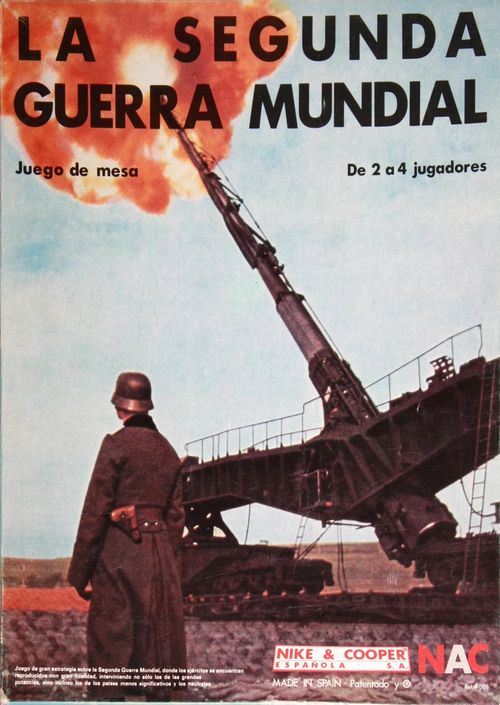
La Segunda Guerra Mundial
La Segunda Guerra Mundial Rulebook
Table of Contents
Table of Contents
- 1. Components
- 2. Explanation of Components
- 3. Number of Players
- 4. Duration of the Game
- 5. Who Wins the Game?
- 6. Movement of the Counters
- 7. Combat
- 8. Combat Between Surface and Air Units
- 9. Transport
- 10. Conquests
- 11. Forces at the Start of the War and Reception of Reinforcements
- 12. Entry into the War of the Neutrals, Russia and the United States
1. Components
- A board with the political map of Europe as of 1939.
- Three die-cut counter sheets.
- A plastic bag for storing the counters after they have been punched out of their sheets.
- One die.
- This instruction book.
2. Explanation of Components
2.1. Board
The board is a political map of Europe and North Africa, showing the territories as they were configured in 1939. The map is divided into hexagonal spaces. The map key (A to G) identifies the features shown: A: Capital. B: City. C: Airport. D: Mountains. E: River. F: Coast. G: Border.
The countries and territories are:
- AXIS (Germany and its allies, in grey tones):
- Germany.
- Italy (plus its possessions of Albania and Libya).
- Finland, Hungary, Romania and Bulgaria.
- WESTERN ALLIES (green tones):
- United Kingdom (and its possessions: Gibraltar, Malta, Cyprus, Egypt, Palestine and Jordan).
- France (plus French Morocco, Algeria, Tunisia, Lebanon and Syria).
- Norway, Holland, Belgium, Luxembourg and Denmark.
- For game purposes this bloc also includes: Poland, Yugoslavia and Greece.
- RUSSIA (red tone).
- NEUTRALS (yellow):
- Spain and Portugal, Switzerland, Sweden, Ireland and Turkey.
Regarding these national configurations the following observations must be made:
- The United States, whose territory does not yet appear on the map, intervenes from a certain date together with the "Western Allies".
- Certain countries form a single playing unit, such as Spain and Portugal, Belgium and Luxembourg.
- Some nations, such as Ireland and Denmark, have no army counters.
In addition to what has been described above, the board shows:
- National capitals: large star.
- Territorial or colonial capitals: small star.
- Cities: asterisk.
- Airports: black circles. (All cities and capitals are also airports.)
- Mountains: areas enclosed by contour lines.
- Rivers: blue lines.
- Lakes: blue areas within a territory (they cannot be occupied by land counters).
- Coast: thick black lines. When it is in doubt whether a hex is land or sea, the hex is decided in favour of whichever occupies the greater area of that hex.
- Border: thin black lines.
- A grid of hexagons covering the whole map: the areas across which the counters move.
2.2. Counters
Each cardboard counter corresponds to a military unit of a given nation. There are three types:
- Land units: with the emblem of the nation. Approximately, each counter corresponds to the military concept of Army, that is, a grouping of divisions and other smaller units in which forces of all types and specialties are found.
- Naval units: with the national emblem and a yellow background. Here too each counter corresponds to a naval combat grouping equivalent to a fleet, and may comprise anything from ships of the line to patrol launches, passing through destroyers, minelayers, submarines, troop transports, etc.
- Air units: with the national emblem and a pink background. Each counter is equivalent to the concept of "air fleet", a large unit of thousands of aircraft among which are fighters, bombers, attack aircraft, reconnaissance aircraft, transports, etc.
In the course of combat in this game it will often happen that a counter is destroyed and leaves the game. This obviously does not mean, since it is impossible, that all the components of the unit have been destroyed; it means that the unit has had a confrontation with the enemy and, having lost it, is out of combat.
All counters in this game have two characteristics, which are repeated identically on all of them:
- The combat factor.
- The movement factor.
These two concepts are the same for all contenders according to the type of unit, so they are not printed on the counter, unlike in other wargames. They are as follows:
- Land units: combat factor 1; movement factor 5.
- Naval units: combat factor 1; movement factor 8.
- Air units: combat factor 1; movement factor 12.
The meaning of these factors is:
- "Combat factor" is the operational capacity of the unit, that is, the maximum fire power it is able to concentrate in combat. To understand the combat factor system, a basic distinction must be made between "surface units" (land and sea) and "air units" (aircraft). The combat factor is valid exclusively in the confrontation of surface units with each other, and in that of air units with each other, but not in combat between a surface unit and an "air" unit, which follows a special rule.
- "Movement factor" is the distance a unit is able to travel at most in a given time. The value represents the number of hexes on the board that the counter may cross at most per turn, although it may travel a shorter route or not move at all.
2.3. The Die
The die is used to resolve combats and stands for the "luck factor". So that it is not disproportionate, the special die of the game does not bear the number "one" nor the number "six", but instead has a "two", two "threes", two "fours" and a "five", so that the chances of a similar "luck" are more evenly matched.
3. Number of Players
The game is designed for an ideal number of three players, although it admits two contenders with total ease, and even more than three.
In reality, the nations of the "Axis" faced on one side, and on the other the rest of the belligerent countries. This is kept in the game; however, in the case of three players it is essential that one plays the "Axis", another plays the group we have called the "Western Allies" and another plays Russia, since although the Russians and the Western nations are allies, their interests and strategy do not always coincide.
The distribution of countries according to the number of players is:
- Two players: one with the "Axis" and the other with the "Western Allies" and Russia.
- Three players: one with the "Axis", another with the "Western Allies" and another with Russia.
- Four players: one with the "Axis", two with the "Western Allies" (one commanding the land forces and the other the naval and air forces), and the fourth with Russia.
It is understood that when a country that is grouped into one of the playing groups is referred to, its possessions and colonies are also included.
4. Duration of the Game
The game is governed by the concept of "turn", which is the movement and the resolution of combats of all the contenders once.
In each turn the order is always: first the "Axis", then the Russians, and last the "Western Allies". It is therefore already determined that the "Axis" begins the game.
The game lasts 18 turns, and each turn corresponds approximately to a four-month period of war, from the end of 1939 to the middle of 1945.
On the "reinforcement reception" template, located in the lower left corner of the board, the turn-marker calendar can also be seen in its lower part. Each time a complete turn is played, the NAC turn-marker counter is advanced one space.
From all of the above it follows that the actual length of the game depends directly on the reflexes and movement speed of the players. The normal period of 18 turns takes about one and a half hours.
By prior agreement of the players, longer or shorter durations are admissible.
5. Who Wins the Game?
Victory in The Second World War can be achieved either by all the Allies together (Russia and the "Western Allies") or by the "Axis". It is therefore not possible for one of the allies alone to achieve a solo victory.
The ways in which victory is achieved are:
- Whoever achieves the surrender of the enemy before the end of turn 18.
- Whoever, at the end of any turn, has three times as many counters (counting land, sea and air) as the enemy. The counters of Russia and the "Western Allies" are counted together. If any neutral has entered the war, its counters are considered to belong to the player who controls them.
- Whoever totally annihilates their enemies.
- If, at the end of turn 18, no one has achieved victory, two possibilities exist: a) to establish a cease-fire with a draw; or b) to continue the war until one of the contenders wins. The choice between these two possibilities must be made before the start of the game.
6. Movement of the Counters
- In each turn, each counter may move only once.
- The movement of a counter is governed by its "movement factor".
- The "movement factor" is the greatest number of hexes a counter may cross in one turn. A counter may make a shorter movement or simply not move.
- Moving part of the "movement factor", attacking an enemy and then moving the rest of the "movement factor" is considered "fractional movement". This fractional movement is strictly prohibited.
- It is compulsory first to make all the movements of one's own counters, and then to resolve the combats that have been engaged. Once this is done, the turn passes to the next player.
- Under no circumstances may a surface counter pass over another surface counter. If a counter is moving in a given direction and on its path finds another friendly or enemy counter, it must go around it; it may never pass over it, even if this means a delay on its route. Hexes occupied by aircraft may be counted as part of a route but may not be occupied.
- Once a counter has moved, it is immobilized until the next turn.
- All land units, when crossing mountainous terrain, have their movement factor reduced by 1 point.
- Each hex of the board may be occupied by only one counter (there is the exception of transports).
- All land units, when crossing a river, lose 1 point of their movement factor.
Obviously, naval counters cannot move over land, nor land counters over sea, unless they are being transported. Air counters may move both over land and over sea.
Zone of Control
- The "zone of control" of a counter is the six hexes that surround the hex in which the counter is located. A counter may not pass through the zone of control of an enemy unit. If it does, it is obliged to stop on the first hex it enters within the zone of control of the enemy unit and engage that unit in combat.
- The zone of control applies only to land and naval units, not to air units.
- When a counter enters the zone of control of two or more enemies, it chooses which of them to attack.
- Because of the zone of control, a land unit may be placed on the coast of a strait and "control" the passage of naval units through it. If naval units do pass, they will be obliged to fight the land unit that is "closing" the strait.
Diagram note: the original shows a hex with a counter and its six surrounding hexes shaded as the "Zona de Control" (zone of control). The diagram itself is not reproduced here.
7. Combat
- Surface units may fight other surface units, using their "combat factor".
- Air units may fight other air units, using their combat factor.
- One or several counters of one's own may engage in combat with one or several enemy counters.
- Combat occurs only when the counters are on adjacent hexes.
- Combats are resolved with the die (the "luck factor"). When combat is engaged, the attacking player rolls the die and multiplies the result by the combat factor, obtaining a "value". The defender does the same, obtaining a second "value" for its counter. The higher of the two values gives victory to the counter that obtained it; the other counter is eliminated and leaves the game. In case of a tie, the die is rolled again.
- Before the die is rolled, it is always stated which units are attacking which.
- When several counters attack one enemy counter, their factors are added together, and the sum is multiplied by the value of the die.
- Several counters may attack several enemy counters, provided that all of them are adjacent to one another, attackers and attacked alike. This possibility is reduced to "two against two".
Examples (captions of the printed diagrams)
The printed booklet illustrates the rules with a series of map diagrams. Their captions are transcribed below; the diagrams themselves are not reproduced.
- Example of a starting position.
- The Germans attack Holland, Belgium and France. Counters 1 and 2 attacked the Dutch 7 with superiority and eliminated it. Counters 3 and 4 attacked the 8; and counters 5 and 6 attacked the 9, eliminating both. In the movement of the "Allied" player, counters 10 and 11 attacked the German 6, winning it.
- A new turn; the Germans move and attack with counters 4 and 5 against the French 10, destroying it.
- The "Allies" move and attack with their counter 11 against the German 4.
- The "Allies" obtained a worse die result in the attack of 11 against 4, and are left without forces.
- In two turns, the Germans move and conquer France by having a land counter in each of the French cities.
Further combat rules
- In a player's turn, each of their counters may move only once and combat only once. If, in the turn of the enemy player, a counter is attacked, it naturally defends itself by rolling the die.
- Naval units may combat land units that are on the coast, and vice versa.
- In mountain combats, when a unit is attacked it doubles its combat factor, that is, it goes from 1 to 2. The attacker, even if it is also in the mountains, keeps its factor of 1. That is, to have an equal combat in the mountains, the attacking army must use two counters against each one of the defender. This rule does not apply to air units.
- The attack of two or more counters of one contender against an enemy counter may only be made per player. That is, a German and an Italian counter together may attack a Russian, or an American and an English counter may attack a German; but one of the Western Allies and a Russian together may not attack one of the "Axis".
8. Combat Between Surface and Air Units
- A land or naval unit may not attack an enemy air unit by itself.
- Combat between air and surface units takes place only if a surface counter and an air counter attack an enemy counter together (whether surface or air). This is called the "combined attack" (ataque combinado).
- For the combined attack the factors change, and become:
- Attackers: surface unit and air units together, factor 3.
- Attacked: surface or air unit, factor 2.
- A combined attack may never be made when the attacked counter is in the mountains.
9. Transport
- Naval transports: sea counters may carry one land counter. They must pick it up at any point on the coast and may disembark it at any point on the coast. While it is being transported, the land counter loses its mobility and its combat capacity. If the transporting unit is destroyed, the transported unit is destroyed as well. Naval units, when acting as transports, may not be placed in a strait, and they act as a "bridge" for the passage of land units.
- Air transports: any air unit may carry one land counter. It must pick the land counter up at any airport (black circles, or any city or capital) and must return it to land, also at an airport.
- The air unit, both to pick up the land counter and to return it, must be on the airport, and the land counter will access the transport from any hex adjacent to the airport. It will also be disembarked on any hex surrounding the airport to which the air unit carries it.
- During air transport the same rules set out for naval units apply.
- For both air and naval transports, the land counters being transported count one point of their movement factor, both for entering and for leaving the transport.
In both cases the transporting counter is situated on top of the transported counter. This is what was referred to above regarding the only exception to the rule that two counters may not remain in the same hex.
When, at the start of a turn, a counter is already on board a transport, if it is disembarked in that turn it may make its full movement. What it may not do in the same turn is board a transport, be carried, disembark and move again, since this would be a "fractional movement" (see Section 6). Likewise, a transport that moves part of its movement factor, leaves a transported unit, and continues the rest of its movement is also "fractional movement", and therefore not permitted.
10. Conquests
- The concept of conquest is, in this game, individualized for each country, territory or colony. For example, metropolitan France may have been invaded and conquered in its entirety, while French forces may still remain in the belligerent colonies against the "Axis", as in reality occurred.
- A country, territory or colony is considered conquered when all its cities are occupied. Occupation may only be carried out by land units, and implies the presence, at the same time, of a counter in each of the cities.
- Once a territory is conquered, the units that have taken part in the conquest may leave the cities and the territory, and may even be used on other fronts, although the territory does not thereby cease to belong to the conqueror.
- A city is conquered when there is an enemy unit in it, or when it is completely surrounded. If the city is coastal, it is sufficient for it to be surrounded by land.
- When a territory is conquered, a "declaration of conquest" must be made, which means that the conquering player announces it to the other players.
- It is recommended that the conquests of territories be noted down on paper.
- When a country, territory or colony is conquered, the counters that may still remain within the corresponding conquered country are obliged to surrender and leave the game. In this case, the surrender does not apply to all the counters of a player, but only to those of the conquered country. Thus, if France is conquered by the "Axis" forces, the "Axis" has taken Paris and the other four cities existing on the map, and the French forces that may remain are obliged to surrender. The English or other Western Allied forces that may be in France at that moment are not obliged to surrender, and of course neither are the French forces outside the metropolis.
- The surrender by conquest affects only land units, never naval ones, not even if they are on the coast.
11. Forces at the Start of the War and Reception of Reinforcements
11.1. The Reinforcement Template
The template located in the lower left corner of the board indicates, for each country, the forces received in each turn.
Certain countries, such as the neutrals and the so-called minor allies of both contenders, do not receive reinforcements.
At the start of the game, the forces that may be placed on the board are:
- Neutrals: all the counters they have.
- Minor allies of both contenders: all the counters they have (one per country).
- Main contenders: the number of units marked for turn 1 of the reinforcement template, placing in each box first the land units, then the naval units and finally the air units.
Each time a turn ends (movement of the counters and resolution of combats by all three players), the NAC turn-marker counter advances one space. The reinforcements that each contender receives for the turn about to begin are shown on the template, and are placed on the board before the turn starts, according to the rules explained below.
11.2. Placement at the Start of the Game
The armies of the neutral countries are placed in each corresponding country by agreement of the players. These counters remain immobilized until the neutral country enters the war, if this occurs.
Neutral countries may not exchange units with one another, so the Spanish units must be placed in Spain, the Swiss in Switzerland, and the Turkish and Swedish in Turkey and Sweden.
The armies of the belligerent countries must be placed at the start of the game in their own territory (nation, possessions or colonies). Land counters may be placed anywhere, naval counters on the coast, and air counters on an airport. (It is convenient to remember that for all purposes airports, capitals and cities are considered.)
From the start, and in successive receptions of reinforcements, land counters may be placed directly on a naval or air counter for transport, but only if both the transported and the transporting counter enter the game at that moment. Thus, a land counter that enters on turn 9 may not be placed directly on a naval counter that is already in play.
Only for the starting placement is the concept of player not followed (for example, "Western Allies"), but that of nation. Thus, although the English and the French may belong to the same player, the French counters must be placed in France or its possessions, and the English in the United Kingdom and its possessions, although they may subsequently be transported wherever one wishes.
The counters of each country may be placed at the start only in their own country. Thus a Polish counter may only be placed at the start in Poland, a Bulgarian one in Bulgaria, a Belgian one in Belgium, and so on.
11.3. Placement of Reinforcements
Throughout the game, reinforcements may be placed as follows:
- The counters of a player may be placed at any point of their country, or of their territories or colonies, provided that these are not being invaded in an individualized way. This is in contrast to the starting placement: here, for example, a French reinforcement counter may be placed in England.
Diagram captions:
- The Germans have invaded Russia and attack with superiority against the enemy units.
- The Russians, being invaded, must receive their reinforcements in a city that has not been conquered, or in any of the hexes adjacent to it.
The following rules govern the reception of reinforcements:
- Reception of reinforcements by a country that is being invaded: in this case only the defender may receive its reinforcements, in a city or in any of its adjacent hexes, for land units. Air units are received at an airport, and naval units at a point on the coast.
- In all the cities that have not been taken by the invader, the invaded country may receive reinforcements.
- The reception of reinforcements by the attacker in a country it is invading, and which it has not yet conquered, may not be carried out.
- The reception of reinforcements by the conqueror of a country that it has already completely dominated may be carried out as if that country were its own territory, and therefore in any place.
- The reception of reinforcements by both the "Axis" and the "Western Allies" may be carried out in any of their territories or conquests. Thus, a German counter may be received, for example, in Romania from the 2nd turn onward.
- As Russia has no possessions at the start, it must take its reinforcements in its own territory, or in the conquests it may make during the game.
- When the United States enters the war on turn 9, the counters of that country may enter any territory that the "Western Allies" still maintain at that moment. Its successive reinforcements will be received in the same way, and always subject to the limitations according to the type of unit concerned.
- If a territory is conquered and subsequently invaded by the allies of the conqueror, or by the conquered country itself from outside, the reception of reinforcements is governed by the rule for an invaded country, but with the conqueror now being the invaded, and the new attacker being the current invader.
12. Entry into the War of the Neutrals, Russia and the United States
- Russia: it cannot enter the war, and it is always against the "Axis" countries, until turn 5.
- If before this turn its territory is invaded (for any country, the entry of at least one counter into its territory counts as invasion), it is considered that from that moment it has entered the war.
- United States: it enters the war from turn 9. Therefore, before this turn there may be no units of this nation on the board.
- Neutrals: the neutral countries, although they have been referred to as a whole, take part in the game individually. They enter the war only when they are attacked, and in that case always against the invader. From then on, for all purposes, they are controlled by the player opposite to the one who invaded them, according to the following table:
| Invasion of | by | passes to |
|---|---|---|
| Spain | the "Western Allies" or Russia | the "Axis" |
| Sweden | " | " |
| Switzerland | " | " |
| Turkey | " | " |
| Spain | the "Axis" | the "Western Allies" |
| Sweden | " | Russia |
| Switzerland | " | the "Western Allies" |
| Turkey | " | Russia |
- The units of the neutral countries, as long as their neutrality lasts, have no zone of control.
- Aggression against a neutral country is considered to be the act of invading its territory (at least one counter invades), or attacking (with or without success) a unit of that country.