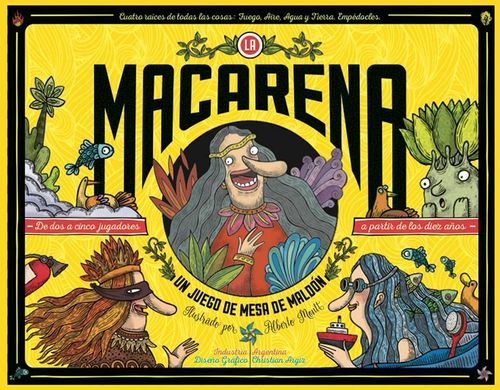
La Macarena
La Macarena Rulebook
Table of Contents
Table of Contents
Overview
Each player chooses a color and takes their 7 MACAS. The two decks are shuffled together, 7 cards are dealt to each player, and 7 cards are placed around the deck to form 7 wells, as shown in the diagram. The elements, coins and amulets are placed to one side of the table. These are handed out at the end of each hand. The player whose birthday most recently passed starts the hand.
Turn: the player draws a card from the deck, then either plays or passes. The turn passes to the player on the right.
- Draw a card from the deck: a player begins their turn by drawing a card from the deck. When there are no more cards to draw, the hand ends.
- Play: players try to lay down their cards on one of the 7 wells. Cards may be laid down as long as the rules explained below are followed. The last card stays on the well and the rest go to the player's personal collection.
- Pass: if a player does not want to play, or cannot, they may pass.
A hand ends when the deck runs out or when a player "leaves", that is, runs out of cards in hand. At the end of the hand the collections are compared and the element tokens and coins are handed out (see End of the Hand). If someone has achieved the objective, the game ends. If not, another hand is played.
Objective of the game:
- 2 to 3 players: collect 2 amulets.
- 4 to 5 players: collect 1 amulet.
Components
Cards: two decks of 52 cards each, of four elements: water, air, earth and fire.
Coins: special prizes. When a player collects four coins, they must exchange them for one element of their choice.
Elements: these tokens are earned by collecting element cards.
Amulets: collecting all four elements allows a player to exchange them for an amulet. Collecting amulets is the goal of the game.
Macas: protectors of the wells. At the start of the game each player chooses a color and takes 7 Macas.
Playing
On each turn, the player tries to collect as many cards as possible into their personal collection. To do so, they try to connect their play, meaning the cards in their hand, with a card on a well, so that they can lay it down. The player must arrange their play according to these rules: Run (escalera), Same Number (igual número) and Number-Run Combination (combinación número-escalera). Once at least one card of their play connects with a card on a well, the player may lay it down. They may lay down as many cards as they like.
- If it is a single card (the player has a 2 and a well shows an A), the player places the card (2) on the corresponding well (A), and nothing is kept in the personal collection.
- If it is more than one card (the player has the 2, 3 and 4), the player shows the whole series on the corresponding well (A), leaves the last card of the series (4) on that well, and keeps all the intermediate cards (2, 3) in their collection.
Whenever more than one card is played, the last card stays on the well and the rest go to the personal collection. Wells accumulate cards throughout the hand; cards are never removed from wells.
When the hand ends, all players count the cards still in their hand.
Personal collection (colección personal): each player adds cards to their personal collection throughout the hand. It is kept hidden from the other players, but the player may look at it at any time. This collection determines the winners of the elements at the end of each hand. Cards placed on the wells do not count toward collecting elements in any way.
Rules for laying down cards:
- Run (escalera): consecutive cards of the same element. It may be ascending and/or descending. The A and the K are considered consecutive.
- Same number (igual número): cards of the same number and different elements.
- Number-run combination (combinación número-escalera): a combination of the two rules above, as shown in the diagram.
Passing
If a player does not want to play, or cannot, they may pass. After drawing the card from the deck, they say "Paso" (I pass) and the turn passes to the player on the right. When a player passes, all of their Macas are deactivated.
Mirror Cards and Mirror Turns
The deck is made up of 2 sets of 52 cards, so every card appears twice. Two identical cards played in succession are mirror cards (cartas espejo).
Mirror cards may be played alone (when a player holds a card identical to one on a well) or as the last card of a series (when a player holds two identical cards connected in some way to a card on a well). When they are played, a special effect occurs: the player announces "espejo" (mirror), activates one of their Macas, and gains a mirror turn (turno espejo).
- When a mirror card is played alone, the mirror card is shown on the corresponding well and kept in the personal collection. This is the only moment in the game when a card played alone goes to the personal collection rather than staying on the well.
- When a mirror card is part of a series, the mirror card is the last one and is the one that stays on the well.
- ALWAYS when two identical cards are played in succession, they count as a mirror and the series is cut.
- NEVER may they be used as "same number".
Mirror turn (turno espejo): an extra turn. The dynamic is the same: the player draws a card, then plays or passes. The special feature of this extra turn is that it may be played on ANY well, even one enchanted by another player's MACA. A mirror turn cannot be refused: when a mirror card is played, a mirror turn ALWAYS follows.
Macas
The Macas are enchantments that protect the wells. Every player has seven Macas. When a player plays a mirror card, they activate one of their Macas: they place the Maca of their color in front of the well where they played the mirror card. This means that, for as long as their Maca stays active, they are the only one who may play on that well. The Maca remains active and protects the well as long as the player plays at least one card on the table on their subsequent turns (not necessarily on that same well). If they choose to pass (because they do not want to or cannot play), all of their active Macas on the table are deactivated and return to their place near the player, freeing the wells for the other players.
The only time a player may play on an enchanted well is during a mirror turn. If during a mirror turn the player manages to play another mirror card on an enchanted well, they activate a Maca on that same well and share it with the owner: both may play on that well. If the Maca was theirs, they place a second Maca. A player may place up to seven Macas on the same well. If a player has all their Macas active and manages to play a mirror card, they must move one of the Macas already in play.
On a normal turn, if a player holds a card that matches a card on an enchanted well, they may not lay it down on that well.
Players who have active Macas at the end of the hand receive one coin for each active Maca.
End of the Hand
When the hand ends, all players count the cards in their hand.
The player who has the most cards in hand must hand over one element of their choice. This choice must be made before looking at the other players' collections.
- If there is a tie, both players hand over one element.
- If a player has no elements, they hand over all the coins they have.
- If a player has nothing, or only an amulet, they hand over nothing.
- The first hand, when no elements have yet been collected, hands over nothing.
Then the personal collections are arranged face up for everyone to see, and the following prizes are handed out:
- Active Macas: one coin for each active Maca.
- Largest collection (most cards in personal collection): in case of a tie, both players receive one coin.
- Leaving (running out of cards in hand): if the hand ends because a player leaves, that player receives one coin.
- Most cards of each element: each hand, one token of each element is handed out. The player with the most cards of each element takes the corresponding token. In case of a tie in number, the player with the highest card of that element takes it, the Ace being the highest card. If there is still a tie, the second highest, and so on, until the tie is broken.
If a player wins an element they already have and do not need, they receive one coin in exchange. That element is not handed to anyone.
When a player obtains four coins, they must exchange them for an element of their choice.
When a player obtains four different elements, they must exchange them for an amulet.
Winning the Game
The game ends at the end of a hand in which a player has achieved the objective (see Objective of the Game above).
If at any point in the game a player enchants every well, placing a MACA on EACH of the wells, LA MACARENA chooses them as her apprentice and they automatically become the winner of the game.
Example
Cata (red), Caro (orange) and Mateo (green) play a Macarena. The hand ends because Mateo has run out of cards in hand. The collections end up as follows:
- Cata: 1 active Maca; 5 cards left in hand.
- Caro: 2 active Macas; 3 cards left in hand. Cata has the most cards in hand, so Cata must hand over one element of their choice. This choice is made before looking at the other players' collections.
- Mateo: 1 active Maca; 0 cards left in hand. Mateo left the hand ("Se fue") and receives one coin.
The personal collections are then arranged face up for everyone to see, and the prizes are handed out as described under End of the Hand.