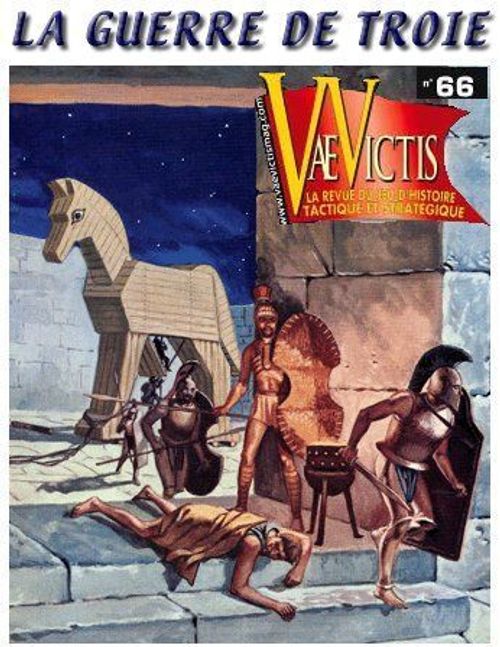
La Guerre de Troie
La Guerre de Troie Rulebook
Table of Contents
Table of Contents
0. In General
"Timeo Danaos et dona ferentis!" (I fear the Greeks even when bearing gifts!") — Attributed to Laocoon by Virgil, the Aeneid, II.
The game is designed for two players but can easily be played solitaire. It requires a 10 sided dice (1d10). The 0 is read as "zero" not "ten". The game map is on page 51 of this magazine; we suggest you mount it on stiff cardboard before play.
0.1 The Heroes
They represent the most important warriors of both sides. They confront each other each turn in personal combat.
0.2 The Personages
They are not combatants but influence the course of the game through events.
0.3 The Olympian Gods
They influence the individual combats by favouring certain heroes over others.
0.4 Initial Placement
The turn marker is placed on Turn 1 on the Turn Record Track. The Trojan Horse is placed on turn 12. The victory point (V.P.) markers are placed at zero.
Priam, Helene and Cassandre are placed in the House of Priam (Maison de Priam). The Trojan heroes, except Memnon and Penthesilee, are placed in Troy. The Greek heroes, except Neoptoleme and Philoctete, and Calchas are placed in the Greek camp. Briseis is placed in Achille's tent. The two armies are placed in their respective spaces on the map.
The 9 gods are placed in an opaque container. All remaining heroes and personages are set aside.
1. Game Turns
"Government by the mob is not good; better to have a leader, a king" — Iliad
The game covers the whole of the Trojan War in twelve turns.
- Turns 1 and 2 cover events before the Iliad.
- Turns 3 through 8 cover the events in the Iliad.
- Turns 9 through 11 cover events after the Iliad [but covered, in addition to the sources mentioned, in Virgil's Aeneid – t.n.].
- Turn 12 covers the episode of the Trojan Horse.
The first 11 turns follow the same sequence as described below; the 12th has its own sequence.
1.1 Turns 1-11, the War
- A- Events. The players either implement the required event or roll 1d10 to determine the applicable random event (see "Table of Events").
- B- Challenges Between Heroes. Each player selects 4 heroes and places them face down on the spaces marked "Heroes 1-4" (may be modified by an event). If there are not enough heroes remaining to one player to make it possible for him to select 4, he assigns all he has remaining to challenges. His opponent may not gain Victory Points for challengers who will not have an assigned opponent. (Example: if a player has only two heroes available, there will be no more than two challenges and one of those may be cancelled as provided in the rules.)
- C- Intervention of the Gods. Each player randomly selects one god and places them face up on the appropriate spaces.
- D- Hero Combat (see 2.1). The hero counters are turned face up. The Trojan player on odd numbered turns or the Greek player on even numbered turns selects one challenge to be cancelled (subject to events). The remaining combats are resolved.
- E- Army Combat (see 2.2). The two armies confront one another in the spaces indicated.
- F- Calculation of Victory Points (P.V.). These are as noted in relevant areas of the rules.
1.2 Turn 12, The Trojan Horse
This game turn is devoted to the final Greek stratagem for the conquest of Troy.
1.3 Reinforcements
On the indicated turns, the following heroes are placed in either Troy or in the Greek Camp depending on their nationality:
- Memnon and Penthesilee: Turn 9.
- Neoptoleme: on the turn following the death of Achille.
- Philoctete: Turn 10.
2. Combats
"When the daughter of the morning, rosy fingered dawn Aurora appeared, around the pyre of Hector, illustrious prince, the people again assembled" — Iliad, XXIV
2.1 Individual Combat
Each hero counter has three values [top to bottom, t.n.]:
- Power (Puissance)
- Special ability (Character)
- Resistance (Resistance)
The combats are conducted as follows:
2.1.1 Invective (Optional)
Homeric combat was traditionally preceded by an exchange of insults between the protagonists. Here is an example attributed to Hector: "Ajax, descended from Zeus and son of Telamon, leader of warriors, do not treat me as if I were a weak child or a woman who cannot fight…" — Iliad VII. Each player is hereby invited to insult his opponents with a small exchange of eloquent invective, with the aim of creating a lively atmosphere.
2.1.2 Combat Procedure
Combats are resolved between the pairings (of heroes) on the board. Each combat is resolved this way:
- The two players roll 1d10, adding the result to the Power rating of their hero.
- The two players add or subtract modifiers linked to Events, Influence of the Gods and the Special Attributes of the heroes can modify this result. See the Event Table [Table des Evenements], Influence of the Gods Table [Table d'Influence Divine] and the Special Abilities Table [Table des Caracteres].
- Having obtained the final modified total, the hero with the higher total inflicted wins the combat. In case of draw, the hero with the higher Power won; if new draw the one with higher Resistance wins. If it's still a draw, the players roll again until they find a winner.
- The difference between the two modified dice obtained (DMD) is now used for combats effects.
2.1.3 Combat Results
The winner: he is considered to be unharmed except on DMD of 0. In that case, the losing side gains one Victory Point and the winning hero is slightly wounded and is not able to take part in challenges in the following game turn. He is placed on the subsequent space on the turn record track to reflect this.
The loser: He subtracts the DMD from the Resistance value of the defeated hero (even if the DMD is 0):
- If the result is below 0 the losing hero is killed. The winner gains 3 VP.
- If the result is 0 or 1 the hero is seriously wounded and is unable to participate in challenges for two turns. The winner gains 2 VP.
- If the result is 2 or 3 the hero is slightly wounded and may not participate in challenges the next turn. The winner gains 1 VP.
- If the result is higher than 3 the hero is unharmed and retreats safely. The winner gains 1 VP.
A winning hero may voluntarily choose to spare a potentially killed adversary in order to make him a prisoner. The winner only receives 2 VP in this case. This decision can have an influence on the final victory conditions. After Phase E. of each turn, the players can exchange prisoners. Terms of the negotiation are totally free.
2.2 Clash of Armies
The two armies are placed in their respective spaces for battle. Each player rolls 1d10 and adds the number of challenges won in the preceding individual combats. The events and influence of the gods may also modify the results. The army that has the higher resulting number wins that battle. If the results are equal there is no effect otherwise the victor receives 2 VP.
2.3 Computation of Victory Points
The VPs are shown on the VP Track by the markers for units (x1) and tens (x10). The markers are inverted to show a negative number. At the end of each turn the two sides calculate the total number of VPs they have gained during that turn [if they didn't do so during the course of the turn itself! – t.n.] Greek VPs are expressed as negatives and Trojan VPs as positive. After all VP for that turn have been calculated, the markers are adjusted to reflect the new totals.
Example: at the start of turn 3 the marker is at +2. During that turn a Greek hero wounds a Trojan (-1 VP), a Trojan hero seriously wounds a Greek (+2 VP) and finally a Greek hero kills a Trojan (-3 VP). The Greek army wins the battle against the Trojans (-2 VP). This results in -5 for the turn and the marker is reset at -3 for the start of turn 4.
3. The Trojan Horse
"The first to enter the gigantic horse is the son of Achilles. The wise Menelaus is next with Odysseus, Sthelenos and the divine Diomedes. Next comes Philoctetes, Anticlos and Menestheus; then comes the magnanimous Thoas, the blond Polypoetes, Ajax, Eurypiles, Thrasymedes the god-like, finally Merion and Ideomeneus." — Quintus of Smyrna, The Rest of Homer, XII.
3.1 Procedure
Turn 12 covers the episode of the Trojan Horse. The "Trojan Horse" marker is placed on the turn record track. The Greek player places all his remaining heroes in the Horse except Agamemnon and Nestor. Wounded Greek heroes can be placed inside the Trojan Horse and counted towards the total of 7 required to gain a bonus point. Essentially, the episode of the Horse comes after the (end of fighting in) the war and the heroes are considered to be healed.
The Greek player then rolls 1d10 and adds:
- +1 if the current VP total is between -1 and -9;
- +2 if the current VP total is -10 or more;
- +1 if Ulysse has captured Helenos;
- +2 if Achille is in the Horse;
- +1 if Philoctete is in the Horse;
- +1 if Neoptoleme is in the Horse;
- +1 if there are 7 or more Greek heroes in the Horse;
- +1 if the "Sinon" event has occurred;
- -1 if the "Sinon" event has not occurred;
- -2 if Hector is alive;
- -1 if Paris is alive;
- -1 if the current VP total is a positive number.
These modifiers are cumulative. If the final, adjusted total is 6 or more the ruse succeeds and the Horse is placed in the city of Troy, prefiguring the fall of the city. Wounded Greek heroes can be placed inside the Trojan Horse and be counted toward the total of 7 necessary to gain a bonus point. Essentially, the episode of the Horse occurs after the (end of combat in) the war and all heroes are considered cured.
Note: the source prints the two paragraphs above on the Horse's healing and the Greek heroes' placement in near-duplicate wording, with differing wording on whether the war ends in "fighting" or "combat". Both are transcribed as printed.
3.2 Final Victory
- If the stratagem of the Trojan Horse succeeds the Greek player wins.
- If the stratagem fails but the VP total is zero or a negative number the result is a draw. [Except for Menelaus who has lost both his wife and the right to rule Sparta – t.n.]
- If the stratagem fails and the VP total is a positive number the Trojan player wins.
Table of Events
Mandatory Events
- Turn 3: Agamemnon confiscates Briseis. Place Briseis in Agamemnon's tent and Achille in his own tent. Achille cannot take part in challenges until Briseis returns to his tent or Patrocle is killed.
- Turn 5: Menelas challenges Paris. Place these two heroes facing each other in the spaces for Hero Combat. If Menelas wins by "killing" Paris, that result becomes a serious wound instead.
- Turn 6: Patrocle challenges Hector. Place these two heroes facing each other in the spaces for Hero Combat. This is a fight to the death; the loser is automatically killed. If Briseis is in Achille's tent, there is no event.
- Turn 8: Achille challenges Hector. Place these two heroes facing each other in the spaces for Hero Combat. This is a fight to the death; the loser is automatically killed. If Briseis is in Achille's tent, there is no event. (The source prints "Beiseis" here; read as Briseis.)
- Turn 9: Paris challenges Achille. Place these two heroes facing each other in the spaces for Hero Combat. This is a fight to the death; the loser is automatically killed. For this combat Paris receives a special bonus of +5 in addition to all other modifiers to reflect his skill at archery enhanced for the occasion by Apollo.
- Turn 10: Philoctete challenges Paris. Place these two heroes facing each other in the spaces for Hero Combat. This is a fight to the death; the loser is automatically killed.
Note: If one of the two heroes involved in a mandatory challenge is dead the event is cancelled. If one or both of the heroes are wounded, the event takes place on the first turn both are available for challenges.
Random Events
A player rolls 1d10. If there is an event, the counter of the personage involved is placed on the turn record track. (The appropriate Personage is placed in the space marked "Evenement" as a reminder. t.n.)
- 0 and 9: There is no random event.
- 1: Cassandre. Cassandre becomes apprehensive. The Trojans do not believe her and take risks in spite of the bad omens. The Greek player can exchange two of their three heroes already assigned for combats.
- 2: Calchas. The soothsayer permits the Greek player to see one of the Trojan heroes selected for combats before placing his own. The resulting combat cannot be cancelled.
- 3: Thersite. This Greek "hero", according to the Iliad, was the ugliest, the most cowardly and the most talkative of all those besieging Troy. The Trojan player selects one combat of their choice not involving Achille or Ajax, son of Telamon which they win automatically. They gain 1 VP but the loser only flees and is not wounded.
- 4: Sinon. A person of post-Homeric legend known chiefly from Book II of the Aeneid, as a symbol of craftiness. He presented himself to the Trojans as a Greek deserter and persuaded them to accept the wooden horse in order to insure the protection of Athena. Once the horse was in the town, Sinon helped the Greeks inside to get out. The Greek player can re-do two die-rolls in the next two turns.
- Note: the event will not happen if there is only one turn to be played. Place Sinon under the Trojan Horse counter after it is played. If this event is rolled a second time it is treated as no event.
- 5: Briseis. If Briseis is in Agamemnon's tent she is restored to Achille and returns to his tent. If she is in Achille's tent, she remains there.
- 6: Helenos. The soothsayer allows the Trojan player to turn one of the Greek heroes selected for combat face up before selecting which of his own will confront them. This combat cannot be cancelled. If Helenos is a prisoner of the Greeks it is the Greek player who can benefit from his talents the same as with Calchas.
Influence of the Gods
Each god's modifier applies to the hero or army listed in the row. Modifiers are cumulative. A = Cancel all other Influence of the Gods modifiers. Zeus imposes a strict balance of fortune whoever is the other God selected during the current turn.
| Hero / Army | Aphrodite | Apollon | Arès | Artémis | Athéna | Héra | Héphaïstos | Poséidon | Zeus |
|---|---|---|---|---|---|---|---|---|---|
| Agamemnon | -1 | -1 | +1 | +2 | +1 | +1 | A | ||
| Achille | -1 | +1 | +2 | +2 | +1 | A | |||
| Ajax (son of Télamon) |
Translator's Note regarding the Influence of the gods Table: This is reasonably straight forward with two considerations: (1) the modifiers are cumulative so, for example, if Aphrodite and Apollon are showing, Hector gains a total of +3, Ulysse gets 0 + 0 = 0, which, to continue the example from the preceding T.N., results in +1 for Ulysse, +2 for Hector before any events are factored in. (2) The effect of Zeus is to nullify the effect of the other gods. It says he is trying to restore equilibrium; "retablit l'équilibre…". To which the gods no doubt respond "Tra-la-la, tra-la-la, Si j'étais toi je ne parlerai pas!" — J. Offenbach, "Orphée aux Enfers".
Special Attributes
Special Abilities
| Hero/Adversary | Experience (E) | Strength (F) | Skill (H) | Craftiness (R) | Speed (V) |
|---|---|---|---|---|---|
| Experience (E) | 0 | +1 | 0 | 0 | 0 |
| Strength (F) | 0 | 0 | +1 | -1 | +1 |
| Skill (H) | +1 | 0 | 0 | 0 | 0 |
| Craftiness (R) | +1 | +1 | 0 | 0 | +1 |
Translator's Note regarding attributes: Experience (E) is experience, Force (F) is strength, Habileté (H) is skill, Ruse (R) is craftiness and Vitesse (V) is speed. In using the table, each hero cross-references his own attribute, on the vertical, with that of his opponent on the horizontal to get the adjustment to his die roll. So, for example, if Ulysse is against Hector Ulysse gets +1 while the poor Trojan gets -1.