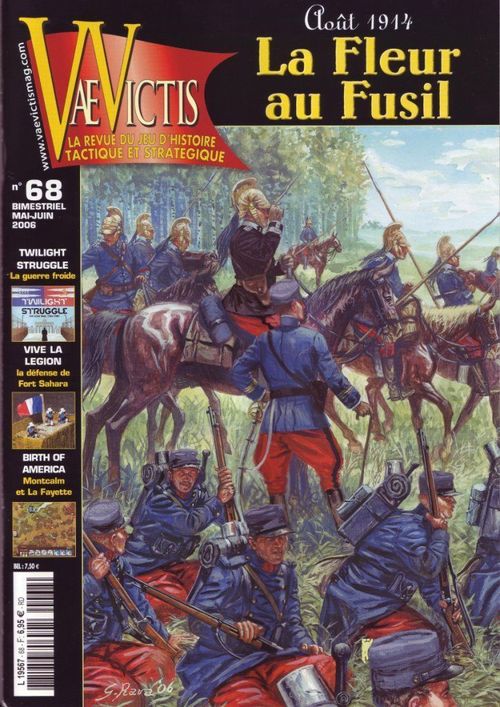
La fleur au fusil, août 1914
La fleur au fusil, août 1914 Rulebook
Table of Contents
Table of Contents
0 – General
0.1 – Scale
A counter represents either an infantry battalion (line infantry, colonials, reserves or light infantry), an artillery group, a cavalry regiment or a headquarters (état major, EM). The Germans (green) have 68 counters (+7 in scenario 4) and the French (blue) have 53 (+3)
0.2 – Terrain
The map covers an area of 16 (north to south) x 14 kilometers. Each hex measures about 800 metres. The type of terrain (see the terrain key) affects movement and combat.
1 – Units
The counters represent the headquarters (brigade, divisional and corps), infantry battalions, artillery groups and cavalry regiments. The French are organized into brigades, each brigade comprising of 2 infantry regiments of 3 battalions each. Artillery groups, cavalry regiments and light infantry (chasseurs) battalions are attached to the brigades as needed for the occasion. The whole is commanded by a brigade headquarters. Some units are considered independent (78th and 138th RI, that appear in scenario 4).
On the other side, the Germans are organized in divisions and army corps. Each division, under the command of a specific headquarters, includes infantry units (line, reserve and light battalions), cavalry and artillery. Two infantry divisions (ID) form an army corps (AK) under the command of a corps headquarters, though the cavalry division (KD) in the game remains independent.
The coloured band on top of the counter marks the parent brigade or division of a unit. The text in the coloured field identifies the parent regiment (or battalions for light infantry). The number in the bottom right is the Movement Allowance of the unit. At the bottom left is the troop quality of the unit: inferior (a "-" sign), normal (no sign) or superior (a "+" sign). Inferior troops are reserves and other understrength units. Superior troops are colonials and light infantry. The rest (line infantry and cavalry) are considered to be of normal quality.
Each unit has 1 to 3 steps. The red number on the middle right shows the number of remaining steps. At the start of the game, all units are at full strength. As they take step losses in combat, reduce them by either flipping them over or removing them from the game. The battalions of light infantry have 3 steps, represented by 2 counters (replace the turned over counter with the replacement counter as the last step loss is taken). Infantry battalions have 2 steps, while cavalry and headquarters have one step each. Artillery units have only one step. The front and back are used to show if the unit is deployed for movement (back) or fire (front). The counters have a white band on the back to differentiate it from the front.
2 - Sequence of play
A game lasts 7 Game Turns (6 in scenario 3). Each Game Turn consists of two Player Turns, the French Player Turn followed by the German Player Turn. The Player Turns are identical, except that during the French Player Turn, the French player is the active player while the German player is the inactive player. In the German player turn, the roles are reversed. Each Player Turn follows the phases listed below:
-
Administrative Phase The Turn Marker (showing a wristwatch) is placed on the current Game Turn, with the side of the current Player Turn facing up.
-
Command Phase The active player checks if his units are in command. "Non commandé" (Out of Command) -markers are placed on units unable to trace command.
-
Movement Phase The active player moves some or all of his units up to their Movement Allowance. Reinforcements enter the map. Artillery units on their movement side that remain stationary during the phase are turned over to their fire side. Place Rally markers on units attempting to rally. They have to remain stationary and stacked with their headquarters to rally.
-
Rally Phase The active player attempts to rally the units so marked and removes the Rally markers afterwards. He removes all "Barrage d'artillerie" markers and places the aerial reconnaissance marker (German only). If none of these activities apply, go directly from the Movement Phase to the Combat Phase.
-
Combat Phase The active player resolves combat with some or all of his units able to attack. Each combat is resolved completely before moving to the next. The phasing player chooses in which order to resolve the combats.
3 – Zones of Control
3.1 – Effects of Zones of Control
A unit exerts a Zone of Control (ZoC) into the six adjacent hexes. It has the following properties:
- A unit that enters an enemy ZoC must stop and end its movement.
- A unit that starts in an enemy ZoC must pay 2 movement points in addition to the terrain cost to exit the hex.
- A unit can never move directly from one enemy ZoC hex to another. A unit starting in an enemy ZoC can move to another ZoC as long as there is at least one hex in-between without a ZoC.
- A unit retreating into a ZOC after combat loses an additional step.
- A Line of Communication cannot be traced through a ZoC hex, unless a friendly unit occupies the hex.
3.2 – Absence of Zones of Control
Headquarters and artillery units do not have ZoCs.
ZOCs have no effect on Forest or Village hexes. Neither do units in Forest or Village hexes exert ZOCs out of such terrain. Exception: if two adjacent village hexes both have enemy ZoCs in them, a friendly unit moving from one to the other must end its movement. If a river without a bridge separates the city hexes, such movement is not allowed at all.
4 – Stacking
4.1 – Stacking limits
Friendly units cannot enter hexes containing enemy units, with the exception of an attack on headquarters or artillery alone (see 7.10).
At the end of a player's Movement Phase, a maximum of 6 steps (the red number on the counter) of units can be in a hex, regardless of terrain. Headquarters and artillery are considered to be 1 step each, other units their current step level.
4.2 – Road stacking
If a unit uses road movement to negate the terrain cost of a hex, it cannot end in a road hex stacked with another unit. It can move through other units along the road. Exception: headquarters don't count for this, and line infantry (not light infantry) can stack up to two units in a road hex.
4.3 – Stacking after retreating
If a retreating stack ends up in a hex already containing friendly units, so that the total exceeds the stacking limit of 6, select enough units that were in the hex before the retreat that the stacking limit is no longer exceeded. These units then have to retreat one hex. If these units can't retreat without ending up in another overstack, the originally retreating stack is eliminated instead.
4.4 – Allowed overstacking
During the Rally Phase, overstacking can occur due to a unit rallying. This is allowed as long as the stack is broken up in the next friendly Movement Phase. If this is not possible (due to the stack being surrounded), surplus units are eliminated (owning player's choice which). Units may setup overstacked at the start of a scenario as long as it is corrected in the following friendly Movement Phase.
5 – Reinforcements
Not all units are on-map at the start of the game. Units starting off-map (because of limits in their camps) enter at specific turns as listed in the scenario instructions. The entry hexes are marked on the map with the national flags to make them easier to find. Reinforcements enter in the Movement Phase of the listed turn. Units entering the map can use their full movement allowance, and has to pay movement points for the hex of entry. A unit is allowed to attack the turn it enters.
If enemy units occupy the entry hex at the time of entry, the reinforcement is delayed one turn. It is possible that reinforcements don't get to enter the game because their reinforcement hexes remains occupied by the enemy.