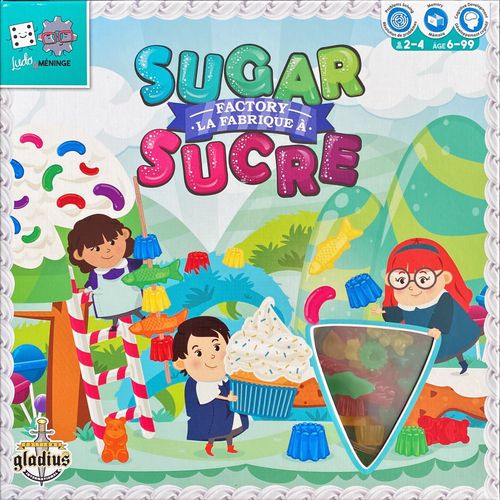
La fabrique à sucre
La fabrique à sucre Rulebook
Table of Contents
Table of Contents
The Game
The Grand Chef of the sugar factory is looking for a new apprentice to help him prepare sweets. Take part in the challenges and show your confectionery talent to be the one who wins the golden apron and becomes apprentice chef!
Setup
-
Assemble the game board and place the two Preparation boards within reach of all players.
-
Choose cards according to the difficulty level you prefer (Beginner, Intermediate, Advanced) and form separate decks for each level. Place them face down on the table. Make sure the "Solution" side of the Cone cards faces the table, and use the answer covers (cache-réponses) of the same colour to cover the decks.
-
Make sure the 2 bowls contain the following candies, and place them near the players.
ATTENTION! It is important that the contents of each bowl are exact so that the challenges can be met correctly!
Contents of 1 bowl (53 candies):
- Jujube beans (haricots en jujubes): 4 of each of the 5 colours (20 total)
- Gummy bears (oursons en gelée): 3 of each of the 4 colours (12 total)
- Sugar fish (poissons sucrés): 2 of each of the 4 colours (8 total)
- Fruit jellies (délices aux fruits): 2 of each of the 4 colours (8 total)
- Liquorice (réglisses): 5 red (5 total)
-
Each player chooses a pawn, then places it on the cloud (the starting square). Play proceeds clockwise.
Sequence of Play
- The youngest player, or the player with the sweetest tooth, starts the game.
- A turn always begins by rolling the 2 dice simultaneously. The player advances their pawn by as many squares as the number shown on the white die.
- The player must then take on the challenge indicated by the icon (cupcake, skewer or cone) on the square where their pawn is.
- If they succeed, they advance by as many squares as the number shown on the colour die.
- If they fail, they leave their pawn where it is.
- Play passes to the next player.
NOTE: A different difficulty level may be assigned to each player according to their age or experience.
VARIANT: If the player fails, they move back by as many squares as the number shown on the colour die.
Difficulty Levels
For children aged 6 to 8, it is advised to begin with the BEGINNER cards (green colour). It is important to increase the difficulty level gradually, so as to favour success and encourage the child to keep going.
End of the Game
The game ends as soon as a player reaches the Golden Cake (square 27).
There are two ways to reach this square:
- With the result of the white die alone, but only if the player obtains the exact number needed to reach the Golden Cake. If not, they leave their pawn where it is and attempt the challenge linked to that square, to advance by the number of squares shown on the colour die and so get closer to, or reach, the Golden Cake.
- With the result of the colour die, after having completed a challenge correctly. In this case, the player does not need the exact number to reach the Golden Cake.
Board Elements
- Starting cloud (nuage de départ): the place where all pawns are placed to begin the game.
- Golden Cake (gâteau doré): the final square. The first player to reach it wins the game.
- Ladders (échelles): made of candy canes, these let a player climb faster. If a player ends a move on a square where the base of a ladder is (squares 8 and 15), they move their pawn to the square at the top of the ladder.
- Liquorice (réglisses): these make the player slide back down a few squares. If a player ends a move on a square where the top of a liquorice is (squares 14 and 24), they move their pawn to the square at the bottom of the liquorice.
The Challenges
There are three challenges, each linked to a square icon on the board:
- Decorating cupcakes (décoration de petits gâteaux): works auditory memory.
- Making skewers (fabrication de brochettes): works visual memory.
- Cone duel (duel de cônes): a speed challenge that works logic.
Challenge: Decorating Cupcakes
You will need a Preparation board, jujube beans and a Cupcake card (Petits gâteaux).
When a player stops on a square showing a cupcake, they draw a Cupcake card of the chosen level and give it to another player. That other player must slowly describe the order on the card aloud, using a phrase such as: "I would like a strawberry cupcake with 3 blue jujube beans and 1 green." They end the order by saying: "Can you prepare my order?"
The player must then answer: "Yes Chef! I can prepare your order!" It is only from this moment that they may touch the candies and begin decorating. They must place the necessary jujube beans on the cupcakes of their Preparation board to reproduce the order, from memory. When they have finished, the order is checked against the card to see whether it is exact.
Tip (Méninge's "Pssst!"): To help children, give them an example.
Challenge: Making Skewers
You will need a Preparation board, a bowl of candies and a Skewer card (Brochettes).
When a player stops on a square showing a skewer, they draw a Skewer card of the chosen level. They analyse the card and, once ready, turn it face down. Using the candies from a bowl, they must reconstruct from memory the skewer or skewers on their Preparation board that appear on the card. When they have finished, they turn the card over to check whether the skewer or skewers have been reproduced without error.
Tip: Say aloud the strategies you use to memorise your card when it is your turn. Look for regularities on your skewers and state the information by category (repeated colours or shapes). You can make up a story or even sing these regularities aloud. Example: "2 orange fish ate a green fruit jelly, but the 2 orange fish would have preferred a blue fruit jelly."
Challenge: Cone Duel
Each participant will need a Preparation board, a bowl of candies and a Cone card (Cônes).
This challenge is a speed test that works logic.
When a player stops on a square showing a cone, they must choose an opponent for the duel. Each player draws a Cone card of the chosen level, taking care to keep the SOLUTION side face down. As soon as the players have their card in hand, the duel begins. They must analyse the information on their card to work out the contents of their cone.
When a player thinks they have found the solution, they place the necessary candies on the cone of their Preparation board and shout "Bonbon!". The other player then completes their cone. The answer of the player who shouted "Bonbon!" is checked first. If that player completed their cone correctly, they win (note that there is only one possible solution). If they made an error, the other player's cone is checked, and that player wins if their cone is completed correctly.
- The winner advances their pawn by as many squares as the number shown on the colour die.
- If there is no winner, both players leave their pawns where they are.
Tip: It is important to show children a good working method to help them meet this challenge (see the next page).
Decoding the Cone Cards
The following is a key to the parts of a Cone card.
- A. This box shows the total number of candies in the cone.
- B. This box shows the kinds of candy in the cone. There must be at least one candy of each of these kinds.
- C. This chart shows the different colours of candy in the cone. There must be at least one candy of each of these colours.
- D. The top section shows additional constraints to respect when making the cone.
Method, in four steps (worked example: the card shown on the page):
- Step 1 – The candies: begin by setting aside all the kinds of candy requested. In the example, take all the fruit jellies and the sugar fish (section B).
- Step 2 – The colours: then keep only the candies of the requested colours. In the example, the blue and red candies (section C).
- Step 3 – The constraints: analyse the constraints shown at the top of the card (section D), and remove candies that are not required, so that only those needed to make the cone remain. (In the example, remove the red fruit jellies, and there must be fewer red candies than blue ones.)
- Step 4 – The number: finally, look at the total number of candies needed (section A). (In the example, 3 candies are needed, so the solution is to keep 2 blue fruit jellies and 1 red sugar fish.)
Cone Card Legend
Colours
- Green circle: use green candies.
- Blue circle with a cross: do not use blue candy.
- Yellow circle = pink circle: use as many yellow candies as pink candies.
- Red circle < blue circle: use fewer red candies than blue candies.
- Purple < red < yellow: use fewer purple candies than red candies, and fewer red candies than yellow candies.
- Green box with "3": use exactly 3 green candies.
- Grey "?": there is a mystery colour in the cone. The player must work it out.
Candies
- Jujube bean: use jujube beans.
- Fruit jelly with a cross: do not use fruit jellies.
- Gummy bear = sugar fish: use as many gummy bears as sugar fish.
- Jujube bean < fruit jelly: use fewer jujube beans than fruit jellies.
- Jujube bean < fruit jelly < gummy bear: use fewer jujube beans than fruit jellies, and fewer fruit jellies than gummy bears.
- Liquorice with "5": use exactly 5 twisted liquorice.
- Mystery candy (grey "?" on a sweet): there is a mystery candy in the cone. The player must work it out.
Colours and candies
- Green gummy bear with a cross: do not use a green gummy bear.
- Red fruit jelly with "5": use exactly 5 red fruit jellies.
Speech bubble on the page: "Be sure to check your answer before you shout 'Bonbon!'."
Challenge Variants: Challenges Worthy of a Chef
It is possible to modify some challenges to increase the difficulty level.
Cupcake decoration: the order can be described with added difficulties, as in these examples.
- Example 1: "I want a cupcake with the darkest icing. It must have one jujube bean the colour of the sky and two the colour of the grass."
- Example 2: "I want a strawberry cupcake with 3 purple jujube beans and one blue jujube bean fewer than the purple beans."
Skewer making: set an observation time. For example, the player has only 15 seconds to look at the card. They then turn it over and try to reproduce what was on it.
Speech bubble on the page: "This way of playing works inferences and some mathematical notions!"
Speech bubble on the page: "Is it still too easy, or a little too hard? Adjust the observation time to your level!"
Game Contents
- 1 game board (4 pieces)
- 2 Preparation boards
- 4 pawns
- 2 dice
- Rulebook
- 108 cards: 30 Cupcake (Petits gâteaux) cards, 30 Skewer (Brochettes) cards, 45 Cone (Cônes) cards, and 3 answer covers (cache-réponses)
- 106 candies in 2 storage bowls: 40 jujube beans, 24 gummy bears, 16 sugar fish, 16 fruit jellies, 10 liquorice