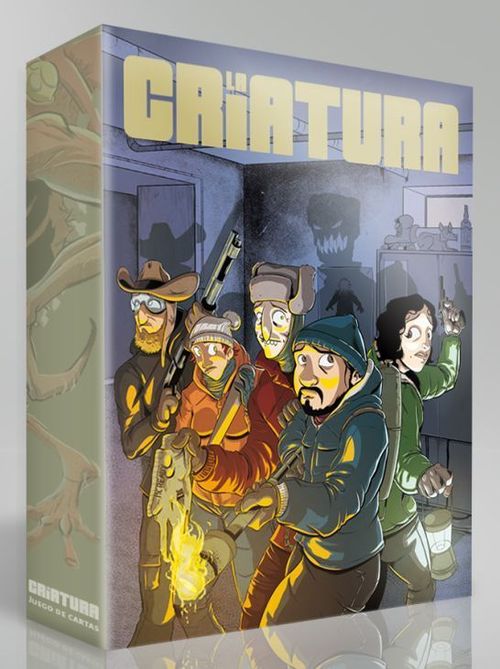
La Criatura
La Criatura Rulebook
Table of Contents
Table of Contents
Components
9 character cards
10 infected cards
1 Creature card
63 event cards
10 weapon cards
1 time marker
1 clock token
1 leader token
15 vote tokens
20 victory tokens
5 sedated tokens
1 six-sided die
Players: 3 to 10.
Playing time: 30 minutes to 1 hour.
Age: 13+.
Objective
The goal of the game is to escape the research base by helicopter. The problem is that there is only room for one scientist, so only one of the players can escape the horror. Will it be a human who boards the helicopter, one of the infected scientists, or the Creature itself?
The helicopter arrives when all the game turns have been used up. A game has as many turns as there are participating players minus one, tracked on the time marker with the clock token. The minimum number of turns is 2 and the maximum is 10. This represents how difficult or easy it is for the Creature to infect scientists when the group is smaller or larger.
Example: With six players at the table, the number of turns to play is 5 (6 − 1). In a three-player game there are two turns (the minimum).
The Creature can be neutralized so that it stops infecting scientists by sedating it twice (the first time it is sedated it manages to escape).
The game is won by the scientist who escapes in the helicopter. If the one who escapes is the Creature or one of the infected, it means the end of humanity…
Setup
At the start of the game the scientist cards are dealt, among which the Creature card must be found. Deal as many scientist cards and Creature cards as there are players. In addition, each player is also given one infected card, to put into play if they become infected by the Creature (see "Playing an infected card", below).
Once the cards are dealt, set up the time marker and place the clock token on the number matching the maximum number of turns for the game (equal to the number of players minus one). Every player receives one vote token and three event cards.
Basic Summary
The game is divided into turns. There are as many turns as there are players present minus one (maximum 10 turns), plus a final turn, the helicopter phase. Each turn is divided into three phases:
Event phase
Vote phase
Movement phase.
During the event phase, players play their event cards so that they take effect during the game.
In the vote phase, players use their vote tokens to decide which scientist to sedate. It is possible to play event cards during the vote phase, as long as you have not used your card during the event phase.
The movement phase is played after the vote phase. In it, all players hand their character cards (including the Creature card) to the leader, who shuffles them and deals them back out among the players, so that the Creature moves from one scientist to another, infecting them.
The objective is to escape by helicopter. Players who have at some point held the Creature card become infected, and so they will try to help the Creature carry out its plans, complicating life for the rest of the players who are still human. The problem is that there will be moments during the game when nobody knows who is who, sowing even more chaos in the game.
First Turn of the Game
In the first turn, players draw three event cards (but they cannot put any event card into play during the whole turn). They also cannot hold any vote. At the end of this first turn, the players must choose who will be their first leader, who will have two vote tokens and will receive the first victory token (see below). The choice must be made at random, using whatever method the players decide on. Once the leader has been designated, the movement phase is played, in which all players hand over their player card (including the Creature card) to the leader, who shuffles them and deals them back out among the players. From this moment on there will be one infected player (the one who had been the Creature in this first turn) and one player holding the Creature card.
Important note: In the first turn of the game the movement phase always occurs; you do not roll the six-sided die (see "Turn sequence: Movement phase" below).
From the second turn onward, play proceeds in the usual way. Do not forget to move the clock token on the time marker to the next position.
Note 1: When a player receives the Creature card, they are the Creature during that turn, but in the next and subsequent turns they become infected, which means they follow the Creature's designs and try to get all the scientists infected. However, only the Creature can directly infect other characters. Infected players cannot in turn infect others.
Note 2: When a player is chosen as leader, they gain a victory token, which frees them from one of the hits inflicted by other players during the final turn of the game (see "Last Turn of the Game", below), and also allows them to sacrifice it to obtain a weapon (see "Victory tokens", below). It does not matter how many times a player is chosen as leader during a game; the maximum number of victory tokens they can gain by this method is one.
Turn Sequence
During each turn, players must carry out the following actions:
Event phase. The leader plays first, and then play continues with the player to their right. Each player may have a maximum of three event cards, and may play one per turn (unless an event card says otherwise). A player may pass and not play an event card on their turn, in order to play it at a later moment, even in a phase other than the event phase (if the card allows it; see "Event cards", below). It is also possible to play some event cards in reaction to others, so it is not necessary for it to be the player's turn to put them into action (although they still cannot play more than one event card per turn).
Vote phase. Each player has one vote token, except the leader, who has two. In this phase it is decided which character will be sedated (in the hope of locating the Creature). Each player places a vote token on top of the character card they wish to sedate. The first player to the right of the leader begins, and voting continues in that order. The leader is the last to vote. The player who receives the greatest number of votes is sedated (see "Sedation", below). In case of a tie, each player who was voted for rolls a six-sided die, and the one who rolls the lower result loses.
Movement phase. When the movement phase arrives, the current leader rolls a six-sided die: with a result of 1 to 4, the movement phase is resolved normally (see below). But if the result is 5 or 6, the Creature has difficulty infecting a new player, and in that turn no movement takes place: each player keeps their character card and the Creature fails to infect anyone (it passes directly to the discard; step 4). With a result of 1 to 4 on the die, movement occurs. Players hand their character cards (including the Creature card) to the leader, who shuffles them and deals them back out among the players. Note that for the movement phase only player cards and the Creature card take part, never infected cards (see "Playing an infected card", below). A player who has been sedated keeps their card until the next movement phase.
Discard. Starting with the leader and continuing to the player on their right, players may discard one or more event cards (if they wish; otherwise they may keep the card or cards in their hand). Once everyone has discarded, the leader begins drawing cards from the deck to complete the three event cards they may hold, and the rest of the players do the same, continuing to the right of the leader. Sedated players cannot discard, but they can draw event cards, as long as they do not have three cards in their hand (see "Sedation", below).
Choosing a new leader. The current leader rolls the six-sided die, and the result is the number of players to count, starting with the player on their right, in order to designate the new leader. Sedated players do not count when choosing a leader. If the same player who was leader is chosen again, they remain leader (and once more gain a victory token).
Last Turn of the Game (Helicopter Phase)
When the clock token reaches the helicopter icon on the time marker, the moment has come to play the last turn of the game, called the helicopter phase, which decides who wins the game.
At this point, paranoia has taken hold of the research base, and all the scientists want is to escape alive, even if it means stepping over their colleagues. In this turn, the weapon cards and the victory tokens accumulated during the game come into play.
Attack
Before the attacks begin, players may play the event cards that are permitted for the helicopter phase. Once the cards have been put into play, the attacks begin.
In order of preference (first the leader designated for this turn acts, and then the player to their right), each player chooses another player as a target and tries to strike them with whatever they have at hand, to knock them unconscious (or badly injured) and thereby escape in the helicopter themselves.
When a player tries to neutralize another, they make an attack roll by throwing a six-sided die. With a result of 5 to 6 (the hit range) they succeed and neutralize their target (if they carry a weapon they may use it and benefit from the greater hit range it has, as indicated on the weapon card; see "Weapon cards", below). A neutralized victim can no longer act and is eliminated from the game. If the victim has a victory token, they may use it to escape a successful attack against them.
Note that there are defensive objects that can neutralize an attack (see "Weapon cards: Defensive objects", below).
Players who are sedated during this phase act last, and their hit range increases by one point (they hit only with a 6). An event card of "Awake" makes the sedated player play the final phase normally. Sedated characters who wake up are likewise the last to act.
Only one of the players can remain standing, so this turn repeats (in the order established at the start) as many times as necessary, until only one player survives; that player boards the helicopter and therefore wins the game.
It is normal for two distinct groups to form in this phase: the surviving humans, and the Creature and its infected. This last turn can be played in two different ways: either the Creature remains hidden, so none of the players reveals their status, or the player holding the Creature card in this final phase decides to reveal their status to the other players.
The Creature card is revealed
If the player holding the Creature card shows their card, the game in the final phase changes. On one hand, all infected players must reveal their status to the other players and will have to protect the Creature, so that any attack against it is suffered by one of the infected, whom the Creature itself designates. That is, if a human successfully attacks the Creature, the Creature does not take the hit, because it has one of the infected receive it in its place (as long as there are infected available).
On the other hand, the players who remain in their human condition (who have not been infected during the game, or whom someone has freed from that state through a "Stimulant" card) gain an advantage over the infected and the Creature: they roll two six-sided dice to determine a hit (whether with weapons or with bare hands) and keep the better result.
Once all the humans have been defeated (or the Creature and the infected have fallen), there is no need to continue the combat: if the Creature's group wins, it is the Creature who boards the helicopter, whereas if the humans win, it does not matter who boards, since the threat of the Creature has been eradicated. If the human players want to determine a winner, they may do so by drawing lots with the six-sided die.
Alternative Rule: Two Seats in the Helicopter
As an option, the helicopter may have two seats available, so the two players left standing after the helicopter phase board it together. This option encourages possible alliances between players, further emphasizing the hidden-roles part of the game (since an infected player or the Creature itself could try to pass as human in order to ally with a scientist who has not been infected). The surprise may come when, once the two survivors are in the helicopter, one of them turns out to be infected… or is the Creature.
If you decide to play with this alternative rule, the Creature should not reveal its card, since doing so would reveal all roles and there would be no point in forming alliances.
If the Creature or an infected player boards the helicopter, the Creature's side is considered to have won the game. For the humans to win, both passengers of the helicopter must be human.
Sedation
The players hold the sedation in their hand to locate the Creature and destroy it. The problem is that in their votes they may choose a companion who is neither the Creature nor has been affected. Sedation works as follows:
The effects of sedation last one complete turn.
A sedated character is half asleep and cannot act normally during that turn. It acts last and can only use event cards during the event phase, and only if it spends a victory token to do so. It keeps its player card during the movement phase and cannot be designated leader. It also cannot take part in votes while sedated. An "Awake" card allows it to wake up from sedation and act normally.
If the player voted to be sedated is currently the Creature, they must declare that they are the Creature and turn over their character card. If this is the first time it has been discovered, the players do not manage to sedate it, and the Creature slips away without the players being able to do anything. All the cards of the active players (not counting any sedated players) are shuffled and dealt out again. Note that infected players remain infected. If an infected player is dealt the Creature card again, nothing special happens: the Creature has simply decided to occupy a familiar body. If it is the second time the players have chosen the Creature to sedate it, the players manage to eliminate the threat (the player who holds the Creature card at that moment receives an infected card). However, there will still be infected scientists who can escape, so the game does not end until one of the players manages to board the helicopter.
Players who are sedated receive a victory token (see "Victory tokens", below).
Victory Tokens
Victory tokens are "trophies" that players earn over the course of the game, which they can use to obtain various benefits.
Players can obtain victory tokens when they are sedated, when they are chosen as leader, or with some event cards. Regardless of how a player obtains a victory token, a player cannot accumulate more than two over the course of the game (although they may spend one they have and accumulate up to a maximum of two again). When using a victory token, a player may obtain one of the following benefits:
Play an extra event card during a turn.
Avoid a hit during the last turn of the game, in the helicopter phase. You sacrifice your victory token and prevent the attack from succeeding.
Score a successful hit in an attack, without needing to roll the dice.
Draw a weapon card from the weapon deck. Note that you may carry at most one weapon (unless you hold an event card that says otherwise).
Event Cards
Event cards are what a player uses to liven up the game, forcing situations and events that may help or hinder the actions of the other players (or of all of them). One event card may be played per turn (unless the card's description says otherwise, or a victory token is used).
Apart from the description of its effects, each event card states who may use it (and only those who meet the requirements may do so):
All. Anyone may play the event card, whether they are the Creature, an infected character, sedated (only if they use a victory token; see above), a normal human, or the leader.
Infected. Only infected characters may play this event card. The Creature cannot do so.
All except the leader. Any player who is not the leader may play this card.
The Creature. Only the player who is the Creature may put this card into play.
Leader. Only the current leader may play this card.
In addition to the indication of who may play it, each event card indicates the phase of the game in which the card may be played. If more than one phase is indicated, the card may be played in any of them, at the player's choice:
Events. The card may only be played during the event phase.
Vote. The card may be put into play during the vote phase.
Movement. You may apply the card's effect during the movement phase.
Helicopter. The card may be played in the last phase of the game, the helicopter phase, just before combat begins. Once the confrontation has begun, the card can no longer be played.
Weapon Cards
Weapon cards are special cards, which do not count toward the event card limit. When you obtain a weapon (with the event card "Armed" or by spending a victory token), you draw a weapon card from the weapon deck and place it, face down, next to your character card. You will only reveal your weapon to the others when the last turn of the game (the helicopter phase) arrives.
Important note: The research base has only a limited number of weapons and defensive objects (see below). This number is 10. This means that if the weapon deck has been completely dealt out among the players and a player gets an "Armed" event card or wants to spend a victory token to equip themselves with a weapon, they cannot do so unless there is again some weapon card in the deck.
You may carry only one weapon. If you get a new "Armed" event card, you may choose to draw another weapon from the deck and keep the one you like best, discarding the other. In the same way, you may spend a victory token to obtain a better weapon, if you already had one, discarding the one you do not like. The event card "Armed to the Teeth" allows you to carry two weapons.
Even if weapon cards are available, you are not obliged to use them if you do not want to.
Weapons have an attack bonus, shown by a "+" symbol followed by a number (+1, +2, +3). This bonus is added to the result of the six-sided die to see whether a hit is scored (remember that a hit is scored with a result of 5 to 6).
Example: Lorena attacks another player in the helicopter phase. Over the course of the game she has obtained a knife, which has a +1 to hit. Lorena rolls the die and gets a 4. Normally this would not be a success (she needs a 5 or 6 to hit), but by adding the weapon's +1 bonus the result is 5 (4 + 1 = 5), so she successfully hits.
Defensive objects
Some weapon cards are objects that the player uses to protect themselves from attacks. These objects also count as weapons, and are therefore counted toward the total limit of weapons a character may carry.
When a player has a defensive object, they may use it to protect themselves from an attack. To do so they must roll a six-sided die and get a number within the protection range indicated on the object. If they succeed, the attack against their character has no effect.
Example: Marcos has a trash can lid that he uses to protect himself from attacks. Its protection range is 5 to 6, which means that when someone successfully hits him, Marcos can raise his trash can lid to repel the attack. Marcos rolls the six-sided die and gets a 5, which means the hit collides with the lid and Marcos suffers no harm.
Playing as an Infected Player
When you are dealt the Creature card and it then passes to another player during the movement phase, your status is that of an infected player. At the start of the game you are given one player card (or the Creature card) and one infected card. You must place one of the two (whose backs look similar) in a prominent position in front of you, so that it is clear to the other players which card represents your character's condition. So that it does not become too obvious that you are changing cards because you have been infected, after each movement phase all players (except those who are sedated) must take their two scientist cards (one player or Creature card and the other infected card) and place in a prominent position the one that represents their current status.
Important: When you hand your character card to the leader so that they shuffle and deal it in the movement phase, you may hand over either your scientist card or the Creature card, never the infected card. Infected players cannot infect another player (only the Creature can do so), so during the movement phase the infected card is not dealt out. If someone is infected, they must hand their scientist card to the leader (so that the leader shuffles and deals it to the rest of the players), and in this way do not reveal their infected status to another player. However, a player who has been infected remains infected (unless an event card frees them from that state), so they will continue to display their infected card.
Example: Luis had the Creature card in an earlier turn, so he has been infected since then. He displays the infected card in front of him (always face down, since he does not want the other players to know his condition). The movement phase arrives, and all the players hand their player cards to the leader so that they are shuffled and dealt at random. Luis, who is infected, does not hand over his infected card; he gives the leader his scientist card. When the leader shuffles and deals the player cards, Luis is dealt a scientist card, but since he was already infected, he again displays his infected card in front of him.
Playing to Win and Lose at the Same Time?
At the start of the game the players begin as enemies of the Creature, but as the turns advance, many of them will become infected, and therefore become its allies. When a player takes on the role of the Creature or of an infected player, they must understand that their objective in the game has changed: now their former allies are the enemies. To the rest of the players they are one more scientist, but in their double role they must do everything possible so that the Creature emerges victorious, whether by voting to sedate whoever they believe is human, by confusing them, or by using event cards against them. The aim is to sow chaos and discord so that your former companions become the Creature's victims.