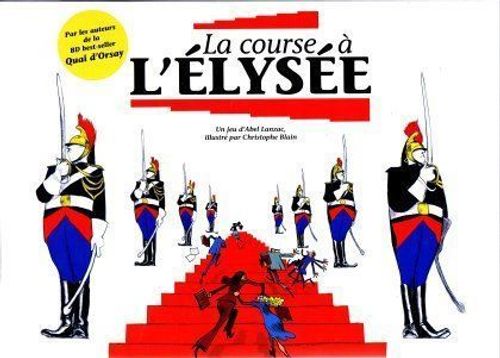
La Course à l'Élysée
La Course à l'Élysée Rulebook
Table of Contents
Table of Contents
Components
- 30 Backstage cards (Coulisses)
- 54 Debate cards (Débat)
- 60 Idea cards (Idée)
- 6 Political Party cards (Parti politique)
- 6 Candidate pawns, each a different colour, matching the 6 political parties
- 6 transparent bases (socles) for the Candidate pawns
- 2 hourglasses (sabliers)
- 1 game board (the steps of the Élysée, les marches de l'Élysée)
- Discard piles (défausses), one for each deck
Goal of the Game
Each player plays a candidate in the French presidential election. The goal is to be elected President of the Republic, after having convinced the other players to vote for you during a series of debates held during the First Round and then the Second Round of the election.
No political knowledge is required! With a little imagination, your electorate will be won over!
"In politics, an absurdity is no obstacle." — Napoléon Bonaparte
Setup
Each player draws 1 Political Party card at random and places it in front of them, face up, so that their party and the Slogan printed on the card are known to all.
Then the player takes the Candidate pawn of the colour corresponding to their party and places it at the bottom of the steps of the Élysée (so all players begin on step D).
At this precise moment, the player is enthroned as "candidate" by their party and can begin their Course à l'Élysée. All that remains is to prepare their presidential programme...
The Idea cards are shuffled. (With fewer than 6 players, the Idea cards whose political leaning, indicated by the marker at the bottom of the card, matches no player are removed from the deck.) Each player receives 3 Idea cards, which must not be seen by the other players. The remaining Idea cards are placed in a face-down pile at the matching spot on the board.
The Backstage deck is shuffled, and so is the Debate deck. Each deck is placed face down at its matching spot on the board.
How a Game Is Played
The game is played in two stages: the First Round and the Second Round of the French presidential election:
- In the First Round, the players sometimes debate among themselves and sometimes throw banana skins at each other: all of this in order to qualify for the Second Round. Only two players will finally qualify.
- In the Second Round, the two finalists are separated during a final debate, at the end of which the President of the Republic is elected!
The oldest player begins. Then the players take turns in clockwise order.
The First Round of the Presidential Election
On their turn, each player applies the effect of the step they are standing on:
If the player is on step C: they draw a Backstage card. The campaign's Backstage cards contain information that may be useful to them: it will help them climb the steps of the Élysée more quickly, or bring down their opponents.
When a player draws a Backstage card, they read it aloud and carry out its action immediately. The card is then discarded, and it is the next player's turn.
If the player is on step D: the hour of the debate has struck! The player draws a Debate card. It indicates the subject of the debate that is about to take place. They read it aloud.
They choose, from among the other players, the opponent they want to debate on this subject. Refusing to take part in a debate is not allowed.
The player seated to the left of the debaters is designated journalist, to moderate the debate. (If the chosen opponent happens to be in that seat, the player to the left of the opponent becomes the journalist.)
The two debaters take a few moments to each choose 1 Idea from the 3 Idea cards in their hand: the best one to try to answer the subject... or the least bad!
"In politics, it is rare to have the right answer at the right moment to the right question... But one can always succeed in slipping in one's idea, provided one makes a little reasoning to bring the question back to the one posed..."
Each of the two debaters slides the Idea card they chose into a base in front of them, so that they can read it at any time during the debate without anyone else being able to see it.
[Transcriber's note: the scanned booklet (its cover and inside pages 2 to 7) gives the effects of steps C and D only. The effects of steps A and B are not legible in the scan, so they are not transcribed here. The booklet's back cover (page 8) was not in the source file and may hold them.]
The Journalist
The journalist takes the Debate card and both hourglasses. Then they start the debate:
- They read the content of the Debate card aloud and introduce the two candidates.
- They ask the candidates what they would do, if elected President of the Republic, to answer the subject posed, and give them the floor, starting with the player who drew the Debate card.
- The journalist starts the hourglass of the candidate who speaks first. They lay that hourglass on its side each time this player decides to stop speaking or is interrupted, and at the same moment start the hourglass of the opponent who will speak next.
- A player's speaking time for the debate is over when their hourglass has run out. The journalist immediately makes them stop speaking.
The Debate
During the debate, the two debaters may speak in turn or, on the contrary, interrupt each other constantly, under the control of the journalist, who manages the two hourglasses. This is the moment to argue, to show that, if they were elected, they would be able to solve the problem posed by the Debate card.
Warning: during every debate, each debater must, within their speaking time and word for word, state two things:
- The Slogan printed on their Political Party card. (For each player it is always the same from one debate to the next, but in politics one must hammer it home...)
- The Idea they chose and slid into the base in front of them. They must present this Idea as the concrete answer they would bring, if elected President, to the problem raised by the Debate card.
Each debater says their Slogan and their Idea in whatever order they like, and brings them up in whatever way they like, but they must state both.
If one of the two debaters breaks this rule, they automatically lose the debate to the benefit of their opponent, and in addition suffer a heavy penalty: they go down 3 steps.
If both debaters break this rule, they both go down 3 steps and nobody wins the debate.
"The art of politics is knowing how to bring together opposites... Some call this 'synthesis', others the ability to cast a wide net to win votes. In any case, do not be afraid to defend an idea from a political party other than the one you embody; on the contrary, 100% of candidates who won elections have done so too..."
The Vote
At the end of the debate, all players except the two debaters vote to elect the best speaker. They may confer for a few moments if they wish, then each player simultaneously points at the player they are voting for. Blank voting is not allowed. Note: in a three-player game, the journalist is the only voter. They have the formidable privilege of choosing the winner of the debate alone.
The winner of the debate is the debater who receives the most votes. They climb 3 steps on the staircase of the Élysée.
They then finally reveal the Idea card that they used in the debate:
- If the political leaning indicated by the marker on their Idea card matches their own political party, they earn no additional points.
- But if the marker matches a different political party from their own, the player of that other party benefits from a windfall effect (effet d'aubaine): they climb 2 steps.
Important: the windfall effect can very well benefit... the loser of the debate!
"This windfall effect is common in politics: it is not rare for a candidate to go poaching on others' territory... But if they defend your ideas, that makes them more credible to you, whether they want it or not..."
"Pay close attention during the debate: you will sometimes have an interest in voting for a debater whose ideas seem close to those of your party, so as perhaps to benefit from the windfall effect..."
In the event of a tie in the vote (with 4 and with 6 players): if the two debaters receive the same number of votes, the other players have the time of one hourglass to agree among themselves and break the tie to choose a winner of the debate. If they do not manage to do so before the hourglass runs out, the penalty falls: the two debaters each climb 3 steps, and all the other players, for not having managed to agree, go down 3 steps!
"In politics, when two candidates make too much noise, the others step back..."
End of the Turn
After the vote, the two Idea cards and the Debate card that were used are discarded.
- The two debaters each draw a new Idea card to bring their hand back up to 3 cards.
- It is then the next player's turn (turns go clockwise). They draw a Backstage card or a Debate card, depending on the step they are standing on at that moment of the game.
End of the First Round of the Presidential Election
When a candidate reaches the Second Round step (whatever the circumstances, it is impossible to climb higher than the Second Round step), they remain there and must wait to be joined by a second player. Meanwhile:
- They cannot be called to a debate as an opponent.
- But they continue to vote, and can still be the target of Backstage cards played by other candidates. If they slide back down following such an attack, they return to the race like the other players.
The First Round ends as soon as 2 players have arrived on the Second Round step.
Note: if, at the end of a debate, the winner of the debate and the beneficiary of a windfall effect arrive on the Second Round step at the same time, the winner of the debate is always considered to have priority over the other.
The Second Round of the Presidential Election
The two winners of the First Round will face off in a final duel: this is the debate of the second round (débat de l'entre-deux tours). The losers of the First Round are the ones who will elect the President. The journalist is designated from among these latter players, as before.
The player who arrived first at the Second Round is the Leader. The other is the Challenger: if they want to be elected, they must win the debate of the second round.
- The Leader determines the ground of the political confrontation: it is they who choose the subject of the debate. To do so, they draw 3 Debate cards, choose 1, which they read and give to the journalist.
"Forcing your opponent to come onto your ground by imposing the theme of the debate: that is how one recognises the true leader of a political campaign..."
- The Challenger, for their part, further refines their programme: after learning the subject of the debate chosen by the Leader, they draw 2 additional Idea cards (so they have a hand of 5 cards, unlike the Leader, who has a hand of 3 cards).
"For the Challenger, there is only one way to defeat the statistics and the polls: choose one's messages well and surprise."
- For this great debate, each of the two debaters chooses, from their hand, not 1 but 2 Idea cards which they must state and defend. To do so, each debater has the time of 2 successive hourglasses and not of just one. Each debater must also state their Slogan, as in the First Round.
"The debate of the second round is the moment of truth... The country holds its breath: who will be President?"
- At the end of the debate, all the other players vote. In case of a tie (with 4 or 6 players), the Leader wins.
End of the Game
The winner of the debate of the Second Round climbs the last step. They have won the game: they are elected PRESIDENT OF THE REPUBLIC.
"Now you know everything. You are ready for La Course à l'Élysée."
Illustrated Example of a Turn
Five players sit around the table: Régis (Parti conservateur, Conservative party), Virginie (Parti social-démocrate, Social-Democrat party), Laure (Parti anti-capitaliste, Anti-capitalist party), Mathieu (Parti alter-écologiste, Alter-ecologist party) and Aurélien (Parti nationaliste, Nationalist party).
It is Laure's turn. She is on step D, so she draws a Debate card and reads it aloud: "Oil spill on the Breton coasts." Laure must choose her opponent for the debate. She chooses Aurélien.
Laure must now choose one card from her 3 Idea cards. The three cards in her hand read:
- "Give power back to the people and set up popular committees (soviets)."
- "Create 300,000 youth jobs."
- "Abolish all useless bureaucracy in France."
She chooses the card "Create 300,000 youth jobs", a measure she will propose to solve the oil spill problem. This card will also let her bring in her Slogan: it is this young generation that will tomorrow "OVERTHROW CAPITAL!"
Aurélien must also make his choice. The three cards in his hand read:
- "Nationalisation of banks and large companies."
- "Creation of a green police."
- "Relaunch social mobility and lifelong training."
He considers for a moment taking the first of these cards, arguing that the pursuit of corporate profit is what causes oil spills, and pleading for their nationalisation. But since he is debating the anti-capitalist candidate, he prefers to avoid that theme. To surprise everyone, he chooses the "Creation of a green police", with which he will propose to monitor the French coasts day and night, and so protect "FRANCE FIRST!"
Mathieu, who sits to Laure's left, will be the journalist for this debate. He must introduce the debate and present the two candidates.
Example: "Good evening, and welcome to DÉBAT TV. Tonight we welcome two candidates for the presidential election, Laure of the anti-capitalist party and Aurélien of the nationalist party. We have just learned that a terrible 'oil spill on the Breton coasts' has occurred. So, faced with such a tragic event, and to avoid such catastrophes in the future, what would you do if you were elected President? I give the floor first to Laure."
Laure and Aurélien debate. Each manages to proclaim their Slogan with conviction. They also each announce their Idea, justify it, interrupt each other, attack each other... until Mathieu (the journalist of this debate) interrupts first one and then the other, the hourglass of each having run out.
Virginie, Régis and Mathieu must now vote for the best debater. Mathieu liked Laure's argument: the anti-capitalist candidate, determined to overthrow capital to prevent any ship from selling oil and to create, right now, 300,000 youth jobs who could clean the beaches of Brittany. Régis, for his part, loved the unexpected proposal of the nationalist candidate, who explained that with a green police force monitoring oil tankers and nuclear plants, no ecological catastrophe would be possible. Virginie (the Social-Democrat candidate) understood that Laure's Idea was in fact Social-Democrat and would earn her a windfall effect. So she votes for Laure.
Laure wins two votes and Aurélien only one:
- Laure is the winner of the debate. She climbs 3 steps.
- She won with a Social-Democrat Idea: Virginie therefore benefits from a windfall effect and climbs 2 steps.
Laure and Aurélien discard their Idea card and each draw a new one.
Laure has finished her turn. It is now Mathieu's turn, seated to her left. At this point in the game he is on step C, so he draws a Backstage card...
"What is hidden in the Backstage of the campaign? It is now up to you to discover it! Throw yourself into La Course à l'Élysée!"