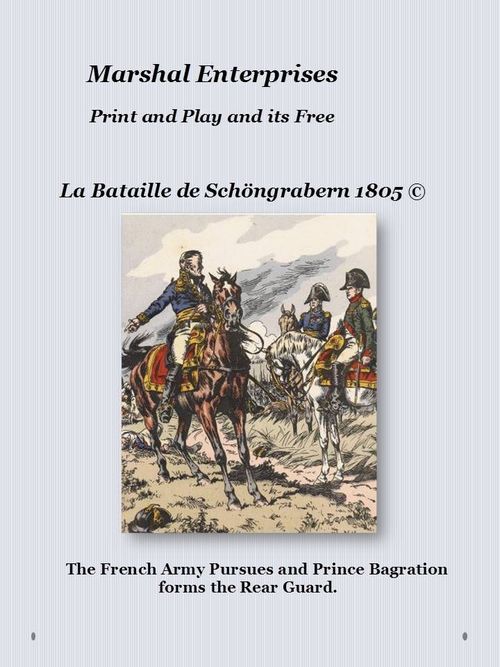
La Bataille de Schoengrabern 1805
La Bataille de Schoengrabern 1805 Rulebook
Table of Contents
Table of Contents
- 1.0 Introduction
- 2.0 Rules Questions
- 3.0 Game Components
- 4.0 Terrain
- 5.0 Command
- 6.0 Special Rules
- 7.0 Scenario 1: Prinz Bagration holds the Line
- Fire Effects Chart
- Fire Defense Chart
- Movement Chart
- Square Formation Chart
- Stacking Chart
- Morale Levels Chart
- Depot Locations
- Cavalry Recall Chart
- Artillery Limbering Chart
- Additional Roll to Close Modifiers
- Additional Roll to Stand Modifiers
- Additional Melee Modifiers
- Command Span Chart
- Cavalry Skirmisher Harassment (11.10.7.1)
- Organization Display
1.0 Introduction
La Bataille de Schöngrabern is a tactical Napoleonic game of Maréchal Murat's battle of the 16th November 1805 with the Romanov rearguard under Prince Bagration. Murat had negotiated an armistice with the Russians, to which the Russians easily agreed since the only thing that Kutuzov wanted was time to make his juncture with Buxhowden
When Napoleon learned of the brash Murat's attempt at diplomacy rather than a vigorous pursuit of the Russian forces in front of him, he was furious…as preserved in Napoleon's correspondence and revealed in a letter to his brother-in-law,… "I cannot find words to express my displeasure. You only command my vanguard and have no right to agree to an armistice without my orders. You will cost me the fruits of a campaign. End the armistice at once, and attack the enemy. Inform him that the general who has signed this has no power to make it, that only the Russian Emperor has the right, and that when the Russian Emperor ratifies this agreement, I will also ratify it. But it is only a ruse. March, destroy the Russian army. You are in a position to take his baggage and artillery." Murat, now with the direct orders of Napoleon in hand, begins to move his command to attack. He has 30,000 troops of all arms and begins the battle from the village of Schöngrabern in lower Austria between 4 pm and 5 pm on November 16.
The reports from the battle remain sketchy, but it does appear Murat wanted to flank the Russians, who were assembled around Gründ, just east of the French, with around 8,000 mixed arms troops. As Murat begins his flanking move to the left of their starting positions in Schöngrabern, Russian artillery from the heights west of Gründ fired into the French-held village, setting the church and around 60 homes ablaze. The French assault was stymied in large part due to extensive vineyards just east of the town that cover most of the terrain between Schöngrabern and Gründ. The effect of the vineyards was to limit substantially the coordinated French attacks. The attacks from Lannes on the right and Soult on the left started and stopped. The Russian fire was withering and their defense was fanatical in an evening when the light was gone quickly. Murat, who was a master at directing cavalry, was far less capable when providing infantry with orders. His attacks at Schoengrabern, like elsewhere where he commanded infantry, would start and stop, and would prove not very effective.
Then General Nicolas Oudinot along with his Grenadiers was able to attack the Russian center. General Thomas-Alexandre Dumas (father of the famous French writer Alexandre Dumas) in his recollection of the battle described that the brave Oudinot had reached pistol range of the Russian leading his attack. However, Oudinot was seriously wounded with a bullet to the thigh. The fallen Oudinot's attack appears to have convinced Bagration that the Russian position was untenable and he broke off the six-hour long battle. After the battle, Napoleon assigned General Gerard Duroc to take over command of Oudinot's grenadiers, and he led them with great success at Austerlitz.
The Russians had fought brilliantly. Even though they lost between 3000 and 4000 troops, Bagration's delaying tactics had allowed Kutuzov to slip away from Napoleon and join Buxhowden in Brunn, Moravia on November 18. The combined Russian armies, including Bagration's battered command, would now exceed the size of Napoleon's forces in the weeks before Austerlitz.
2.0 Rules Questions
Check the La Bataille forum at Consimworld: http://www.consimworld.com.
3.0 Game Components
A complete game of La Bataille de Schöngrabern includes the following components:
- Two 17" x 11" maps
- One hundred counters
- Two Series Rules book (Règlements de l'An XXX, et la Règlements des Maries Louises)
- One Exclusive Rules Books
- Charts and tables
- Four organizational displays
- Game Turn Record Track
- Terrain Effects Chart
3.1 Extra Counters
Chef de bataillon Fruchard can be represented by a counter with all blank values; his only purpose is to command the Artillerie Brigade.
4.0 Terrain
4.1 Vineyard (Weintrauben)
Note: The vineyard is planted in neat rows to facilitate the growing, care and harvesting of the grapes. As such, travel across rows is difficult for any formation and the paths through the vineyard are narrow. Quickly crossing rows of vines is difficult.
4.1.1 Cavalry
- Cavalry must be in skirmish order or in general order.
- Only three increments are available from each regiment for melee from a single hex.
- There are no charges in the vineyard. Cavalry may charge into the vineyard.
- The cavalry regiment is subject to the movement costs and three increments per regiment for melee calculations.
- The tirallieur a cheval rules with regards to slowing infantry movement do not apply in the vineyard. (Shaded in the original: Règlements de l'An XXX only.)
4.1.2 Infantry
- Infantry is in general order or skirmish order. No other formations are possible.
- No regiments may enter or move through the vineyard, only battalions.
- Infantry on the path moves at 2MP per hex, no bonus.
- Only three increments per battalion per hex are used for all fire and melee calculations.
- Units in General order use the value printed on the counter.
- Skirmishers use up to three factors per hex.
- Melee factors will be a fraction of the total while in the vineyard.
4.1.3 Artillery
- Movement only on the path and must be in march order, no bonus. May not unlimber on the path.
- No prolonging.
- One battery per hex stacking on the path.
- If retreated or routed or disordered off the path while in the vineyard, they are eliminated.
4.1.4 Combat a la Melee
- Combat is based on a maximum of three increments per infantry battalion or cavalry regiment.
4.1.5 Line of sight
- The vineyard does not block line of sight. Unlimbered artillery at the top of slope hexside has line of sight anywhere into the vineyard.
4.2 Streams
Note: The temperatures were freezing at this time but the slopes of the stream banks are steep and slick.
Thus the reason for a +1 MP to cross except at a ford.
4.3 Fords
Fords act as clear terrain for all purposes. Units moving across a ford pay no additional movement point costs to do so.
Units that melee across a ford calculate the melee values the same as if they were attacking up a slope.
4.4 Villages and Hamlets
A single hex by itself is considered a Hamlet. All other hexes which contain buildings are considered villages.
4.5 General Order
The following terrain requires formed units to enter General Order when entering:
- Pine Forest
- Vineyards
- Hamlets
- Villages
4.6 Depots
4.6.1 French: Their Division's / Brigade's entry hex (S, Road, L).
4.6.2 Coalition: Guntersdorf (when capture the road off map).
4.7 Terrain and Artillery Ricochet
Shaded in the original. Artillery Ricochet applies only to the Règlements de l'An XXX.
Artillery fire which targets the following hexes terminates in them. Ricochet fire may bounce into, but not through the following hexes.
- Hamlets
- Villages
NOTE: Artillery Ricochet only applies to the Règlements de l'An XXX.
4.7.1 Slopes and Artillery Ricochet: Artillery Ricochet terminates where it meets an upslope. Where Artillery Ricochet meets a down slope hexside, the slopes creates a one hex shadow over which the shot will pass with no effect before continuing along the shot path.
4.8 Abenddämmerung zum Nacht (Dusk)
Note: Most of this battle is fought in the late evening and at night, in freezing temperatures. Snowing has been falling intermittently since October as Europe's winter at this time started earlier and was much longer than we have today.
On Nov. 16, 1805 the sun set at 17:30 Wien Time.
4.8.1 Starting with the 17:40 turn:
- the specific fire values of artillery are reduced by 1/3.
- there is not a four hex range for forming square during a charge.
- the longest range for forming square is three hexes.
4.8.2 Starting with the 18:40 turn:
- The specific values for artillery are reduced by ½.
- There is not a three or four hex range for forming square during a charge.
- The longest range for a forming square is two hexes.
- Skirmisher range is reduced to one.
- Infantry and foot artillery movement is reduced by 2.
4.9 Artillery Leader
4.9.1 Artillery Brigade Leader
Chef de bataillon Fruchard commands the Reserve Artillerie of the V Corps. He may create an Artillerie Brigade using all the IV & V Corps Divisional Artillery. He has no values and is solely to allow the 4 batteries to combine their movement and fire.
4.9.2 Combined French Artillerie Fire
The four French batteries may fire at a single target as a single fire attack if they are all stacked in 2 hexes either with or adjacent to Chef de bataillon Fruchard.
5.0 Command
The Organization and Display Charts reveal the command structure of the armies. Refer to them as necessary.
5.1 French
5.1.1 Command Points: The French receive one Command Point for Murat.
5.1.2 MU Size: The largest MU which the French may create if Murat is:
- On-map: a Corps of the whole Avant garde.
- Off-map, an Infantry Division - with its attached artillerie batterie(s), Cavalry Brigade or the Artillerie Brigade.
5.1.3 Leader Casualties: The following leaders may not be replaced: Murat, ADC, Fruchard, Legrand, Oudinot and Suchet. Sebastiani may be replaced by Murat's ADC. If Fruchard is killed all the French batteries move to return to their divisions.
5.1.4 Leaders of Special Ability:
- Artillery: None
- Cavalry: None
5.1.5 Light Cavalry Leaders: The following light cavalry leaders may roll for initiative to form their own MU. None, Sebastiani waits for orders from Murat.
5.1.6 Where is Murat? Each turn a die is rolled before the command phase and if Murat is:
- off-map and the roll is 1-3 then he enters the map.
- on-map and the roll is 1-3 then he is removed from the map.
5.2 Coalition
5.2.1 Command Points: The Russians may receive One Command Point for Prince Bagration for a total of 1 Command Points. If Wintzingerode is stacked with Bagration, Bagration's command span increases to 15. If Bagration leaves the field then Wintzingerode takes over command, Wintzingerode's command span is 6.
5.2.2 MU Size: The largest MU the Coalition may form is an Army.
5.2.3 Leader Casualties: The following leaders may not be replaced: Bagration, Bolkonsky, Wintzingerode, Ulanius, Lieders, Stryk, Penitzky, and Nostitz.
5.2.4 Leaders of Special Ability:
- Artillery: None
- Cavalry: None
5.2.5 Light Cavalry Leaders: The following light cavalry leaders may roll for initiative to form their own CP. Nostitz.
6.0 Special Rules
6.1 Cavalry Skirmish Order
Shaded in the original. Applies only to players using the Règlements de l'An XXX.
Even though there is a row for cavalry skirmishers on the Fire Defense Chart and a column on the Movement Chart, this applies only to players using the Règlements de l'An XXX.
6.2 Elite Infantry Troops
Note: Well trained and experienced infantry troops were able to refrain from firing until it had its most devastating impact. This rule reflects the discipline of elite troops and their ability to hold fire to the critical moment of an assault.
6.2.1 Elite infantry troops are defined as those with a printed morale, without modification, of 11 through 16.
6.2.2 The effect is that all the attacking units in this case suffer a minus to the roll to close check. The exact minus is determined based on the morale of the defending unit. A 15 or 16 morale is -6, a 13 or 14 -9, an 11 or 12 is a -12. These minus values are applied as modifiers to the attacker's morale.
6.2.3 When an elite unit attacks, the opposite is true. The roll to stand morale check of the defender is adversely affected. All the defending units are impacted utilizing the rational identified above. 15 or 16 morale is +6, 13 or 14 +9, 11 or 12 is a +12.
6.2.4 When an elite unit is the attacker against an elite unit, this rule does not apply. In the event of an elite versus an elite, the attacker has the standard modifiers.
6.3 Russian Dragoon's Ability
Note: The Russian dragoons had a demonstrated ability to fight as more than a mounted wave of assault troops.
The Russian dragoons have a "Sk" on the top of the specific side of their counter. This value permits them to adopt an infantry type skirmish mode in 2 hexes. When they are sitting on a hex side with their specific side facing up, a dragoon regiment of 6 increments or less will assume to have 2 increments in each of the two hexes. A dragoon regiment of 7 increments or larger will assume to have 3 increments in each of the two hexes. The Russian dragoon has a fire value equal to 2 factors per increment. Combine all factors which are firing on a single target hex.
This is not a "cavalry skirmisher" formation as defined in the Cavalry Tirailleurs. (Shaded in the original: Règlements de l'An XXX only.)
For all fire aspects the unit is assumed to be infantry in skirmish order. The dragoon unit may not charge, reaction charge, opportunity charge, or melee in any fashion. If an enemy cavalry unit charges the dragoon, or attempts to melee the dragoon, the Russian checks his morale, at the moment of contact. If successful, the Russian dragoon then may retreat up to his movement value away from the enemy, and at the end of this movement assumes a column formation. If unsuccessful, the Russian dragoon will rout its full movement away from the enemy.
This special ability may only be used when the dragoon is in; clear, pine forest or vineyard.
6.4 Russian Jägers
Note: Russian jägers deployed into the buildings unlike their Infantry counterparts.
Russian jägers in a village hex must be in skirmish order, never general order. The entire unit deploys into the number of built-up hexes detailed by the phasing player. They have no rear or flank hexsides while in the village or town. The jägers however do count for stacking if a unit stops in the hex. Units that move through the town or village will not be over stacked as a result of the jägers.
6.5 Russian Cossaques
Note: The Russian Cossaque regiments that are present in the game are irregular cavalry. Based upon that premise, apply the following series of adjustments in their use and interaction with other units within the structure of the game.
The Cossaques will check morale whenever an infantry formation which is not disordered or an artillery unit fires at the Cossaque. A Cossaque casualty is not required. In addition if the Cossaque suffers a casualty due to the fire it routs.
Further, Cossaques may not charge infantry that is in good order from any orientation, or unlimbered artillery into a front hexside of the enemy.
6.6 French Grenadiers / Voltiguers (combined elite companies)
Note: The French combined elite companies which form the 1ere Grenadier Division of the V (Reserve) Corps, have been assembled by combining 4 elite companies from different regiments into ad hoc battalions for the campaign. Général de Division Oudinot leads these battalions. Many of the battalions have the ability to skirmish and many are elite infantry.
6.7 Artillery
6.7.1 Combined Fire
The four French batteries may fire at a single target as a single fire attack if they are all either stacked together or adjacent to each other in 2 hexes (without a leader).
6.7.2 Artillery Ammunition
Shaded in the original. Applies only to players using the Règlements de l'An XXX.
- All batteries start with 8 rounds.
- French batteries may not resupply.
- Russian batteries resupply from Guntersdorf, until it is captured.
7.0 Scenario 1: Prinz Bagration holds the Line
7.1 Introduction
MdE Murat had agreed to an armistice during the morning, but this was quickly rescinded and Bagration was notified when hostilities would be re-started. As the pursuit commander, Murat did not necessarily take an active part in the release of the infantry divisions under his command. The terrain was not suited to his cavalry. Therefore, the French advance was not an orderly advance of superior forces.
7.2 Time
Beginning with the 16:00pm turn, November 16th and ending with the 21:00pm turn (16 turns). Note the Dusk rules (E4.8), starting at 17:40.
7.3 Command
French: Maréchal d'Empire Murat
Russians: Prince Bagration
The IV Corps & V Corps artillerie start detached into an ad hoc brigade under the command of Chef de bataillon Fruchard.
7.4 Starting Positions
7.4.1 French delayed arrival
While a few units do start on the map, the arrival of other French troops is variable. The entry times listed are the first opportunity the infantry or cavalry regiments may move onto the map. A roll one (1) on a six sided dice is required for each regiment. With each subsequent turn the probability increases by one increment ie (1, 2), then (1, 2, 3) etc.
7.4.2 Romanov use of terrain
Note: Prinz Bagration was a skillful master of terrain and screening his troops from detection. At this battle, he worked with the Tsar's Aides to negotiate a pause in the battle that the Russians used to their advantage. Bagration selected this terrain and the coming nightfall to aid his ability to hold the French pursuit of the Russian main army under Kutusov. If Bagration loses here, there may be no Austerlitz.
The Russians set-up as detailed below. Each of the Russian counters in the vineyard has a blank placed on it. In addition, 6 blank counters may also be used with another blank on top of them in the vineyard. These are placed without the knowledge of the French player. The blank is only removed when the French melee or end their move adjacent to, a Russian counter stack (discovered).
When Russians move more than four hexes away from French units, the blank may be replaced if the Russian unit is still in the vineyard. However, the Russian unit may not be PGD and have a blank placed on it.
Once the Russian each dummy (blank counters) with blanks is discovered, it is removed permanently.
Start on the Map at 16:00, at Schöngrabern (artillerie may be unlimbered & stacked)
- 1ère Grenadier Division/V Corps d'Armée (part)
- Général de Division Nicolas Charles Oudinot
- 5e Grenadier Régiment (1ère & 2e btns)
Ad hoc Artillerie Brigade
- V Corps d'Armée Staff (part)
- Chef de bataillon Fruchard
- 1ère Grenadier Division/V Corps d'Armée (part)
- 1ère Co. / 1ère Artillerie à Pied
- 3e Division / V Corps d'Armée (part)
- 15e Co. / 5e Artillerie à Pied
- 5e Co. / 1ère Artillerie à Pied
- 3e Division / IV Corps d'Armée (part)
- 14e Co. / 5e Artillerie à Pied
Start offmap at 16:00
- Avant Garde Staff
- Maréchal d'Empire Joachim Murat
- ADC Murat is with Légère Cavalry Brigade.
- Park: Chef de bataillon Fruchard is commanding the Artillerie Brigade.
Start on the Map at 16:00, must be located in the first vineyard area bounded by the two streams. Starting with the 16:20, roll to receive permission to leave the area. A roll one (1) on a six sided dice is required for each regiment. With each subsequent turn the probability increases by one ie (1, 2), then (1, 2, 3) etc.
- Light Brigade
- GM Ulanius
- 6th Jäger (1st, 2nd, & 3rd btns)
- Khaznenkov Cossaque
- Sysoev Cossaques
The remainder of the Russian Army is placed anywhere on the map, 12 hexes from the western edge of the map. That is in the Vineyard or closer to Gründ. It is up to the Russian's discretion.
- Rearguard Staff
- GM Prinz Pyotr Bagration
- ADC: From the Tsar– General-Adjutant Wintzingerode
- Prince André Bolkonsky has gone to command the artillery
- Note: Prince Bolkonsky is from Tolstoy's "War and Peace"
- Infantry Division
- GM Major Lieders
- Little Russia Grenadier (1st, 2nd, & 3rd btns)
- Kiev Grenadier (1st, 2nd, & 3rd btns)
- Novgorod Musketeer (Gr btn only)
- Infantry Division
- GM Stryk
- Narva Musketeer (Gr btn only)
- Azov Musketeer (Gr, 2nd & 3rd btns)
- Podolia Musketeer (Gr, 2nd & 3rd btns)
- Brigade
- GM Penitzky
- Chernigov Dragoons #3
- Pavlograd Hussars #2
- Line Light foot artillery (4th Regiment)
- Attached from Rearguard Staff
Note: The Austrians had been battered the day before.
- Austrian Brigade
- Generalmajor Johann Nepomuk Graf Nostitz-Rieneck
-
- Hesse Homburg Hussaren
7.5 Reinforcements
Enter at 16:00, road to Schöngrabern (no roll to enter)
- 1ère Grenadier Division/V Corps d'Armée (part)
- 1ère Grenadier Régiment (1ère & 2e btns)
- 2e Grenadier Régiment (1ère & 2e btns)
Enter at 16:00, road to Schöngrabern (roll to enter)
- Attached Légère Cavalry Brigade
- Général de Brigade Horace François Bastien Sébastiani
- 9e Hussar Regiment
- 10e Hussar Regiment
- The Chasseur à Cheval enter at 17:00
- Attached from Staff
- ADC Murat
Enter at 16:20, at S (roll to enter)
- 3e Division / V Corps d'Armée (part)
- Général de Division Louis-Gabriel Suchet
- 17e Legere Régiment (1ère & 2e btns)
- 34e Ligne Régiment (1ère, 2e & 3e btns)
Enter at 16:20, at L (roll to enter)
- 3e Division / IV Corps d'Armée (part)
- Général de Division Claude Juste Alexandre Louis Legrand
- 26e Legere Régiment (1ère & 2e btns)
- 75e Ligne Régiment (1ère & 2e btns)
Enter at 17:00, at S (roll to enter)
- 3e Division / V Corps d'Armée (part)
- 40e Ligne Régiment (1ère & 2e btns)
- 64e Ligne Régiment (1ère & 2e btns)
Enter at 17:00, at L (roll to enter)
- 3e Division / IV Corps d'Armée (part)
- 3e Ligne Régiment (1ère, 2e & 3e btns)
- 18e Ligne Régiment (1ère & 2e btns)
- Bataillon de Tirailleurs Corse
- Bataillon de Tirailleurs du Pô
Enter at 17:00, road to Schöngrabern (roll to enter)
- 1ère Grenadier Division/V Corps d'Armée (part)
- 3e Grenadier Régiment (1ère & 2e btns)
- 4e Grenadier Régiment (1ère & 2e btns)
Enter at 17:20, road to Schöngrabern (roll to enter)
- Attached Legere Cavalrie Division (part)
- 1ère Chasseur à Cheval Régiment
- 13e Chasseur à Cheval Régiment
- 21e Chasseur à Cheval Régiment
Enter at 17:40, at S (roll to enter)
- 3e Division / V Corps d'Armée (part)
- 88e Ligne Régiment (1ère & 2e btns)
7.6 Boundary
Both map sections.
7.7 Victory
| Result | Condition |
|---|---|
| Coalition Decisive | Hold four hexes of Guntersdorf |
| Coalition Substantial | Hold five hexes of Guntersdorf |
| Coalition Tactical | Hold all hexes of Guntersdorf |
| French Marginal | Capture one hex of Guntersdorf |
| French Substantial | Capture two hexes of Guntersdorf |
| French Decisive | Capture all hexes of Guntersdorf |
If the French win decisively, there is probably no Battle of Austerlitz. The French would catch up to Kutusov before his battered army is reinforced.
Fire Effects Chart
| Unit | Line | Column | Square | General Order / Redoubt | Skirmish |
|---|---|---|---|---|---|
| FRENCH | |||||
| Ligne | x3 | PRINTED | x3 | PRINTED | NP |
| Légère (including Tirailleurs Corse / Pô) | x3 | PRINTED | x4 | PRINTED | x3 |
| Oudinot's Grenadiers / Voltigeurs | x4 | PRINTED | x4 | PRINTED |
Disordered formations fire at half strength.
Fire Defense Chart
| Type | Formation | Clear | Pine Forest | Vineyard⁵ | Hamlet | Village |
|---|---|---|---|---|---|---|
| Infantry | Column | 6 | - | - | - | - |
| Infantry | Line | 9 | - | - | - | - |
| Infantry | Square | 4 | - | - | - | - |
| Infantry | Skirmish Order | 14 |
- Artillery in Disorder is either unlimbered or limbered for the purposes of this chart.
- When Artillery is stacked with infantry use the fire defense of Artillery w/Infantry row of the chart above.
- Cavalry Skirmish Order only applies to players using the Règlements de l'An XXX.
- Use whenever infantry and artillery stacked together is the target of a Fire Attack.
- See Vineyard rules.
Movement Chart
| Terrain | Infantry | Cavalry | Artillery | Personalities / Skirmishers | Cavalry Skirmishers⁵ |
|---|---|---|---|---|---|
| Clear | 1 | 1 | 1 | 1 | 1 |
| Pine Forest | 2 | 5 (3¹) | NP | 2 | NP |
| Vineyard | 3 | 5 | NP | 3 | NP |
| Hamlet | 3 | 3 | 3 | 3 | NP |
| Village |
- Cossacks 3MP.
- Artillery prohibited except at fords in Road Order.
- In road order only, may not unlimber or prolong.
- Cost is in addition to the cost of the other terrain in the hex being entered.
- Applies only to the Règlements de l'An XXX.
The terrain illustrations on the chart page (forest, vineyard, path, village, slope, stream, vineyard path and ford) are not transcribed.
Square Formation Chart
| Unit | Hexes / Situation | Form Square | Disorder | Rout |
|---|---|---|---|---|
| French/Units | ||||
| In Column | 4 Hexes | 11-66 | - | - |
| In Column | 3 Hexes | 11-66 | - | - |
| In Column | 2 Hexes | 11-43 | 44-61 | 62-66 |
| In Column | Adjacent | 11-31 | 32-54 |
- These modifiers are not cumulative.
Note: When modifying the dice any number greater than 66 is treated as 66, less than 11 is treated as Form Square.
Transcriber's note: the Russian "In Column, 3 Hexes" row as printed reads 11-42 / 43-56 / 61-66, leaving 57-60 with no printed result. It is transcribed as printed; the Russian Disorder and Rout ranges should be checked against the publisher's chart.
Stacking Chart
| Unit | Clear | Pine Forest | Vineyard | Hamlet | Village |
|---|---|---|---|---|---|
| Infantry | Any 1 regiment or 18 Column, Line, Square; 3 Skirmish²,³,⁵ | Any 1 battalion or 3 Skirmish²,³ | Any 1 battalion or 3 Skirmish²,¹ | Any 1 battalion or: 3 Skirmish²,³ | Any 1 battalion or: 3 Skirmish²,³ |
| Cavalry | Any 1 regiment or 18 Column, Line; 3 Skirmish²,³,⁶ | Any 1 regiment | Any 1 regiment¹ | Any 1 regiment | Any 1 regiment |
| Artillery | Any 6 increments or 1 battery & 1 battalion | Any 1 battery | Any 1 battery⁴ | Any 1 battery & 1 battalion | Any 1 battery & 1 battalion |
- See Vineyard rules, only 3 increments may melee.
- For infantry battalions in Skirmish Order in two hexes with more than 6 increments, the extra increments (greater than 3/hex) are ignored. Cavalry units in Skirmish Order, regardless of increments, are always deployed in two hexes may. References to units in two hexes apply only to the Règlements de l'An XXX. In the Règlements des Maries Louises units are always deployed in one hex regardless of size.
- Units in Skirmish Order may move through other units or have other units move through them, but they may never remain stacked with other units.
- May enter via path hex in Road Column, they may not unlimber in the hex.
- No more than 3 infantry battalions may be stacked together.
- No more than 3 cavalry regiments may be stacked together.
Morale Levels Chart
| Formation | Battalions | Morale Level 1 | Morale Level 2 | Morale Level 3 |
|---|---|---|---|---|
| FRENCH Legrand, IV | 11 | 2 | 4 | 6 |
| Oudinot, V | 10 | 2 | 4 | 6 |
| Suchet, V | 11 | 2 | 4 | 6 |
| RUSSIANS Bagration (Corps) | 17 | 3 | 5 | 8 |
Morale Check Modifiers
| Side | Level 1 | Level 2 | Level 3 |
|---|---|---|---|
| French | -3 | -6 | -9 |
| Russians | -4 | -6 | -8 |
Depot Locations
- French: Their Division's entry hex. (S, Road, L)
- Russians: Guntersdorf.
Cavalry Recall Chart
| Nationality | Success |
|---|---|
| French | 1-5 |
| Russian Light | 1-4 |
| Russian Heavy | 1-5 |
| Condition | Modifier |
|---|---|
| If stacked with a leader with a cavalry Mêlée Bonus | -1 |
Artillery Limbering Chart
| French | Limbers |
|---|---|
| Batterie à pied | 1-3 |
| Russian | Limbers |
|---|---|
| Light foot | 1-2 |
| Condition | Modifier |
|---|---|
| Stacked with a leader with artillery bonus or Chef de bataillon Fruchard. | -1 |
Additional Roll to Close Modifiers
| Condition | Modifier |
|---|---|
| If the assaulting stack is assaulting across a stream | -6 |
| If the assaulting stack is assaulting across a ford | -3 |
Additional Roll to Stand Modifiers
| Condition | Modifier |
|---|---|
| If the target of an Assault exclusively by units which are assaulting across a stream | +6 |
| If the target of an Assault exclusively by units which are assaulting across a ford | +3 |
Additional Melee Modifiers
| Condition | Modifier |
|---|---|
| Cavalry attacking across a stream | x 2/3 |
| Infantry attacking across a stream | x 2/3 |
Command Span Chart
| Command Link | Span in Hexes |
|---|---|
| Army Leader to Division / Brigade Leader | 10¹ |
| Division Leader to Units | 3² |
| Brigade Leader to Units | 2² |
- Use when the Army leader is in direct command of the Brigade leader and the Brigade leader does not have a Division commander. (15 hexes with Russian ADC bonus)
- Light Cavalry Leaders use their Cavalry Mêlée rating as their Command Span when they are forming an MU as a result of a successful initiative check.
Cavalry Skirmisher Harassment (11.10.7.1)
Shaded in the original. Applies only to players using the Règlements de l'An XXX. The section reference 11.10.7.1 is as printed; it refers to the series rules.
| Terrain Type | Defense Factor |
|---|---|
| Clear | 2 |
| Pine Forest, Hamlet, Village | 4 |
Modifiers to Basic Defense Factor:
| Modifier | Value |
|---|---|
| Cavalry Skirmishers | +1 |
| Retreating Before Assault/Charge | +2 |
| Cavalry or Horse Artillery PGD | +1 |
Organization Display
The organization sheet's two sides are headed "Avant Garde" (French) and "Romanov" (Coalition). The sheet's leader and asset icons are transcribed as the key below.
Avant Garde (French)
- Murat, CP. ADC: α. Park: Fruchard α.
- Légère Cavalerie (Sebastiani): 9e Hussards; 10e Hussards; 1ère Chasseurs à Cheval; 13e Chasseurs à Cheval; 21e Chasseurs à Cheval.
- 3e / IV Corps (Legrand): 2 x 26e Legere; 2 x 18e Ligne; 2 x 75e Ligne; 1 x Tir Corse; 1 x Tir Pô; 3 x 3e Ligne; 14e / 5e Art à Pied.
- 1ère / V Corps (Oudinot): 2 x 1ère Grenadiers; 2 x 2e Grenadiers; 2 x 3e Grenadiers; 2 x 4e Grenadiers; 2 x 5e Grenadiers; 1ère / 1ère Art à Pied.
- 3e / V Corps (Suchet): 2 x 17e Legere; 3 x 34e Ligne; 2 x 40e Ligne; 2 x 64e Ligne; 2 x 88e Ligne; 15e / 5e Art à Pied; 5e / 1ère Art à Pied.
Romanov (Coalition)
- Bagration, CP. ADC: Bolkonsky α. ADC: Wintzingerode α.
- Light Brigade (Ulanius): 3 x 6th Jager; Khaznenkov Cossaque; Sysoev Cossaques.
- Infantry Division (Lieders): 3 x Little Russia Gren; 3 x Kiev Gren; 1 x Novgorod.
- Infantry Division (Stryk): 1 x Narva; 1 x Azov; 1 x Podolia.
- Brigade (Penitzky): Chernigov Dragoons #3; Pavlograd Hussars # 2; Line Light foot artillery.
- Austrian Brigade (Nostitz): 4. Hesse Homburg Hussaren.
Key: CP = Generates a Command Point. α = Army Asset. γ = Corps Asset. Leader icon = Leader not Replaceable.