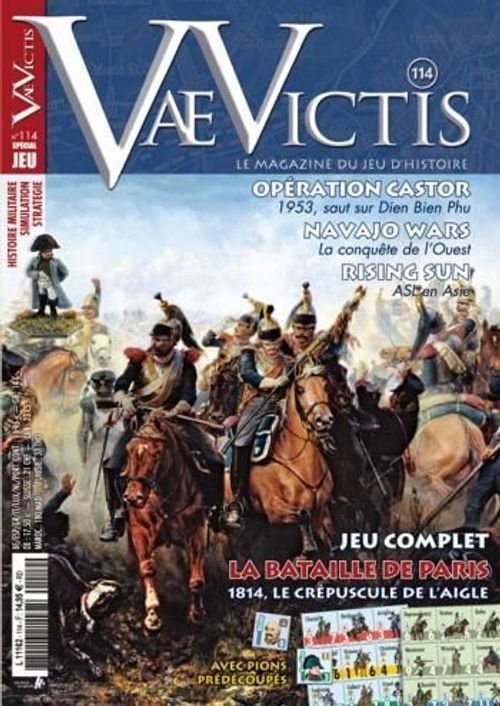
La Bataille de Paris: 1814, Le Crépuscule de l'Aigle
La Bataille de Paris: 1814, Le Crépuscule de l'Aigle Rulebook
Table of Contents
Table of Contents
1 - Overview
The game proposes two scenarios: the first scenario corresponds to the historical situation in which the weakened strengths of Marmont, Mortier and Moncey resist out of honour, faced with an enemy four times greater in number, and inflict upon them the heaviest losses of the campaign. In this scenario the outcome is certain and the French player can only "win" by delaying as long as possible the inevitable fall of Paris.
The second scenario is hypothetical but historically plausible. If Napoleon had decided to follow the Coalition to Paris on 23 March instead of attempting to force them to return toward their rear lines, it would have still be possible for the French army, despite their numerical inferiority, play out their fate in a global engagement at the gates of Paris.
2 - Game elements
The game comprises a map, this set of rules and a board of 108 counters.
There are three types of counters: combatting units, commanders and markers.
-
Combatting unit, containing the following information that impacts the game:
- type: infantry (represented by a foot soldier) or cavalry (represented by a cavalryman)
- size or strength (1 point represents about 500 men)
- quality (also incorporating the aspects of fatigue and motivation): A = elite, B = fair, C = weak or ? = random
- movement capacity
- the formation to which it belongs, represented by a stripe of the unit's colour.
Other information with no direct impact on the game is given:
- name of the unit
- the eagle, identifying the units of the Garde Française (certain units of Mortier's and Napoleon's formations)
The combatting units with an initial strength factor greater than or equal to 2 have a reverse side indicated by a lighter coloured stripe. These units have two step losses and the reverse side is used when the unit suffers a step loss. Units with a strength factor of "1" have only one step loss and are removed from the game after the first loss.
Regardless of the size indicated on the reverse side of a unit with two step losses, it will be eliminated if it receives a second step loss.
Front / Reverse (labels for the counter images in the source)
Note: Combatting units other than the National Guard and the "Légions de volontaires parisiens" are divisions.
-
The colour of the Nation: France, Russian, Austria, Prussia. (The source shows a colour swatch for each nation; the swatches are not reproduced here.)
-
Commanders: These units represent the principal commanders and their general staff who have an influence on the movement and sometimes the combat of the units of their formation. Exception: Napoleon can command all the French units.
3 - How to win?
In this battle, the objective of the Coalition is to force the capitulation of Paris. The level of the "morale of Paris" (an indicator of public opinion and the political will to continue the combat and risk the sacking of the city) is the principal factor by which to judge victory in the game. The morale of Paris begins at level 11 (see the counter on the map) and evolves (see rule 8).
Victory conditions vary according to the scenario played and are described in rules 9 and 10.
4 - Basic terms
-
Stacking: The French player may stack up to three combatting units without penalty in the same hexagon. The Coalition player is limited to two combatting units without penalty. The commanders and markers do not count. Any overstacked hexagon is subjected to a penalty of -1 die roll modifier (DRM) in combat per combatting unit in excess.
-
ZoC (Zone of Control): All combatting units (and not their commanders) have a ZoC that extends to the six adjacent hexagons except in the city/village hexagons and across rivers/streams without a bridge.
Exception: The French units in Paris AND adjacent to fortifications have a ZoC that extends to the six adjacent hexagons regardless of the terrain.
A unit must stop as soon as it enters an enemy ZoC. If it begins its movement in an enemy ZoC, it can move to a hexagon free of enemy ZoC and continue its movement but cannot enter another enemy ZoC during this turn. Friendly units have no effect on enemy ZoC.
Exception: Commanders can enter another enemy ZoC but must stop their movement as soon as they enter a new enemy ZoC.
5 - Game turn
A game turn represents approximately 1 hour of real time. It is composed of a French game sequence and a Coalition game sequence.
A - French player sequence (the French player is then the "in phase" player)
- a - French movement: the French player moves all or part of his units (see rule 6).
- b - French combats: the French player declares the attacked enemy units and the attacking friendly units. He cannot change his mind, including on the distribution of his forces, once the first combat has begun (see rule 7). The French player resolves the combats in the order he chooses.
B - Coalition player sequence
- c - Placement of Coalition reinforcements (see table "Arrival of Coalition reinforcements").
- d - Coalition movement: the Coalition player moves all or part of his units (see rule 6).
- e - Coalition combats: the Coalition player declares his attacks (same conditions as the French player; see rule 7), then resolves them in the order he chooses.
6 - Movement
6.1 - Overview
Commanders have a movement potential of 7. The combatting units have a maximum movement potential indicated on the counter (see rule 2). The terrain effects table (see "Cost of Terrain" Table at the end of the rules) indicates the number of movement points necessary to enter different types of hexagons. For example, it costs 2 movement points to enter a woods hexagon.
Movement points are not transferable from one unit to another nor can they be transferred to a later turn. All units must stop for the rest of the turn as soon as they enter an enemy ZoC (see rule 4). Units can never enter a hexagon occupied by a combatting enemy unit.
6.2 - Command
A combatting unit only uses his full movement potential if it begins the movement phase less than 5 hexagons from his formation's commander (or from Napoleon for the French army). The "route" of the 5 hexagons between the combatting unit and its commander cannot pass through a hexagon occupied by an enemy unit (an enemy ZoC has no influence here). Otherwise the movement potential is divided by 2 for this turn (rounded up).
Exception: At the moment they enter the map, reinforcements move with full movement potential even if the commander is not yet on the map or is too far from the entry hexagon.
6.3 - Fog of war
A player can never inspect his adversary's stacks of counters except to calculate the strength ratio of an attack that has already been declared (and he can no longer change his mind).
The French units with a size "1" can deploy, move and combat with only their reverse visible (a French flag). They keep all their other characteristics.
The French player has five decoy markers (French flag in recto-verso or Coalition on the reverse) that can be placed (and replaced) freely during each movement phase of the French player on any hexagon he controls.
A hexagon is controlled by the camp that last occupied it with one its units or was the last to exert a ZoC non-contested by the enemy (that is, to be the only camp to exert a ZoC there).
The Coalition only controls Romainville, Pantin, le Bourget and the hexagons that are 3 hexagons away from Noisy at the beginning of the game.
The decoy markers have two possible uses:
- on the top of a stack, they hide the potential of the unit at the top of the stack.
- on an empty hexagon, they create an uncertainty about the placement of the French forces.
The decoy markers have no ZoC.
If an enemy unit comes in contact with an isolated decoy marker, it is immediately removed.
The decoy markers placed on a combatting unit are not removed until the combat is resolved.
The French player collects all his decoy markers at the beginning of his turn but can decide to leave them in place on the map.
6.4 - Capture of a commander
A commander alone in a hexagon can be captured. When an enemy unit enters his hexagon, roll the die: 5 or 6, the commander is captured. 1 to 4, he is placed on the closest friendly unit. The capture of a commander has an impact on the morale of Paris (see rule 8).
7 - Combats
7.1 - Overview
Combat occurs between adjacent units. The player in phase MUST attack all the enemy units that are adjacent to his units.
Note: This does not force all the units of the player in phase that are adjacent to the enemy to attack (for example if two stacks of the player in phase are adjacent to an isolated enemy stack, one of the two can attack to satisfy the obligation to attack the adjacent enemy units).
Exception 1: if a canal or a bridge on a river separates the adjacent units, the combat is always optional, even if the units in phase are the only adjacent ones.
Exception 2: if a river without a bridge separates the adjacent units, the combat is impossible and the units are not considered adjacent for the combat.
Exception 3: if a unit of the player in phase is in a city/village hexagon, combat is always optional even if this unit is the only one adjacent to the enemy. In addition, a unit in a city/village that wants to attack the enemy can choose to attack only one of the enemy hexagons if several are adjacent to him.
7.2 - Attack of several units
Units of a stack may only attack together as a single stack. A single hexagon/stack of units may attack two enemy hexagons simultaneously. A hexagon occupied by the enemy must be attacked as a whole and only once per combat phase.
Several friendly stacks can attack several enemy stacks if all the attackers are adjacent to all the defenders.
Coalition units from different formations cannot attack together (but they can defend together).
In the case of an obligatory attack for a stack composed of units of two formations, the Coalition chooses the participating formation but all the units are subjected to the effects of the combat.
7.3 - Retreat before combat
If a stack composed exclusively of cavalry units is attacked exclusively by the infantry, these units can refuse the combat and retreat one hexagon. This hexagon must be free of enemy ZoC. The attacking units can neither advance after combat, nor attack another target.
7.4 - Combat resolution procedure
Combats are declared BEFORE inspecting the stacks of each camp. They are then resolved one by one in the order chosen by the player in phase.
At the time of the combat resolution, right after each camp has revealed the detail of its forces, each player decides which unit will be the "head unit". This is the unit that will take the first loss but will also be used to calculate the quality factor.
For each combat, a die roll modifier (DRM) is calculated according to the following elements:
a - strength ratio DRM: the size of all the attackers is added up, as well as the size of the defenders.
Note: The notion of defender has nothing to do with the overall strategic situation; the French will be the attacker during its combat phase.
The total of the attackers represents the numerator of a fraction (top) and the total of the defenders represents the denominator (bottom). This fraction is simplified and related to a fraction on the strength ratio table (rounded in the defender's favour).
Example: 15 strength factors attack 4 factors, the strength ratio is 3/1 in favour of the attacker. This strength ratio corresponds to a combat DRM. In this same example, 3/1 gives a +2 DRM to the strength ratio.
b - Quality: the "head" units are compared in this combat.
A head unit of quality A gives a +1 DRM to the attacker and -1 DRM to the defender.
A unit of quality C gives a -1 DRM to the attacker and +1 DRM to the defender.
The DRM of each camp are added together to establish the quality DRM.
Example 1: the Russian attacks with Harpe (quality B, no effect) and the French defends with Michel (A), the final quality DRM will be -1.
Example 2: The French attacks with Friant (A) and the Russian defends with Cossacks (C), the final quality DRM is +1+1 = +2.
Note 1: the head unit takes the first loss in his camp. If more than one step loss is attributed to this camp, the second loss is attributed as the player wishes (this can be the head unit again).
Note 2: If the chosen head unit has a "?" type quality, roll a die to calculate the quality DRM: 1 or 2 = C, 3 or 4 = B, 5 or 6 = A. Re-roll the die for the same unit in a later combat.
c - terrain: the "Terrain Die Roll Modifiers" table gives a DRM based on the terrain occupied by the defender or an obstacle (bridge, fortifications) between the defender and ALL the attackers. Unless otherwise indicated, terrain DRM are cumulative.
d - commanders: a commander present in a hexagon in attack provides a DRM equal to the value of his combat modifier. In defence, the commander subtracts a DRM equal to the value of his combat modifier. Only one commander per camp can provide his modifier in a combat.
e - the Morale of Paris: depending on the level of the morale of Paris, the DRM for a combat initiated by the French or the Coalition will be modified by a bonus or a penalty. If the morale is greater than or equal to 9, the French player will have a +1 combat DRM bonus (+1 in attack and -1 in defence). If the morale is less than or equal to 3, he will have a -1 combat DRM penalty. (-1 in attack and +1 in defence).
f - combined attack: If the defender has only infantry or cavalry and the attacker has infantry AND cavalry, the DRM is +1 unless the defender is in a city/village/wood or on the other side of a bridge.
g - overstacking: -1 DRM per unit exceeding the stacking limit in attack and +1 per unit exceeding the stacking limit in defence.
The final combat modifier is the sum of all these modifiers.
Example: Kretow (2 A 6 cavalry), Heilfreich (6 B 4 infantry) and Udom (10 A 4) attack Lagrange (3 B 4 infantry), Ricard (2 B 4 infantry) and the commander Marmont in Bagnolet. The strength ratio is 2+6+10 = 18 against (3+2 = 5) or 3/1 for a strength ratio DRM of +2. The Russian chooses Kretow as head unit and the French Ricard. The quality DRM is +1. With Bagnolet, the terrain DRM is -2. For the commanders, Marmont in defence gives a commander DRM of -2 (no Russian commanders). At this point in the game, the morale of Paris is 9. The DRM morale is -1 for this Coalition attack. Finally, the attacker has infantry and cavalry, the defender only infantry. But the "combined attack" bonus is not applicable for a combat in which the defender is in a village. The total overall DRM is +2+1-2-2-1 = -2.
7.5 - Combat result
Once the overall DRM is determined, the attacker rolls two dice (2D6) to get a number between 2 and 12. The DRM is added to or subtracted from this result of the die roll to get the modified result.
To this modified result of the dice corresponds a combat result given on the combat resolution table. This result is given in the form X/Y. X applies to the attacker and Y to the defender.
A number indicates the number of step losses. The unit de tête chosen by each camp must take the first loss. The rest of the losses are freely attributed by the owner (who may attribute two losses to the same unit if it has two available step losses).
REMINDER: Some units only have one step loss (no value on the back side). If a unit that is already turned over (light coloured stripe) must suffer a second step loss, it is destroyed (removed from the game).
An R result indicates a retreat of a hexagon by the concerned stack(s) according to the owner's choice if possible, except to an enemy ZoC. All the units of the same hexagon retreat together.
7.5.1 - Retreat and advance after combat
The defender may choose to lose an additional step in order for his units to not retreat (one step loss for a whole stack).
This retreat may not happen across enemy units but can take place across enemy ZoC at the cost of an additional step loss per stack if this is the only route possible.
If the only hexagon available is a hexagon that must still endure an attack, the units can retreat there but will not count in the calculation of the strength ratio (except for an overstacking penalty).
The attacker can advance only one unit and only if the defender received a result R and decided to retreat.
Exception: There is never an advance after combat across the fortifications of Paris except on a modified die result of 12. In all other cases (defender eliminated per result of the table or by choice of the defender to convert the R into step losses even if that eliminates it) the advance after combat is not permitted.
Example (cont.): The Coalition rolls two dice and gets 8. The DRM of -2 applies and the modified result is 6 for a combat result of 1/R. The Coalition must lose a step with its head unit (Kretow). The French decide to stay at Bagnolet and to lose a step with his head unit (that always takes the first loss) Ricard.
7.6 - French advantages
7.6.1 - French tactical option
In all the French attacks involving a French commander in contact with the enemy, the French player can declare before rolling the dice that he is using "the tactical option". In this case, the combat result is reduced by one loss for each camp and the defender suffers an automatic R result if the initial result affecting him was at least 1.
Example: 1/2 becomes 0/1R, 1/1 becomes 0/R.
7.6.2 - Napoleon's option
In an attack led by Napoleon in contact with the enemy, the French can transform an R result for the defender into an obligatory step loss.
7.7 - Wounding and death of commanders
Loss of a commander: During a combat, if the result of the two dice is "2" before modifiers, a commander in attack is wounded or killed (and put out of combat for the rest of the game). Similarly, on a "12" before DRM, one of the commanders in defence is hit. If two friendly commanders are concerned, the affected one is drawn at random.
For each commander hit, a die is rolled: 1-4 the commander is wounded, 5-6 he is killed. This only concerns commanders who are "at the front" in the hexagons that attack or defend and never commanders at a distance.
Note: Commanders that are killed have an influence on the morale of Paris (see rule 8). For Napoleon, his wounding also has an influence on the morale of Paris, his death would lead to French defeat.
The counter of a wounded or killed commander is turned over and always has a combat modifier of "0". The commander is replaced by his general staff who will only be used for the command rule. A commander counter that is turned over because the commander was killed is immunised against other commander loss results.
A commander counter that is turned over because the commander was wounded is still at risk for the penalty in combat for the loss of the commander and its consequences for morale.
8 - Morale of Paris
The morale of Paris indicates both the morale of the whole of the French armies and the political will to continue the combat despite the risk of the city's sacking.
The game begins with a level of "11". When the level reaches "0", the French ceases the combat and victory goes to the Coalition.
As long as the morale of Paris is greater than or equal to "9", the French have a +1 bonus on the combat DRM (+1 in attack, -1 in defence).
If the morale of Paris is less than or equal to "3", the French have a penalty of -1 on the combat DRM.
The effects of the evolution of the morale of Paris are applied immediately.
The morale of Paris is adjusted according to the following events:
Transcriber note: the source's text layer renders the map's red key-point symbol as "???" (here and in 9.3). It is transcribed as printed; the symbol itself is only on the map.
a - Seizure of the cities/villages or key points represented by the red "???" symbol on the map: each time the Coalition takes control of another of these hexagons, morale is reduced by 1. If the French take the hexagon back, morale increases by 1. A recapture will decrease the morale again by 1 but the net maximum effect of each hexagon is 1 on the overall morale.
Note: at the beginning of the game, the morale of Paris is "11".
If the French player takes back Pantin or Romainville from the allies, the morale of Paris will increase by 1 each time.
b - attack of Paris: The first time a Coalition unit attacks a hexagon of Paris, morale decreases by 1.
c - entrance into Paris: The first time a Coalition unit enters a hexagon of Paris, morale decreases by 4.
d - death of a commander: When a commander is killed (and not wounded) or captured, the morale of Paris decreases by 1 for a French commander, and increases by 1 for a Coalition commander.
Exception: If Napoleon is wounded, morale decreases by 3. (If Napoleon is killed or captured, the French player automatically loses the game).
If more than five Coalition units enter Paris at the end of a turn, morale falls to 0 and the Coalition victory is automatic.
9 - Historical scenario
9.1 - Initial placement
The Coalition places his five available units first at the start of the game (Heilfreich, Szaszafskoy, Rdngr+Lisnwth, Cosaques, Barclay de Tolly) in Pantin and/or Romainville and/or three hexagons from Noisy. All the other units enter as reinforcements.
The French player places Marmont's whole formation (commander included) in Charonne, Belleville and/or les Maisonnettes. Mortier's whole formation (commander included) is placed on the hexagons of Montmartre, La Chapelle, la Villette and/or St Denis.
The French player places at least 7 units of Moncey's formation in Paris. The rest, as well as the decoy counters, can be placed in any city/village hexagon on the map except Le Bourget, La Courneuve, Drancy, Bobigny, Aubervilliers, Noisy, Pantin and Romainville.
9.2 - Reinforcements and restrictions
All Coalition units arrive by any hexagon on the edge of the map that corresponds to the colour of their formation (blue for Blücher, green for Barclay, yellow for Wurtemberg).
Reinforcements only pay the cost of the first hexagon by which they enter the map.
Mortier's formation (French, yellow stripe) cannot move freely at the beginning of the game. Only one unit (French player's choice) can move on turn 1, two units on turn 2, and all remaining units starting on turn 3.
9.3 - Victory Conditions
In the historical scenario, the objective of the Coalition is to seize the objective cities "???" around Paris as quickly as possible or to penetrate the capital to bring the "morale of Paris" down to "0". At this point, the French armies will accept a cease fire and withdraw to the south and Paris will become an open city.
- If the morale of Paris falls to "0" before turn 9, victory is won by the Coalition.
- If it falls to "0" on turn 9, the game is a tie.
- If the French succeeds in holding on until turn 10 (morale of Paris greater than "0"), it is considered victorious regardless of its military position.
Note: At nightfall, the Coalition was unable to take the city in one day and Napoleon could arrive the next day.
9.4 - Arrival of Coalition reinforcements
The Coalition player places Heilfreich and Szaszafskoy on Pantin and/or Romainville.
- Turn 1: (formation Barclay de Tolly): Wisznitzki, Mezenzow, Kretow. (Formation Blücher): Borosdin.
- Turn 2: (formation Barclay de Tolly): Czglokow, Pasiekiewicz.
- Turn 3: (formation Barclay de Tolly): Cav Gd Royale, Garde royale. (Formation Blücher): Emmanuel, Panczulisew.
- Turn 4: (formation Barclay de Tolly): Szewicz, Depreradowicz, Rosen, Udom, Duka. (Formation Blücher): Karnilow, Pillar.
- Turn 5: (formation Blücher): Turczaninow, Urusow, Blücher.
- Turn 6: (formation Blücher): Lapetiew, Swarikin, Harpe, Krasowsky. (Formation Wurtemberg): Koch, Stockmayer, Weissenwolf, Doring, Wurtemberg.
- Turn 7: (formation Blücher): Szerbatow, Roeder, Jurgass, Pirch, Horn, Klux, Ziethen, Prz Guillaume. (Formation Wurtemberg): Trautenberg, V Walseben, Jett.
- Turn 8: (formation Wurtemberg): Trenk, Desfour.
- Turn 9: (formation Wurtemberg): Creneville, Von Weiss, Fresnel.
10 - Hypothetical scenario
The Emperor arrives!
Note: If Napoleon had followed closely behind the Coalition in their movement toward the capital, the battle of Paris would have a greater reputation...
10.1 - Initial placement
Same as the historical scenario.
10.2 - Reinforcements and restrictions
Same as the historical scenario with the addition of the possible French reinforcements of Napoleon's formation (green stripe).
10.3 - French plans
Before the beginning of the game, the French player secretly chooses one of four plans.
- Fontainebleau plan: Napoleon does not arrive 30 March. But the Coalition doesn't know that and must restrict their advance as long as the uncertainty persists. The French player will never ask to roll the reinforcements die, but the uncertainty will persist for a while among the Coalition.
For the following three plans, starting at turn 7, the reinforcements of Napoleon's formation (green stripe) may arrive. Staring with turn 7, the French may roll a die (1d6) to test the arrival of the reinforcements. If he gets a 1, the reinforcements don't arrive this turn. For each successful arrival, the French reinforcements are placed according to the plan, at the beginning of the French movement phase. He can decide to delay his reinforcements as long as he wants and in that case does not roll the reinforcement die.
Note: He can therefore leave the allied player questioning the arrival zone or even the arrival itself (as in the Fontainebleau plan).
-
Charenton plan: Napoleon arrives just in time and has to cross the Seine to attack the Coalition. Starting with turn 7, the French can, depending on the roll of the reinforcement die, place the French reinforcements 2 hexagons from Charenton or on the left bank of the Seine (south of the Seine), in the hexagons he controls and outside of enemy ZoC.
-
Belleville plan: Napoleon decides to place himself at the centre of the presence to finish off the allied centre already exhausted from the morning's battle. Starting with turn 7, the French can, depending on the roll of the reinforcement die, place the French reinforcements 2 hexagons from Belleville in the hexagons he controls and outside of enemy ZoC.
-
Montmartre plan: Napoleon arrives the previous day and decides to play to the north. The objective is to squash Blücher, too far advanced on the north of Paris, or to push the Coalition back from the suburbs of Paris. Starting with turn 7, the French can, depending on the reinforcement die roll, place the French reinforcements 2 hexagons from Montmartre in the hexagons he controls and outside of enemy ZoC.
In the three plans in which the French must deploy his reinforcements, if the deployment zone is already completely controlled by the Coalition or their ZoC, the reinforcements appear in the hexagons controlled in Paris.
10.4 - Victory Conditions
10.4.1 - Fontainebleau plan
- If the morale of Paris falls to "0" on turn 9 or earlier, victory goes to the Coalition.
- If the French player succeeds in holding out until turn 10 (morale of Paris greater than "0"), he is considered victorious regardless of his military position.
Note: Here, the victory conditions are the same as the historical scenario except that a tie in the historical scenario would be considered a victory for the Coalition.
10.4.2 - Charenton, Belleville and Montmartre plans
- If the morale of Paris falls to "0" before turn 11 or is less than "8" on turn 11, victory goes to the Coalition.
- If it is equal to "8" on turn 11, the game is a tie.
- If it is greater than "8" on turn 11, the French player wins.
- The French player wins immediately regardless of the morale of Paris if two of the three Coalition formations lose more than half of their units (10 lost units for Blücher, 9 for Barclay and 7 for Wurtemberg).
- The French automatically lose the game if Napoleon is killed.
10.5 - Arrival of the Coalition reinforcements
Same as the historical scenario.
Competitive Game Suggestions
- Play the historical scenario alternating back and forth. The player with the most turns as the French is the winner. In the case of a tie, on a French victory until the last turn, the highest morale of Paris level at the end of the game wins.
- Play the hypothetical scenario back and forth. The French player will choose his plan. The alternating game can be played with another plan. The best score of French morale is the winner. Automatic victory takes precedence over morale. Automatic victory for each player is a tie game.
- Choose the historical or the hypothetical scenario. Each player bets on the morale level the French will reach at the end of the game or on the number of turns to hold. The most ambitious takes the French and must at least fulfil his contract to win.
Game Sequence
A - French player's sequence (the French player is then the "in phase" player)
- a - French movement: The French player moves all or part of his units (see rule 6).
- b - French combats: The French declares the attacked enemy units and friendly attacking units. He cannot change his mind including about the distribution of his forces once the first combat is begun (see rule 7). The French resolves the combats in the order of his choice.
B - Coalition player's sequence
- c - Placement of Coalition reinforcements: (see Coalition reinforcements table).
- d - Coalition movement: The Coalition moves all or part of its units (see rule 6).
- e - Coalition combats: The Coalition player declares his attacks (same conditions as the French, see rule 7) then resolves them in the order of his choice.
Terrain Cost Table
| Terrain | Movement cost |
|---|---|
| Clear | 1 MP |
| City | 1 MP |
| Village | 1 MP |
| Heights | +1 MP (from the bottom to the top) |
| Road | Bonus of a hexagon if the whole movement takes place on a road outside of enemy ZoC |
| Woods | 2 MP |
| Canal | +2 MP in addition to the cost of the terrain (except if the canal is crossed by a road or city/village hexagon and the arrival hexagon is not in enemy ZoC) |
| Uncrossable river | Except by bridge [except in Paris where the Seine is considered as a canal for movement and combat] |
All effects are cumulative.
Terrain Modifiers
| Terrain | DRM | Note |
|---|---|---|
| City/village | -2 | No obligation to attack for a unit in a city/village hexagon. Enemy ZoC do not enter cities/villages. |
| Woods | -1 | |
| Canal or bridge over a river | -1 | No obligation to attack |
| Attack through the walls of Paris (1) | -4 | No advance after combat. Exception: on a modified die roll of 12, an advance after combat is possible if the defender suffers an R result and chooses to retreat. |
| Attack toward the heights | -1 | Attack from a lower point to a higher point |
| St Denis and Vincennes (2) (fortifications) | -4 | for the French only |
(1) Not cumulative with city. (2) Not cumulative with village.
Combat Results Table
DRM generated by the strength ratio
| Strength ratio | DRM |
|---|---|
| 1/6 or less | -6 |
| 1/5 | -5 |
| 1/4 | -4 |
| 1/3 | -3 |
| 1/2 | -2 |
| 2/3 | -1 |
| 1/1 | 0 |
| 2/1 | +1 |
| 3/1 | +2 |
| 4/1 | +3 |
| 5/1 | +4 |
| 6/1 or more | +5 |
Reminder: The head unit of each camp automatically takes the first loss attributed to its camp.
Combat results
| Modified dice | Combat result attacker/defender |
|---|---|
| 2* and - | 3R/0 |
| 3 | 2R/0 |
| 4 | 1/0 |
| 5 | 1/0 |
| 6 | 1/R |
| 7 | 1/1 |
| 8 | 1/1 |
| 9 | 1/1R |
| 10 | 0/1R |
| 11 | 1/2 |
| 12* and + | 0/2R |
*: for 2 or 12 before modification, a commander is hit. Roll 1d6 to determine the severity: 1-4, he is wounded; 5-6, he is killed.