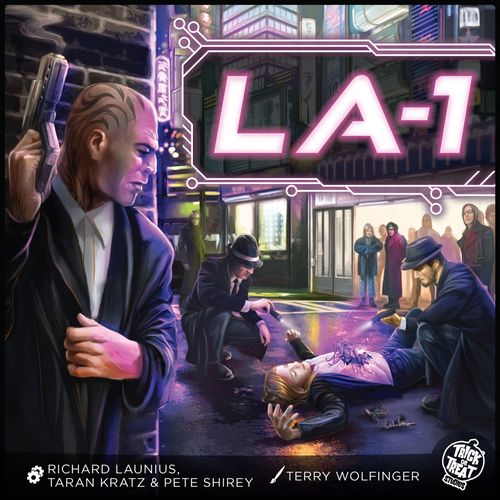
LA-1
LA-1 Rulebook
Table of Contents
Table of Contents
- Before You Start
- Solo Play
- Replaying A Case
- Components
- Central Setup
- Player Setup
- Case Setup
- Card Types
- Playing The Game
- Phase 1: Darkness
- Phase 2: Actions
- Free Actions
- Phase 3: Investigations
- Case End
- Cleanup
- Campaign
- The Darkness of LA-1
- Numbered Encounter Deck
- Skill Tests
- Skill Upgrades
- Multiple Use Cards
- Skill Test Example
- City Guide
- Reference Section
Before You Start
Decide if you are just playing a single game, or playing a campaign. If this is the first game for most of the players it is recommended that you play Case 1 – Big Bounties. Otherwise, pick any case.
If playing a Campaign, start with Case 1 and each future game will progress to the next Case. See the Campaign Play section (pg. 7) for details.
Solo Play
When playing the game solo, you will play as 2 Investigators. Keep all of the components for the 2 Investigators separate. You will take individual turns with each Investigator.
Replaying A Case
The game is designed so that you may play a case multiple times (although not in the same campaign). While some content might be the same, there are many randomized story elements in each case. The second time you tackle a case you might end up with a different suspect or conclusion entirely.
Components
- 1 Game board
- 7 Character standees & Character cards
- 35 Heat tokens (5 per Character)
- 7 Character Skill decks (15 cards each). Each Character has their own deck
- 4 Case folders
- 5 Player mats
- 461 Numbered Encounter cards (in a card box)
- 8 Location Encounter decks (16 cards each)
- 32 Darkness cards
- 29 Major Skill cards
- 35 Local Skill cards
- 1 Lead Investigator token
- 27 Damage cards
- 24 Fate cards
- 45 Credits tokens
- 5 Plot tokens
- 9 Passport tokens
- 20 Clue tokens (with an orange bag)
- 28 Basic tokens (with a gray bag)
- 21 Karma tokens
- 1 Darkness marker
- 21 Curse tokens
Central Setup
Every game starts with this basic setup.
- A. GAME BOARD: Place this in the center of the table.
- B. LOCATION ENCOUNTER DECKS: Separate the Location Encounter cards into 8 separate decks based on the location indicated on their back. Shuffle each deck separately and place them on the corresponding Location on the game board, covering up the dark side (interior spaces at each location) of the Location.
- C. LOCAL SKILL CARDS: Separate the Local Skill upgrade cards into 3 decks by the city section listed on them. Shuffle each deck and place them face-down onto the Game board in their corresponding city sections.
- D. MAJOR SKILL CARDS: Shuffle the Major Skill upgrade cards together to form the Major Skill deck, and place it face-down to one side of the Game board.
- E. DAMAGE CARDS: Shuffle the Damage cards together to form the Damage deck, and place it face-down to one side of the Game board.
- F. FATE CARDS: Shuffle the Fate cards together to form the Fate deck, and place it face-down to one side of the Game board.
- G. NUMBERED ENCOUNTER CARDS: Make sure the Numbered Encounter cards are sorted numerically in the provided card box, and place the box near the Game board. Do not read these cards prior to being instructed to do so.
- H. CREDITS, KARMA, AND PASSPORT TOKENS: Place Credits, Karma, and Passport tokens in a supply to the side of the Game board.
- I. BASIC TOKENS: Place all gray Basic tokens into the matching bag and set it next to the Game board.
- J. CLUE TOKENS: Place all orange Clue tokens into the matching bag and set it next to the Basic tokens' bag.
Player Setup
- PLAYER MAT: Give each player a Player mat.
- CHARACTER: Each player chooses an Investigator character. Give each player the Character standee, Heat tokens, and Skill deck associated with their character, and place their Character card on to their Player mat.
- CHARACTER STANDEES: Place the Character standees at their starting locations on the Game board, as written on the back of their Character cards.
- SKILL CARDS: Some Character cards' Starting Items sections specify certain Skill cards that begin the game in play. Remove these cards from their Skill decks and place them face-up in front of their Player mat. Then shuffle the rest of the Skill deck and set it face-down next to each player's mat. Each player draws 5 cards from their Skill deck to form a starting hand. This is the maximum hand size for all Investigators, but it can be altered by game effects.
- KARMA, PASSPORT, & CREDIT TOKENS: Give each player Karma, Passport and Credit tokens as specified by their Character card's Starting Items section.
- LEAD INVESTIGATOR MARKER: If possible, give this to a player playing Edward Doyle or Roni Mace. Otherwise, randomly assign it to a player.
Case Setup
- CASE FOLDER: After Central and Player setup is complete, choose a Case to play and take its Case folder, which outlines the setup, story, and goals for that case. Read the Case folder's instructions to complete the next steps. For your first case we recommend playing Big Bounties.
- CURSE TOKENS: Place these in the general supply near the Game board. Some cases will instruct you to use certain tokens during the game.
- L. INVESTIGATION TOKENS: Draw random Basic and Clue tokens from their bags, shuffle them face-down and fill the token spaces on the Game board as described in the Case folder. (Light spaces are face-up; dark spaces are face-down.)
- M. PLOT TOKENS: The Case folder will specify how these tokens should be placed during setup, usually onto specific numbers on the Darkness track.
- N. CASE, SPECIAL CASE, AND SUSPECT CARDS: The Case folder may instruct you to put specific Numbered Encounter cards on the Game board or into decks as part of setup.
- O. DARKNESS MARKER: Place this on the 0 space of the Darkness track on the Game board unless specified differently in the Case folder.
- P. DARKNESS CARDS: There are several different types of Darkness cards in the game. The Case folder will tell you which ones to shuffle together for any case. Place that deck face-down onto the Darkness card space on the Game board. Return any unused Darkness cards to the box.
- SPECIAL RULES AND ADDITIONAL SETUP: Read any special rules and perform any additional setup instructions as specified in the Case folder.
- STARTING THE GAME: Begin the case by reading aloud the narrative from the Case folder, then move to the first Darkness phase.
Card Types
LA-1 contains various cards that players interact with in different ways throughout the game.
- FATE CARDS: These cards determine outcomes of skill checks and other events throughout the game.
- DAMAGE CARDS: Cards given to Investigators after they suffer damage from encounters and combat (see pg. 8).
- SKILL CARDS: You keep these in your hand and use them to modify the results of skill tests. Players begin with a deck of these, which can be upgraded throughout the game.
- ITEM CARDS: These cards can be played on your turn. Some of them are unlimited use and some are limited use and then discarded.
- NUMBERED ENCOUNTER CARDS: Narrative cards that are revealed when something in the game prompts a player to find a specific one.
- ALLY CARDS: Cards that remain in play and help the Investigators.
- CONDITION CARDS: Cards that remain in play and alter an Investigator.
- LOCATION ENCOUNTER CARDS: Cards revealed when a player investigates a location on the board (see pg. 7).
- DARKNESS CARDS: Contain generally negative effects that occur at the start of a round, and as the Darkness track advances (see pg. 5). They come in various types:
- Angels: Represents the influence, power and elite prejudice of citizens from the City of Angels.
- Dark City: Represents the people and pressure of being an Investigator in LA-1.
Playing The Game
Overview
Each player represents an individual Investigator, and all Investigators work cooperatively as members of the Mace & Doyle Detective Agency. Each game begins by reading a Case folder, which explains a job Mace & Doyle have been hired to complete. Players may not know how to complete the case and win the game when starting, but will discover that through gameplay as they follow leads uncovered in their Investigations.
Strategy Tip: The general flow of the game is that you want to use your hand of skills to succeed at encounters to gain Clue tokens from locations, then place those Clue tokens on your Case or Suspect cards to advance your investigation.
This game is played over a series of rounds, each round containing 3 phases:
- Phase 1: Darkness
- Phase 2: Actions
- Phase 3: Investigations
Phase 1: Darkness
The Darkness phase represents the ever-present darkness, corruption, and crime of LA-1.
Pass Lead Investigator Token
Begin the Darkness phase by passing the Lead Investigator token to the next player clockwise around the table. Ignore this on the first turn of the game.
Resolve Darkness Card
The Lead Investigator draws the top card from the Darkness deck and reads it.
Resolve each individual section of the card one at a time, starting from the top.
The final section might be marked with a 4+ Investigators icon; only resolve sections showing this icon if you are playing with 4 or more Investigators.
The cards often have effects that "Advance Darkness". Each time Darkness advances, move the Darkness marker one space up the Darkness track, to the next higher number. This might trigger additional effects if an icon on the track is reached.
Once the Darkness marker passes a gap in the track, it may never be moved backwards beyond that gap.
Heat
Many events affect the player with the most Heat (Heat is unwanted attention from the law, the elites in the City of Angels, or from criminal elements). If there is a tie for the player with the most Heat, the Lead Investigator chooses which player is affected.
If you ever need to draw a Darkness card for any reason and cannot because the deck is empty, re-shuffle the Darkness discard to recreate the deck and advance Darkness +1 space.
Darkness Track Icons
City Growing Dark: When the marker passes a City Growing Dark icon, the corruption of the city overwhelms a location. The Lead Investigator draws and discards a Fate card, the bottom of which will name a random location.
Turn the drawn location Dark by sliding the encounter deck at that location to cover the Light space and reveal the Dark space. If a location ever needs to be turned Dark and it is already Dark, advance Darkness +1 space.
New Clues: When the Darkness marker reaches one of these spaces, refill all empty token spaces on the Game board. Slide all tokens up to fill the topmost uncovered token spaces at their location. Then count the number of empty token spaces across all locations. If there are 4 or fewer empty spaces, place a random Clue token face-down on each space.
If there are 5 or more empty spaces, draw 4 random Clue tokens, plus enough random Basic tokens that you could fill all the empty token spaces. If there are not enough tokens in the general supply bag, use as many as you can. Shuffle all the newly drawn tokens together face-down and place one at random face-down on each empty token space.
Plot Tokens: Your Case folder will identify which spaces on the Darkness track have a Plot token on them. When you reach a Plot token, discard that token and resolve a Numbered Encounter card as instructed to by your case.
Phase 2: Actions
In this phase, each Investigator takes an individual turn. Players may decide to take their turns in any order but generally it is recommended to start with the Lead Investigator and go clockwise around the table.
Each Investigator will get to take 2 of the following Actions on their turn. You may perform the same Action twice. You must complete an Action entirely before performing another Action (including Free Actions).
Strategy Tip: Players should use this phase to set up for the following Investigation phase.
Move
Move your Investigator to any location.
In order to move to a City of Angels location from LA-1 or LA-2, you must discard a Passport token.
Some other location effects may trigger when you move into them, as specified on the location or related cards.
Lay Low
Reclaim one of your tokens from Heat. If you are at an LA-2 location, reclaim an additional token.
Prepare
Draw 1, 2, or 3 cards from your Skill deck. Then discard down to your max hand size if necessary (usually 5 cards). It's possible to have more than 5 cards in your hand at other times, you only need to discard down to your hand limit after taking a Prepare action.
Black Market
While at an LA-1 or LA-2 location, add a token to Heat and pay the Credits listed to take a token from the Black Market. If you do, replace it with a randomly drawn Basic token if possible.
Hot Tip
Move the top Location Encounter card at your location to the bottom of its deck.
Bribe Contact
Pay 5 Credits to gain a new Local Skill card. Draw 3 cards from the Local Skill deck for your city section, choose 1 to keep in your hand and return the other 2 to the bottom of the deck. Note: Each section of the city specializes in different skill types.
Location Action
Most locations have an Action printed on them, which you may perform while at that location.
Special Actions
There might be additional Actions listed on your Character card, Case cards, Skill cards, and other places. Anything noted as "Action" may be performed as one of your 2 Actions on your turn, or when specifically denoted to modify or assist you when taking an action or resolving an encounter.
Analyze a Token
Discard 1 of your Basic tokens back to the general supply to gain the indicated benefit:
- ALIBI: Remove any 3 Heat tokens from the Game board and return them to the associated players.
- EXECUTIVE ORDERS: Gain 2 Passport tokens.
- GUMSHOE LUCK: Gain 2 Karma tokens.
- HACKER: Reveal 2 face-down tokens anywhere (except in the general supply).
- LIGHT: Reduce Darkness by up to 2.
- LOCAL SKILL: Draw 3 Local Skill cards from your city section, keep 1 in hand and discard the other 2 face-down to the bottom of their deck (this does not cost Credits in the way the Bribe Contact action does).
- STEM PACK: Discard all face-up and face-down Damage on your character.
- UPGRADE: Draw 3 Major Skill cards, keep 1 in hand and discard the other 2 face-down to the bottom of their deck.
Free Actions
Investigators may perform the following free Actions on any of their turns during the Action or Investigations phases.
Shuffle
Turn 1 location of your choice Dark, then shuffle your discard and Skill deck together to form a new Skill deck. If all locations are already Dark, advance Darkness +1 space instead.
Trade
When on the same location, Investigators may give or trade any number of tokens with each other. This includes Credits, Karma, Passports, Basic tokens, and Clue tokens.
Play Items/Abilities
Play an Item or Ability card from your hand face-up on the table in front of you. This card is now available to be used and no longer counts against your hand limit.
You may have a maximum of 3 total Item or Ability cards in play at a time. If you play a 4th card, immediately discard a card from in play of your choice. Condition and Ally cards do not count against this limit.
Phase 3: Investigations
The Investigation phase is the heart of the game, where you perform Investigations or Stakeouts and further the Case by placing Clue tokens on the Case or Suspects. During this phase, each Investigator takes a turn where they perform 1 of the Actions below (Advance Case, Investigate, Fight Darkness, or Rest). Investigators may take their turns in any order.
Advance Case
Advance your case as described in your Case folder or on your Case cards by playing Clue tokens to the Case, Suspects, or other Case cards. These tokens stay with the card they are played to until you are instructed to remove them or the card leaves play, then they return to the general supply.
Clue tokens are orange and come in five types, which may or may not be relevant depending on the current Case: Physical, Statement, Mystery, Eye Witness, and Forensics.
Investigate
Resolve the top card of the Location Encounter deck at your location, it may be an Investigation or a Stakeout card. After resolving that card, place it on the bottom of its deck. Or take an Investigate Action on a Case card at your location. This is generally a good way to progress the case. It is the most fun to have another player read the Investigation card aloud to you so you can make any decisions without knowing the consequences.
Strategy Tip: Stakeouts tend to be easier than Investigations, but have lesser rewards. To resolve a Stakeout successfully you will usually need to spend Credits or Karma, or perform a random card draw. Stakeouts seldom have penalties. To resolve an Investigation card successfully, you will usually need to make a Skill Test (see page 8) using one of the skills listed on the back of the card (which is sometimes a mystery). In most cases, successful Investigations will enable you to gain 1 or more tokens from the board. Collecting tokens is important, especially Clue tokens, as they are the key to solving cases and winning the game.
Fight Darkness
If you are at a Dark location, discard 2 Karma tokens to slide the Location's Encounter deck back to the Light side.
Rest
Discard 2 face-down Damage cards from your Character. If at the Mace & Doyle Investigations location, discard 3 instead.
Once the Investigation phase is complete, begin a new round starting with the Darkness phase.
Case End
The game can end in one of 2 ways:
- CASE SOLVED: The Investigators get to a "Case Closed" conclusion.
- DARKNESS CLOSES IN: The Investigators fail to solve the case before the darkness of LA-1 closes in on them, making the case impossible to complete.
Case Solved
Your Case folder will provide information on how to progress the case, and may give you a specific card to read when you solve it. The game ends when you reach a case card that reads "Case Closed".
Darkness Closes In
If the Darkness marker reaches the final space of the Darkness track before you're able to close the case, the Investigators lose. The darkness of LA-1 has prevented you from continuing. Your Case folder will instruct you to read a specific card in this situation.
Cleanup
If playing in a Campaign, follow any instructions on the Case cards related to a campaign or future games.
If you are not playing in a Campaign, numerically sort the Numbered Encounter card discard pile back into the provided card box, so that it is ready for future play.
Campaign
Campaign play is an optional mode where you play multiple Cases back-to-back as one ongoing story. After you finish a case, you may pick any unplayed case for your next game session. During a campaign, players should continue to play the same Investigators in each subsequent game (unless their Investigator is killed).
When ending a game during campaign play, there will be consequences and rewards that may carry over into future Cases. These are described on the Case cards.
From game to game, your Investigators keep all their Status conditions with their Investigator cards and put them into play during the setup of the next case. Any conditions your Investigators have should be kept with those Investigators and put into play during the setup of the next case.
Each Investigator may also keep in their Skill deck a number of upgrades (either Local or Major) equal to the number of cases you have finished in this campaign. (Example: After your first game each Investigator may keep 1 card, after your second 2 cards, and so on).
You never carry over any tokens your Investigators may have.
During a Campaign, you do not need to reset the Encounter decks between each case. Only shuffle old Encounter discards back in if the entire deck is completely empty. If you need to pack up between sessions, bag the discarded Encounter cards separately, and each player should place the Status condition and Investigator cards they are keeping in a separate bag with their Starting cards. If there are any case-specific cards that need to carry over, assign a player to put them in their bag.
The Darkness of LA-1
Life in LA-1 is grim, and thus there are many harmful things that can befall your Investigator. The following are some of the most common you will experience.
Heat
Heat represents the pressure police, angels, and gangsters are putting on you and your colleagues as you try to do your jobs.
When instructed to add 1 or more tokens to Heat, place that amount of your Heat tokens on the Heat space of the Game board. If you don't have enough, place as many as you can, then advance Darkness +1 space. The Darkness marker is only advanced 1 space per instance of placing Heat, regardless of how many tokens you were unable to place.
Locations Turning Dark
Whenever instructed to turn a location Dark, slide the encounter deck at that location to cover the Light space and reveal the Dark space. If a location ever needs to be turned Dark and it is already Dark, advance Darkness +1 space.
Burning Cards
When instructed to burn cards, discard that number of cards from the top of your Skill deck. If you need to burn cards but don't have enough, burn as many as you can and then advance Darkness +1 space. The Darkness marker is only advanced 1 space per instance of burning cards, regardless of how many cards you were unable to discard.
Damage
When you take Damage, draw 1 Damage card for each Damage you received and place the drawn cards face-down next to your Character card. When you take a 3rd or 6th Damage card, flip it face-up. Any text written on it now applies to you. If there are 7 Damage cards beside your Character card, your Investigator is killed. When healing Damage, only discard face-down Damage unless otherwise specified. After healing, remaining Damage slides down to fill the lowest numbered Damage slots available.
Death of an Investigator
When your Investigator is killed, return your current Character card and all related tokens and cards to the game box. Then advance Darkness +2 spaces and choose a new Character card that you will play starting on your next turn. Setup the Character as if starting the game (Draw 5 cards, put any starting items in play, gain appropriate tokens, and place the Character standee on its starting location.)
If playing a campaign, players may not play the eliminated Investigator for the rest of the campaign, unless there are no non-eliminated Investigators available.
Numbered Encounter Deck
LA-1 uses a large, Numbered Encounter deck containing all of the various events that might happen to the Investigators of Mace & Doyle.
Whenever something instructs you to draw a numbered card, search through the Numbered Encounter deck until you find that number, then remove and read that card. If there are multiple of the same number, choose one randomly without looking at them. If instructed to draw a numbered card that is no longer in the deck, ignore that part of the instruction.
When resolving an Encounter card, it is recommended to have another player at the table read it aloud to the active Investigator. If there is Skill test or decision to be made, do not read the results until that test or decision has been resolved. The active Investigator then chooses what to do or performs the required test.
After resolving a card from the Encounter deck, unless instructed otherwise, discard it to the game box. Many number cards stay in play until they have been fully resolved, and specify where they're placed, what is required to resolve them, and what effects they have while in play. This might include minor cases, witnesses, mutations, and so forth.
Skill Tests
There are 6 types of skills in the game: Mind, Mech, Mojo, Moxie, Move, and Muscle. Often Investigations, Plot encounters, and Case cards will require you to perform a Skill Test to overcome a challenge presented to your Investigator.
Each Skill Test will have a number that you must equal or exceed to be successful.
Skill tests will always list a skill and a success number (for example, TEST Muscle 5 requires a total of 5 or higher to succeed, and Muscle skill cards may be played).
To Perform a Skill Test
- Some Skill Tests will give you a choice of Skill type to use. The Investigator must pick before starting the test.
- At the start of the Skill Test you may play any number of Skill cards from your hand matching the required skill (in this example, Muscle cards).
- Draw 1 card from the Fate deck and add (+) or subtract (-) the number on that Fate card to the value of the Skill cards you just played, if any.
- If the card drawn matches the Skill type required (in this case, Muscle) or is a Luck card, you must draw another Fate card and add it to the total. This continues unless the card drawn doesn't match the required skill type and isn't a Luck card. In this situation, cease drawing Fate cards and go to the next step.
- Some Skill tests combine 2 or more skills, in which case all Fate cards matching any of the skills used will add an additional Fate card draw.
- Once all Fate cards are drawn, if your total value equals or exceeds the test number, the Test is a success, otherwise it is a failure.
- However, if you exceed the Test number by 3 or more, you've drawn too much attention to yourself and must place a token on Heat.
- Discard any Skill cards played to your discard pile, and discard any Fate cards drawn to their discard pile.
Important: Regardless of the Skill required, whatever card is drawn is always added to the Skill Test. Drawing a corresponding Skill or Luck card just means another card must be drawn and added to the total as well. The only time a card drawn during a Skill Test does not contribute its value to the test is if something says that it should be ignored, such as when using a Skill Push ability or a Karma token.
There are several ways Investigators can gain an advantage in the Skill Tests.
Using Karma
After drawing a card from the Fate deck during a Skill Test, you may spend 1 Karma token to ignore the card you just drew, discard it, and draw another one instead. You may do this multiple times as long as you have Karma tokens available.
Using Item Cards
Cards you have in play may be used to help you with Skill Tests as well. All cards can be used at most once for each Skill Test, even if they are a multiple use card. Any cards that add to your value must be used before you draw any Fate cards for a Skill Test.
Reshuffling the Fate Deck
Before beginning to draw Fate cards for a Skill Test you may always choose to reshuffle the Fate discard pile back into the Fate deck, without looking through the contents of the discard pile.
Character Abilities
All Investigators have 2 icons shown on the top right corner of their Character card denoting abilities they have that help in Skill Tests. These abilities come in 2 types:
- Skill Push: This Investigator may choose to discard any Fate cards matching this Skill type when drawn, ignoring their value (don't add or subtract their value to the Skill Test), and then draw a new Fate card to replace them. This is optional for each such card.
- Skill Bonus: This Investigator adds +1 to their total during a matching Skill Test.
Each character also has a special ability unique to their character.
Under the six skill icons on the Character card, a single dot means the character has Minor starting skills in that type, and a ringed dot means the character has Major starting skills in that type.
Assisting Other Investigators
Sometimes it helps to work together. Other investigators at your same location may each play up to 1 corresponding Skill card from their hands at the same time you play Skill cards, and add their value as well. Your Skill bonuses, items, abilities, and so forth do not affect another player's Skill Test unless specified.
Skill Upgrades
There are two types of upgraded Skill cards that enhance your Character's deck: Local Skill cards and Major Skill cards. They function similarly in your Skill deck, but are gained through different methods during the game.
Local Skill Upgrades
Whenever you gain a Local Skill upgrade, draw three cards from the Local Skill deck of the section of the city you're in. Choose one of those cards to keep in your hand, and return the other two to the bottom of their Local Skill deck.
The Local Skills in each city section specialize in two particular skills as shown on the Game board.
Major Skill Upgrades
Whenever you gain a Major Skill upgrade, draw three cards from the Major Skill deck. Choose one of those cards to keep in your hand, and return the other two to the bottom of the Major Skill deck.
Major Skills are the best upgrades in the game and come in a wide variety of skills, items, and abilities.
Multiple Use Cards
Many items and abilities have multiple uses as identified by the numbers on the top and sides of their cards. When put into play, place the card face-up, with the highest number on the edge oriented towards you.
Once per phase, you may use the card by rotating it so the next-lowest number is oriented towards you. If already on the lowest number, discard the card to your personal Skill deck's discard pile when used.
Skill Test Example
Edward Doyle uses his Investigation action to resolve the top card at his location, East Angeles. The Investigation card reads, "You watch the suspect as he flirts with a pretty young woman. You approach her after the suspect moves on. TEST Moxie 6."
- Edward decides not to shuffle the Fate discard back into the Fate deck as he doesn't remember seeing many Moxie cards drawn yet.
- He then plays a 2 Moxie card from his hand.
- Roni Mace is also at East Angeles so she plays a 1 Moxie card to assist Edward's test.
- Edward now draws the top card of the Fate deck. He reveals a +1 Move. This would normally end his Fate draw, but Edward has the Skill Push ability for Move on his character card so instead he discards the card and draws a new one.
- The next Fate card drawn is a Luck +1. A lucky draw, so Edward must draw another card and add it to this total.
- The next Fate card drawn is a Moxie +2. Since Moxie is the type of test being taken this triggers Edward to draw yet another card to add to his test.
- Edward then draws a Mind +1. This card does not match the skill being tested so his Fate draws are over, unless he chooses to spend a Karma token. In this situation he chooses not to as his total is high enough to pass the test.
2 + 1 + 1 + 2 + 1 = 7. Which is equal to or higher than the required 6 so the test is a success!
Edward reads the "IF SUCCESSFUL" text on the location card and follows the instructions.
City Guide
The City of Angels
There are two locations in the City of Angels. Built on towering stilts above the ever-present dark clouds, this district of wealthy and powerful elites governs the entire city state. They have all the power and use it to crush opponents on a whim. Still, they keep businesses running, the graft paid, and garbage picked up – and best of all, they leave you alone. That is, unless you do something to gain their attention.
To move from LA-1 or LA-2 to the City of Angels, the player must spend 1 Passport.
The Hollywood Estates
Home to the mansions of the truly rich and famous and the private hospitals that keep the Angels young forever. The wealthy and powerful live lush lifestyles that tend to venture into corruption and crime – that's when they hire you.
- When this city is Light: If you are here at the start of your Investigation phase, draw 1 card.
- Location Action: Pay 1 credit to discard 1 face-down damage, pay 4 credits to discard 1 face-up damage. You may repeat this any number of times.
- When this city is Dark: If you are here at the start of your Investigation phase, place 1 token on Heat.
Capital Square
A place of high commerce and high politics. The headquarters of many major companies are located here, as well as the central government for all three cities.
- When this city is Light: If you are here and fail an investigation, place 1 token on Heat.
- Location Action: Discard any number of cards from your hand. Gain 2 Credits for each card you discard.
- When this city is Dark: If you are here at the start of your Investigation phase, place 1 token on Heat.
LA-1 (Old Angeles)
There are five locations in LA-1. LA-1 is connected to The City of Angels and LA-2 by a huge elevator that carries massive, overcrowded trams of workers between the cities.
East Angeles
- When this city is Light: Action: Place 1 token on Heat to gain 3 Credits.
- When this city is Dark: Receive 1 Damage when you enter this location.
Torrance
- When this city is Light: Action: Pay 3 credits to gain 1 Karma token.
- When this city is Dark: Each time you gain a Clue token from this location, add 1 token to Heat.
- Action: Pay 5 Credits to gain 1 Karma token.
Ash Town
- When this city is Light: When you enter this location, you may discard and redraw any number of Skill cards.
- Action: Pay 3 credits and gain a passport.
- When this city is Dark: All Skill Tests are increased by 1 at this location.
Mace & Doyle Investigations
- Action: Pay 10 Credits to draw 3 Major Skills and pick 1 to keep. Then, you may move to another location.
Tech Alley
- When this city is Light: Action: Place 1 token on Heat to exchange 1 token at any location with the top token at that location.
- When this city is Dark: Each time you gain a Clue token from this location, take 1 Damage.
LA-2 (The Underworld)
There are two locations in LA-2. Below the surface lies the sprawling underworld the locals call LA-2.
The Crypt
- When this city is Light: When you enter this location, take 1 Damage.
- Action: Place 1 token on Heat to gain 1 Karma.
- When this city is Dark: When you enter this location, take 2 Damage.
Mutant Warrens
- When this city is Light: When you have an encounter here, you may take 1 Damage to ignore a drawn fate card. Discard it and draw a new one. You may do this any number of times per encounter.
- Action: Return a Basic (gray) token to the supply. Gain credits equal to its Black Market price as shown on the game board.
- When this city is Dark: When you enter this location, place 1 token on Heat.
Reference Section
Tokens
- CREDIT: pays for Skills and Black Market tokens. Sometimes Credits help solve your cases!
- PASSPORT TOKEN: use to travel from LA-1 or LA-2 up to the City of Angels.
- KARMA: use to discard a drawn Fate card and draw a new Fate card to replace it, or 2 can be spent to turn a Dark location Light.
Clue tokens: Physical, Statement, Mystery, Eye Witness, Forensics.
Basic tokens:
- ALIBI: Remove any 3 Heat tokens from the game board and return them to the associated players.
- EXECUTIVE ORDERS: Gain 2 Passport tokens.
- GUMSHOE LUCK: Gain 2 Karma tokens.
- HACKER: Reveal 2 face-down tokens anywhere.
- LIGHT: Reduce Darkness by 2.
- LOCAL SKILL: Draw 3 Local Skill cards from here, keep 1 in hand and discard the other 2 to the bottom of their deck.
- STEM PACK: Discard all face-up and face-down Damage on your character.
- UPGRADE: Draw 3 Major Skill cards, keep 1 in hand and discard the other 2 to the bottom of their deck.
Skill Tests (see pg. 8)
Skills: Mind, Mech, Mojo, Moxie, Move, Muscle. Fate cards can also show -Luck or +Luck.
- SKILL BONUS: This investigator will always add +1 to the matching Skill tests.
- SKILL PUSH: This investigator may choose to discard any Fate cards matching this Skill type when drawn, ignoring its value and drawing a new Fate card to replace it.
Darkness Track (see pg. 5)
- PLOT TOKEN: Resolve the corresponding event as described in the case folder.
- CITY GROWING DARK: Turn a random location Dark.
- NEW CLUES: Refill clue tokens.
- DARKNESS CLOSES IN: The Investigators fail to solve the case before the darkness of LA-1 closes in on them, making the case impossible to complete.
Gameplay
- DAMAGE: Usually taken face-down. Your 3rd and 6th damage are face-up. When you take your 7th damage, your investigator is killed (see Death of an Investigator, pg. 8).
- PLACE A TOKEN ON HEAT.
- LOCATION ACTION: Indicates an Action you can do during Phase 2 of your turn while at a specific location.