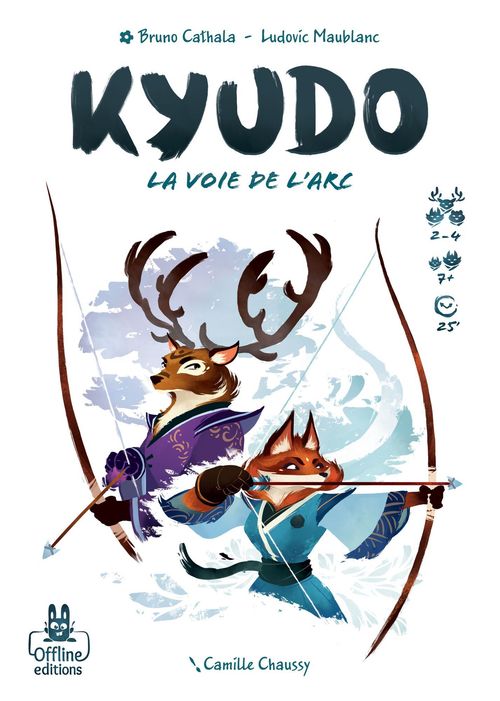
Kyudo
Kyudo Rulebook
Table of Contents
Table of Contents
Your Number
The dice track in this box is completely UNIQUE; there is no other similar dice track for the game Kyudo. Your unique number identifies your track. The symbols of the zones on your target are also unique to each box of Kyudo.
Components
- 1 pad of game sheets. Each sheet has: the Exceptional Move flags (5 effects, each associated with a specific colour); the circles (spaces you must reach with your arrows; as soon as all the circles of one colour are filled, that colour is said to be "closed"); the target; the spectators; and the attractiveness of each colour with regard to the spectators.
- 4 dice, each with 1 ARROW face and 1 face of each of the 5 COLOURS.
- 9 tokens (3 of each type).
- 1 dice track.
- 1 storage bag.
- 4 Character cards, each with its personal talent.
- 1 "arrow" pointer.
Setup
-
Give one sheet to each Archer.
-
Each Archer draws a Character card and places it face up in front of them.
-
For each type of token, keep one token fewer than the number of players. Put the surplus tokens back in the box, and make one pile for each category in the centre of the table with the others.
-
Choose the 1st Archer by any method you like. They take the 4 dice.
-
The other Archers, in clockwise order, tick the boxes of their choice in the Exceptional Move flags:
- The 2nd ticks 1 box.
- The 3rd ticks 2 boxes (in 2 different flags).
- The 4th ticks 3 boxes (in 3 different flags).
(For example, the 3rd archer chooses to tick one box in the BLUE flag and one in the RED flag.)
Goal of the Game
You can win in two different ways:
- EITHER by closing all the colours of your target WHILE being the archer who still has the most spectators.
- OR by eliminating all your opponents. (An archer who loses their last spectator is immediately eliminated from the game.)
How to Play
Each Archer starts the game with 20 spectators in their personal stand.
The Archers play in turn, clockwise. On their turn, an Archer rolls the 4 dice, trying to make a combination that lets them hit their target, or progress in the table of exceptional moves, or call on their personal talent.
To make their combination, the archer may roll the dice at most 3 times (on the 1st roll, they roll all 4 dice, and on the following two rolls they may re-roll all or some of the dice).
When they decide to stop (usually after the 3rd roll, but they may stop after the 1st or 2nd if they wish), they trigger the effects of the combination obtained.
Triggering the Effects of the Combination Obtained
The Archer decides how to combine the dice faces. They may:
Combine one or more ARROWS with ONE COLOUR
Combining one or more ARROW faces with a single COLOUR face simulates the Archer aiming at that specific colour on their target. Each ARROW face then allows them to tick one circle on their target, in the colour aimed at.
Examples:
- With one arrow and several different colour faces (black, green, red), the Archer CHOOSES one of three possibilities: tick 1 circle in BLACK, OR tick 1 circle in GREEN, OR tick 1 circle in RED.
- With three arrows and a blue face, the Archer ticks 3 circles in BLUE.
- With two arrows, one black face and one blue face, the Archer chooses one of three possibilities: tick 2 circles in BLACK; OR tick 1 circle in BLACK and 1 circle in BLUE; OR tick 2 circles in BLUE.
When all the circles of one colour are ticked, the colour is said to be "CLOSED". If you keep aiming at it, each opponent for whom this colour is not yet closed will lose spectators: each arrow symbol associated with this colour makes them lose a number of spectators that depends on the attractiveness of the colour! (1 for Black and Orange, 2 for Green and Blue, 3 for Red.)
Example: Mary has already ticked 3 circles in GREEN. She obtains the combination ARROW-ARROW-ARROW-GREEN. With her 1st arrow, she ticks her last box of the GREEN colour. This colour is now closed for her. But she still has 2 ARROW symbols to associate with GREEN. Each opponent who has not yet closed their GREEN colour will therefore lose 4 spectators (2 for each ARROW). (Lost spectators are crossed off their personal sheet in descending order, starting with spectator "20", then "19", and so on.)
Important: An archer who loses their last spectator is eliminated!
Combine at least two dice of the same colour
Combinations of identical colours let you trigger exceptional moves, which can be a great help towards final victory! On your Exceptional Move flags, tick as many boxes as there are dice in your combination.
As soon as you have ticked all the boxes located in one corner of your flag, you trigger the associated exceptional move. Thus, each Archer can trigger each exceptional move at most 4 times in the game.
- It takes 3 boxes to be ticked to trigger the BLACK exceptional move. Each Archer can trigger it at most 4 times.
- It takes 2 boxes to be ticked to trigger the RED exceptional move. Each Archer can trigger it at most 4 times.
Exceptional Moves
Black flag: Immediately tick 2 still-empty circles of your choice on your target. They may be in the same colour or in 2 different colours.
Orange flag: Take the corresponding token from those available in the centre of the table. If none is available, steal it from the opponent of your choice. Use: later in the game, when you place one or more arrows in a colour you have closed, discard this token (put it back in the centre of the table). The colour aimed at is considered, for this turn only, as making each opponent who has not closed this colour lose 4 spectators for each arrow.
Green flag: Take the corresponding token from those available in the centre of the table. If none is available, steal it from the opponent of your choice. Use: later in the game, at any time when you would lose spectators, discard this token (put it back in the centre of the table). You lose no spectators.
Blue flag: Immediately tick one still-empty circle of your choice on your target.
Red flag: Take the corresponding token from those available in the centre of the table. If none is available, steal it from the opponent of your choice. Use: later in the game, discard this token (put it back in the centre of the table) at the end of your dice rolls, to place the die of your choice on the face of your choice (COLOUR OR ARROW).
Important: it is possible to make several combinations, but each die can belong to only one combination.
Example: the player may choose to tick 1 circle in green (ARROW + GREEN); the two remaining faces then have no effect. OR they may choose to tick 1 circle in black (ARROW + BLACK) and use the 2 green faces to tick two boxes in the green Exceptional Move flag.
Combine 4 ARROWS to trigger the Ultimate Combo
This is a very aggressive combination! If you trigger this combination, each opponent immediately loses 4 spectators. (The only way to protect against it is to discard a shield token.)
Combine 4 different COLOURS to use your Personal Talent
Each Archer has a different personal talent, written on the Character card drawn at the start of the game.
When an Archer decides to stop rolling while holding a combination of 4 different colours, they immediately trigger their personal talent.
Character Abilities
Kitsune: The Archer chooses one of the two following colours: BLUE or GREEN. Each opponent must draw a circle on their target in the chosen colour, even if that colour had already been closed previously. They therefore have one more circle to tick to finish their target!
Kuma: All opponents must discard a token (if they have several, they choose which one they lose; if they have none, they lose nothing). Then the Archer takes the token of their choice from the centre of the table.
Saru: The Archer captures one of the 4 dice! They place it on their card. Until this Archer's next turn, the opponents take their turns rolling only 3 dice. On their next turn, the Archer begins by removing the die from their card, so that everyone, including themselves, plays with the 4 dice again.
Shika: The Archer takes the ring arrow and places it on one of the 5 colours on their character card. Until their next turn, this colour becomes dangerous for the opponents. On their turn, each face of this colour showing on the dice at the end of their rolls makes them lose 1 spectator. On their next turn, the Archer begins by removing the ring from their card.
End of the Game
As soon as an Archer has ticked all the circles of their target, they check whether they have the greatest number of spectators. If so, they immediately win the game (even if an opponent has exactly the same number of spectators).
Otherwise the game continues, as long as this player has not managed to remove enough spectators from the opponents to have the best popularity, or as long as another player, with more spectators than they have, does not manage to finish their target.
It is also possible to win by being the last player who still has spectators!