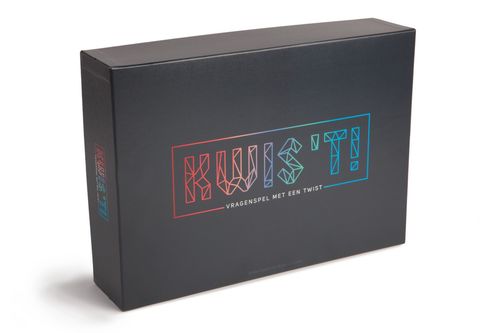
Kwis 't!
Kwis 't! Rulebook
Table of Contents
Table of Contents
Contents of the box
- 1 game board
- 1 rulebook
- 233 question cards
- 120 bonus cards (of which 12 are action cards)
- 5 bonus tokens (bonusfiches)
- 1 Kwismaster card
- 6 player cards
- 6 score pawns (scorepionnen)
- 6 bet discs (inzetschijven)
- 6 pencils
- Answer sheets
Goal of the game
Answer questions and bluff. Good answers earn you points. In addition, you receive bonus points for successfully bluffing and for correctly spotting a bluff. At the end of the game, the player with the most points wins.
Setup
Lay the game board open on the table. Choose a colour and take the score pawn, bet disc and player card in that colour from the box. Each player places their score pawn on the O of the score track, which runs around the edge of the playing area. Place your bet disc and player card in front of you.
Each player takes an answer sheet and a pencil.
Shuffle the stack of bonus cards (including the action cards) and place it on the designated space on the game board. Then, depending on the number of players, take four, five or six question cards and place the Kwismaster card underneath them. The Kwismaster card ensures that you cannot see the answers on the back of the question cards. The table on the left shows, for each number of players, how many rounds you play. The number of question cards you use each time is always equal to the number of rounds.
| Number of players | Number of rounds (= number of question cards) |
|---|---|
| 2 | 6 |
| 3 | 6 |
| 4 | 4 |
| 5 | 5 |
| 6 | 6 |
If you play with two players, you play six rounds and both players are the Kwismaster three times each. If you play with three players, you also play six rounds and each player is the Kwismaster twice. With four, five or six players, you play as many rounds as there are players, and each player is the Kwismaster once.
Determine who starts as Kwismaster. This player reads out the questions and answers them in the first round. After that, the Kwismaster role moves one place clockwise each round.
Player card: the player card shows the actions you take each round. It functions as a memory aid during the game. In addition, the colour of the player card shows which colour you play.
Round sequence
Each round consists of phases 1 to 9 and follows a fixed order: prepare, answer questions, bet, check, play action cards and finish. Each of these phases contains a number of steps, which are explained below.
Preparation
- Shuffle the five bonus tokens and place them face down on the designated spaces on the game board.
Questions and answers
- The Kwismaster reads out the five questions on the question card. Each player, including the Kwismaster, writes their answers on the answer sheet. Because you may bluff later in the round, you have to guess whether your answers are right. When everyone is ready writing, the pencils are put down and the answers can no longer be changed.
- The Kwismaster reads out the answers printed on the back of the question card. You now know how many questions you answered correctly. Keep this secret from the other players.
- The bonus tokens on the game board are turned face up. You now know how many bonus cards are linked to each bet space in this round.
Bets
- You now place your bet disc on the game board, on one of the bet spaces (the order in which players do this is not fixed; players are free to decide for themselves when to do so).
IMPORTANT!
When betting with your bet disc you have three options:
- Honest bet: you bet on the number of questions you answered correctly. You are not bluffing.
- Bluff: you bet on a higher number of correctly answered questions than you actually have. You are bluffing in this case.
- Tactical bet: you bet on a lower number of correctly answered questions than you actually have. As a result you receive fewer points from the bet space, but you may, with your bet, earn more bonus cards than you would with a higher bet space. You are not bluffing.
Checking
- Now comes a checking round. Every player may check the answers of one other player, to see whether that player is bluffing. The Kwismaster starts, and the other players follow clockwise. You may also decide not to check anyone.
When there is a check, there are two possible outcomes:
- The checked player is not bluffing. The checked player receives the bonus card(s).
- The checked player is bluffing. The checker receives the bonus card(s). The checked player is returned to the bet space that matches the number of questions they actually answered correctly, and does not receive a bonus card.
The bonus token that lies in the bet space of the checked player determines the number of bonus cards that the checked player (6.1) or the checker (6.2) receives.
Won bonus cards are placed face down in front of you (you may always look at which bonus cards you have received). Bonus points are counted at the end of the game for your total.
The checked player removes their bet disc from the game board and immediately receives the points of the bet space by moving their score pawn forward on the score track. The number of points matches the bet space where the disc stands.
Example, phase 6:
Blue checks Red. Red bet on the bet space "3 or more answers correct". The bonus token on that space shows 3 bonus cards. Blue does not trust Red's bet and checks him. Red turns out to have only 2 answers correct, so Red was bluffing. Blue receives the 3 bonus cards and places them face down in front of them. Red's bet disc is returned to the bet space "2 or more answers correct". Red removes the bet disc from the board, receives the 2 points of that bet space and moves their score pawn forward 2 spaces. Red receives no bonus cards.
White checks Yellow. Yellow bet on the bet space "5 answers correct". The bonus token on that space shows 4 bonus cards. White does not trust Yellow's bet and checks them. Yellow turns out to have 5 answers correct, so Yellow did not bluff. Yellow receives the 4 bonus cards and places them face down in front of them. Yellow removes the bet disc from the board, receives the 5 points of that bet space and moves their score pawn forward 5 spaces.
Players who were not checked
-
After each player has had the chance to check a fellow player, all players who were not checked still have their bet disc on the game board. The Kwismaster asks these players whether they have bluffed. If you were not checked but did bluff, you may make that known. For players who were not checked there are three options:
-
You bet honestly or tactically and did not bluff. You do not receive any bonus cards.
-
You bluffed but did not make it known. You do not receive any bonus cards.
-
You bluffed and make it known. A fellow player checks your answers to establish that you did indeed bluff. You receive the number of bonus cards shown on the bonus token in the bet space you bet on. Your bet disc stays on that bet space.
In all three situations you receive the points of the bet space you are on. Take your bet disc off the game board and move your score pawn forward on the score track according to the points of your bet space.
Example, phase 7:
White did not bluff and therefore receives no bonus cards. White receives the 3 points of their bet space.
Green bluffed, but did not make it known. Green receives no bonus cards. Green receives the 4 points of their bet space.
Blue bluffed and made it known. Blue receives the 4 bonus cards shown on the bonus token of their bet space, and also receives the 5 points of their bet space.
Action cards
- Every player who has received one or more action cards must play them at the end of the round. If you play more than one action card, you decide yourself the order in which you play them. If several players have action cards, each player takes their turn in clockwise order, starting from the Kwismaster. Played action cards leave the game.
End of the round
- The Kwismaster passes the question cards, together with the Kwismaster card, to the player on their left. That player leads as Kwismaster in the next round. Begin again at phase 1.
Summary sidebars from the rulebook
Earning points. You earn points in four ways:
- The points of the bet space for correctly answered questions. This gives you 1, 2, 3, 4 or 5 points.
- Bonus points if you are checked but did not bluff.
- Bonus points if you check a fellow player who has bluffed.
- Bonus points if you bluffed but were not checked.
Removing the bet disc. Because a checked player immediately removes their bet disc from the game board, you can see from the bet discs that remain on the board who can still be checked.
End of the game
The game ends after four, five or six rounds, depending on the number of players. After the last round, each player counts their bonus points. Add these bonus points to your point total. The player with the highest final score wins Kwis 't!
Frequently asked questions
1. May I check myself?
No, this is not allowed.
2. I have not answered a single question correctly. Must I bluff now?
Yes. If you did not answer any question correctly, you must bluff, because the bet space "0 answers correct" is not on the game board.
3. I have answered all five questions correctly. Can I not bluff now?
That is right. If you answered all five questions correctly, you cannot bluff. You will notice that you are checked regularly if you are on the bet space "5 answers correct", so you still earn bonus cards.
4. May I keep action cards for a later round?
No. You always play your action cards in the round in which you receive them. As a result, you may not be able to use an action card.
5. With the action card 'Beter goed gejat dan slecht bedacht' (roughly "Better well stolen than badly planned") I draw two bonus cards from another player. One of these two bonus cards is an action card. Must I play this one immediately too?
Yes. If you draw an action card from a fellow player's hand with an action card ('Beter goed gejat dan slecht bedacht' or 'De gelegenheid maakt de dief', roughly "Opportunity makes the thief"), you must also play that action card immediately.
6. The stack of bonus cards is empty. What now?
In the unlikely event that the stack of bonus cards runs out, each player draws four bonus cards of their choice from their own hand. Immediately add the bonus points of these four cards to your score by moving your score pawn forward on the score track. Each player hands in their four bonus cards. All these bonus cards are shuffled into a new bonus card stack.