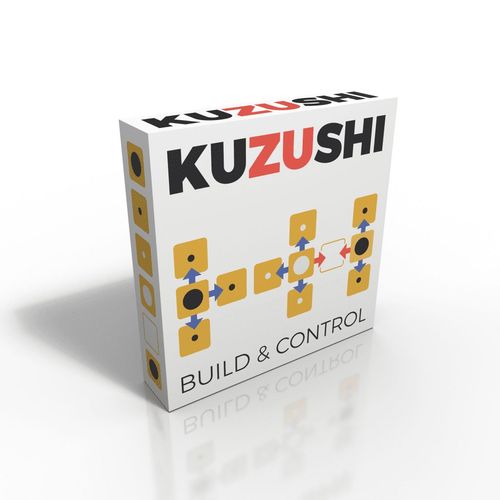
Kuzushi
Combines with
Kuzushi Rulebook
Table of Contents
Table of Contents
Objective
Control the most space by having a majority of your colored tiles at the end of the game.
Setup
- Agree to a GRID size – in Kuzushi, players build and fill a square GRID in any direction during play; for 2 players, the recommended size for the GRID is 6×6 (meaning 6 spaces across and 6 spaces down, forming a 6 long and 6 wide square).
| Players | GRID Size | Recommended Play Area Size |
|---|---|---|
| 2 | 6×6 | 24×24" or 61×61cm |
| 3 | 7×7 | 28×28" or 71×71cm |
| 4 | 8×8 | 32×32" or 81×81cm |
- Choose turn order and give a double-sided CITY tile only to player 1.
- Choose colors and distribute to each player all BASE/FLAG tiles of their color.
- Player 1 places a CITY tile with their color face-up in the center of the play area to begin play; the CITY tile cannot be flipped, removed, or replaced until the game ends.
How To Play
- Starting with player 2, proceed in chosen TURN order for each player until either the GRID fills OR a player plays their last tile.
- Count placed tiles for each player; the player with the most placed tiles of their color (BASES, FLAGS and CITY) WINS!
- In the event of a TIE, the player with the most placed tiles orthogonally touching each other WINS the tiebreaker.
On Your Turn
- Place a BASE tile from your stack on any PLAYABLE space OR find an already placed FLAG of your color and flip it over to convert that tile into a BASE. BASE tiles cannot be removed or replaced until the game ends.
- Place or remove FLAG tiles touching your new BASE orthogonally (meaning directly left, right, above, and below). See CONFLICT for rules on resolutions.
- Return any FLAGS that were removed to their respective player and END your TURN.
PLAYABLE Moves
Any open space orthogonally touching any CITY, BASE, or FLAG that is within the bounds of the agreed GRID size. In the example, you may place a BASE on any of the green O spaces, but the red X spaces are unplayable as they are outside the established 6×6 GRID for 2 players.
Resolving CONFLICT
- If a player has more BASES orthogonally touching a space than all other player, place a FLAG tile of their color in that space.
- Conversely, if NO player has a majority of BASES orthogonally touching a space, remove any FLAG tile from that space.
- When a FLAG is removed, that space becomes PLAYABLE again.
- Return any removed FLAG tiles to their respective player.
Example Game
The example game is shown in a series of diagrams. Their captions read:
- White plays a BASE, then marks the spaces it owns with FLAGS.
- Black plays their CITY.
- Black plays a BASE, marks the spaces it owns with FLAGS, and returns the contested FLAG to White.
- White continues, playing a BASE and resolving FLAGS. The board is now 6 wide and can't get any wider.
- Black plays. Black places a FLAG at A because they have more bases next to it than White. Note that Black cannot place a FLAG on the red X space because it would be outside the GRID.
- White flips over a Flag on the board to promote it to a Base, then resolves Flags around it.
Play continues until the 6×6 board is completely filled. In this game, White WINS 19-17. If the game had TIED 18-18, White would win on tie-breaks because they have the largest "island" of adjacent tiles of their color.
Clarifications
- You may never place a tile on top of another tile in the play area; see PLAYABLE above.
- If you spot an error in FLAG tile placement during PLAY you must correct it; see CONFLICT above.
- If you run out of room in your play area, you may carefully slide all the tiles over and continue PLAY.
- To save time, you may score a game by counting the number of unplayed tiles for each player – BUT remember to subtract 1 from player 1's tile count to take their CITY tile into account.
Variations
- Double the number of tiles (from 19 to 38 of each color, not including the CITY) and 2 players can play to build an 8×8 GRID.
- With 4 or 6 players, you can play in teams of 2 or 3 with the same rules but the winning team has the highest combined score of its members.