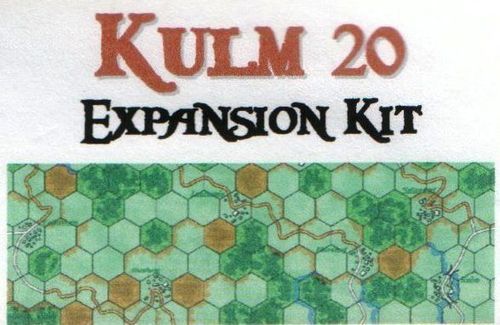
Kulm 20: Expansion Kit
Official rulebook: Victory Point Games · PDF
Kulm 20: Expansion Kit Rulebook
Table of Contents
Table of Contents
Exclusive Rules
[0.0] EXCLUSIVE RULES
This expansion kit for Dresden 20 uses that game's counters, tables, and its copy of the Napoleonic 20 Standard Rules, combined with this game's map, cards, and this rules sheet to play Kulm 20.
These Exclusive Rules supersede the Standard Rules when there is a conflict.
[1.0] INTRODUCTION
Kulm 20 is based on the battle that occurred during Napoleon's final campaign in Germany, on 29-30 August, 1813. One player commands the Coalition forces under the Austrian Field Marshall Karl Schwarzenberg, while the other player commands the French army, nominally under the command of the Emperor Napoleon.
[2.0] GAME EQUIPMENT
The Game Maps: The standard Kulm 20 game uses an 11" x 17" map with an 8.5" x 5.5" extension map that must be trimmed before setting up the game and aligned along the left edge of the larger map, near the top. These maps portray the portions of Saxony and Bohemia where the campaign occurred.
The blue units are French. The Anti-French units include the Russians (green units), Austrians (white units), and Prussians (gray units).* See Note below.
Unit abbreviations include:
- OG = Old Guard
- YG = Young Guard
- G+R = Guard & Reserve
- Res = Reserve
- Cv = Cavalry detachment
- Ph = Pahlen
- Cu = Cuirassier Corps
Elite Forces: For the purposes of Routing (a -2 die roll modifier; see 9.6.8) and Rallying (a +1 die roll modifier; see 10.0), the following units are considered Elite Forces: the French Old Guard, Russian III Corps, and the Allied Guard and Reserve.
The Allied Guard and Reserve and the French Old Guard units are also considered Elite for purposes of Morale fluctuations when committed to battle.
Note: The Allied Guard and Reserve unit is considered both a Russian and an Austrian unit when face-up, and is thus affected by all game effects that apply to either (or both) of those nationalities. This is important for implementing various card events. It is a Russian unit only when face-down (i.e., hidden).
[5.0] RANDOM EVENTS
Skip the French Player's Random Events Phase on the first Game Turn.
The Kulm 20 Event cards are physical components and are not reproduced in this booklet.
[3.0] SETTING UP THE GAME
After sides have been determined (i.e., who will play the French and Anti-French side), the standard game setup proceeds as follows:
- Place the Game Turn marker on the 'August 29 Morning' space.
- Place the French marker on the '7' space and the Allied marker on the '2' space of the Morale Track.
- Place the units on the map as listed below:
French
- Hex 0124: I
- Hex 0224: Cv
The following French units may arrive as reinforcements:
- Area A: VI, XIV
- Area B: (Group 1) YG, GC
- Area B: (Group 2) OG, Res Artillery
The French II, Ic, and Vc units are not used in the historical scenario.
Allied
- Hex 0526: Ru II
- Hex 0425: Ru Cv
- Hex 0823: Ru III
- Hex 0722: Ru cII
- Hex 0521: Ru I
- Hex 0317: Pr II
- Hex 0420: Res Art
- Hex 0816: Au Cu
- Hex 0917: Au I
- Hex 0712: Au Cadre
- Hex 0815: Au/Ru G&R
- Hex 0511: Au 1Lt
Place the Pontoon bridge marker on its "No Pontoon Bridge" side near that location (0730 / 0831).
[4.0] SEQUENCE OF PLAY
The French player is the First Player.
[4.1] Sudden Death: At the end of Game Turns 12 through 14, the Allied Player rolls a die. If the result is less than or equal to (≤) the number shown on that box of the Turn Track, the game ends and the winner is determined. If the die roll is greater than the number shown, play proceeds to the next Game Turn.
[6.0] MOVEMENT
[6.10] Mountain Roads: Bounded by steep slopes and deep ravines, the narrow roads through the mountain defiles were a dangerous feature the Allies had to deal with as they retreated back into Bohemia. Certain roads in Kulm 20 are Mountain Roads as shown below by the yellow lines with a dashed brown border:
A Mountain Road provides the usual road movement bonus [6.6], but it differs from normal roads in the following ways:
- Leaving a Mountain Road costs +1 Movement Point unless the unit leaves via a connected Road.
- An Infantry or Cavalry unit attacking out of a Mountain Road hex suffers a -1 penalty to its Combat Strength.
- An Artillery unit attacking out of, or defending in, a Mountain Road hex has its Combat Strength reduced to zero ('0') and cannot provide defensive support.
- Units may not pass through a friendly unit occupying a Mountain Road hex. This supersedes Standard Rule 6.9.
- A unit that retreats into or through a Mountain Road hex occupied by a friendly unit must roll to conduct a Hazardous Retreat (see 9.8.3, 9.8.4).
- If a unit defending in a Mountain Road hex suffers a DW result, place a Routed marker on it after its retreat unless it retreats into a connected Road hex. This does not cause Morale to fluctuate as the unit still only retreats one hex.
A unit in a Mountain Road hex that suffers a Routed result (AR or DR) must roll to conduct a Hazardous Retreat (see 9.8.3, 9.8.4) if the first hex of its retreat path is not into a connected Road hex.
[9.0] COMBAT
[9.8.6] Retreat Direction Priority:
- French units must retreat towards an active French LOC. There are three French LOC hexes along the northern map edge and one French LOC on the eastern map edge:
- At the start of the game, only the LOC in hex 0123 is active.
- The other two French northern edge LOCs (0112 and 0116) are both active after any French unit enters the map through Reinforcement Area A.
- The French eastern edge LOC (0732) becomes active only if the French Player draws the Some Good News Event card.
- Once active, an LOC functions normally for the rest of the game.
- Allied units must retreat towards one of the two Allied LOC hexes indicated on the south map edge.
[11.0] REINFORCEMENTS
[11.6] Unit Arrival Locations: Only the French Player receives reinforcements. They arrive in one of the two designated color-coded entry areas along the northern map edge.
[11.7] French Reinforcements: Starting on Turn 1, and every turn thereafter until they come into play or are removed from the game via an Event card, the French Player rolls a die for each available reinforcement unit that has not yet entered the map.
[11.7.1] VI and XIV Corps: These units enter play in Entry Area A. They require a die roll of % or ^ to enter on Turn 1; a roll of #-^ to enter on Turn 2; if they have not yet already done so, they automatically enter play on Turn 3.
[11.7.2] Imperial Guard: For entry purposes, the Imperial Guard is divided into two Groups: the first Group is the YG and GC units, and the second Group is the OG and Res Artillery units. Starting on Turn 2, the French Player rolls a die for each unit in Group 1; a unit enters play in entry area 'B' on a die roll of ^, other results have no effect. Keep rolling each turn until both units have entered play. Once both units from Group 1 have entered play, the French Player begins rolling for the units in Group 2.
[13.0] PASSING ("LULLS")
"Lulls" may be declared by either player starting with Turn 1 (i.e. ignore the standard restriction that "Lulls" may only be declared after the first Night turn).
[14.0] NIGHT TURNS
French Objective Hexes: Teplitz (1423)
Allied Objective Hexes: none.
[14.0; 3] If the French do not occupy at least two of the following three hexes, the Allied side recovers two (2) Morale Points when resting at night: Falkenhaim (hex 0512), Lauenstein (hex 0419), or Nollendorf (hex 0425) – these towns have their names underlined on the map.
[16.0] OPTIONAL RULES
New Unit Types
[16.8] Light Infantry: The Austrian 1st Light Division functions as a normal infantry unit in all respects except that it may also Disengage like Cavalry (as per Case 8.3).
Combining Kulm 20 and Dresden 20
As the southern edge of the DRESDEN 20 map overlaps the northern edge of the KULM 20 map, this makes it possible to play a week long (35 Turn) merged "mini-campaign" combining these two battles.
[17.0] THE MERGED GAME
To merge DRESDEN 20 and KULM 20, set up and play a normal game of DRESDEN 20. If, and only if, that DRESDEN 20 game ends in a French victory, then play continues using the combined maps to cover the subsequent French pursuit of the Allied army. If the DRESDEN 20 game ends in a Draw or any level of Allied Victory, game play ceases on the last turn of 28 August (Game Turn 20 of DRESDEN 20).
Procedure
[17.1] Beginning a General Retreat: The instant Allied morale drops to zero, game play is immediately suspended as the Allied Player executes the following steps in the indicated sequence:
- The Allied Morale marker is removed from the Morale Track and set one full day (five turns) ahead on the Game Turn track.
- The three Allied LOCs on the DRESDEN 20 map become inactive. The two Allied LOCs on the KULM 20 map become the only active Allied LOCs.
- Increase French Morale by one (+1).
- Disengagement: In whatever order he desires, the Allied Player must retreat each of his units a number of hexes equal to its full, printed Movement Allowance, ignoring any reductions for Weather or Night Turn effects. (Movement Points are not actually spent during Disengagement; just count hexes).
- The Allied Player may alter the Disengagement movement distance of each Elite unit by up to 2 hexes (more or fewer).
- All Hazardous Retreats (9.8.4) conducted during Disengagement automatically fail.
- Disengagement's Retreat Direction Priority (9.8.6) is toward either an Allied LOC (now on the KULM 20 map) -or- Allied Entry Areas Y or Z on the DRESDEN 20 map.
- Disengagement does not allow French units to Advance After Combat (9.9).
- Remove the DRESDEN 20 Event cards from play and replace them with the KULM 20 Event cards.
- Advance the Game Turn marker to the next turn and resume play, skipping the French Player Turn in its entirety (i.e. proceed directly to the next Allied Player Turn).
Example: Allied Morale falls to zero during the Allied Player Turn of Game Turn 17 in DRESDEN 20. This triggers an Allied General Retreat. The Allied Morale marker is removed from the Morale Track and placed on Game Turn 2 of the KULM 20 Game Turn Track. The Allied Player then performs Disengagement of all his surviving units and swaps out the DRESDEN 20 Event Deck for the KULM 20 cards. Finally, French Morale is increased by one (+1). Normal play then resumes with the Allied Player Turn of "Turn 18."
[17.1.1] Expansion Kit Event Cards: When using NAPOLEONIC 20 EXPANSION KIT Event cards, separate them out of the old DRESDEN 20 deck and shuffle them in with the new KULM 20 deck. Players keep any "Retain" cards they have in their hands.
[17.1.2] French LOCs: In this, the Merged Game, only the French LOCs on the DRESDEN 20 map are used, with the exception of the French LOC near Aussig, should it become active if the "Some Good News" Event being drawn and the conditions outlined in Case 17.6 having been met. The other French LOC hexes on the KULM 20 map are never active.
[17.2] General Retreat Effects: While the Allied Morale marker is on the Turn track, their army is conducting a General Retreat and the following special rules are in effect:
- When moved, Allied units must move as if retreating according to Case 9.8.
- Allied units cannot voluntarily enter EZOCs. If an Allied unit finds itself in an EZOC, the normal rules apply (i.e., it cannot voluntarily leave and must conduct an attack if required to do so).
- Anything that causes the Allied Morale marker to move is ignored.
- If an Allied unit suffers a Routed result in combat (AR or DR), it immediately undergoes a Special Hazardous Retreat check (see 9.8.4). This is in addition to other Hazardous Retreat checks that Retreat might otherwise require.
- The Allied Artillery unit has its Combat Strength halved (rounded down). It cannot provide Defensive Support (16.3.1).
[17.3] Freiberg & Komotau: Rather than retreating towards Teplitz, the shattered Allied left wing fell back on Freiberg and Komotau, with the French II and I Cavalry Corps in pursuit.
- Allied Withdrawal: During his General Retreat (only), the Allied Player can exit units off the DRESDEN 20 map via reinforcement Entry Areas Y and Z; these exited units are placed in the Freiberg & Komotau Holding Box.
- Allied units cannot do this after General Retreat has ended.
- Once exited, these units cannot return to play.
- French Pursuit: If any Allied units are in the Freiberg & Komotau Holding Box, the French player may exit his units through either the Y or Z Entry Areas in "pursuit." These exited units are also placed in the Freiberg & Komotau Holding Box.
- French units may continue to exit the map to Freiberg & Komotau after the Allied General Retreat has ended.
- Once exited, these units cannot return to play.
- French Non Pursuit: If there are fewer French pursuing Strength Points in the Freiberg & Komotau Holding Box than withdrawn Allied Strength Points, then:
- When the General Retreat ends (see 17.5), Allied Morale will be reset to 2 rather than 1.
- During Night Turns, the Allies gain two (+2) Morale for Recovery from Rest (14.0) rather than one.
Meissen: If a General Retreat occurs and the Austrian IV Corps was either previously placed in the Meissen Holding Box (see DRESDEN 20 Rules, Case 3.2), or is still on the Game Turn track because it has not yet entered play, that unit is immediately placed in the Freiberg & Komotau Holding Box. If there is a French unit in the Meissen Holding Box, it remains there.
[17.4] The French Pursuit: After winning at Dresden, the French were slow to start their pursuit. In part, this was because rumors had reached Napoleon about defeats suffered by his other armies. As a contingency, he kept the Imperial Guard on a tight leash in case he might have to rush off to restore the situation elsewhere.
[17.4.1] The Slows: On the first French Player Turn after the Allies have gone into General Retreat, all French units have their Movement Allowances reduced by one (-1), to a minimum of one (1) Movement Point.
[17.4.2] The Imperial Guard Reserve: During the Allies' General Retreat, all four units of the French Imperial Guard (IG [Old Guard], Young Guard, Guard Cavalry and Artillery Reserve) are required to remain within six (6) hexes of a crossing over the Elbe river, either the bridges at Dresden or Konigstein, or the pontoon at Pirna if it has been built. If a Guard unit finds itself further away than six hexes, it must move toward a crossing point by the most expeditious route possible.
Once within the required 6 hexes of a crossing point, the French Player may move these Guard units as desired within this "Reserve Area" until they are Released (17.4.3). Only the four Guard units are affected; other French units have no such movement restrictions.
[17.4.3] Releasing the Imperial Guard: When the Allied General Retreat ends, the French Player begins rolling to release individual Guard units in Reserve (17.4.2) in accordance with the provisions of Case 11.7.2. Once released, that Guard unit is no longer bound by the restrictions of 17.4.2 and can move freely.
[17.4.4] Withdrawing the Guard: If the Bad News & Spoiled Rabbit card is drawn, it affects only those Guard units not yet released (see 17.4.3). All released Imperial Guard units are exempt from the effects of the Event.
[17.5] Ending the General Retreat: A General Retreat remains in effect for one full day (i.e., five Game Turns). When the Game Turn marker is advanced to the turn with the Allied Morale marker (see 17.1), the Allied Morale marker is returned to the Morale Track and placed in the '1' box.
Exception: If there are fewer French pursuing Strength Points in the Freiberg & Komotau Holding Box than withdrawn Allied Strength Points when the General Retreat ends, the Allied Morale marker is returned to the '2' box on the Morale track.
[17.6] The French Pontoon Train: There may only be a single Pontoon Bridge in play at any given time. If the pontoon bridge was never built at Pirna, it can be built at Aussig when the Some Good News Event occurs. If a pontoon bridge is built at Pirna (see DRESDEN 20 Exclusive Rule 6.0), ignore the provisions of the KULM 20 French Event Some Good News (which allows the French to build a pontoon near Aussig).
To "move" the pontoon bridge from Pirna (if built there) to Aussig, the French Player must first dismantle it; to do this, simply remove the Pontoon Bridges Built marker from Pirna (eliminating that crossing point) and place it six turns ahead on the Game Turn Track. When that turn is reached, it is placed on its No Pontoon Bridges side near Aussig and a subsequent Some Good News Event for the French will rebuild the pontoon bridges there in the usual manner.
[17.7] Weather: If variable weather is used (DRESDEN 20 Case 16.8), choose one of these three methods to resolve this after the KULM 20 Event cards have been switched into play:
- Method #1 (simple): The weather status immediately and permanently changes to Clear.
- Method #2 (intermediate): Permanently flip the Weather marker to its Improving side on the Morning, 28 August turn (KULM 20 Game Turn 1). Apply a permanent +1 die roll modifier to all subsequent Weather rolls. Cease making Weather rolls once the weather has turned Clear.
- Method #3 (advanced): When the Event card decks are switched out, locate the Change in the Weather card from the DRESDEN 20 deck and shuffle it into the KULM 20 deck. Continue making Weather rolls every turn for the duration of the game.
[17.8] How to Win: The prerequisite to a merged game scenario is a French Victory at Dresden which allows the action to continue onto the Kulm map. The victory conditions in a merged game scenario (which begins once the Allied General Retreat begins) are as follows:
- A French Decisive Victory is achieved if Allied Morale is reduced to zero (0) and French Morale is one (1) or more. This cannot occur before the Allied Morale marker is returned from the Game Turn Track to the Morale Track.
- A French Marginal Victory is achieved if, at the end of the game (i.e. the conclusion of the last Game Turn), French Morale is at least 1 higher than Allied Morale.
- An Allied Marginal Victory is achieved if French Morale is reduced to zero (0) and Allied Morale is one (1) or more.
- A Draw occurs with any other result.
In a merged game, the French achieve a Decisive Victory by reducing Allied Morale to zero (0) twice: once at Dresden and then again after the General Retreat concludes! Once an Allied General Retreat has been initiated, an Allied Decisive Victory is no longer possible – the best the Allied Player can achieve is a Marginal Victory (providing some redemption for losing at Dresden).
[17.9 – Optional] Alternate Outcomes: Had the battles of Katzbach and Grossbeeren gone better for the French, Napoleon might have accelerated the release of the Guard to support the pursuit at Kulm.
Players must determine the results of those battles by either playing those games or by rolling on the Battle Outcome Tables when the Bad News & Spoiled Rabbit card is drawn:
| Result | Katzbach die roll | Grossbeeren die roll |
|---|---|---|
| Allied Victory | 1, 2 | 1 |
| Allied Minor | 3, 4 | 2, 3 |
| Draw | 5 | 4, 5 |
| French Victory | 6 | 6 |
Battle Outcome Tables as printed in the booklet (the die faces are shown as dice pips in the original; the faces listed above are read from those pips).
Based on these results, the following schedule determines whether Imperial Guard units are removed from the game:
Outcome Schedule (Imperial Guard removal)
| Outcome at Katzbach \ Outcome at Grossbeeren | Allied Decisive | Allied Minor | Draw | French Decisive |
|---|---|---|---|---|
| Allied Decisive | none | 6 | 5-6 | 4-6 |
| Allied Minor | 6 | 5-6 | 4-6 | 3-6 |
| Draw | 5-6 | 4-6 | 3-6 | 2-6 |
| French Decisive | 4-6 | 3-6 | 2-6 | auto |
The number range shown is the die roll required to keep an Imperial Guard unit available for possible entry into the game. The French Player must still roll to release the unit from the "reserve area" (six hexes from a crossing point) as usual.
[18.0] DESIGNER'S NOTES
After defeating the Allies at Dresden on the 27th, Napoleon was sure they would continue the battle for a third day. But that night the Allies began a confused retreat, leaving the French scrambling to mount a pursuit the next morning.
Already poised behind the enemy right, the French I Corps was in the best position to block the Allies. Ordered to proceed via Peterswalde to seal the mountain exits, Vandamme was to act as the anvil to Napoleon's hammer, crushing the Allies between them.
While this was a clever plan, and one that might have broken the Coalition had it worked, Napoleon was very much 'off his game.' Shortly after issuing his orders, confirmation of the French defeats at Grossbeeren and the Katzbach reached him. Alarmed by this news, The Emperor recalled some of his forces and left the conduct of this pursuit to the discretion of his Corps commanders. Without their master's personal direction, the pursuit soon grew disorganized and slowed to a crawl.
Meanwhile, deep in the Allied rear, the French I Corps became embroiled in a fight with the Allied rear guard near the village of Kulm (modern-day Chlumec). As the battle wore on, more Allied forces continually arrived, until eventually Vandamme's lone corps was facing nearly half the Allied army. Even at those odds, however, the issue was still in doubt.
The fortuitous arrival of II Prussian Corps behind Vandamme's position was mostly accidental. Finding his assigned retreat route blocked by a traffic jam of broken-down baggage wagons, Kleist had simply diverted to the nearest alternate road. His approach on Kulm via Nollendorf was so unexpected that Vandamme at first assumed the troops coming down out of the mountains were the Young Guard marching to his rescue. Surrounded, I Corps was quickly annihilated. The defeat effectively robbed Napoleon of any advantage he had gained with his hard-fought victory at Dresden.
The battle of Kulm cost the French about 18,000 men; although overall Allied losses were roughly equal, they'd managed to escape a dangerous potential trap and restore their morale. More importantly, with Schwarzenberg's army still largely intact, that force still posed a threat to Dresden, forcing Napoleon to stay in the area and preventing him from reinforcing his other weakened armies. All of this was just one of many steps that led eventually to Leipzig and the Battle of Nations.
Kulm is a difficult battle to model at this (or indeed any) scale. The chaos of the Allied retreat, coupled with the uncoordinated French pursuit, all being conducted through rugged mountainous terrain, made it extremely difficult for the actual commanders to have a clear idea what was going on. We strongly recommend that players use the Fog of War rules when playing this game to gain a better understanding of just how confused this battle was.
Kulm 20 introduces the new terrain feature to the Napoleonic 20 series of games: Mountain Roads. Although these narrow tracks offered the most expeditious passage through the mountainous terrain, they left any army using them dangerously vulnerable to enemy action.