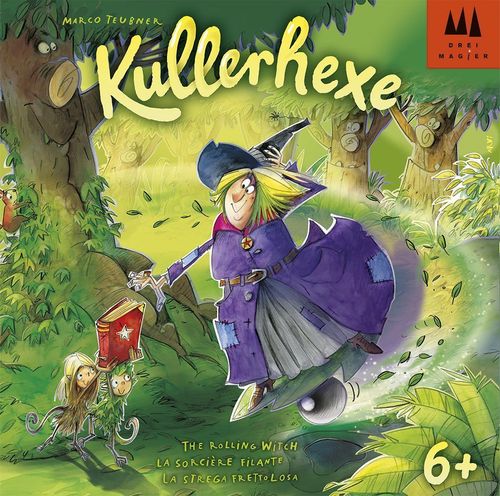
Kullerhexe
Kullerhexe Rulebook
Table of Contents
Table of Contents
Components
- 1 game board (the forest map)
- 8 trees
- 22 destination cards, each showing items
- 108 raspberries
- 20 stars (including 5 replacement stars)
- 10 dwarf cards (5 large and 5 small)
- 1 hourglass
- 2 holding clamps
- 2 foam pieces
- 1 dancing wizard figure with a black hat
- 1 green fabric bag
Setup
-
Take everything out of the box and place it in the middle of the table. Put the 2 foam pieces in 2 corners of the box.
-
Place the game board on top of the foam pieces.
-
Use the 2 holding clamps to secure the board in place.
-
(The source prints this step as "2".) Place the hourglass in the middle of the game board.
-
Place the trees on their designated spots on the board.
Little Petal's tip: the trees are not all the same size, and each tree must be placed in its own designated spot, because the bases differ in size.
-
Finally, place the dancing wizard on one of the 8 items on the game board. Put the wizard's hat on his head very casually. Do not press the hat down too hard on his head!
Note: points G and H only matter in 2-, 3- and 5-player games.
-
Shuffle the destination cards and place them face down in a column (the draw column) beside the box. Pour the raspberries into the green fabric bag. Prepare the stars as follows:
- 3 players: 9 stars
- 2 players: 12 stars
- 5 players: 15 stars
Set aside any extra stars; they have no use in the game.
-
Each player chooses a dwarf and takes the large and small dwarf cards for that dwarf. Place the large dwarf card in front of you. Drop the small dwarf card into the matching-colour hole on the game board. That hole becomes your dwarf cave.
Goal
Guide the dancing wizard toward the items you are looking for. The player who finds the most items and earns the most raspberries wins the game.
How the Game Works
The game is played in turns, clockwise, in teams of 2 that change each round.
The youngest player starts and places the box between themselves and the player on their left. These two players form the first team of this round.
Taking a Turn
-
Flip one destination card face up and place it beside the card column. The item on the card tells you where the wizard must go. If the wizard is already standing on that item, you have been very lucky: it counts as reaching the destination, and you may flip the next card.
-
Turn the hourglass over and place it in the middle of the game board.
-
With both hands, press down on the two clamps and guide the wizard. When the board is pressed down, the wizard rolls down the same path.
-
You may consult your teammate about which clamps to press or which direction to send the wizard, but you may never touch the game board with your hands.
-
Work together to bring the wizard to the item you are looking for. An item counts as obtained only if the wizard has passed through the dotted line around that item.
Note: the wizard must stop on the destination. Passing over an item without standing on it is not acceptable.
-
While the hourglass has not yet run out, you may flip the next card and try for the next item.
-
If the hourglass runs out before you bring the wizard to the destination, your last flipped card counts as not obtained. The best thing to do is to put that card back at the bottom of the draw column.
-
Your turn ends immediately if the wizard gets stuck in one of the holes (pits or dwarf caves), or if his hat falls off.
Little Petal's tip: not all trees in the magic forest are the same size. Be careful that the wizard's hat does not catch on the short trees!
Otherwise, you keep collecting items until one of these happens:
- the hourglass runs out, or
- the wizard gets stuck in a hole, or
- the wizard's hat falls to the ground.
Scoring
When your turn ends, check your destination cards to see how many items your team has collected. Hand the items you found or obtained to the wizard and, in return, receive raspberries.
As a reward for good teamwork, you and your teammate each take raspberries from the fabric bag equal to the number of items you collected. Then, like a real dwarf, put all of your raspberries into your dwarf cave (the hole matching your dwarf card's colour).
Example: Wiki and Conrad together obtained 2 destination cards. Each of them receives 2 raspberries and drops them into the holes matching their dwarf cards.
At the end of your turn, place a star on a tree of your choice.
Then the next round begins: the box moves one step to the left, as described above, and the turn passes to the next team.
Preparing for the Next Round
Place the flipped destination cards in a burnt-card column, which you may form next to the draw column.
When the draw column is empty, shuffle the burnt cards and form a new draw column.
If the wizard was stuck in a hole, place him on any one item of your choice.
End of the Game
The game continues until the last star has been placed on the last tree.
Then find out who has collected the most raspberries in their dwarf cave. To do this, lift the board off the box. The player with the most raspberries wins. If several players are tied, they all win.
Little Petal's tip: you can stack your raspberries into a tower; whoever has the tallest tower wins!
Two-Player Game
In the 2-player game, the two players form one team and fight against the magic forest together. No dwarf cards and no stars are needed.
- Shuffle the destination cards and form the draw column beside the box.
- Each player makes 6 columns of 6 raspberries each.
- Place the wizard on one of the items on the game board.
- Turn the hourglass over and play as described in "How the Game Works", above.
The game lasts exactly 6 rounds. In each round, you need one of your raspberry columns.
When a round is over, exchange the items you collected for raspberries from the wizard. As a reward for good cooperation, take raspberries from your first raspberry column equal to the number of items you collected, and set aside the rest of that column out of the game.
Example: you collected 2 items. You can take 2 raspberries from the first column, and the 2 remaining raspberries of this column are set aside out of the game.
Then prepare the next round: place the flipped cards in the burnt-card column, turn the hourglass over, and continue with the second column of raspberries, as before.
At the end of the sixth round, count your score. If you have as many raspberries as the magic forest or more, you win! If you have fewer, the forest has defeated you. In that case, the best thing to do is to play again!
You can make the game harder by building columns of 7 or 8 raspberries instead of 6. In any case, the game is played for 6 rounds.
Translation and Source Notes
- The source does not name the items on the board or the cards; they are shown only as pictures.
- The Persian booklet gives the number of raspberries the magic forest must be matched with only as "the forest's amount", without stating the number in the text. That number is not given in the source text, so it is not filled in here.
- The 2-player section says no stars or dwarf cards are needed, but the general setup (step 7) still lists star counts for 2 players. Both are transcribed as printed.
- The 2-player example is ambiguous about the count: it says "2 remaining raspberries of this column are set aside" without stating how many the column held at that point. Transcribed as printed.
- The example under "How the Game Works" is headed "2-player game" in the source, but it shows four players taking turns in teams. It is transcribed as a team-rotation example.
- The Persian booklet's step numbering runs 1, 2, 3, 2, 5, 6, 7, 8. The hourglass step has been numbered 4 here, and the source's printed "2" is noted in step 4.